1945: Ernest Littlefield Goes Through the Gate
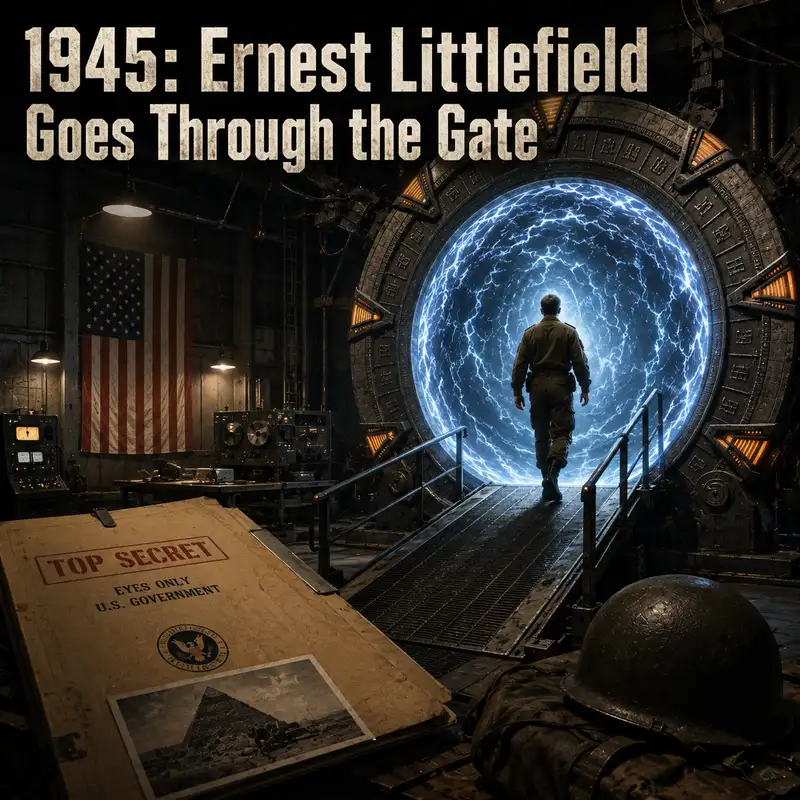
The air hose fell to the concrete first. A moment earlier, it had connected Ernest Littlefield to a room full of scientists, soldiers, generators, and motion-picture cameras. Then the Stargate shut down. The line had been cut cleanly at the event horizon, and the man inside the heavy diving suit was no longer in the laboratory. He was somewhere else. No one in the room knew where, no one knew how to follow him, and no one knew how to bring him back.
That moment in January of nineteen forty-five was the first successful modern human passage through the uncovered Stargate. It should have transformed the American research effort into the most important exploration program in history. Instead, it became a classified accident, a missing file, and a lie told to the woman Ernest intended to marry. The central question is not simply why Ernest went through. It is why a genuine technological breakthrough produced no operational program, no rescue mission, and almost no institutional memory for more than half a century.
The experiment took place while the United States was still fighting the Second World War. President Franklin Roosevelt had supported research into the artifact because the military suspected it might have weapons value. The ring had been excavated beneath ancient cover stones, was made from an unknown material, and responded to electrical power in ways no conventional machine could explain. A device that absorbed enormous energy and carried unfamiliar symbols was bound to be investigated for military use.
Professor Langford led the research effort. His team possessed the Stargate itself, but not the dial-home device designed to control it. They had no Ancient operating instructions, no address database, no understanding of wormhole physics, and no evidence that another gate existed at a reachable destination. They were working with the largest component of a transportation system while missing the part that supplied its normal interface and safety functions. No one yet knew there was a system to be missing pieces from.
The laboratory solution was direct and hazardous. Military personnel rotated the inner ring by hand. Technicians applied power as each symbol was aligned. Cameras recorded the attempts because film was one of the few ways to preserve every mechanical movement and electrical response. The team could observe when a chevron locked, when the ring vibrated, and when the room began behaving like a power station with serious opinions about experimental procedure. They could not see what the gate was calculating internally or which safety protocols their improvised equipment had bypassed.
Repeated attempts produced violent feedback. Ernest later described the team reaching the fifth symbol before the room began to shake. On one occasion, a generator exploded. Catherine Langford, then twenty-one years old and excluded from the official research, suggested that the team use direct current rather than alternating current to reduce the charge feeding back into the equipment. Her contribution illustrates the project’s institutional contradiction. The military had little use for a young woman in the laboratory, yet the laboratory was willing to benefit from an engineering insight offered over tea.
Ernest supplied the conceptual breakthrough. The thirty-nine symbols were not merely characters in an enormous combination lock. They represented destinations. His reasoning was simple enough to explain and difficult enough that no one else had established it. If the purpose were only to unlock one machine, the number of possible symbol sequences was absurdly large. If the sequences selected different locations, the complexity made sense. The Stargate was not one door with one code. It was a transportation terminal with an address system.
The team appears to have reached a valid destination through a mixture of theory, experimentation, and extraordinary luck. They had no complete model for stellar drift and no knowledge of the network’s coordinate corrections. The destination later designated P three X nine seven two happened to share several spatial reference points with Abydos and could be reached without the sophisticated compensation later used by Stargate Command. The nineteen forty-five team did not understand why the sequence worked. It understood only that the final chevron locked and the impossible surface formed inside the ring.
Opening the gate created a decision before the team had time to create doctrine. An active event horizon proved that the machine did something, but not what waited beyond it. There was no mobile analytic laboratory probe to sample the atmosphere, no camera capable of crossing and transmitting an image, no radio contact, no verified return address, and no second team prepared for recovery. The choice was to close the experiment with its central question unanswered or send a human being into an environment that could not be observed in advance.
Ernest volunteered. Professor Langford warned that the ancient description of a doorway to heaven might mean death rather than transportation. Ernest accepted the risk because he believed the gate led somewhere real and because scientific proof required an observer on the far side. His decision was courageous, but courage does not make a mission plan complete. It only determines who pays when the plan has gaps.
The diving suit was the closest thing the project possessed to self-contained protective equipment. It offered a sealed helmet, a supply of air through a hose, and some protection from an unknown atmosphere. A rope and line connected Ernest physically to the laboratory. To the team, the tether probably looked like a recovery measure. If the far side were dangerous, they could pull him back. That assumption treated the event horizon like the mouth of a tunnel rather than a boundary that converted matter, transmitted it, and reconstructed it at another gate.
The equipment therefore created an impression of control without providing actual extraction capability. Once Ernest crossed, his body was no longer a few feet beyond the ring. He had been transmitted to another planet. The rope and air hose could not remain a continuous physical connection across a wormhole that handled matter in one direction. When the gate disengaged, the lines were severed. The laboratory received no voice report, no suit telemetry, and no indication whether Ernest had arrived alive. The only confirmed result was absence.
On the far side, Ernest emerged inside a large, abandoned structure built along a cliff above a violent sea. The destination gate functioned as a receiver, but its dial-home device was damaged. The central control crystal had already been shattered before he arrived. Ernest possessed no address sequence for Earth that he could enter through another method, no independent power source sufficient to operate the gate, and no understanding of how to turn the ring manually from that location. The first modern interstellar expedition had reached its destination and immediately lost all strategic mobility.
The problem was not simply that the control pedestal was broken. Ernest had crossed without a return concept. The research team did not know that physical travel through an established wormhole was one-way. It did not know that the receiving gate needed a new outgoing connection for him to return. It did not know whether the far side possessed controls, power, or a usable point of origin. Those facts would later become elementary gate operations. In nineteen forty-five, they were invisible requirements revealed only after a man had been stranded.
Ernest’s survival remains one of the least explained parts of the record. The structure offered shelter, and the planet provided food that he later shared with Daniel Jackson. He also found water, or he could not have survived for decades. The screen record does not establish a complete food system or medical explanation for his longevity. It does establish that survival was austere. He lived without another confirmed person, replacement clothing, modern medicine, or any assurance that Earth would ever dial the address again.
He marked the passing days on paper and kept journals until isolation changed the boundary between memory and companionship. In those journals, Catherine appeared beside him. He described walking with her, discussing the alien writing, and sharing a life that existed only in his mind. This was not evidence that Catherine had somehow reached the planet. It was evidence of the psychological method Ernest used to survive prolonged solitude. He preserved the person he had left behind by making her part of the world in which he was trapped.
The abandoned complex gave that solitude a purpose. Ernest called the site Heliopolis, borrowing the name of an ancient Egyptian center of learning. He found a chamber containing four distinct systems of writing and a device that displayed information through representations of chemical elements. He concluded that the structure had served as a place of exchange among four advanced civilizations. Later Stargate Command intelligence identified those civilizations as the Ancients, the Asgard, the Nox, and the Furlings.
Ernest could not fully translate the archive, but he understood its significance. The elemental symbols offered the basis for a universal language because matter is constructed from the same components regardless of culture. The archive appeared to preserve shared knowledge from civilizations far beyond Earth. The first human to cross the gate had landed in something resembling an interstellar diplomatic and scientific conference site. He had reached exactly the kind of place the military hoped the Stargate might reveal, and he had no way to report it.
The destination carried another intelligence implication. P three X nine seven two was absent from the Abydos cartouche used by the Goa’uld. Yet a Stargate was already present there. That meant the Goa’uld could not be assumed to have built the network they used. Ernest’s expedition had unknowingly reached physical evidence that the dominant enemy of the early Stargate era was itself dependent on older infrastructure. In strategic terms, this was the difference between facing an original technological civilization and facing an empire that had inherited or appropriated much of its mobility.
None of that intelligence reached Earth in nineteen forty-five. The laboratory saw the gate open, saw Ernest cross, and saw the tether fall. The project had achieved technical activation, human transit, and access to a major alien site, but headquarters recorded only a disappearance. This is the distinction between an event and an exploitable capability. A breakthrough becomes useful only when information returns, procedures can be repeated, and the organization understands what happened well enough to act again.
Professor Langford told Catherine that Ernest had died in an explosion. The deception may have been intended to protect her from the knowledge that her fiancé had chosen the mission without speaking to her and might still be alive somewhere unreachable. It also protected the classified program from questions. Catherine was denied the truth, denied the opportunity to challenge the official decision, and denied the possibility of pressing for another attempt while evidence was still fresh. Personal protection and institutional convenience produced the same result.
The research effort ended after the war, and the Stargate was placed in storage. The surviving record does not preserve a complete termination order explaining every factor. The loss of Ernest, the inability to reproduce a safe expedition, wartime secrecy, changing national priorities, and the absence of a known military application all likely contributed. What is certain is that success was administratively converted into failure. The gate had worked, but the program closed as though repeated activation had produced nothing of value.
The records were fragmented as thoroughly as the machinery. Professor Langford retained notes, but removed the successful activation and Ernest’s passage from the material Catherine inherited. Film and other files disappeared into government archives. Decades later, even General West, who oversaw the revived effort, may not have known that the device had opened in nineteen forty-five. Classification can protect information from an adversary. It can also protect information from the people responsible for solving the problem.
Catherine spent decades petitioning presidential administrations to restart the research. She did so believing the gate had never been successfully activated and believing Ernest had died in a laboratory accident. Her persistence eventually helped create the program that reached Abydos, yet the government possessed evidence that might have changed her technical priorities and personal life. The institution benefited from her dedication while withholding the event most likely to explain why the earlier project had ended.
More than fifty years after the experiment, Daniel Jackson found the missing truth in archival film sent to Stargate Command. The file lacked a conclusion, summary, and explanation for the project’s termination. He watched military personnel turn the gate manually, saw the event horizon form, and recognized the suited figure crossing. The discovery occurred not because a formal review process worked, but because one researcher kept watching old footage after the available paperwork had already implied failure.
Daniel enhanced the images and isolated the chevrons locked before Ernest’s transit. That reconstruction converted an old film into a recoverable gate address. It also demonstrated why complete technical recording matters. The nineteen forty-five team had failed to return an explorer, but its camera preserved enough data for a later generation to follow him. Film intended to document an experiment became a delayed navigation record.
General George Hammond authorized a mission to the planet for two reasons. The first was humanitarian. Ernest might still be alive, and the United States had left him there. The second was strategic. A gate on a world outside the known Goa’uld map could reveal who had actually created the network and might contain technology useful against the Goa’uld. Catherine joined S G One, an unusual operational choice justified by her knowledge of Ernest and her central role in the program’s history. The rescue mission was scientific, military, and deeply personal before anyone stepped onto the ramp.
A mobile analytic laboratory probe preceded the team and confirmed that the destination could be entered. It did not reveal the concealed damage to the dial-home device. That failure was a reminder that reconnaissance answers only the questions the sensors can observe. The pedestal was present, which looked like confirmation of a return route. Its most important internal component was broken. S G One reached Ernest, but the rescuers initially became stranded by the same missing capability that had trapped him.
The reunion exposed the human cost that the old film could not show. Ernest had imagined Catherine as a young woman who forgave him and remained beside him. The real Catherine arrived older, carrying her own grief and anger. She had believed him dead. He had believed, at least within the world created by isolation, that they had shared the lost decades. Recovery returned Ernest to human contact, but it could not return either of them to nineteen forty-five.
The annual storm then began tearing apart the cliffside structure. Captain Samantha Carter and Teal’c attempted to connect the damaged control system directly to the Stargate, but the pedestal fell through the collapsing floor into the sea. The team needed a new power source and had very little time. They used the storm itself. Wires were rigged to channel a lightning strike into the gate, and the copper helmet from Ernest’s diving suit helped provide the conductor that made the attempt possible.
The solution was improvised, dangerous, and not suitable for routine operations. The gate could absorb energy in several forms, but an uncontrolled lightning strike might also have destroyed its mechanisms. The team had no better option. Teal’c manually rotated the ring, Carter managed the power, and the others prepared to move as soon as the wormhole formed. The equipment that had failed as Ernest’s life-support system in nineteen forty-five became part of his extraction system more than fifty years later.
Daniel nearly repeated Ernest’s original mistake. The four-race archive appeared to contain knowledge beyond anything Earth possessed, and the collapsing fortress might make it unrecoverable. Daniel considered remaining behind so he could preserve more of it and uncover the gate again later. Ernest understood the temptation because he had already surrendered a human life to it. Knowledge that could never be shared had become his torment. He left the archive and returned with Catherine.
S G One escaped as the structure collapsed, but most of the repository was lost. The mission recovered Ernest, his journals, and the knowledge that four advanced civilizations had once cooperated there. It did not recover the full archive, secure the site, or establish a repeatable route back. Tactically, the team completed the evacuation. Scientifically, it preserved only a fragment. Strategically, it opened a line of inquiry that would later reshape Earth’s understanding of the Ancients and their allies.
The nineteen forty-five experiment succeeded technically. The team activated the Stargate and transmitted a human being to another planet. As a mission, it failed because Ernest had no reliable reconnaissance, communication, or return capability. As an intelligence operation, it failed because no information came back and the surviving evidence was buried. Institutionally, it failed because the government concealed the event so effectively that its own later program had to rediscover it.
Judging the team solely by later Stargate Command standards would be unfair. They did not know the gate was part of a network, did not know the rules governing matter transmission, and did not possess the unmanned systems later used before transit. Their work required real imagination and personal courage. The more serious failure came after Ernest disappeared. The project stopped asking what the successful activation meant, preserved no usable path for rescue, and allowed secrecy to replace analysis.
Ernest Littlefield’s passage established the pattern that would define much of Earth’s later expansion. A small group made an extraordinary discovery with incomplete information. One person accepted a risk the institution could not properly support. Alien technology worked, but not in the way its human operators assumed. The immediate experiment produced more questions than answers, and the organization responded by classifying the questions. Progress came later only because someone reopened the file.
The first modern traveler through the Stargate was not a soldier entering battle or an explorer backed by a mature space program. He was a scientist in a diving suit, carrying air through a hose that could not reach the place he was going. His passage proved that the ring was a doorway. The severed line proved that Earth had opened it before learning the difference between sending someone through and bringing someone home.