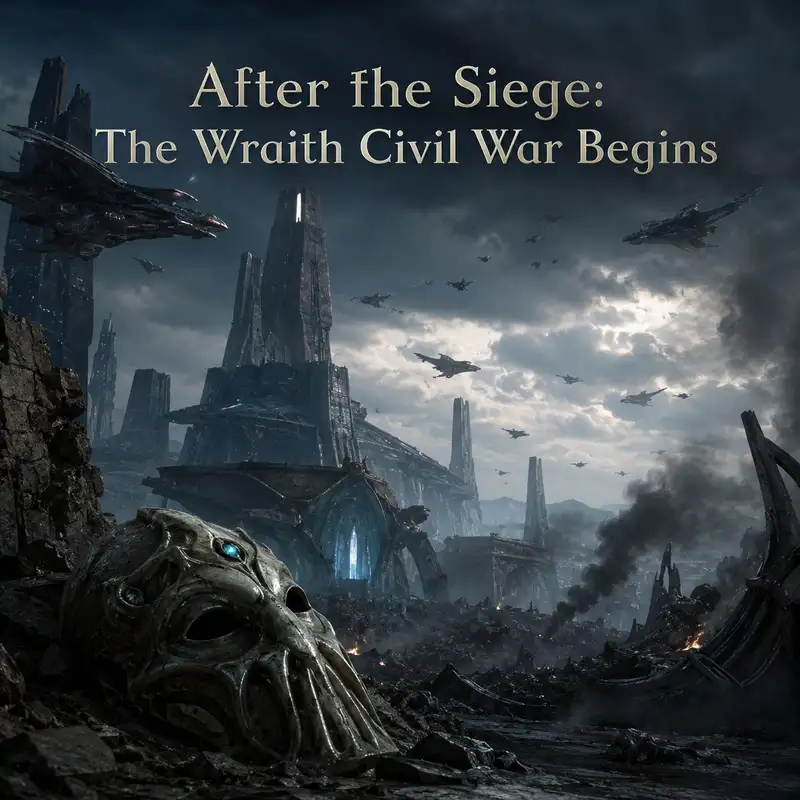
After the Siege: The Wraith Civil War Begins
The nuclear flash above Atlantis faded into a wall of smoke, heat, and hard radiation. Wraith sensors searched the ocean for the city they had crossed the Pegasus galaxy to destroy. They found nothing. The towers were gone. The shield signature was gone. Only open water remained beneath the cloud. Moments later, the surviving Wraith ships broke orbit and entered hyperspace. Atlantis had survived the siege not by destroying the enemy fleet, but by convincing that fleet it no longer had a target. It was an elegant tactical deception. It was also the moment when the Wraith war changed direction.
The Wraith had approached Atlantis as a coalition. They left as separate hives returning to a galaxy that could not sustain them all. The siege did not create every cause of the coming civil war, and Atlantis did not defeat the Wraith as a civilization. The deeper problem had begun much earlier, when the expedition's first rescue mission disturbed the Wraith hibernation cycle. The failed assault on Atlantis removed a shared objective and exposed the political reality beneath the temporary unity. Too many Wraith were awake, Earth remained beyond their reach, and every hive now had to decide whether another hive was an ally, a competitor, or a future meal ticket.
The chain of events began with a decision that was tactically understandable and strategically disastrous. Colonel Marshall Sumner and several Athosians had been taken by a Wraith scouting force. Major John Sheppard led a rescue mission to recover them. Inside the Wraith facility, Sheppard killed the queen who served as caretaker for the sleeping population. Her death awakened the Wraith around her, and the expedition escaped as hundreds of chambers began to open. No commander in Atlantis possessed enough intelligence to predict the full consequence. Saving prisoners was consistent with the expedition's values and military obligations. It also struck the alarm bell of a civilization built around long periods of hibernation.
Wraith hibernation was not merely a biological habit. It was the foundation of their strategic economy. Human populations in Pegasus were allowed time to recover between major cullings. Some Wraith remained awake to monitor feeding grounds, maintain facilities, and respond to threats, while the larger population slept. The system was predatory, but it was also regulated by scarcity. A hive could not feed indefinitely on a world whose population had already been stripped. Human beings were not only victims in this system. To the Wraith, they were the renewable resource upon which military readiness, political power, and individual survival depended.
The appearance of the Atlantis expedition disrupted that balance twice. First, the expedition awakened Wraith who should have remained dormant for generations. Then the newcomers revealed the existence of Earth, a human world with a population far beyond anything available in Pegasus. From the Wraith perspective, Earth appeared to solve the central limitation of their civilization. A rich feeding ground could support more waking hives, more ships, and a longer period of military activity. The promise was powerful enough to encourage broad mobilization before the Wraith had confirmed that they could actually reach the Milky Way.
Teyla Emmagan recognized the resulting strain before most of Atlantis understood its significance. Through her inherited connection to the Wraith, she sensed an unprecedented number of them awake at the same time. More importantly, she sensed desperation beneath their confidence. There were too many Wraith to sustain for long and not enough humans available to feed them. That intelligence transformed the meaning of the approaching armada. The fleet remained militarily overwhelming, but it was not the instrument of a stable empire operating from a secure resource base. It was a mass of hungry hives racing toward a promised solution.
The Wraith could cooperate on a large scale, but cooperation did not make them a unified state. Authority centered on individual hives, usually under queens whose power rested on their own ships, warriors, feeding territories, and relationships with other hives. They shared biology, technology, telepathic communication, and a broad culture of dominance over human worlds. They did not answer to one ruler of Pegasus. Alliances could be real and militarily effective, yet they remained arrangements among powers with overlapping needs. The expedition initially saw a single enemy because every Wraith force it encountered wanted Atlantis destroyed. Shared purpose concealed political fragmentation.
Atlantis gave the hives an unusually strong reason to cooperate. The city represented Ancient technology, a route to information about Earth, and a surviving enemy command center capable of killing Wraith. The expedition had already destroyed ships, rescued prisoners, disrupted cullings, and demonstrated access to weapons the Wraith did not fully understand. A coalition assault therefore made sense. It concentrated enough force to overwhelm the city's depleted defenses and prevented one hive from claiming Atlantis while others watched. For a brief period, the Wraith had a common operational objective more important than their competition with one another.
The first assault nearly succeeded. Atlantis lacked the power required to operate its shield for an extended defense. Its personnel were exhausted, its ammunition and medical capacity were limited, and evacuation plans offered no guarantee of safety. The arrival of the Daedalus changed the tactical balance. The Earth warship brought a charged zero-point module, Asgard transport technology, nuclear weapons, railguns, and F three-oh-two fighters. The new power source restored the city shield, while the Daedalus initially used transporters to place nuclear warheads aboard Wraith ships. Earth had arrived with a remarkable collection of capabilities. It had not arrived with enough ships to win a prolonged fleet war.
The Wraith adapted quickly. They began jamming the Asgard transport beam, depriving the Daedalus of its most effective attack. Darts continued to strike Atlantis, including attacks conducted at extreme velocity against the shield. Wraith forces already inside the city had to be hunted through corridors and damaged sectors. Every successful defense consumed power, weapons, personnel, and time. The Daedalus could damage the enemy, but the remaining Wraith ships could stay, call reinforcements, and continue the siege. Atlantis had survived the first blows. It still faced an opponent with greater numbers and the freedom to keep coming.
The solution was deception rather than firepower. Sheppard recognized that the Wraith would remain as long as they knew Atlantis survived. Rodney McKay and Radek Zelenka adapted a Puddle Jumper cloaking generator to the city's shield system. The Daedalus would detonate a nuclear weapon above the shield, producing the signature of a catastrophic self-destruction. While the blast blinded Wraith sensors, Atlantis would switch from shield to cloak. Teyla used her connection to the Wraith to convince them that the defenders intended to destroy the city rather than surrender it. The Wraith paused their attack, unwilling to help their enemy complete the demolition.
The plan depended on timing measured in seconds and on technology never designed to hide an entire city. It also depended on the Wraith drawing the expected conclusion. If the cloak activated too early, the blast could destroy Atlantis. If it activated too late, the Wraith would see the city survive. If their sensors penetrated the field, the deception would fail and the shield would no longer be protecting the expedition. This was the sort of plan that works beautifully in an after-action report, provided the after-action report is written by people fortunate enough to remain alive.
The explosion came, the cloak held, and the Wraith scan found empty ocean. Even a Stargate activation during the deception did not persuade them to remain. Their fleet withdrew. The result was a tactical victory, but the nature of that victory matters. Atlantis did not compel a Wraith surrender. It did not destroy the coalition's ability to fight. It denied the coalition a reason to continue fighting at that location. The city survived by removing itself from the enemy's operational picture. Once Atlantis appeared destroyed, every hive had more urgent problems elsewhere.
Those problems were demographic and political. The expected route to Earth had not been found. Pegasus human populations had not recovered from the previous culling cycle. The Wraith had awakened in numbers suited to an abundant new feeding ground, then discovered that the feeding ground was inaccessible. A hive remaining on full wartime footing needed humans for its queen, commanders, specialists, and warriors. It also needed worlds that could be culled without being exhausted completely. The shortage was not comparable to a temporary fuel delay. Hunger threatened the survival of individual Wraith and the cohesion of every hive.
For the human societies of Pegasus, the crisis meant more than a change in enemy politics. Hives searching for food increased pressure on worlds that had expected more time before the next major culling. Settlements were emptied, survivors were scattered through the Stargate network, and communities already living at the edge of recovery faced extinction. A civil war among predators does not automatically liberate the prey. It may reduce the number of predators over time, but it also encourages each faction to seize resources before its rivals can reach them. In Pegasus, the principal resource was human life.
The geography of the conflict intensified that competition. A hive ship was more than a battleship. It was a mobile base, a population center, a transport system, and a means of carrying Wraith power from one feeding region to another. Human worlds were dispersed across a gate network that did not guarantee political unity or mutual defense. A queen who learned that a rival intended to cull a productive world faced pressure to arrive first, bargain for access, or destroy the competitor. There was no neutral authority to assign feeding grounds and no reserve stockpile capable of supporting every awakened hive. Mobility made the shortage easier to reach and harder to regulate.
The first visible signs of inter-hive conflict appeared before the Wraith formally announced a civil war. Two hive ships converged near a human world marked for culling. Sheppard, held aboard one of them, exploited the queen's suspicion by suggesting that the second hive intended to eliminate her and claim the feeding ground. He then used a captured dart to fire on the ships in a way that made each faction believe the other had attacked. Darts turned on one another. The hives opened fire at close range and destroyed each other. A few carefully placed shots succeeded because distrust was already present.
That engagement revealed the new strategic opportunity available to Atlantis. The Wraith could be induced to fight one another. Their numerical superiority, once the central reason they had defeated the Lanteans and threatened Atlantis, could be redirected inward. A single expeditionary force could never match every hive ship in Pegasus. It might, however, use intelligence, deception, and limited strikes to deepen existing rivalries. This was irregular warfare on an interstellar scale. Atlantis did not need to conquer Wraith territory. It needed to prevent the hives from combining their strength against the city and its allies.
The opportunity carried serious limits. Inter-hive warfare was difficult to control once initiated. Destroying one hive could strengthen another by removing a competitor. Driving Wraith away from one feeding ground could redirect them toward a less defended population. False-flag attacks might work once and then produce tighter security or indiscriminate retaliation. Most importantly, Atlantis lacked a reliable map of Wraith loyalties, territorial claims, and command relationships. The audience could see separate queens and rival ships. Atlantis had to build an intelligence picture from fragments, prisoners, telepathic contact, recovered data, and encounters in which a mistake could expose the city.
The civil war became explicit when a Wraith faction approached Atlantis under a flag of cooperation. Michael, the Wraith whom the expedition had previously transformed into a human and then returned to his own kind, served as the intermediary. He explained that every hive had emerged from hibernation prematurely after learning of Earth. The Wraith had failed to locate the planet or develop an effective means of reaching it. For the first time in their history, he said, too few humans were available to feed the waking population. Hives were forming alliances, and the strong were attacking the weak.
The proposed alliance showed exactly what the civil war had become. Michael's hive wanted Carson Beckett's retrovirus, a treatment designed to suppress Wraith characteristics and turn them into humans. The faction proposed using it against rival hives. Transformed enemies would become helpless, and the victorious Wraith could then feed on them. In exchange, the faction offered technical information, including data that could help Atlantis defeat Wraith jamming and transport weapons aboard hive ships. The offer combined diplomacy, intelligence sharing, biological warfare, and cannibalistic logistics with an efficiency that would have impressed a procurement office and alarmed everyone else.
This was not a Wraith peace movement. The queen leading the faction intended to conquer her enemies, not abolish culling. The retrovirus would restore what she called balance by reducing Wraith numbers and providing a temporary alternative food source. Once the rivals were gone, ordinary humans would again become the primary supply. Her promise to spare Atlantis was a bargain between belligerents, backed by the threat that she could reveal the city's survival to every other hive. The expedition was not choosing between cooperation and a clean refusal. It was choosing among dangerous options while an enemy ship waited above the planet.
The episode exposed a central contradiction in Atlantis strategy. The expedition wanted to exploit Wraith divisions, but every useful partnership risked empowering a faction that remained committed to feeding on humans. Technical intelligence gained from one hive could improve the defense against all hives. A biological weapon supplied to that same ally could also create a dominant enemy. Working with the Wraith might reduce immediate pressure on Atlantis while increasing pressure on worlds outside the agreement. The city could protect itself without protecting Pegasus, and those two objectives were not always the same.
The Wraith civil war was not ideological in the usual sense. It did not divide reformers from traditionalists or produce rival visions of government. Its primary causes were hunger, territorial competition, and the collapse of a temporary coalition. Hives could form alliances, exchange codes, and coordinate military action, then turn against one another when feeding rights or survival demanded it. Personal ambition mattered, especially among queens and senior Wraith, but ambition operated within a biological emergency. The conflict was a war over who would remain awake, who would control the human population, and which hives would be sacrificed to restore the old balance.
Atlantis bore part of the responsibility for creating that emergency. The expedition did not invent Wraith predation, hive rivalry, or the culling system. Those institutions had shaped Pegasus for thousands of years. Yet the newcomers awakened the Wraith early, advertised Earth as an extraordinary feeding ground, and survived long enough to keep that promise alive. Later, by hiding Atlantis and denying the Wraith access to Earth, the expedition left the mobilized hives trapped inside the resource limits of Pegasus. Human intervention did not create the fault lines, but it applied enough pressure to open them.
The siege therefore ended with a strategic paradox. Atlantis became safer because the Wraith became more dangerous to one another. The hidden city gained time to repair, reconnect with Earth, receive support from the Daedalus, and expand its knowledge of the enemy. Pegasus civilians gained no comparable guarantee. Some hives were distracted from Atlantis, but they still needed to feed. Civil war reduced unity without reducing appetite. It exchanged the danger of a coordinated armada for a wider pattern of raids, alliances, betrayals, and local wars whose front lines moved from one human world to another.
The Wraith also learned from the siege. They had seen Earth weapons destroy ships, watched the Daedalus arrive from another galaxy, and discovered that Atlantis personnel would use Ancient systems in unconventional ways. Even believing the city destroyed, individual hives retained information about the Tau'ri, Earth, and the possibility of intergalactic travel. The failure at Atlantis did not erase their interest. It merely changed the competition. Any hive that found Earth, captured an Earth ship, or acquired a superior technology could gain decisive leverage over its rivals. Civil war made intelligence about Atlantis more valuable, not less.
That made secrecy a form of strategic terrain. As long as most Wraith believed Atlantis destroyed, the expedition could operate from a concealed base. Every gate mission, captured officer, compromised computer, and contact with a Wraith faction threatened that advantage. The city had to conduct reconnaissance and diplomacy while protecting the fact of its own existence. The cloak had hidden Atlantis from sensors for a few crucial minutes. Maintaining the deception afterward required disciplined operations, secure communications, and considerable luck. A secret base is only secure until enough people survive an encounter to compare notes.
The answer to why the Wraith civil war began is therefore more precise than saying the hives simply turned on one another after losing a battle. Their civilization had mobilized around the expectation of a new human population. The route to that population remained closed. Their normal hibernation cycle had been broken. Their political structure offered no central authority capable of rationing scarcity across Pegasus. The apparent destruction of Atlantis removed the common target that had justified cooperation. Once those conditions combined, rivalry became a survival strategy and alliance became a temporary calculation.
Atlantis won the siege by becoming an absence on the enemy's sensors. That absence did more than save the city. It removed the point around which the Wraith coalition had formed and sent every hive back into a galaxy already short of food. The departing ships were not retreating into peace. They were returning to compete for worlds, followers, technology, and survival. Beneath the cloak, Atlantis celebrated a victory. Across Pegasus, the next war had already begun, and human beings would pay for both sides of it.