Aiden Ford and the Wraith-Enzyme Soldiers
The unit’s first proof-of-concept mission ended with dead men falling from a transport beam, a captured strike team, and a commander blaming his former superior for sabotage. Lieutenant Aiden Ford still believed the plan could work. That contradiction defined the Wraith-enzyme soldiers. They were stronger, faster, harder to stun, and capable of surviving injuries that should have stopped ordinary fighters. They were also dependent on a substance taken from the enemy, led by an officer whose judgment had been altered by the same drug, and committed to operations that became more reckless each time someone questioned them.
Before the enzyme, Ford was a United States Marine Corps first lieutenant and the youngest member of John Sheppard’s original field team. He was not the expedition’s chief scientist, diplomat, or commanding officer. His value was simpler and more military. He provided security, carried out orders, piloted Puddle Jumpers when required, and helped turn a group of specialists into a functioning reconnaissance team. During Atlantis’s first year in the Pegasus galaxy, Ford repeatedly entered Wraith facilities, defended civilians, and accepted missions with uncertain extraction. He was young, but he was not inexperienced in danger.
His transformation began during the Wraith siege of Atlantis. While defending the city, Ford was attacked by a Wraith warrior. An explosion threw both of them from a high platform into the ocean, with the Wraith still feeding from him. Atlantis personnel later found Ford outside the city shield, face down in freezing water, after more than an hour. By every normal medical expectation, he should have been dead. He survived because the Wraith feeding process had flooded his body with a biochemical agent that had never been intended to save a human life.
The Wraith enzyme served a cruelly practical purpose. Feeding placed enormous stress on a victim’s body. Without assistance, the human heart could fail before the Wraith had taken as much life as it wanted. The enzyme temporarily strengthened the victim and kept the heart beating. It prolonged the feeding process. Normally, the Wraith released it gradually. The warrior attached to Ford died suddenly, causing a massive dose to enter Ford’s bloodstream. The same substance designed to keep prey alive long enough to be consumed kept him alive in the ocean.
Doctor Carson Beckett quickly identified the medical danger. Ford’s body had become dependent on the enzyme. As the concentration declined, his system could fail. Beckett’s proposed treatment was a controlled reduction using enzyme harvested from dead Wraith. The objective was not punishment and not an attempt to erase a useful capability. It was medical stabilization. A gradual withdrawal might allow Ford’s body chemistry to return to normal without killing him. That plan required time, monitoring, and a patient willing to accept that feeling stronger did not mean being healthy.
Ford experienced the situation differently. He felt powerful, alert, and physically superior. His left eye changed visibly, but the more important effects were behavioral. He became aggressive, suspicious, and increasingly certain that concern from his friends was actually fear. He reported for duty when he had not been medically cleared. He interpreted restrictions as an effort to control him. When the expedition prepared to conceal Atlantis from the Wraith, Ford overpowered a Marine, took the remaining enzyme, stole a Puddle Jumper, and escaped through the Stargate.
That escape converted a medical emergency into a security crisis. Ford knew the city, its personnel, its gate procedures, its defensive limitations, and many of the expedition’s contacts. If captured and interrogated by the Wraith, he could expose Atlantis even after the city had successfully faked its destruction. Colonel Steven Caldwell therefore viewed him as a compromised insider whose capture might endanger the entire expedition. Sheppard saw a wounded officer and friend who could still be recovered. Both assessments were reasonable. The difficulty was that Ford was now capable of evading one and exploiting the other.
His dependence forced him into a brutal supply system. Ford began hunting isolated Wraith, killing them, and removing the enzyme sacs from their bodies. This was not merely revenge. It was resupply. Every dose extended his enhanced condition and postponed withdrawal. Every empty vial created another mission requirement. The enemy had become both target and pharmacy, which is an awkward arrangement even before the pharmacy starts shooting back. Ford could not separate his war against the Wraith from his need to keep enough Wraith alive, accessible, or recently dead to sustain him.
Atlantis located him after an off-world team found a dead Wraith whose enzyme sac had been removed. On that planet, Ford demonstrated why the drug seemed attractive. He tolerated environmental conditions that threatened ordinary personnel. He survived gunfire, moved with exceptional speed, and fought with greater strength. He had also killed the Wraith hunting Ronon Dex, a former Satedan soldier used as prey in the Wraith runner program. Ford was not hiding from the war. He was conducting his own campaign, and he wanted his former team to recognize it as legitimate.
When Ford captured Rodney McKay, he did not simply demand supplies or passage. He wanted validation. He insisted that the enzyme had improved him and that Beckett’s treatment was unnecessary. He intended to rescue Sheppard and Teyla, prove his usefulness, and then return to Atlantis on his own terms. This distinction matters. Ford had not joined the Wraith or decided to betray Earth. He still understood himself as a member of the expedition. The enzyme distorted his judgment without erasing every loyalty that had shaped him before the siege.
His attempt to prove himself ended with Atlantis forces trying to take him into custody. Ford was shot, kept moving, and deliberately entered a Wraith Dart’s culling beam. The decision looked suicidal, but it was a calculated gamble. Capture offered the only visible route off the planet. Once rematerialized aboard a Wraith vessel, the enzyme allowed him to recover while ordinary captives remained incapacitated. He killed a guard, harvested more enzyme, and escaped. Ford had turned an enemy capture system into an extraction method. It was ingenious, dangerous, and completely dependent on his altered physiology.
After escaping the Wraith ship, Ford began recruiting. He found men in the Pegasus galaxy who had personal reasons to fight the Wraith and little access to conventional military power. The enzyme offered an immediate answer to helplessness. A recruit did not need an Ancient warship, an Earth weapons program, or years of industrial development. He needed access to the drug and the willingness to accept dependence. Ford’s own survival became the recruiting demonstration. He had been shot, stunned, captured, and still walked away. To people raised under the threat of culling, that was persuasive evidence.
The recruits’ consent was real in the narrow sense that they chose to join him, but the choice was shaped by trauma, incomplete medical knowledge, and Ford’s own distorted account of the risks. He presented dependence as the only meaningful drawback and treated continued dosing as a manageable inconvenience. No one in the group could provide an independent assessment because everyone’s status, confidence, and combat identity depended on the same substance. Ford had created a unit in which the recruiting message, the medical policy, and the commander’s personal justification were all identical.
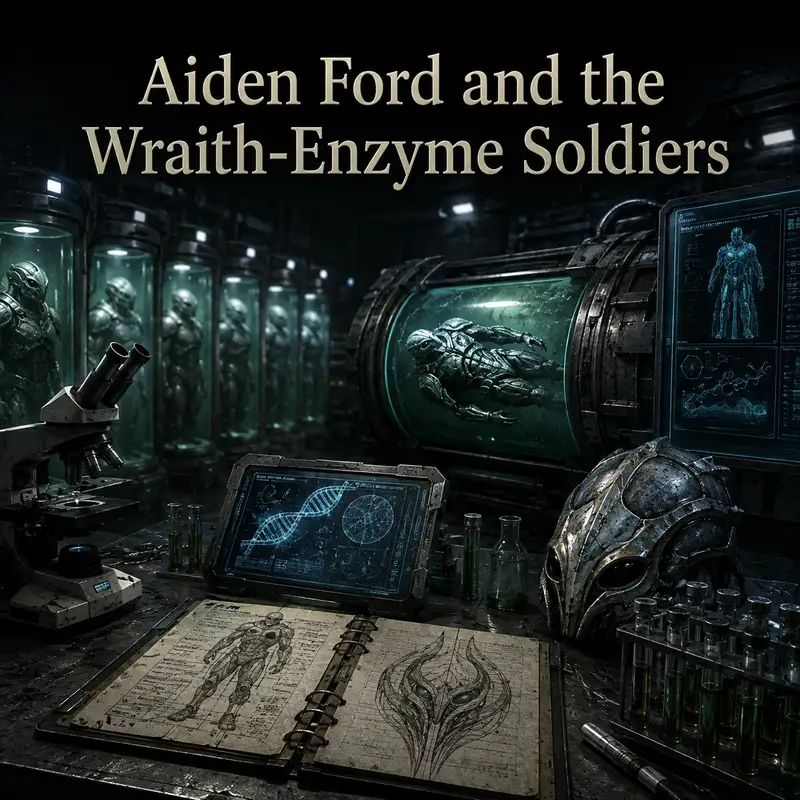
The resulting organization was more than a collection of addicts hiding in a cave. Ford’s group built a small irregular warfare network. Jace developed technical knowledge and refined methods of administering the enzyme. Kanayo helped lead field operations. The group captured Wraith and kept them unconscious as a renewable source. It acquired Genii computers, a foreign generator, weapons, explosives, and a damaged Wraith Dart. Members raided Genii safehouses for supplies and intelligence. They studied Wraith movements, communications, and territorial behavior. Their base was improvised, but it supported research, logistics, detention, planning, and combat operations.
That competence made the group dangerous. It also concealed its structural weakness. Every member depended on a substance that had to be taken repeatedly. The supply chain began inside a Wraith body. Production required capturing or killing an enemy who was physically powerful, technologically advanced, and capable of telepathic communication at useful ranges. Storage and dosage had to be managed without a proper medical facility. A conventional unit worries about ammunition, food, batteries, and casualty evacuation. Ford’s unit had all of those problems plus the possibility that its soldiers would become medically unstable if one cabinet of vials was destroyed.
The enzyme did provide real combat effects. Teyla, Ronon, and McKay experienced increased strength and endurance after Ford drugged them. Wraith stunners became less effective. Injuries could be tolerated more easily, and physical performance improved. Ford’s followers could overpower better-equipped opponents and take risks that ordinary fighters would avoid. Yet the drug did not produce tactical judgment, discipline, or command reliability. It amplified the user. A trained fighter became more dangerous. An impulsive commander became more certain that impulse was insight.
Ford wanted Atlantis to adopt the enzyme as a military capability, and he decided that voluntary evaluation would take too long. He ambushed Sheppard’s team, brought them to his base, and secretly placed the drug in their food. Sheppard alone remained undosed because Ford wanted an unimpaired witness who could report that the others had become better soldiers. Ford believed this was evidence. In military and medical terms, it was coercive experimentation conducted on prisoners. The act destroyed the legitimacy he was trying to recover.
His reasoning revealed the enzyme’s psychological trap. Ford believed Atlantis rejected the drug because its leaders feared what he had become. Any objection therefore confirmed his suspicion. Medical caution became jealousy. A rescue attempt became an arrest. Questions about dosage became efforts to weaken him. By constructing a test in which disagreement counted as proof of bias, Ford made himself impossible to persuade. His followers reinforced that closed system because their own confidence, physical power, and dependence all came from the same source.
The group’s major operation was an attack on a Wraith hive ship moving toward inhabited worlds. Ford’s intelligence indicated that the ship would pause its hyperspace journey near an uninhabited planet with a Stargate. The strike team would travel there, use the captured Dart to reach the hive, enter through the Dart bay, plant C four, and trigger secondary explosions. If successful, the attack could destroy a ship before it began another culling. The concept combined good intelligence, enemy equipment, internal sabotage, and a strategically valuable target.
The plan also carried more failure points than Ford admitted. The captured Dart was damaged and difficult to fly. Its controls were in Wraith script, its systems were only partly understood, and its automatic functions had not been fully tested. The team did not know whether the explosives would produce the necessary secondary damage. Communications could reveal them. The extraction route depended on the same unfamiliar craft used for infiltration. There was no independent rescue force, no medical support, and no acceptable response if the ship altered course or another hive appeared. Confidence had replaced redundancy.
As a raid concept, the operation had one useful principle: attack the enemy during a predictable movement pause and strike from inside the defensive perimeter. As an executable mission, it lacked the preparation normally required for that principle to succeed. Ford had intelligence but not confirmation, a vehicle but not mastery of it, explosives but no tested damage model, and enhanced personnel but no reserve. The plan was built around what the squad could do at peak performance. It gave almost no attention to what would happen after the first surprise was lost.
Sheppard initially pretended to support the mission because he saw a chance to get everyone home. McKay repaired the Dart and modified its interface. The intended escape was to use the Dart’s own gate controls and return to Atlantis instead of approaching the hive. Ford anticipated the deception. He kept McKay behind as a hostage, restricted the available gate addresses, and ordered Sheppard to complete the attack. At that point Ford was no longer merely a rogue officer pursuing an unauthorized target. He was compelling prisoners to conduct a combat operation by threatening one of their teammates.
The assault failed almost immediately. As the Dart approached the hive, its automatic systems took control. Sheppard released the boarding party without a clear view of the destination. Several of Ford’s men materialized in a lethal position and fell. The survivors reached the ship, but the infiltration triggered an alarm. Ford cut communications, rejected correction, and blamed Sheppard for wanting him to fail. The unit had obtained surprise, a captured platform, inside knowledge, and enhanced soldiers. It lost the advantage because its commander could not accept information that challenged the plan.
The survivors were captured and separated. Then the enzyme began to wear off. For Teyla and Ronon, whose exposure had been brief, the decline was severe but manageable. Ford and Kanayo faced a deeper physiological collapse. Kanayo died during withdrawal. Ford weakened to the point that the Wraith placed him in a cocoon to preserve him for later feeding. The substance that had made the squad appear nearly unstoppable now incapacitated it without enemy fire. Its decisive vulnerability was not a Wraith weapon. It was time since the last dose.
McKay provided the clearest controlled comparison. Left at Ford’s base, he took a large quantity of enzyme to overpower the guards and reach Atlantis. The dose gave him enough strength and confidence to escape. It also produced extreme agitation, rapid pulse, dangerous blood pressure, paranoia, nausea, pain, and potentially fatal withdrawal. Beckett could treat symptoms, but Ford had taken Atlantis’s remaining supply, making gradual reduction impossible. McKay survived because he reached a staffed infirmary with medications and continuous observation. Ford’s soldiers operated without that safety net.
From a military medical perspective, the enzyme was therefore a poor field drug. Its benefits were immediate and visible, while its costs appeared later, often after the user had committed to a mission. It encouraged continued dosing because withdrawal felt like proof that another dose was necessary. It impaired consent, complicated command decisions, and made casualty treatment dependent on scarce alien material. A unit using it could perform impressively at the point of contact and then collapse during extraction, detention, or a prolonged operation. Combat power that disappears when resupply is delayed is not dependable combat power.
Ford’s organization also lacked a legitimate chain of command. His followers were loyal because he had given them a weapon against the Wraith and because he controlled access to that weapon. Their shared dependence blurred the difference between unit cohesion and chemical reliance. Ford could plan raids, assign tasks, and inspire personal loyalty, but he could not provide lawful authority, independent medical review, or a process for removing him when his judgment failed. The commander, the intelligence officer, the chief recruiter, and the principal patient were the same man.
Despite everything, Ford’s final actions showed that the officer he had been was not entirely gone. After escaping the cocoon and obtaining more enzyme, he helped free Sheppard’s team. When Wraith forces closed in, Ford stayed behind to hold a corridor and ordered Sheppard to move. He did not demand recognition. He did not explain the superiority of the drug. He covered the withdrawal of others. It was the most disciplined decision he had made since leaving Atlantis, and it came only after his own operation had collapsed around him.
Sheppard used intelligence gathered by Ford’s group to exploit tension between two hives. By convincing one queen that the other intended betrayal, he turned the Wraith ships against each other. The resulting battle destroyed both vessels and allowed the surviving Atlantis personnel to escape through a space gate in the Dart. Ford was last seen aboard one of the hives before its destruction. Core screen continuity never confirmed his death. A later appearance was part of Sheppard’s injured mind and reflected guilt, not proof of Ford’s survival or loss.
The irony is that Ford’s most valuable contribution was not the enzyme assault. It was his group’s intelligence work. Jace and the others had recognized growing territorial divisions among the Wraith. That assessment helped Sheppard create a battle Atlantis could not have won directly. The cave network’s stolen computers, intercepted data, and study of hive behavior produced a strategic opportunity. The soldiers’ enhanced strength failed to destroy one hive from inside. Their analysis helped destroy two by turning Wraith politics into a weapon.
Ford and the Wraith-enzyme soldiers were not simply villains, and they were not an unrealized special-operations success. They were a compromised irregular force built around a genuine tactical advantage and a fatal logistical dependency. Their members had courage, useful intelligence, and understandable motives. They also kidnapped allies, conducted nonconsensual dosing, accepted unstable command, and entered combat without a survivable withdrawal plan. Biological enhancement did not remove the need for discipline, medical control, consent, logistics, or competent leadership. It made those requirements more important.
Aiden Ford wanted the enzyme to prove that he was still useful, still loyal, and still worthy of a place on the team. Instead, every attempt to demonstrate control showed how much control he had lost. The drug preserved his body during a Wraith attack, enhanced his performance, and gave frightened men the means to fight back. It also tied their survival to the enemy they hunted and made each success demand another dose. Ford’s squad became stronger at the individual level while becoming more fragile as a unit.
The Wraith enzyme had been designed to keep victims alive while something else consumed them. In Ford’s hands, it kept soldiers fighting while dependence consumed their judgment, cohesion, and future. His final stand aboard the hive remains the clearest measure of the man beneath the drug. Ford mattered most not when he was stronger than everyone around him, but when he accepted the cost of covering their escape. The enzyme created the soldiers. The last decision belonged to the Marine.