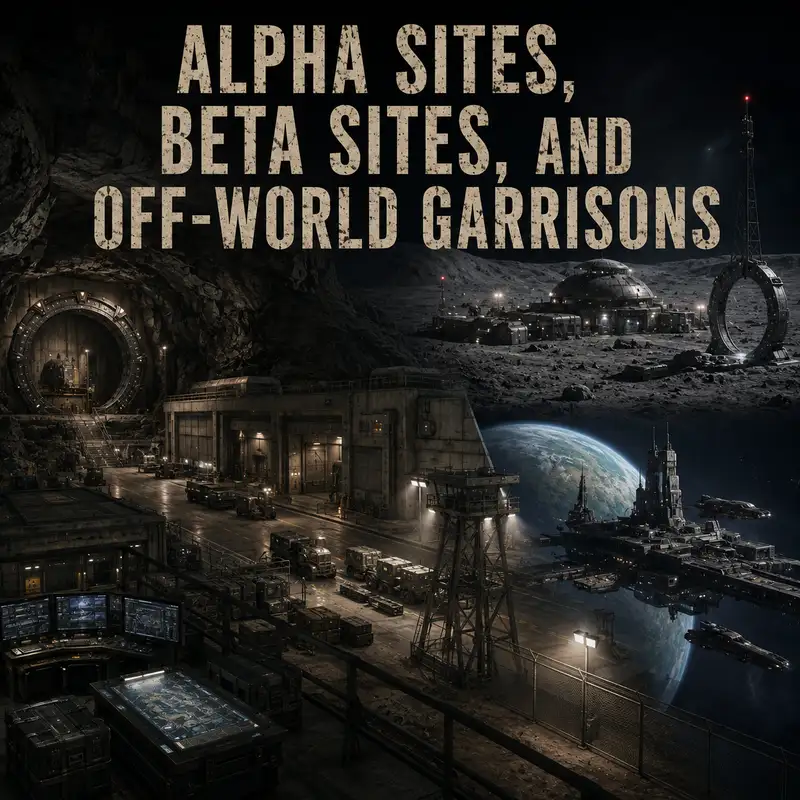
Alpha Sites, Beta Sites, and Off-World Garrisons
Colonel Riley had minutes to decide whether the Alpha Site could still be saved. Goa’uld ships were entering the atmosphere, Kull warriors were closing on the facility, and the evacuation route depended on a Stargate that every survivor would have to reach under fire. Riley ordered the remaining personnel to withdraw to the Beta Site and activated the self-destruct. When Stargate Command reestablished contact, the base had been reduced to a crater, the gate lay horizontal in the wreckage, and ninety people were still missing. Earth’s safest off-world refuge had become a battlefield.
That destruction revealed the contradiction at the center of Earth’s off-world basing strategy. Alpha Sites and Beta Sites were created to provide strategic depth beyond Earth, giving Stargate Command somewhere to evacuate personnel, stage missions, shelter allies, conduct dangerous research, and preserve a functioning command if Cheyenne Mountain fell. Yet every base depended on a fixed gate address, finite supplies, and the continued secrecy of its location. The farther Earth spread its defenses, the more places it had to defend.
The need for an off-world refuge became obvious during the first major Goa’uld attack on Earth. Stargate Command could close the iris and protect the gate room, but it could not guarantee the survival of the government, the scientific community, or the program if enemy motherships controlled the planet from orbit. Earth required a place beyond the Solar System where selected personnel could survive, preserve critical knowledge, and continue the war. A Stargate made that evacuation possible. It also reduced the escape route to a ring less than seven meters across.
P three X nine eighty-four became the first known Alpha Site in the prime timeline. Its most important defensive feature was not a mountain, shield, or weapons battery. Its address was believed to be unknown to the Goa’uld. During Apophis’s approach to Earth, personnel and selected civilians on the Alpha list began moving through the gate. Daniel Jackson later reached the same world from aboard an enemy mothership and used it as an intermediate stop before returning home. The site had already proven its purpose before Earth possessed a single interstellar warship.
The designation Alpha Site described a role rather than one permanent planet. It meant the primary off-world fallback location available to Stargate Command. The ideal world needed a breathable atmosphere, accessible water, tolerable climate, a functioning gate, defensible terrain, and enough distance from hostile territory to reduce the chance of accidental discovery. It also needed an address that had not already appeared in a Goa’uld navigation archive. The final requirement was difficult to verify when the enemy had been using the network for thousands of years.
The Alpha list reflected the grim arithmetic of evacuation. Earth could not move billions of people through one gate before an orbital attack. Even with continuous operation, security checks, medical screening, baggage control, and the physical movement of people through the embarkation room would limit throughput. Selection therefore favored leadership, technical specialists, military personnel, scientists, physicians, and others judged necessary to preserve organized resistance. The plan offered continuity for a fragment of civilization, not rescue for the population. Strategic depth can be reassuring until someone asks who receives the available space.
The Alpha Site also became the designated fallback for S G teams unable to contact Earth. That protocol gave personnel another extraction option if Cheyenne Mountain was compromised, the iris could not be opened, or the home gate was unavailable. A stranded team could dial the Alpha Site, report the emergency, receive medical attention, and wait for the situation on Earth to be resolved. The procedure reduced dependence on one destination, but only if every team carried the correct address and the Alpha Site itself remained secure.
A functioning off-world garrison required much more than a Stargate and several tents. It needed perimeter defenses, gate guards, authentication procedures, communications, power generation, water purification, food storage, medical facilities, ammunition, spare parts, shelters, vehicles, and personnel trained to maintain all of them. Naquadah generators reduced dependence on imported fuel, but generators still required technicians and replacement components. Every meal, battery, bandage, and rifle magazine either had to be produced locally or carried through the same gate reserved for missions and emergencies.
The first Alpha Site gradually expanded from a survival refuge into an operational base. It supported S G teams, scientific work, training, and the temporary housing of allied forces. That growth made strategic sense. An off-world location allowed hazardous research to occur away from Earth and gave resistance groups a sanctuary beyond Goa’uld-controlled territory. It also concentrated people, intelligence, and experimental technology in one place. A base becomes more useful as additional missions are assigned to it. It also becomes a more rewarding target.
The danger became clear when Rebel Jaffa and Tok’ra refugees arrived together. The Jaffa had escaped the destruction of Cal Mah, while the Tok’ra had lost a base in the Risa system to Anubis. Both groups opposed the Goa’uld, but centuries of conflict, infiltration, and mutual suspicion did not disappear because Earth assigned neighboring living quarters. The Alpha Site became neutral ground where three forces with different cultures, command structures, and security practices attempted to operate as one coalition.
An Ashrak infiltrated the site among the refugees and began killing personnel while sabotaging the base. A naquadah reactor was tampered with in a way that could have destroyed the installation. The assassin exploited exactly what made the site valuable. Refugees had arrived quickly. Identities were difficult to confirm. The Jaffa and Tok’ra suspected each other, and every accusation weakened the alliance. The Ashrak was eventually stopped, but the incident proved that a secret address did not protect a base from an enemy concealed inside a friendly evacuation column.
The site’s mission had outgrown its original security model. A fallback refuge could remain small, isolated, and tightly compartmented. A coalition headquarters needed shared intelligence, common procedures, medical coordination, and rules for resolving disputes among armed allies. Earth wanted the benefits of a joint base without possessing a mature joint command. The result worked when personal trust bridged the gaps. It became fragile whenever casualties, sabotage, or old grievances placed that trust under pressure.
Anubis eventually compromised the location after Jonas Quinn was captured and subjected to a mind probe. Stargate Command responded by moving the Alpha Site rather than merely strengthening the old one. With Tok’ra assistance, Earth transported a Stargate to a planet with a completely new address. The relocation was an impressive logistical operation. It also showed that the base’s best defense remained concealment. Earth could rebuild structures and move equipment. It could not prevent a major enemy fleet from controlling the sky once the location was known.
At the relocated site, Samantha Carter and Jacob Carter worked on a prototype weapon capable of defeating Anubis’s Kull warriors. That research made the base strategically important even if the enemy did not know the details. When Goa’uld vessels appeared, Colonel Riley ordered an evacuation to the Beta Site. Al’kesh bombers struck the installation while Kull warriors hunted survivors on the ground. Riley’s self-destruct denied the enemy the laboratories and stored intelligence, but it also destroyed the position Earth had built to survive the loss of other positions.
The rescue force found scattered survivors, including Jacob, while Carter remained wounded and pursued through the forest. The prototype weapon survived and was used to kill the Kull warrior tracking her. Tactically, the research program succeeded. Operationally, the base was lost. Strategically, the attack helped fracture the alliance among Earth, the Tok’ra, and the Rebel Jaffa. The survivors disagreed over how the location had been compromised and whether living together had created unacceptable risk. One weapon had been preserved. The coalition that developed it was damaged.
The battle exposed the limits of a gate-centered garrison. The Alpha Site could control access through its Stargate, but it had no comparable barrier against ships arriving from orbit. Once bombers entered the atmosphere, the defenders faced attacks from directions the gate room was not designed to cover. Evacuation also had to pass through one chokepoint while the base was under assault. The Stargate offered instantaneous travel after connection. Reaching it remained a conventional movement problem involving distance, wounded personnel, suppressive fire, and very little patience from the enemy.
The Beta Site existed to prevent the loss of the Alpha Site from becoming the loss of the entire off-world network. The surviving record provides far less detail about its location, construction, or normal garrison. Its purpose is clear from the evacuation order. It was the secondary fallback, a place to receive personnel when the primary site had been compromised. The designation should not be confused with an alternate reality in which P three X nine eighty-four was called the Beta Site. In the prime timeline, Earth later maintained a separate Beta Site as part of its own layered defense.
Redundancy was the Beta Site’s contribution. A reserve location did not need every laboratory or alliance function housed at the Alpha Site. In fact, duplicating all of them would have reproduced the same concentration of risk. It needed secure gate access, emergency supplies, medical capacity, command communications, and enough room to absorb survivors. The site also had to remain secret from people who did not require its address. That requirement could create an awkward briefing when the personnel expected to evacuate there were also considered potential security risks.
Earth established another Alpha Site on P four X six fifty. This time the main facility was constructed inside a mountain, following the hardened model used at Cheyenne Mountain. The base included computer-controlled gate operations, naquadah-generated power, and hangar space for F three-oh-two fighters. Hardening improved protection against ground assault and limited bombardment. Fighters provided reconnaissance and a local aerospace response. Neither measure made the site invulnerable, but the design showed that Earth was moving from an improvised refuge toward a permanent forward installation.
The new base performed several roles without becoming as politically crowded as its predecessor. Carter brought industrialist Alec Colson there to prove that Earth’s alien-derived aircraft were real. The site also served as a controlled location for contact with a Replicator duplicate of Carter. Conducting that meeting away from Earth reduced the consequences if the visitor proved hostile, which she did. Fifth’s Replicator ship approached the planet, and the confrontation again demonstrated that isolation protects the homeworld by transferring danger to the personnel assigned outside it.
Specialized bases extended that principle. The Gamma Site was a scientific research facility located twenty-four thousand light-years from Earth. More than thirty scientists studied alien organisms and technologies there under Colonel Pearson’s command. Its unusual ionosphere made orbital targeting difficult, which offered some protection against attack from space. The location also allowed Stargate Command to examine hazardous discoveries without placing them beneath Colorado. The arrangement was sensible until an organism escaped containment and made the distance from Earth a problem for rescue.
The R seventy-five insects stored at the Gamma Site changed from lethargic agricultural pests into rapidly multiplying carnivores. They breached the laboratory, killed personnel, spread underground, and overran the gate room. Pearson locked down the base and sent visiting International Oversight Advisory representatives outside under S G One’s protection. The self-destruct destroyed the installation, while the Odyssey arrived to recover survivors and deploy a neurotoxin against the swarm. The Gamma Site protected Earth exactly as intended. It did so by becoming expendable.
That loss clarified the difference between an off-world laboratory and a secure garrison. Scientists require access to specimens, power, instruments, and freedom to work. Security personnel require containment barriers, surveillance, emergency authority, and plans for destroying the research. Those needs can conflict. A base commander must be able to isolate laboratories, preserve the gate route, evacuate civilians, and call for ship support before the hazard reaches the surface. A self-destruct is not a containment plan. It is the final admission that the earlier plans have failed.
Other off-world installations existed because Earth’s growing fleet and weapons programs required resources. On P three X four oh three, Colonel Edwards commanded a military and geological operation surveying rich naquadah deposits. The mineral was important to Earth’s expanding shipbuilding program. The world appeared available until local Unas killed a member of the survey team and made clear that the mining area was sacred territory. A garrison intended to secure an industrial site had entered an existing political landscape it did not understand.
The military solution would have been removal of the Unas and occupation of the mine. Daniel Jackson and Chaka produced a better result by negotiating access and recognizing the Unas as inhabitants rather than obstacles. The agreement preserved the resource while avoiding a campaign against a population defending its own land. The episode carried a broader lesson for every off-world base. A planet without advanced cities is not necessarily unclaimed, and control of the Stargate does not confer ownership of the territory around it.
The Alpha Site concept also traveled to the Pegasus galaxy. As the Wraith approached Atlantis, the expedition searched for an Alpha Site where personnel could evacuate if the city had to be abandoned. The plan repeated the Milky Way doctrine under harsher conditions. A secret address offered survival only while it remained secret, and a refugee base with limited supplies could not replace Atlantis’s power, archives, or defenses. The terminology had become institutional shorthand for a difficult promise: there would be somewhere else to go.
Icarus Base represented the most ambitious version of the off-world garrison. It combined a large scientific project, a substantial military security force, fighter support, starship access, and a Stargate powered by a planet rich in naquadria. The base existed to solve the nine-chevron address and reach an Ancient destination beyond known range. It was not merely a refuge. It was a strategic research installation whose experiment depended on energy available nowhere on Earth.
The Lucian Alliance attacked with Ha’tak vessels, overwhelming the local defense and destabilizing the planet’s core. Colonel Everett Young ordered an evacuation through the gate, but Doctor Nicholas Rush dialed the nine-chevron address instead of Earth. The surviving personnel arrived aboard Destiny while Icarus Base and the planet supporting it were destroyed. The base had ships, fighters, fortifications, and trained troops. Its final survival plan still narrowed to one gate, one dialing decision, and a power source becoming increasingly enthusiastic about exploding.
Off-world garrisons also created command and political problems. Most were operated by the United States military, but their missions affected foreign governments, allied civilizations, and the International Oversight Advisory. A research site might be funded internationally while remaining under an American colonel. An allied refugee population might bring its own leaders and weapons. A ship captain arriving during an emergency could control the strongest force in orbit without commanding the base below. Clear relationships had to be established before contact was lost, not improvised while the self-destruct clock was running.
A resilient base required layered warning beyond the gate. Ground sensors and patrols protected the immediate perimeter. Unmanned aircraft extended reconnaissance. F three-oh-twos could challenge smaller vessels and identify threats in the atmosphere. Battlecruisers provided orbital firepower, transport beams, and an extraction route independent of the local gate. Intelligence from allies could warn of an attack before ships entered the system. No Alpha Site possessed all of these capabilities at all times, which is why secrecy and redundancy remained essential even after Earth built a fleet.
Logistics determined how long a garrison could remain useful. A refuge designed for several hundred people could become a humanitarian crisis if thousands arrived without warning. Medical supplies had to account for human, Jaffa, and Tok’ra physiology. Food acceptable to one population might be useless to another. Ammunition and power cells could not be assumed compatible across allied forces. Spare parts for alien-derived systems might exist only on Earth or aboard one ship. The gate shortened distance, but it did not reduce consumption.
The record of the Alpha, Beta, and specialized sites shows that Earth never found a permanently safe planet. Addresses leaked through captured personnel, infiltrators, allies, and enemy intelligence. Fixed facilities were vulnerable to orbital attack. Laboratories generated hazards from inside. Mining operations encountered people already living on the land. Evacuation plans depended on a gate that could be occupied, damaged, or cut off. Each solution created another task for the garrison and another reason the enemy might care about its location.
The sites still transformed Earth’s strategic position. They gave Stargate Command continuity beyond Cheyenne Mountain, provided sanctuary for allies, moved dangerous research away from the homeworld, supported resource extraction, and created forward bases for a growing space force. Their value was not that they could never be lost. Their value was that losing one did not have to end the program. The Beta Site mattered because the Alpha Site could fail. The next Alpha Site mattered because the previous one had.
Colonel Riley’s final order captured the logic of the entire system. Evacuate what can be saved. Destroy what cannot be allowed to fall into enemy hands. Send the survivors to another address and rebuild. When the smoke cleared, the Alpha Site’s Stargate remained in the crater, harder to destroy than the people, laboratories, and defenses built around it. Earth’s off-world garrisons provided strategic depth, but never sanctuary without conditions. Their real purpose was to buy one more place from which the war could continue after the place before it was gone.