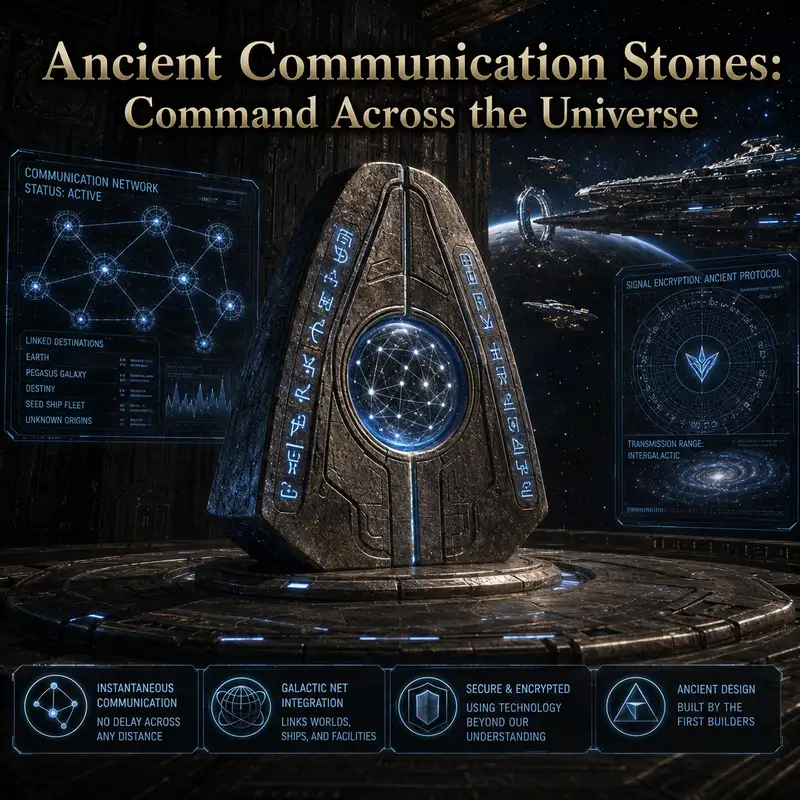
Ancient Communication Stones: Command Across the Universe
Colonel Everett Young placed an Ancient communication stone on Destiny’s interface expecting to open his eyes inside a secured room at Homeworld Command. Instead, he awakened in the body of a blue-skinned alien aboard an unknown vessel. On Destiny, that alien awakened inside Young’s body and attacked the nearest officers. The link ended only when a crew member pulled the stone from the device. In a few seconds, the most powerful command channel available to the expedition had connected two hostile ships, exchanged their commanders, and bypassed every security measure except the hand close enough to remove the stone.
That incident captured the central contradiction of the Ancient communication stones. They could carry a human consciousness across intergalactic distance in real time, allowing leaders, specialists, intelligence officers, and family members to become physically present where no ship or Stargate could take them. They could not guarantee that the intended minds were connected, that the person using a familiar body was trustworthy, or that an order issued from borrowed flesh was lawful. The stones defeated distance more completely than almost any other Ancient device. They did not defeat identity, consent, or command friction.
Earth’s first encounter with the technology did not look like body exchange. Joe Spencer, a barber in Indiana, acquired a carved black stone that had reportedly been found during an archaeological excavation in Egypt. When he touched it, he began experiencing vivid scenes from Jack O’Neill’s service with S G One. A matching stone had been recovered from an off-world ruin and stored at Stargate Command, where O’Neill had activated it. Both men possessed the Ancient Technology Activation gene. The link carried perceptions and memories between them over years, convincing Joe that classified missions were real while giving O’Neill occasional impressions of an ordinary life he did not recognize as someone else’s.
That first link established several properties without revealing the complete system. The stones were Ancient. They could connect minds across distance. Initialization depended on someone with the Ancient gene, although later users did not always require the gene once the stones had been activated. Most importantly, the stones alone produced a limited psychic connection rather than deliberate command presence. Joe could witness fragments of O’Neill’s experience, but he could not choose the destination, speak through O’Neill, or control the general’s body. Earth possessed a communications component without the terminal that explained what the component had been designed to do.
The missing terminal was later recovered beneath Glastonbury Tor. When Daniel Jackson and Vala Mal Doran placed initialized stones into its recessed controls, the effect changed from shared perception to full consciousness exchange. Daniel awakened in the body of a man named Harrid, while Vala occupied Harrid’s wife, Sallis, in the Ori home galaxy. Harrid and Sallis were transferred into Daniel and Vala’s bodies on Earth. Daniel could see through Harrid’s eyes and move his body, but he had no access to Harrid’s thoughts or memories. The device had not created telepathy between cooperative users. It had exchanged the people operating two biological platforms.
That distinction turned the stones into a strategic intelligence system. Daniel and Vala learned that the Ori governed human societies through religious authority and that opposition existed inside those societies. Later, Vala used another terminal in the Ori galaxy to occupy Daniel’s body at Stargate Command and warn Earth that an invasion fleet was preparing to cross into the Milky Way. She could not send documents, weapons, or a reconnaissance team. She could deliver eyewitness intelligence from a region beyond ordinary gate access. A small black stone accomplished what an intergalactic courier, a secure radio network, and a diplomatic mission could not.
The screen record does not provide a complete physics manual. The safest description is operational. Initialized stones, used with a compatible terminal or control interface, establish a real-time link between users. In the mature configuration, each user’s consciousness occupies the other person’s body for the duration of the connection. Removing a stone or shutting down the system usually ends the exchange, although several incidents showed that termination could fail. The stones do not transport matter, and they do not create a copy that remains safely at home. The person is functionally present at the distant end, while someone else is functionally present in the body left behind.
That made the device more useful than a conventional video conference and more limited than a Stargate. A commander could inspect a ship, speak privately with subordinates, operate equipment, and experience the local environment. A scientist could place hands on an Ancient console rather than describe a repair across a radio link. A wounded expedition could bring in a doctor without moving a medical team through space. Yet not one kilogram of food, medicine, ammunition, or replacement machinery crossed with the user. The stones created command reach without logistical reach. Earth could advise Destiny from billions of light-years away and still could not deliver a filter cartridge.
The Icarus evacuees arrived on Destiny with five Ancient communication stones and a portable interface. Nicholas Rush used one before informing the rest of the survivors. He returned claiming that General Jack O’Neill had placed him in charge. The claim was false, but most people aboard had no independent way to verify it. The first use of the expedition’s strategic communication system therefore became an authentication failure. Rush understood that information from Earth carried authority. He also understood that controlling the only channel allowed him to describe that authority however he wished.
Once Colonel Young recovered, the stones became a formal command link. Homeworld Command maintained a dedicated laboratory and personnel prepared to serve as host bodies. Destiny established its own communications room, operators, watches, and schedules. The system had limited capacity because only a small number of stones and suitable users were available at one time. A place in the rotation became a resource. Command conferences, intelligence interviews, specialist visits, medical consultations, and family contact all competed for the same table. Earth had achieved real-time communication across the universe and immediately required a duty roster.
Identity had to be managed as carefully as bandwidth. To observers, the visiting consciousness still looked like the host body. General O’Neill could arrive aboard Destiny in the body of an airman, while Young could attend a Pentagon briefing in someone else’s uniform and face. Rank insignia did not prove who was speaking. Voice, appearance, fingerprints, and physical access all belonged to the body, not the mind using it. Authentication depended on trusted stone-room personnel, prearranged procedures, personal knowledge, and continuous control of the device. The system made impersonation unnecessary because it provided something more convincing than a disguise.
The physical condition of the host also became part of command planning. A transferred user inherited the host body’s strength, injuries, disabilities, medication requirements, and immediate environment. Doctor Amanda Perry, a brilliant engineer who had been quadriplegic since childhood, could walk and work aboard Destiny while occupying another woman’s body. The Destiny volunteer transferred into Perry’s body had to manage a ventilator, limited mobility, and specialized care on Earth. One proposed host could not tolerate the experience and broke the connection. The technology moved expertise, but it transferred physical risk in both directions.
Perry’s visit demonstrated the system at its best. Destiny’s faster-than-light drive had failed between galaxies, and the resident science team did not understand the Ancient propulsion system well enough to repair it safely. Rush identified Perry as the best available expert. Through the stones, she came aboard without waiting for a ship, a wormhole, or years of travel. She examined the consoles, collaborated with the crew, and helped restore propulsion. Earth had not transported a technician. It had transported the technician’s judgment, memory, and dexterity into a body already on site.
The same operation exposed the ethical problem hidden inside that success. Camile Wray volunteered her body so Perry could continue working, then awakened inside Perry’s immobilized body on Earth. Wray required a caretaker and had to learn immediately how to breathe, move, and communicate through equipment designed for someone else. Perry, meanwhile, experienced mobility she had not possessed since childhood. Both women consented, but consent did not make the exchange emotionally simple. Any intimate contact, medical procedure, combat injury, or personal decision affected a body whose owner was temporarily absent. The stones separated bodily possession from personal identity without providing a legal manual for either.
Personal visits became a major part of the program because morale was also a survival requirement. Young used another officer’s body to see his wife. Wray used host bodies to spend time with her partner, Sharon. Eli Wallace attempted to reassure his mother while wearing a stranger’s face, then later arranged for her to visit Destiny in another body. These connections kept families informed and reminded the stranded crew that Earth had not abandoned them. They also blurred boundaries among duty, privacy, sexuality, and consent. A host could agree to a communication shift without anticipating every choice the visitor might make while using the body.
Operational command became equally complicated. Senior officers on Earth could visit Destiny, inspect conditions, and issue orders as though physically aboard. Colonel David Telford could occupy Young’s body and temporarily exercise command of the ship, while Young occupied Telford’s body on Earth. During one plan to channel stellar energy into Destiny’s Stargate, Earth-based scientists entered the bodies of Eli Wallace and Chloe Armstrong so they could operate the ship directly. The arrangement gave Homeworld Command extraordinary reach. It also placed people who did not live with Destiny’s daily risks in control of the bodies, equipment, and lives of those who did.
Faster-than-light transitions made that remote command unstable. Entering or leaving faster-than-light travel could interrupt the connection and return every consciousness to its original body without warning. When Destiny dropped from faster-than-light travel during the stellar-dialing operation, Young abruptly returned to his own body aboard the ship while Telford found himself back on Earth. The exchange then reestablished itself. Command authority changed twice in moments, and personal situations at both ends changed with it. A device capable of spanning billions of light-years could still be disrupted by the ship changing drive states.
Even when the connection functioned, the stones did not erase the difference between headquarters and field command. Earth could review reports, inspect the ship through borrowed eyes, and place experts at Ancient consoles. Destiny’s crew lived continuously with failing power cells, limited supplies, and the consequences of a wrong calculation. During later debate over another attempt to dial Earth, Milky Way experts could examine Eli’s work and support a plan that people aboard considered dangerously uncertain. Their judgment carried institutional weight, but no officer in the Pentagon would share the casualty if Destiny was destroyed. The stones made remote command better informed. They did not make remote command local.
The stones also became an intelligence instrument. Rush used them to occupy Telford’s body and investigate suspected Lucian Alliance contacts on Earth. Telford simultaneously occupied Rush’s body aboard Destiny. Rush could pass security checks, access Telford’s accounts, and attend a clandestine meeting because the body was genuine. The operation was a form of human intelligence collection without infiltration in the conventional sense. The agent did not need a false identity. He borrowed the suspect’s actual one.
That advantage carried counterintelligence consequences. Repeated transfers appeared to leave residual impressions behind. Scott experienced fragments associated with Telford’s life, and those impressions helped expose conduct Telford had concealed. Young later used the possibility of residual memory while investigating whether Telford had compromised Icarus Base. Complete access to a host’s mind was not normal, but the separation was not perfectly clean. Every exchange risked leaving traces in both directions, turning a communication session into an unintended intelligence collection event.
The Telford operation also showed how physical coercion crossed the link. Lucian Alliance personnel captured Rush while he occupied Telford’s body and tortured that body for information. Telford remained aboard Destiny inside Rush. Severing the connection would have returned each man to a body already affected by what had happened at the other end. The stones allowed commanders to project consciousness beyond any rescue range, but they did not create diplomatic immunity, medical evacuation, or a safe exit from captivity.
The accidental connection with the Nakai was an even clearer security failure. When Young attempted a normal report to Earth, the interface found a compatible link on an alien vessel instead. Young occupied an alien body and gained a brief view of the ship. An alien occupied the body of Destiny’s commander, reacted violently, and obtained direct access to the expedition’s communications room. The exchange contributed to a hostile encounter and an abduction. Later, a Nakai consciousness used the same channel to take control of Lieutenant James because the stones had not been reset. Clearing the stones after alien access was not clerical housekeeping. It was communications security.
Physical control of the stone room therefore mattered as much as encryption would matter in an ordinary network. Operators monitored users through kinos, guards remained nearby, and someone had to be able to remove a stone immediately if the person returning was not who everyone expected. Access schedules could be altered by command for intelligence reasons, which created political disputes over who controlled contact with Earth. When Homeworld Command’s facility was attacked and its equipment buried, Destiny maintained continuous watches in hope that a connection would return. The entire intergalactic command system could be reduced to several people staring at an inactive stone.
The attack on Homeworld Command produced the most complicated exchange. Wray and Master Sergeant Ronald Greer were on Earth in borrowed bodies when a Lucian Alliance strike devastated the facility. Senator Michaels and Doctor Andrew Covel occupied their bodies aboard Destiny. A faster-than-light transition temporarily returned everyone to their original bodies, allowing the visitors on Destiny to see the destroyed command center through Wray and Greer’s eyes. When the connection reformed, Covel altered the control algorithm so he would not have to return permanently to his irradiated body on Earth.
Covel’s action turned the stones into a hostage system. One user could manipulate the link and deny another person return to a body that legally and biologically belonged to them. Michaels ordered the interference reversed, even though returning meant facing lethal radiation while attempting to neutralize the bomb. The event demonstrated that the Ancient hardware was only one part of the security problem. Human-built controls, software, procedures, and operators could be corrupted by fear. A perfect signal is not a perfect command system when the person controlling the disconnect has decided not to go home.
Medical support remained one of the strongest arguments for accepting those risks. After the Lucian Alliance boarding action, Earth could send doctors to Destiny one at a time through available host bodies. Specialists could examine patients, guide Johansen, and advise on procedures the expedition had never expected to perform. The stones could also bring analysts, engineers, and political officials aboard for specific problems. This was telepresence in the most literal possible form. It expanded the crew’s expertise without expanding its food requirement, although the host volunteer still lost time, control, and sometimes considerable comfort.
The death of Ginn and Amanda Perry revealed a failure mode no one had anticipated. Ginn used the stones to travel to Earth in Perry’s body while Perry occupied Ginn’s body aboard Destiny. Simeon murdered Ginn’s body during the connection. Both women were lost, even though one consciousness had been operating a body far from the killing. Later, their consciousnesses reappeared through the stone system and were transferred into Destiny’s computer. That survival was extraordinary and should not be treated as a routine backup function. The stones had not made death harmless. They had produced an unusual continuity of consciousness that the crew barely understood and could not reliably repeat.
By this stage, the communication stones had become part radio, command post, intelligence platform, medical transport, diplomatic chamber, family visitation system, and security hazard. Their strategic value came from moving the one resource Destiny most often lacked: the right person with the right knowledge. Their weakness was that the transfer required another person to surrender a body at the destination. Every session therefore created two missions, two sets of medical risks, two security perimeters, and two chains of responsibility.
Earth learned to initialize and reset the stones, operate communication terminals, imitate their transmission characteristics, and integrate surviving artifacts into portable control systems. The screen record does not show Earth manufacturing new communication stones at scale. The capability remained dependent on recovered Ancient devices, trained operators, and a small number of terminals. Earth could field the system operationally. It had not reproduced the civilization that designed it, which was a recurring distinction in the Stargate Program and a reliable source of difficult maintenance meetings.
The stones changed command because they made distance almost irrelevant to presence. General officers could stand aboard Destiny. Scientists could touch the machinery they were advising others to repair. Spies could enter an enemy network in the enemy’s own trusted body. Families separated by billions of light-years could speak face to face. None of those people arrived with independent transportation, legal jurisdiction, or the means to sustain the ship. Their authority still depended on local acceptance, and their safety still depended on whoever guarded the interface.
Ancient communication stones allowed command across the universe by moving consciousness instead of messages. That was their brilliance. It was also their danger. They could bring Earth into Destiny’s corridors without bringing Earth’s institutions, resources, or protections with it. The link connected minds instantly, but every order still passed through a borrowed body, every mission still depended on trust, and every return depended on someone at the table leaving the stone in place.