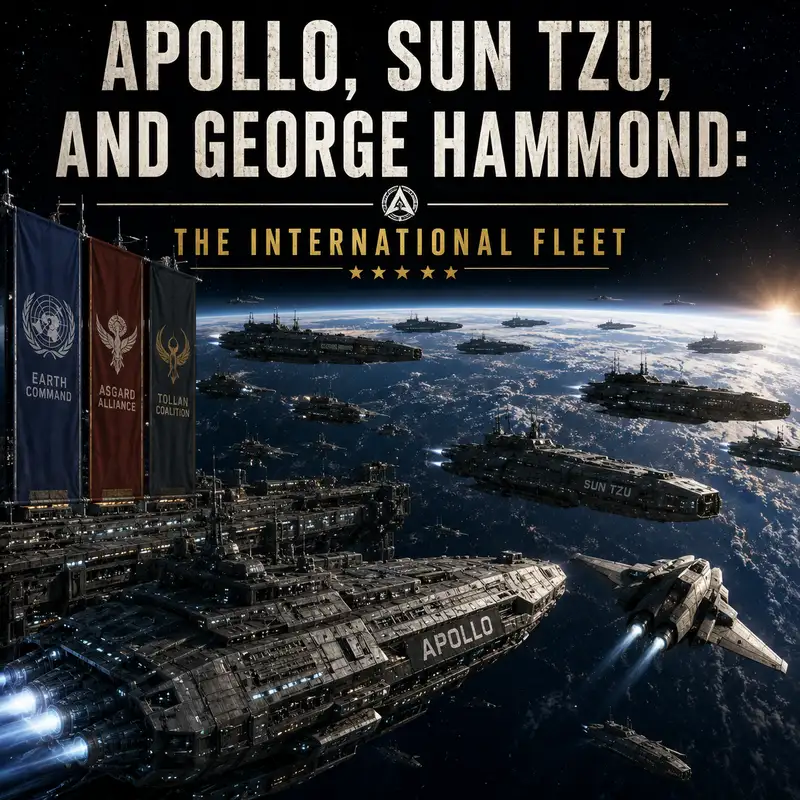
Apollo, Sun Tzu, and George Hammond: The International Fleet
The message from Apollo reached Earth after the battle had already been lost. Colonel Abraham Ellis reported that Sun Tzu had been crippled and was venting atmosphere. Apollo was taking aboard the other ship’s crew while dealing with damage of its own. Both battlecruisers had attacked a single Wraith super-hive. Neither had stopped it. The enemy continued toward Earth, and the international fleet’s first visible act of cooperation became an evacuation conducted in the wake of strategic failure.
That engagement revealed how far Earth’s space forces had developed and how small they remained. Apollo, Sun Tzu, and the newly completed George Hammond belonged to the same B C three-oh-four class, but they represented different stages in the politics of the fleet. Apollo was an American strike platform repeatedly used to execute policy in the Pegasus galaxy. Sun Tzu placed an Earth battlecruiser under Chinese identity and command. George Hammond joined advanced technology, institutional memory, and a commander whose career crossed science, special operations, expedition leadership, and fleet warfare.
The central question is not whether these ships were technically international. Their names and crews provide part of that answer. The deeper question is how Earth moved from one nation secretly building Prometheus beneath Nevada to several governments sharing the risks of interstellar power. The transition required common technology, compatible training, political bargaining, and a willingness to accept that a ship carrying another country’s personnel might still be the strongest available defense for the entire planet.
Earth’s first capital-ship program had been almost entirely American in control. Prometheus was funded, constructed, crewed, and commanded through the United States national-security system. Daedalus and Odyssey followed within the same military framework, even as they served missions authorized through broader alliances. This concentration was operationally convenient. It also became politically difficult to defend once Russia, China, Britain, France, and other informed governments understood that alien technology was being converted into warships able to cross galaxies.
The International Oversight Advisory gave those governments influence over funding and strategy, but influence was not the same as possessing a ship. Russia established the first clear precedent. In return for renewing the Gate Alliance Treaty and leaving the principal Stargate under the existing command arrangement, Moscow received the Korolev. That vessel was rushed into service and destroyed during its first major battle against the Ori. The loss proved that sharing technology meant sharing casualties as well as prestige.
The B C three-oh-four made wider distribution possible because it was a class rather than a single experiment. Prometheus had required constant modification and outside assistance. The later battlecruisers used a common human-built hull, similar command systems, F three-oh-two facilities, and Asgard-derived propulsion, shields, sensors, and transporters. A common design allowed crews from different governments to train against the same basic architecture. It also allowed one ship to receive survivors from another without first conducting a diplomatic conference on corridor width.
The surviving record does not provide a complete international fleet charter. It does not identify every funding share, national command relationship, construction site, or rule governing when a government could refuse deployment. What it shows is a practical arrangement. Homeworld Command coordinated planetary and off-world defense. The International Oversight Advisory influenced resources and major policy. Individual ships retained captains and national identities. Strategic necessity then forced them to operate together, often before the political system had finished defining what together meant.
Apollo was the clearest example of a battlecruiser used as an instrument of higher policy. It arrived at Atlantis on its first voyage under Colonel Ellis, ahead of schedule and carrying orders the local expedition had not requested. Reconnaissance showed the Asurans constructing large numbers of Aurora-class warships. The Asurans knew Earth’s location and possessed the means to reach it. The International Oversight Advisory and Homeworld leadership concluded that waiting for an attack created too much risk.
Ellis brought the Horizon weapons platform, a delivery system carrying six Mark Nine tactical nuclear warheads and four decoys. The plan was precise in engineering terms. Apollo would emerge near Asuras, release Horizon, and destroy the shipyards before the new fleet launched. John Sheppard would remain behind in a cloaked Puddle Jumper to assess the damage. The plan was less precise in political terms. Elizabeth Weir believed the strike could provoke an enemy that had not attacked since regaining control of its homeworld.
The dispute exposed the divided authority surrounding Atlantis. Weir led the expedition and carried responsibility for the city’s survival. Ellis commanded Apollo and possessed orders she could not cancel. She contacted Richard Woolsey and General Jack O’Neill in an effort to stop the mission, but the authorization remained in force. Civilian international oversight had approved a military strike, while the civilian leader closest to the target believed the operation endangered the base she had been appointed to protect.
Apollo completed the attack exactly as planned. All six warheads detonated against designated military targets, and the Asuran shipyards were destroyed. Tactically, the mission was a clean success. The enemy fleet under construction could not launch against Earth or Atlantis. The strike also demonstrated a new form of Earth power projection. A human-built ship had crossed a galaxy and delivered several strategic weapons against a civilization using Ancient technology without placing a ground force on the planet.
The consequences arrived through a different route. The Asurans constructed a satellite around a Stargate and positioned it above Atlantis. Energy transmitted through the active wormhole powered a beam that damaged Apollo and began draining the city shield. Because the satellite’s gate occupied the local connection, Atlantis could not evacuate through its own Stargate. The expedition eventually had to raise the city from the ocean and leave Lantea. Apollo had eliminated one threat and helped create another that forced Earth’s principal Pegasus base to abandon its planet.
The first strike did not prove that Weir had been correct about every alternative or that Ellis had been wrong to fear the Asuran fleet. The ships were real, the danger to Earth was credible, and negotiation might have failed. It proved that a technically successful attack can remain strategically incomplete. Apollo had enough firepower to destroy shipyards. Neither the ship nor the officials directing it possessed a reliable estimate of how the Asurans would retaliate, which target they would choose, or what technology they would use.
That experience became part of Apollo’s operational identity. Ellis was direct, impatient with ambiguity, and accustomed to making decisions from a bridge rather than building consensus inside a civilian expedition. He also adjusted when the facts changed. During the crisis over Atlantis, he accepted damage to his ship, supported the city’s survival plan, and acknowledged that his handling of Weir’s command had crossed boundaries. The ship represented military authority, but its captain learned that arriving with orders did not make local knowledge irrelevant.
Apollo later returned to Pegasus with a more formidable weapons fit. It and Daedalus had received Asgard plasma beam weapons capable of destroying Asuran warships far more effectively than their earlier missiles and railguns. The upgrade changed the class from a platform able to survive advanced enemies into one able to kill them under favorable conditions. It did not remove the need for intelligence, coalition partners, or a plan larger than firing until the target disappeared.
During the final campaign against the Asurans, Apollo and Daedalus attacked their warships across Pegasus and helped drive them back toward their homeworld. The decisive operation combined Earth ships, Wraith hives, Traveler vessels, F three-oh-twos, Ancient drones, and Rodney McKay’s plan to force the Asuran nanites into a single mass. Ellis directed Apollo’s beams against enemy hyperdrives and launched fighters to prevent escape. The battlecruiser’s role was not to destroy the civilization alone. It was to hold the fleet in place while another mechanism destroyed the planet beneath it.
That campaign showed the mature use of Apollo. The ship could execute a preemptive strike independently, but it was more effective as one element of a multinational and interspecies task force. Its sensors, transporters, fighters, shields, and beam weapons supported several simultaneous objectives. The vessel that had once arrived at Atlantis with a decision already made now fought inside a plan that depended on cooperation with people and species its government did not fully trust.
Apollo’s later engagement with the Wraith super-hive produced the opposite result. The hive had been powered by a zero-point module and had grown far beyond normal Wraith performance. Daedalus had already damaged itself attempting to stop it in Pegasus. When the vessel paused near the Milky Way, Apollo and Sun Tzu were positioned to intercept. The two Earth ships represented the kind of combined force the international fleet had been created to provide. They also faced a target outside the assumptions of the class.
The live-action record gives Sun Tzu only a small amount of history. Reference material identifies it as a Chinese-operated B C three-oh-four, but the ship’s bridge, captain, and crew are never shown directly. No reliable record establishes its exact production arrangements or whether every late Asgard upgrade had been fitted before the battle. That absence is important. Sun Tzu should not be assigned invented commanders, weapon counts, or victories simply because it shared a hull design with better-documented ships.
Its existence still marked a political achievement. China had long argued that the United States was not sharing the military benefits of the Stargate Program as fully as the Gate Alliance Treaty required. A Chinese battlecruiser meant that participation had moved beyond committee seats and access to reports. Chinese personnel now operated one of Earth’s most sensitive military platforms, with independent responsibility for a ship able to enter hyperspace, carry fighters, and employ technology descended from several alien civilizations.
That transfer required more than handing over access codes. A national crew had to be trained in deep-space navigation, Asgard-derived systems, damage control, fighter operations, and the security procedures surrounding Earth’s most classified technologies. Spare parts and technical data had to cross national boundaries. Homeworld Command had to trust the crew with navigational information leading to off-world bases and allied worlds. China had to trust that the ship it received could be repaired without becoming permanently dependent on an American technical team.
The exact industrial arrangement remains unstated, but the common class suggests a centrally coordinated production and support system. Earth had not created separate national starship traditions within a few years. It had created a shared design that could receive different national crews and names. That was efficient and politically practical. It also meant that a defect, compromised software package, or shortage of one alien-derived component could affect several governments at once.
Sun Tzu’s only recorded battle ended with the ship crippled and losing atmosphere. Apollo was damaged but remained capable of receiving the crew. The transfer demonstrated at least a basic level of interoperability under combat conditions. Two ships built to a common design and operating under a shared mission could shift from attack to mass rescue without waiting for Earth. The surviving record does not describe how many personnel crossed, which compartments were opened, or whether fighters were abandoned. It establishes the result. Apollo became responsible for another nation’s sailors while the enemy continued toward Earth.
The defeat was not evidence that internationalization had failed. Apollo and Sun Tzu confronted a uniquely enhanced hive ship that also survived attacks by Daedalus and later resisted Earth’s remaining defenses. Their failure showed the difference between distributing capable ships and creating overwhelming fleet mass. Earth had several battlecruisers on paper, but Odyssey was away on a mission, Daedalus had been damaged, and two available ships were forced to engage an enemy stronger than the class had previously faced.
The rescue also created an immediate operational penalty. Apollo now carried additional survivors while damaged, reducing its ability to reenter combat and increasing pressure on life support, medical spaces, and damage-control teams. Sun Tzu’s loss of combat capability removed one of the few capital ships available for Earth defense. The fleet had become international enough to save one another’s crews. It remained too small to replace the firepower lost during the rescue.
George Hammond entered service after this crisis with a name that connected the fleet to its institutional origins. The ship had originally been intended to bear the name Phoenix. After Lieutenant General George Hammond died from a heart attack, it was renamed in his honor. Hammond had commanded Stargate Command when Earth possessed no fleet, later led Prometheus above Antarctica, and then directed Homeworld Security as the gate program became a planetary defense organization. Naming a battlecruiser for him turned one officer’s career into a summary of the transformation the ship represented.
The name Phoenix also appears in an alternate future in which Samantha Carter commanded a B C three-oh-four against the Wraith. That future was erased and does not establish the prime ship’s operational history. In the principal timeline, Carter took command of George Hammond after leading S G One, serving in research and development, commanding Atlantis, and helping design or understand many of the systems used throughout the fleet. Her appointment placed one of Earth’s most technically informed combat officers in charge of its newest battlecruiser.
Carter’s command represented another form of internationalization. She was a United States Air Force colonel, but her career had been shaped by Russian cooperation, Tok’ra intelligence, Asgard science, the International Oversight Advisory, and command of a multinational expedition. She understood that an Earth ship might carry American markings while serving a mission whose personnel, risks, and political consequences belonged to several governments. She also understood that the most advanced system aboard could become the least reliable part of the plan before anyone finished explaining it.
George Hammond first appeared as a transport for the Icarus Project. It carried Eli Wallace and senior personnel from Earth to a secret base on a planet rich in naquadria, where scientists were attempting to dial a nine-chevron Stargate address. This was not a normal fleet mission. The ship was supporting a scientific program whose power requirement could not be met safely on Earth and whose destination remained uncertain. Strategic transport had become as important as orbital defense.
The Lucian Alliance attacked Icarus Base with three Ha’tak motherships, gliders, and a troop transport. Carter reported that Hammond’s shields were holding, but the battlecruiser was not the principal target. The attackers concentrated on the planet and the installation below. Hammond reduced the incoming fighter force, yet enough craft reached the base to begin a ground assault. The engagement showed the continuing limit of space control. A capital ship could survive in orbit and still fail to prevent an enemy from reaching the objective.
The naquadria-rich planet became unstable during the attack. Base personnel could not evacuate to Earth through the local gate and instead dialed the unknown nine-chevron address, stranding themselves aboard Destiny. Hammond could fight the attacking ships, launch fighters, and recover some personnel outside the base. It could not stabilize the planet, recover everyone below, or reverse the dialing decision once the evacuation began. The three enemy Ha’taks were destroyed when the planet exploded. The base and Earth’s direct control of the expedition disappeared with them.
George Hammond later attacked the Lucian Alliance installation used to reach Destiny. The operation again combined the battlecruiser, F three-oh-twos, intelligence from compromised personnel, and a ground objective protected by alien-derived defenses. Carter withdrew when the planet began to explode, leaving two fighter crews behind rather than sacrificing the ship and everyone aboard it. The decision reflected the command problem Hammond himself had faced repeatedly at Stargate Command. A rescue attempt could continue until it endangered the force required for every mission afterward.
The vessel’s recorded service is brief, but its missions show how the international fleet’s purpose had widened. Apollo had been introduced through a preemptive strike in Pegasus. Sun Tzu appeared during an interception intended to defend Earth. George Hammond moved scientists, protected a remote base, fought a nonstate power using captured Goa’uld ships, and supported operations connected to an Ancient vessel beyond conventional reach. The fleet was no longer organized around one enemy or one galaxy.
These ships also reveal that national distribution did not eliminate American dominance. Apollo and George Hammond remained under United States Air Force command. Homeworld Command operated from Washington. Much of the industrial and scientific infrastructure supporting the class remained tied to American facilities. Russia had received Korolev, and China had Sun Tzu, but the screen record does not show equal fleets, equal access to every technology, or a fully independent international naval headquarters.
What emerged was a coalition fleet rather than a unified planetary navy. Governments contributed authority, personnel, funding, and political consent. Ships retained national character. Homeworld Command coordinated urgent missions, while the International Oversight Advisory influenced the larger program. This arrangement was imperfect but recognizable. Earth had built an interstellar version of coalition warfare before it had built the institutions needed to make coalition warfare routine.
The force also remained dangerously thin. At the time of the super-hive attack, every available ship already had another mission, another repair requirement, or another theater demanding attention. A battlecruiser supporting Atlantis could not defend Icarus Base. A ship carrying the Asgard core could not be casually recalled. A damaged Sun Tzu reduced both Chinese national capability and Earth’s combined order of battle. International participation increased the number of hulls. It did not make those hulls less scarce.
Apollo, Sun Tzu, and George Hammond therefore represent more than three entries in a ship registry. Apollo showed that Earth could project force across a galaxy and that higher political authorities could use a battlecruiser to bypass local objections. Sun Tzu showed that advanced military technology could be placed under another major power’s identity and crew, with all the trust and dependency that required. George Hammond showed the fleet carrying institutional memory into a new era of scientific expeditions, counterstate warfare, and strategic transport.
The international fleet did not make Earth secure. Its ships could destroy Asuran warships, survive Ha’tak fire, and cross intergalactic distance, yet one enhanced hive could cripple two of them and continue toward the homeworld. The achievement was not superiority. It was the creation of a force in which several governments had a direct stake, trained personnel could operate common vessels, and a captain could rescue another nation’s crew without asking whether the political agreement had anticipated that particular disaster.
Earth’s fleet became international not when another flag was painted on a B C three-oh-four, but when Apollo opened its damaged compartments to Sun Tzu’s survivors and one nation’s loss became everyone’s next mission.