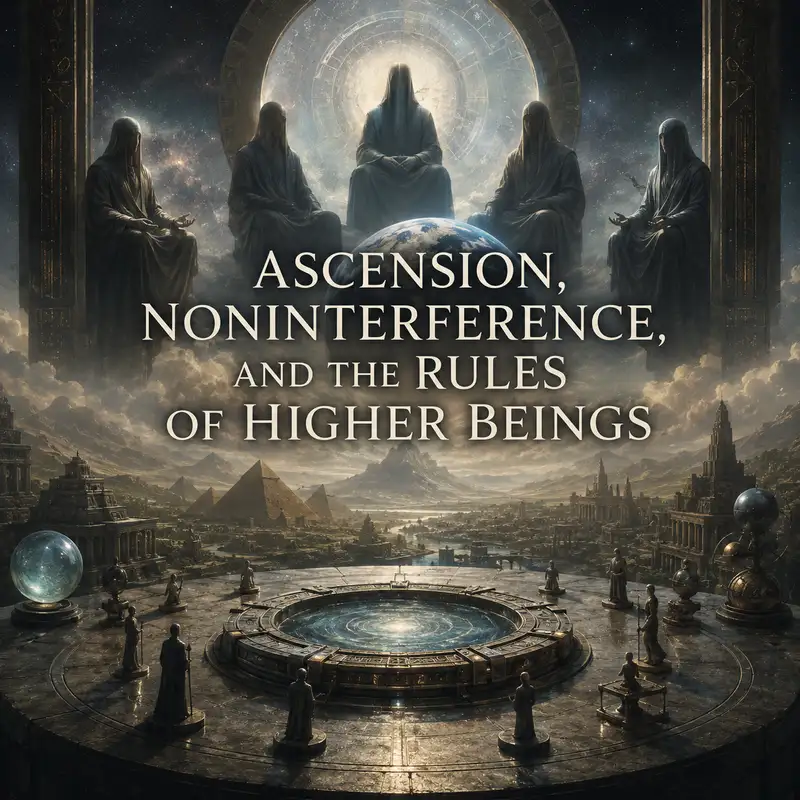
Ascension, Noninterference, and the Rules of Higher Beings
Daniel Jackson sat in a diner that did not exist while a weapon on Dakara prepared to send a destructive wave through the entire Stargate network in the Milky Way. His friends were trying to stop Anubis with ships, weapons, and a plan assembled under impossible pressure. Daniel had none of those things. He did not even have a physical body. What he had was access to the plane where Anubis’s greatest protection had been created, and where the beings capable of stopping him had chosen to watch. The immediate crisis was military. The decision that mattered was political.
Ascension is often described as advancement to a higher plane of existence. That description is correct, but incomplete. In practical terms, a person’s physical form is transformed or left behind while consciousness continues as an energy-based being able to perceive reality in ways ordinary humans cannot. Ascended beings can manifest to people, influence energy and matter, and retain knowledge beyond the capacity of a normal human brain. Yet ascension is not simple death, automatic entry into an afterlife, or proof of divinity. It is a change of state, and the person who undergoes it remains capable of choice.
The Ancients reached ascension after an extraordinarily long period of biological and intellectual development. Others arrived by different routes. Oma Desala helped Daniel ascend when radiation poisoning made his death unavoidable. She also guided the Harcesis child Shifu and the people of Abydos. Anubis reached the higher plane through deception. Orlin, Merlin, Morgan Le Fay, and Chaya Sar were Ancients who could take or abandon physical form. These examples establish two important limits. Not every Ancient ascended, and not every ascended being was an Ancient. The higher plane was a condition of existence, not membership in one species or government.
It also did not produce omniscience. Daniel could understand and perceive more after ascending, but he did not suddenly know every event, every technology, or every consequence. He described ascension as the beginning of a journey rather than its completion. Ascended beings learned, disagreed, made mistakes, concealed information, and pursued different objectives. Their abilities made them look divine from below, but their conduct remained recognizably political. They formed communities, enforced boundaries, punished violations, and argued over responsibility. The most important rule among the ascended Ancients was therefore not a law of physics. It was a policy.
That policy was noninterference. The ascended collective Daniel and Oma usually called the Others prohibited its members from using their superior powers to direct events on the lower planes. The stated principle was respect for free will. A being who could alter weather, destroy armies, cure disease, reveal advanced knowledge, or move people between planes could easily become a ruler whether that was the original intention or not. Gratitude could become dependence. Dependence could become worship. Advice backed by overwhelming power could cease to be advice. The Ancients had seen enough false gods to recognize the risk of becoming a more sophisticated version of the same problem.
From a strategic perspective, noninterference functioned like an arms-control regime combined with strict rules of engagement. It attempted to prevent ascended beings from turning less advanced civilizations into clients, weapons, laboratories, or sources of power. It also reduced the chance that rival ascended factions would fight through populations on the lower plane. A direct contest between beings capable of manipulating matter and energy on a planetary or greater scale would make conventional war look pleasantly manageable. Restraint protected the lower planes from one category of conflict, but only by refusing them access to the power that might also have protected them from another.
Oma Desala lived at the edge of that policy. She believed that individuals capable of ascension should be guided toward it, but the candidate still had to choose. When Daniel lay dying, she did not remove the radiation or repair his body. She offered another path and required him to release his attachment to physical life. This distinction mattered to the Others. Guidance could be tolerated where coercive rescue could not. Oma could teach, appear, and invite. She could not simply decide that someone deserved salvation and carry that person upward without consent. Even her permitted assistance remained controversial because every act of guidance changed what the person below knew was possible.
Daniel discovered the practical meaning of the rule when Jack O’Neill was imprisoned by Ba’al. O’Neill was tortured, killed, restored in a sarcophagus, and tortured again. Daniel could enter the cell, speak with him, and offer ascension as an escape if O’Neill chose it. He could not break the door, kill Ba’al, conduct reconnaissance for the rescue force, or prevent another cycle of torture. He had the power. He lacked authorization. In military terms, Daniel could provide counsel to a prisoner but could not participate in the operation. It was a remarkably precise distinction to enforce in a room where a friend was being dismantled one death at a time.
The encounter also showed why ascension could not be treated as an emergency extraction procedure. O’Neill had to want it, understand enough to make the choice, and remain capable of the inner change Daniel believed was required. Daniel could not force the decision merely because the alternative was unbearable. He also refused O’Neill’s request to make the next death permanent. The rule preserved personal agency, but it offered very little comfort to someone whose available choices had been created by an enemy. Free will remained present in theory. Ba’al controlled almost every condition under which it had to be exercised.
Daniel eventually crossed the line at Abydos. As Anubis attacked the planet, Daniel warned his former team, helped them find Ancient information, and tried to influence the confrontation. When Anubis prepared to destroy Abydos despite an agreement, Daniel attempted to use ascended power against him. The Others intervened before he could complete the attack. Daniel was returned to human form without his memories of the higher plane. The sanction was decisive. The ascended collective did not merely disapprove of intervention. It possessed the means and willingness to remove a member’s status when persuasion failed.
Abydos also exposed the central contradiction in the policy because Anubis was not an ordinary Goa’uld. Oma had helped him ascend after he deceived her about his nature. The Others rejected him, but they did not return him completely to physical existence. Instead, he remained suspended between planes and was restricted to actions he could theoretically have achieved as a Goa’uld. The judgment was meant to punish Oma and limit Anubis. It did neither cleanly. He retained knowledge gained through ascension and used conventional servants, laboratories, fleets, and weapons to turn that knowledge into material power.
Anubis became an expert in operating inside the letter of the rule. He did not need to hurl ascended energy across a battlefield when he could design superior shields, engineer Kull warriors, recover Ancient systems, and command human or Jaffa subordinates. The Others judged the formal category of his action. The galaxy experienced the consequences. It was oversight by capability rather than effect, a distinction familiar to any institution that has ever approved a dangerous program because the paperwork described it as limited. Anubis’s empire remained a lower-plane problem even when its decisive advantage came from knowledge acquired above it.
The final confrontation with Anubis returned Daniel to the threshold of ascension. While Anubis prepared to use the Dakara device against life throughout the galaxy, Daniel encountered Oma and the disguised presence of Anubis in the diner-like environment of the higher plane. Oma finally accepted that her original mistake could not be corrected by waiting for the collective to change its policy. She attacked Anubis directly and committed herself to an unending struggle that prevented him from acting below. This was not a general intervention by the Ancients. It was one dissenter taking personal responsibility and accepting a permanent cost.
Orlin’s history reveals another side of enforcement. He gave the people of Velona the knowledge to build a powerful defensive weapon when they faced the Goa’uld. Once protected, the Velonans prepared to use that advantage for conquest. The ascended collective intervened to eliminate the danger Orlin had created, and Orlin was condemned to remain alone on the ruined world. The sequence is uncomfortable. The Others prohibited intervention to preserve the freedom of lower beings, then used overwhelming power to correct an intervention by one of their own. The people of Velona paid for Orlin’s misjudgment and for their leaders’ ambition.
The case demonstrates why the Ancients distrusted gifts of advanced knowledge. A weapon provided for legitimate defense does not remain tied to its donor’s intent. It enters a political system, acquires operators, and changes the local balance of power. Once the immediate enemy is deterred, the protected society may discover that its neighbors are now vulnerable. Orlin solved a tactical survival problem and created a strategic expansion problem. The ascended response stopped Velona’s expansion, but it did so only after the situation had passed beyond diplomacy, inspection, or withdrawal of technical support. Higher beings had no established advisory team, end-use monitoring program, or particularly gentle recall procedure.
Orlin later chose a different method when the Ori plague threatened Earth. He descended into the body of a young boy because a younger human brain could retain more of his ascended knowledge. He arrived without ascended immunity, without guaranteed protection from the Others, and without the ability to preserve everything he knew. The information overloaded his physical brain and progressively damaged his mind. Even so, he helped Stargate Command develop a cure and revealed critical intelligence about the Ori. Descension allowed him to act on the lower plane because he accepted lower-plane vulnerability. The price was not symbolic. It consumed the person who chose to pay it.
Chaya Sar, known to the people of Proculus as the goddess Athar, received a different sentence. She had used ascended power to destroy a Wraith fleet and save her world. The Others punished her by binding her protection to Proculus alone. She could defend that planet indefinitely, but she was forbidden from extending the same sanctuary to refugees from other worlds. The result was a single protected population inside a galaxy structured around culling. To the Ancients, her confinement enforced a rule. To the people living beyond Proculus, it created a border between miraculous safety and abandonment that no military alliance could negotiate.
Her case shows that noninterference was not administered through one automatic penalty. Daniel was stripped of ascension. Orlin was confined in human form. Chaya retained power but only within a narrow geographic mission. Oma was burdened with the consequences of Anubis. The surviving record never reveals a written code, a court, a vote, or a transparent appeals process. Enforcement appears collective, powerful, and tailored to the offense. That flexibility may have prevented rigid outcomes, but it also meant that lower beings could not predict the response. The rules were binding on those above and largely unknowable to those below.
Merlin, known among the Ancients as Moros, treated the Ori as proof that noninterference alone was insufficient. He descended and retained enough ascended knowledge to create the Sangraal, a weapon intended to destroy ascended beings within its reach. The project was aimed at the Ori, whose power depended on worship and whose followers were being prepared for a crusade into the Milky Way. From Merlin’s perspective, building the weapon below the threshold of direct ascended action may have been the only way to resist. From the Others’ perspective, one former member was constructing a device capable of killing an entire category of higher life.
Morgan Le Fay was sent to watch Merlin and stop him if necessary. She eventually concealed him and his work rather than simply erase both, suggesting that obedience did not eliminate her doubts. Much later, she helped Daniel search for the weapon while presenting herself through an Atlantis interface. She provided information indirectly, tried to remain within the boundary, and was removed by the Others when her assistance became too explicit. Her interruption was more revealing than any speech. The collective was watching, the rule still applied during an intergalactic war, and even a threat to the Ancients themselves did not automatically authorize open cooperation.
The Ori represented the doctrine’s hostile opposite. They embraced intervention, demanded worship, empowered Priors, and organized human societies around obedience. Their conduct explained why the Ancients feared becoming governors of the lower planes. Yet the Ori also learned to exploit the restrictions on their rivals. Priors, soldiers, warships, and the Orici Adria acted in physical form. Their crusade could therefore be treated as a material conflict even though its leadership, purpose, and strategic power originated with ascended beings. The Ancients opposed direct Ori entry into the Milky Way, but they left the conventional defense of its populations to people who could be infected, conquered, or killed.
This produced a jurisdictional war. The higher plane had one set of boundaries, while fleets and armies fought beneath it. The Ori pushed knowledge, orders, and engineered representatives downward without personally crossing the line in a form that would trigger direct confrontation. The Ancients maintained restraint and relied on lower beings to resist. Earth, the Free Jaffa, and their allies were therefore fighting both a military campaign and a legal gap between ascended powers. Adria was not merely a commander. She was a deliberately constructed workaround, carrying as much Ori knowledge as a human brain could hold while remaining corporeal enough to lead the invasion.
For Stargate Command, the rules of higher beings were an intelligence problem before they were a philosophical one. There was no formal liaison, no published doctrine, and no reliable method of contacting the ascended collective. Information arrived through exceptional individuals who were often punished, cryptic, temporarily human, or operating under constraints they would not fully explain. Commanders could not know whether a proposed action would draw intervention, whether an ascended ally would be permitted to help, or whether the Others would interpret an enemy’s conduct as a violation. Strategic planning had to assume that no rescue was coming.
That assumption was essential because an ascended intervention was not an operational capability. It could not be scheduled, tasked, supplied, rehearsed, or placed under command. There was no communications plan for requesting one, no rules for coordinating it with a fleet, and no assurance it would occur twice. When an ascended being provided information, the intelligence still had to be evaluated. When one offered protection, the geographic and moral limits mattered. When one descended, the resulting human body required security, medical care, and time. A miracle that depends on an individual conscience is not a force structure. It is an exception with uncertain availability.
The doctrine also created a problem of political legitimacy. The ascended Ancients rejected the right to rule lower civilizations, yet they retained the right to define interference, punish members, conceal information, and decide which consequences were acceptable. The populations affected by those decisions had no representation. Abydos could be destroyed while Daniel was restrained. Proculus could be protected while neighboring worlds were culled. Velona’s civilization could be destroyed to correct an unauthorized transfer of technology. The Others avoided becoming an empire, but they still exercised sovereign power over the boundary between planes.
That does not make the policy irrational. Routine intervention would have created its own disasters. Civilizations might worship their protectors, compete for favor, or surrender political responsibility in exchange for security. Ascended factions could arm clients and turn planetary wars into proxy contests. Every medical crisis, invasion, famine, and succession dispute would become a demand for judgment from beings with no democratic mandate and almost unlimited coercive power. The Ori demonstrated where that path could end. Noninterference was an attempt to ensure that transcendence did not become permanent occupation.
The failure lay in treating restraint as sufficient rather than necessary. Anubis used retained knowledge and physical proxies to devastate the galaxy. The Ori used Priors and armies to spread coercion while remaining above the direct conflict. In both cases, actors willing to exploit the rules gained freedom of action from the scruples of those who obeyed them. The Ancients protected themselves from becoming tyrants, but their moral distance sometimes became strategic permission for tyrants operating one level below. Refusing to pull a trigger is not the same as preventing the weapon from being fired.
Ascension therefore did not erase character. Daniel remained driven to help, even when the rules frustrated him. Oma remained a teacher willing to challenge the collective and a person burdened by guilt. Orlin remained capable of attachment, error, and sacrifice. Morgan balanced duty against a growing belief that the Ori had to be opposed. Chaya chose one world and paid for it forever. Anubis carried ambition and cruelty into a state that magnified both. The higher plane did not make its inhabitants morally complete. It gave their unresolved values greater reach.
The practical rules can be reconstructed even though their full legal structure cannot. Direct use of ascended power to determine lower-plane events was prohibited. Guidance and assistance toward ascension could occur within limits, especially when the individual chose freely. An ascended being could take human form and act as a mortal, but retained knowledge might exceed the body’s capacity and the person became vulnerable to ordinary consequences. The collective could restrain, exile, confine, or de-ascend violators. Enforcement was real. Interpretation was discretionary. Exceptions depended less on a clear public standard than on who acted, how far they went, and whether the Others chose to respond.
The central lesson is that ascension and noninterference were separate achievements. Ascension provided power and perception. Noninterference was the political discipline created to keep that power from becoming divine rule. It succeeded often enough to prevent the Milky Way from becoming an Ancient protectorate. It failed often enough to leave entire populations exposed to enemies who understood how to operate beneath the threshold. The policy limited the people most willing to obey it and struggled against those most willing to exploit it.
When Stargate Command faced Anubis, the Ori, or any other threat connected to the higher plane, its personnel still had to secure the gate, gather intelligence, build alliances, deploy ships, and accept casualties. The beings above might advise, descend, rebel, or remain silent. None could be treated as a dependable reserve. The higher plane was not heaven’s command post waiting to reinforce the righteous side. It was another theater with factions, laws, punishments, and wars of its own, while the people below lived with decisions they were never allowed to debate.