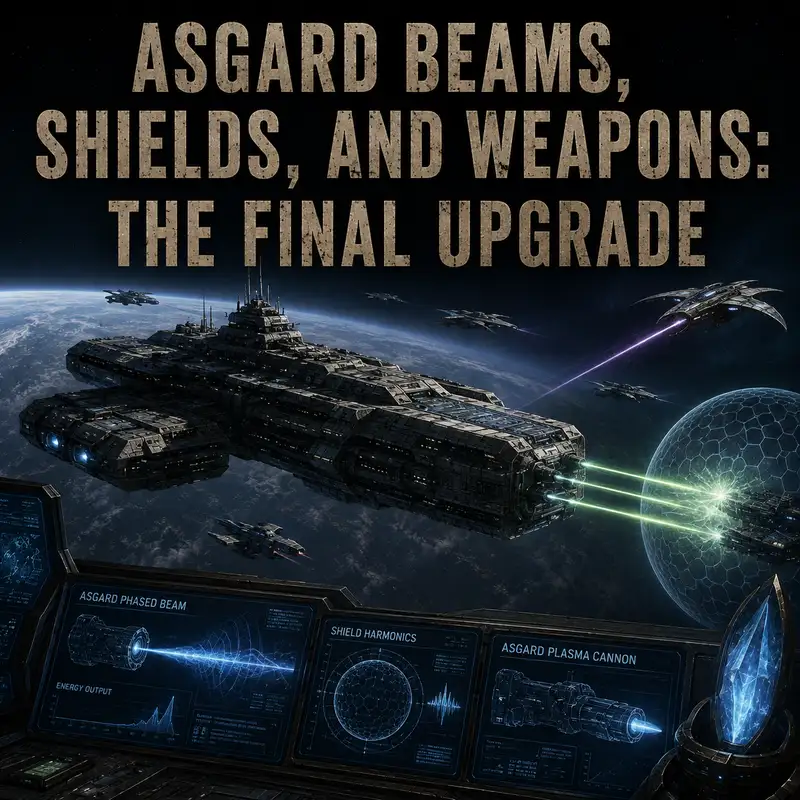
Asgard Beams, Shields, and Weapons: The Final Upgrade
An Asuran warship emerged from hyperspace into a prepared ambush and survived for only seconds. Daedalus and Apollo had been waiting with weapons hot. Their forward beam weapons struck the Ancient-designed vessel, overwhelmed its defenses, and destroyed it before the Replicator crew could adapt. Not long before, Earth battlecruisers had fired missiles and railguns at Ori warships with almost no effect. The human hulls had not changed beyond recognition. The crews had not suddenly become better shots. The difference was Asgard firepower.
That difference completed a transformation that had begun long before the final transfer at Orilla. The Asgard had already given Earth transport beams, defensive shields, sensors, and hyperdrive technology. Those systems allowed human ships to cross galaxies, survive direct attack, and move personnel without landing. The final upgrade added a weapon capable of defeating capital ships that had previously treated Earth’s arsenal as background noise. The important question is why this combination changed fleet warfare so dramatically, and why it still failed to make Earth invincible.
Asgard assistance had always been selective. Their leaders regarded Earth as promising, useful, and dangerously immature in roughly equal measure. They shared enough technology to preserve an ally and support joint operations, but resisted transferring capabilities that could destabilize Earth or other protected worlds. That policy was not simple paternalism. The Asgard had watched advanced science create their own genetic crisis and had spent generations fighting Replicators that consumed technology faster than conventional militaries could defend it. They had reasons to be cautious about handing civilization-level tools to a planet still arguing over who controlled the Stargate.
The first Asgard beam technology routinely integrated into Earth operations was primarily transportation rather than firepower. Asgard transporters converted matter into an energy pattern, moved it across distance, and reconstructed it at a selected destination. Operationally, this allowed a ship to recover people from orbit, deliver supplies, extract wounded personnel, and place teams where no runway or ring platform existed. It also allowed commanders to bypass a blocked Stargate. A rescue that once required controlling the gate room could now begin with a sensor lock and a clear transport window.
That capability depended on information and access. The ship needed to identify the target, penetrate any interference, and maintain enough control of its systems to complete the transfer. Shields, jamming, and corrupted software could block or redirect the beam. A transporter was not a universal answer to every boarding or rescue problem. It was a precise logistics system that became a tactical tool when the crew understood exactly what had to move and where it had to arrive.
Weaponizing the transporter revealed both its value and its limits. During the defense of Atlantis, Daedalus used Asgard beaming to place a nuclear weapon aboard a Wraith hive ship. Hermiod had to bypass safeguards intended to prevent the transporter from being used as a weapons-delivery system. The first attack destroyed its target. The Wraith then modified their defenses and blocked later attempts. Earth had gained a method that could ignore armor and deliver a warhead internally. The enemy needed only one surviving engagement to begin developing a countermeasure.
Asgard shields followed a different logic. They formed an energy barrier around the ship, absorbing or redirecting incoming fire before it reached the hull. The screen record does not provide a reliable power output, thickness, or mathematical limit, and none is required to understand their military meaning. Shields converted a lethal first hit into time. That time could be used to maneuver, return fire, launch fighters, restore propulsion, or withdraw. A shield was therefore not merely protection. It was an extension of command decision-making under attack.
The Asgard installed their own shields and weapons on Prometheus after S G One helped contain the Replicators at Hala. That gift allowed Earth’s prototype battlecruiser to survive engagements no human-built armor could have endured. It did not make Prometheus an Asgard ship. The vessel still combined human structure, alien-derived control systems, and power limitations that complicated every repair. The upgrade demonstrated what allied technology could do when attached to a platform not originally designed around it. It also provided the experience needed to build the next class more cleanly.
The B C three-oh-four was designed from the beginning to integrate Asgard systems. Daedalus and its sister ships carried Asgard-derived shields, transporters, sensors, and intergalactic hyperdrives inside a human-built military architecture. Human crews operated them through familiar command stations. Human technicians maintained the surrounding systems. Human railguns and missiles remained available because Earth could manufacture their ammunition. The battlecruiser was not technologically pure. It was operationally coherent, which is considerably more useful during damage control.
Power remained the controlling variable. Daedalus crossed to Atlantis with a zero-point module connected to its systems, reducing the first intergalactic journey to only a few days and strengthening the ship’s defenses. Once the module was delivered to the city, Hermiod warned that Daedalus’s shield strength would be severely reduced. The shield generator had not become worse. The available power had changed. Every later discussion of Asgard defenses must begin there. A shield’s performance depended on the energy supplied, the condition of the emitters, the intensity and duration of incoming fire, and the other systems competing for power.
This made shields highly effective without making them permanent. A B C three-oh-four could absorb attacks from Goa’uld ships, Wraith vessels, and many other opponents long enough to fight or escape. Concentrated fire from stronger enemies still drove shield strength downward. Damage could reduce power generation or open gaps in coverage. A commander watching the shield percentage fall was not reading an abstract health bar. He was watching the time available for every remaining decision disappear.
Earth’s original offensive systems did not match that defensive improvement. Railguns could engage fighters and unshielded targets. Missiles could carry conventional or naquadah-enhanced warheads. Nuclear weapons could destroy ships if transported inside them or delivered after the shields failed. These weapons were valuable because Earth understood them and could produce replacements. Against the strongest shielded capital ships, however, they often required an opening created by sabotage, transport, deception, or a technological weakness the enemy had neglected.
The Battle of P three Y two twenty-nine exposed the gap. Odyssey and Korolev joined an Asgard vessel, Free Jaffa ships, and other allies against four Ori warships. Missiles and energy fire struck the enemy shields without meaningful effect. Ori beams destroyed Korolev and cut through the allied formation. Earth’s ships could reach the battle, coordinate with the fleet, and survive longer than ordinary vessels. They still lacked a weapon capable of changing the result. Strategic mobility had delivered them to a fight their offensive technology could not win.
The final Asgard transfer addressed that problem. At Orilla, Thor’s people installed their most current technology and a computer core containing their recorded knowledge aboard Odyssey. The core carried its own power source and became integrated with the ship’s major systems. Among the upgrades were new energy weapons that the crew had not yet tested. The exact internal mechanics are never fully explained on screen. Later personnel called them Asgard plasma beam weapons. Their operational effect was much easier to observe than their engineering.
Unlike a missile, the beam did not have to cross the engagement space as a separate object and survive interception. Unlike a transported warhead, it did not require access through the enemy shield to an internal destination. The weapon concentrated energy directly against a target’s defenses and continued applying it as long as the firing solution and power supply held. Against an Ori warship, repeated beam strikes caused the shields to fluctuate and then fail. The target was destroyed through direct shipboard fire.
The first use occurred under conditions no procurement officer would voluntarily approve. Three Ori warships attacked while Odyssey’s hyperdrive was offline and Orilla prepared to destroy itself. The ship’s shields fell from strong condition toward collapse as it tried to clear the planet. General Hank Landry ordered the untested weapons powered. The beams destroyed one Ori vessel, creating the opening Odyssey needed to escape. Earth had moved from being unable to damage an Ori warship to killing one before the post-installation diagnostic was complete.
That result changed doctrine immediately. A B C three-oh-four no longer needed to place a team aboard an enemy vessel, deliver a nuclear device through rings, or wait for a momentary shield fluctuation to threaten a top-tier capital ship. The battlecruiser could engage from its own weapons envelope and concentrate fire on one target until the defense failed. Fighters, missiles, and railguns remained useful, but the plasma beams became the primary anti-capital weapon wherever they were installed.
The upgrade also changed target selection. A beam could be directed against a hyperdrive or another critical section rather than used only to destroy the entire vessel. During the final operation against the Asurans, Earth commanders ordered beam fire against enemy hyperdrives to prevent escape while fighters and allied ships filled the gaps. Precision mattered because the strategic objective was not simply to win a duel. It was to keep an entire fleet trapped near a planet long enough for another weapon to take effect.
Firepower did not remove the energy budget. Shields, hyperdrive, transporters, sensors, and beam weapons all depended on available power and functioning distribution systems. During the battle over Asuras, Daedalus and Apollo absorbed enough fire that their commanders considered shifting power away from the beam weapons as shield strength collapsed. A ship could maximize offense or endurance, but not assume every high-demand system would operate indefinitely at full output. The final upgrade increased the choices available to the captain. It did not eliminate the need to choose.
The transfer created a new vulnerability at the same time. The Asgard core or its power source emitted a distinctive signature detectable through subspace. Ori vessels began appearing whenever Odyssey left hyperspace. The weapons could destroy one attacker, but repeated contacts would eventually overwhelm the ship. Isolating the core was difficult because it had been tied into the hyperdrive and other major systems. Earth had received a more integrated warship and discovered that integration can turn one diagnostic problem into a ship-wide operational crisis.
The danger belonged primarily to the unique core installation aboard Odyssey, not automatically to every later beam weapon. That distinction is essential. The complete Asgard archive, its independent power source, time-dilation capability, and matter-conversion potential remained aboard Odyssey. Other battlecruisers received selected technologies. The surviving record explicitly confirms that Apollo and Daedalus were retrofitted with the plasma beam weapons. It does not establish that every B C three-oh-four immediately received the entire package.
That limited rollout still transformed the Pegasus theater. Daedalus and Apollo began hunting Asuran Aurora-class warships using intelligence that predicted their movements. In the first ambush, the target was destroyed almost instantly. The two Earth ships then divided their patrol areas and destroyed several more vessels over the following week. Ships based on Ancient designs that had once demanded caution could now be defeated in direct attacks by human-built battlecruisers.
The tactical success forced the Asurans to adapt. They stopped traveling alone and withdrew toward their homeworld, where their fleet and planetary drone defenses could support one another. The beam weapons remained effective, but two Earth ships could not safely attack the entire concentration. Better guns had changed the enemy’s behavior without solving the campaign. That is an important form of military success, although it tends to be less satisfying than a clean surrender.
The final battle required a coalition of Earth battlecruisers, Wraith hives, Traveler ships, fighters, Ancient drones, and a plan to collapse the Replicator nanites into one mass. Daedalus and Apollo used their beam weapons to damage Asuran ships and target hyperdrives. They could not destroy the Replicator civilization by themselves. Even if every vessel had been broken apart, the nanites on the planet would have remained. The beams won ship engagements. Scientific manipulation and planetary destruction ended the strategic threat.
This distinction prevented the new weapon from becoming an answer to every enemy. The Asurans were vulnerable as ships and extraordinarily difficult to eradicate as a distributed machine civilization. The Ori combined powerful shields, heavy weapons, and ideological control extending beyond the hulls of their fleet. The Wraith used biological ships able to regenerate damage and vary greatly in strength. A weapon effective against one defensive system could perform very differently against another.
The Wraith super-hive provided the most dramatic example. A zero-point module had transformed one hive into a vessel far larger, denser, and more powerful than the normal class. Daedalus fired an Asgard beam weapon and inflicted only limited damage before the hive returned fire and forced the battlecruiser out of the engagement. Apollo and Sun Tzu later failed to stop the same vessel. The precise late-service weapons fit of Sun Tzu is not established, so the battle should not be used to claim that every participating ship carried identical systems.
What the engagement does establish is that the Asgard beam was not an automatic kill mechanism. The super-hive’s power, hull density, regeneration, and defensive strength exceeded the target assumptions that had made earlier attacks so successful. Daedalus could hurt it, but not quickly enough to survive the exchange. Firepower must be judged against the target, the power available, the time on station, and the enemy’s ability to return fire. A weapon can be the best in the fleet and still be the wrong size for the problem in front of it.
Shields followed the same rule. Asgard-derived defenses could keep a B C three-oh-four alive through battles that destroyed Ha’taks in one or two hits. They still failed under sustained Ori fire. They could resist Wraith weapons, yet a super-hive could drive them down rapidly. A zero-point module could strengthen them, but such modules were rare and usually committed to missions larger than one ship. The final upgrade made Earth’s warships harder to kill. It did not provide an unlimited reservoir of defensive energy.
Nor did shields protect against threats already inside the perimeter. Wraith software once infected Daedalus and tried to deliver the ship to the enemy. A Goa’uld symbiote compromised Colonel Caldwell and used his access against Atlantis. The International Oversight Advisory later used Odyssey’s Asgard core to manufacture a Replicator intended for deployment aboard the Ori fleet. That machine escaped, multiplied, and began taking control of the ship. No external shield could stop code, a cleared insider, or an enemy built in the core room.
The Replicator incident exposed the political danger of the final transfer. The core had been designed to translate an operator’s requirement into a finished technical solution. The covert program did not need to understand every element of Replicator engineering. It described the desired weapon, removed the known vulnerability to anti-Replicator technology, and allowed the Asgard system to fill in the missing design work. The final upgrade had reduced the distance between intention and capability. It had not improved the judgment behind the intention.
Industrial reality imposed another limit. Thor gave Earth knowledge, but he did not leave an Asgard shipyard, trained population, or supply chain. Human engineers duplicated the plasma weapon quickly enough to retrofit at least two additional battlecruisers, which was a remarkable achievement. The continuity does not establish unlimited production, effortless maintenance, or installation aboard every later hull. Designs still required materials, fabrication, power integration, software, testing, and crews able to repair damage without an Asgard engineer standing nearby.
The screen record also does not settle whether the plasma beam had been newly invented in response to the Ori or had simply been withheld until the final transfer. Thor called the package the Asgard’s latest technology, and Odyssey was the first Earth ship shown using the weapon. Earlier Asgard vessels did not demonstrate the same decisive result against the Ori. Anything beyond that is interpretation. The important historical fact is not when the Asgard completed the design. It is when Earth gained operational access to it.
That access carried political weight. The Asgard had selected Earth as custodian of their legacy, but Earth was not one government. Homeworld Command, the United States military, the International Oversight Advisory, and allied states all had claims on how the technology should be used and shared. Retrofitting Apollo and Daedalus increased planetary defense. Concentrating the full core aboard Odyssey created a unique strategic asset that governments could pressure commanders to employ for missions far beyond ordinary fleet combat.
The final upgrade therefore changed Earth’s status without resolving Earth’s weaknesses. Human ships could now destroy Ori and Asuran capital vessels through direct fire. They could transport teams, defend distant bases, and survive long enough to shape fleet engagements. They remained few in number, dependent on rare materials, vulnerable to internal compromise, and committed across more than one galaxy. New firepower increased the missions political leaders believed the fleet could accept faster than it increased the number of ships available.
The Asgard beams, shields, and weapons did not turn Earth into the civilization that created them. They gave human commanders time, reach, and a credible way to kill enemies that had once been untouchable. They also handed Earth the maintenance burden, security risk, and moral responsibility attached to that power. The final upgrade closed the tactical gap between one battlecruiser and one advanced enemy ship. It left the larger strategic gap exactly where the Asgard had warned it would be, between possessing extraordinary technology and becoming wise enough to control what it made possible.