Atlantis as a Forward Base: The Zero Point Module Crisis
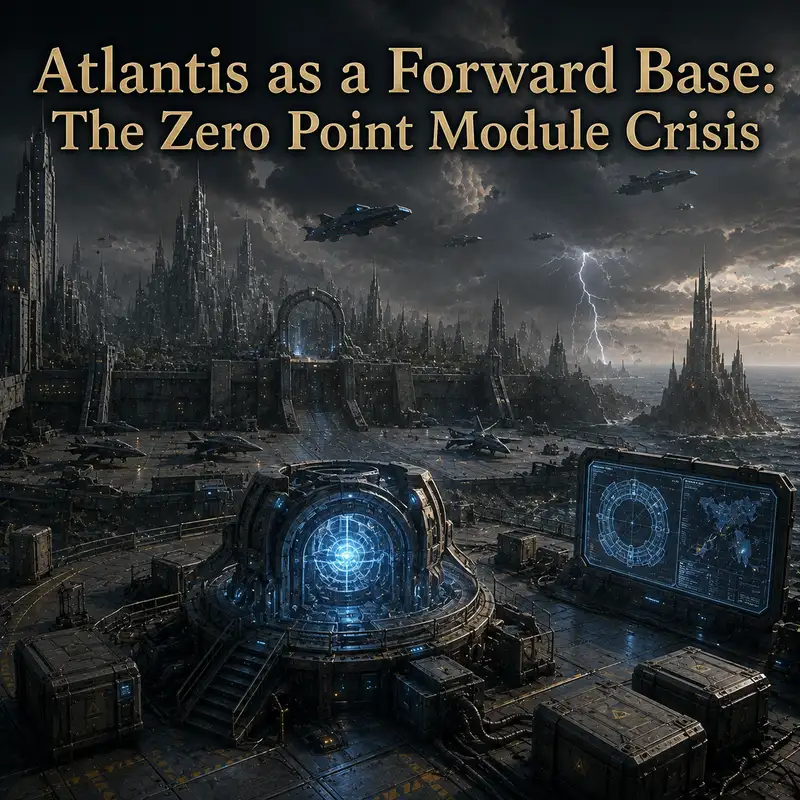
Rodney McKay had less than a day of power left when Atlantis fell out of hyperspace between stars. The city’s engines had failed, its shield was leaking energy into vacuum, and there was no nearby planet on which to land. The expedition had escaped an Asuran weapon only to convert its headquarters into a drifting lifeboat. Every remaining system depended on one nearly exhausted zero-point module. Atlantis was the most advanced base Earth had ever occupied, but at that moment its survival could be measured by the declining charge inside a device nobody in the expedition knew how to manufacture.
That crisis was not an isolated engineering failure. It was the central logistical problem of the Atlantis expedition. The city could serve as a research center, diplomatic post, gate hub, intelligence headquarters, and military forward base. It could also raise a shield against fleets, fly between planets, and open an intergalactic wormhole to Earth. Those capabilities did not draw from the same ordinary electrical budget. The functions that made Atlantis strategically decisive required Ancient power on a scale Earth’s generators could not provide.
A zero-point module drew vacuum energy from an artificially created region of subspace-time until that region reached maximum entropy. In practical terms, it was a compact power source with an extraordinary reserve and a definite end. The expedition could connect one, monitor it, route its output, and occasionally move it between systems. Earth could not build a replacement, restore a depleted unit, or establish a reliable supply chain. Atlantis had inherited the electrical sockets of a civilization millions of years ahead of Earth. It had not inherited the factory that produced what went into them.
This distinction separated routine base operations from full city operations. Naquadah generators could power lights, laboratories, computers, life support, selected transporters, and many gate-room functions. They made daily occupation possible. They could not sustain the citywide shield under major attack, power the stardrive, support an intergalactic Stargate connection, or unlock every high-energy system at once. Atlantis could function while underpowered, but it functioned as a reduced installation rather than the city-ship the Lanteans had designed.
Power management therefore became part of command rather than a matter left inside the engineering department. Weir and later expedition leaders had to decide which systems were essential, which laboratories could remain dark, and when a defensive capability justified exposing the remaining reserve. McKay and Zelenka could estimate consumption, but they could not decide what political or military risk the expedition should accept. A request to activate an Ancient system was effectively a request to spend future survivability in exchange for present knowledge.
The expedition’s one-way arrival demonstrated the problem before anyone had unpacked. Earth used the partially depleted module recovered from Proclarush Taonas to establish the eight-chevron wormhole to Pegasus. That module had already powered the Ancient defense outpost during the battle over Antarctica. The connection consumed what little useful capacity remained. Once the last personnel and equipment crossed, Earth no longer possessed enough power to reopen the route, and the expedition had no module available to dial back.
Atlantis appeared to offer a solution. Its main power room contained three zero-point module interfaces. The problem was that the modules installed there had spent ten thousand years sustaining the shield beneath Lantea’s ocean. An alternate Elizabeth Weir had awakened from stasis at intervals to transfer the load among them, following instructions left by Janus. Her work preserved the city until the expedition arrived. It did not preserve a meaningful strategic reserve.
The arrival activated systems across Atlantis and increased the demand on the last usable module. The underwater shield began to collapse. In another timeline, the city flooded and almost the entire expedition died. Janus had added a failsafe that raised Atlantis to the surface when power fell below a critical threshold. The city survived, but the exhausted module could no longer provide the shield that had protected it. Atlantis became habitable and exposed at the same time.
That condition shaped the first year. The expedition occupied a base with an Ancient database, Puddle Jumpers, deep-space sensors, transporters, and technology it only partly understood. It also lacked the power to use much of that inheritance. Areas of the city remained closed because opening them created additional demand. High-energy systems were avoided unless necessary. The control room could send teams through the Pegasus gate network, but it could not call Earth for replacement personnel, ammunition, medicine, or political guidance.
The Stargate reduced travel time inside Pegasus while doing nothing to eliminate the supply problem. Food still had to be grown or traded. Ammunition still had to be conserved. A broken Earth component still needed an Earth replacement. The gate could move a team in seconds, but it could not manufacture a technician who had been killed or a drug that had expired. Atlantis possessed strategic mobility within the local network and strategic isolation from the planet that had sent it.
The power shortage also turned natural hazards into military emergencies. When two massive storms converged on Atlantis, the city could not simply raise its shield. Most personnel evacuated through the gate while McKay and Radek Zelenka attempted to channel atmospheric electricity through the city and briefly energize the defensive field. The plan worked, but the evacuation created an opening for the Genii to seize the control room. An energy deficit had produced a security vulnerability, a diplomatic crisis, and a hostage situation before the weather had finished arriving.
This was the pattern of the zero-point module crisis. Every missing unit forced Atlantis to compensate through manpower, risk, diplomacy, or improvisation. Scientists became power managers. Puddle Jumpers substituted for unavailable defensive systems. Off-world alliances became part of the logistics plan. Evacuation sites had to be prepared because the city could not guarantee its own protection. The expedition had found a fortress and spent much of its first year planning how to abandon it.
The search for additional modules therefore became an operational priority rather than a scientific side project. The elder Weir left five gate addresses associated with Lantean outposts believed to contain zero-point modules. One led Sheppard’s team to Dagan, where the device had been hidden by a brotherhood ordered to protect it until the Lanteans returned. The expedition solved the ancient safeguards while fighting off a Genii attempt to seize the prize. Then the modern Brotherhood took the module for itself and hid it again.
The Dagan mission showed why locating a power source was not the same as acquiring one. The module sat on an inhabited world with its own history, religious obligations, and political actors. Atlantis could claim descent from the Ancients and still fail to persuade the custodians. It could defeat the Genii tactically and still leave empty-handed. The most valuable item in the region was small enough to carry through a gate, which made it both a power source and an object of intelligence competition.
Other discoveries created similar constraints. A module powering an Ancient field protected a human population from the Wraith. Removing it would have strengthened Atlantis by exposing the people who had survived beneath its protection. Elsewhere, apparent offers of a module became bargaining tools or deception. Ladon Radim used a depleted unit as part of a Genii political operation. Scarcity made every reported module credible enough to investigate and valuable enough to lie about.
The situation became urgent when Atlantis’s deep-space sensors detected Wraith hive ships approaching Lantea. Without a charged module, the city lacked a sustainable shield and could not withstand orbital attack. The expedition repaired an Ancient weapons satellite, prepared an Alpha Site, armed a self-destruct system, and sought nuclear weapons from the Genii. Those measures were not substitutes for a shield. They were layers in a denial and evacuation plan built around the assumption that Atlantis might be lost.
Earth changed the balance by recovering a zero-point module that had been hidden in ancient Egypt. The module allowed Stargate Command to reopen the route and send Colonel Dillon Everett with reinforcements. It then traveled aboard the Daedalus, where its power accelerated the battlecruiser’s intergalactic passage. When the ship arrived, Asgard transporters delivered the module into Atlantis. One device had supported strategic communication, rapid reinforcement, and the defense of the base in sequence.
Even then, the module did not make Atlantis invulnerable. The shield stopped Wraith Darts and protected the city from direct impacts, but sustained bombardment by a large hive fleet would have depleted the power source within days. The expedition therefore used the module to support a deception. A nuclear explosion created the appearance of Atlantis’s destruction while a modified cloaking system concealed the city. The objective was not to absorb every enemy shot. It was to convince the Wraith to stop shooting.
That decision represented sound power management. A shield spends energy by resisting an enemy that can continue attacking. A cloak preserves energy if the enemy accepts the false picture. Atlantis survived because its commanders treated the zero-point module as a strategic reserve rather than an unlimited technical solution. The base remained in Pegasus, but its survival depended on secrecy and the Wraith belief that there was no base left to find.
The arrival of the Daedalus improved logistics without resolving the underlying shortage. Personnel, equipment, and information could now travel between galaxies by ship. The journey still required time, maintenance, fuel, and a vessel that could be diverted from other missions. Routine intergalactic gate travel remained expensive in zero-point energy. Atlantis had gained a supply line, but not a renewable source of the power required for its largest systems.
This also changed how Atlantis used recovered technology. A device that functioned perfectly in an Ancient laboratory might require more power than the expedition could afford to provide outside an emergency. Scientists could understand a system and still be unable to field it. Military planners could identify a useful capability and still leave it offline because shields, communications, and life support had higher priority. The city contained more technology than Earth could exploit, not only because the knowledge was missing, but because the electrical budget imposed its own form of classification.
The module also became a center of gravity for enemy intelligence. A hostile program inserted into Atlantis’s systems attempted to defeat the safety mechanisms governing power distribution and turn the module’s output against the city. The attack showed that the expedition did not merely have to guard the physical device. It had to secure the software, control interfaces, and personnel authorized to route its energy. A power source capable of protecting a city could become a city-killing weapon if its safeguards were compromised.
Scarcity encouraged the expedition to search for alternatives. On Doranda, McKay attempted to complete Project Arcturus, an Ancient system designed to extract energy on a scale that made a zero-point module appear modest. The project had already failed during the Lantean war. McKay believed he could correct the design. Instead, the test killed a member of his team and destroyed much of the surrounding solar system. The proposed solution to Atlantis’s power shortage became evidence of why the Ancients had abandoned it.
A later experiment built around a bridge to a parallel universe appeared safer and more controllable. It promised a continuing flow of energy without consuming a conventional module. The system worked until the expedition learned that it was transferring catastrophic effects into the other universe. Shutting it down drained Atlantis’s only zero-point module completely. The base avoided destroying another reality and lost its strategic reserve in the process. The device had produced power exactly long enough to create a new power emergency.
These failures were not simply examples of scientific arrogance, although arrogance was present in useful quantities. They reflected the pressure placed on Atlantis’s research staff. A successful replacement for the zero-point module would have changed every operational calculation. The city could have kept its shield ready, dialed Earth more freely, explored high-energy systems, and moved under its own power. The strategic reward was so large that unfinished Ancient projects repeatedly looked worth the risk.
The Asuran occupation briefly altered the balance. When the Replicators seized Atlantis, they brought three zero-point modules to repair the city and power its stardrive. After the expedition retook the base, Earth authorities divided the recovered set among competing theaters. Atlantis kept one. A second went to the Antarctic outpost for planetary defense. A third supported the Odyssey during the war against the Ori. The allocation was militarily rational and politically revealing. Atlantis was important, but it was not the only place where one module could decide whether a civilization survived.
One module restored the expedition’s major defensive options. Atlantis could raise its shield, cloak the city, and dial Earth when necessary. It still could not perform every high-energy mission without calculation. When Lantea faced a massive coronal ejection, the Ancient record showed that three modules had once allowed the shield to protect a broad area of the planet. The expedition’s single unit could cover Atlantis and little beyond it. Sheppard instead moved the module aboard the Daedalus to strengthen the ship’s shields and deflect the radiation at its source.
The episode was a useful demonstration of power as a maneuver asset. The module did not belong permanently to one building. Commanders could move it to the platform where its output produced the greatest effect. Doing so also meant accepting that Atlantis temporarily lost the capability it normally supplied. Every transfer changed the defensive posture of the city, the ship, Earth, or another theater. There was no harmless allocation.
The mobile drilling platform beneath Lantea’s ocean offered a more conventional supplement. The Lanteans had designed it to draw geothermal energy from the planet and transmit that power to Atlantis. Recovering the station did not replace a zero-point module, but it created an additional source for major operations. When an Asuran satellite later attacked Atlantis with a continuous energy beam, the expedition combined geothermal power with its single module to activate the city’s stardrive.
The escape exposed the limit of that solution. Atlantis rose from the ocean and entered hyperspace, but the drive failed before reaching the selected planet. The city was left adrift with roughly one day of shield power. A base designed to move between worlds had become a damaged spacecraft with civilians, laboratories, medical wards, and a Stargate aboard. The expedition had converted all available energy into movement and discovered that a partial trip through deep space has fewer advantages than the planning documents usually suggest.
Survival required a raid on Asuras. Sheppard’s team used an experimental hyperdrive-equipped Jumper and Elizabeth Weir’s connection to the Replicator network to infiltrate the city and steal a fresh module. They succeeded, but Weir remained behind to hold the Asurans long enough for the others to escape. The module restored Atlantis, allowed the city to reach a new planet, and reestablished contact with Earth. Its acquisition cost the expedition its commander.
Once Atlantis was established at the new site, power conservation became part of mature base doctrine. The intergalactic gate bridge and Midway Station reduced the need to spend zero-point energy on direct connections to Earth. Personnel could move through a chain of ordinary Stargates instead. The system was slower and introduced new security risks, but it protected the module for shields, emergencies, and city operations. Strategic logistics had been redesigned around avoiding use of the most capable power source available.
The Wraith understood the value of the same technology. After acquiring modules taken during the destruction of the Asurans, one faction integrated a zero-point module into a hive ship. The result was not merely a Wraith vessel with a longer endurance. Its shields, weapons, and propulsion improved enough to overpower Earth battlecruisers and threaten Earth directly. The module amplified the system into which it was inserted. In Atlantis it sustained a defensive city. In a hive, it created an offensive capital ship.
The final defense of Earth brought the crisis to its fullest expression. Todd returned two modules, which combined with the one already in Atlantis to provide a complete set of three. For the first time under Earth control, the city approached the power configuration its builders had intended. Atlantis launched from Pegasus, crossed toward the Milky Way, and used an experimental wormhole drive when its conventional stardrive failed. It arrived over Earth, raised its shield against the super-hive, and survived reentry before landing in the Pacific.
That operation demonstrated what Atlantis could be when fully powered: a mobile intergalactic headquarters, protected base, strategic transport, weapons platform, and planetary defense asset. It also depended on modules recovered from enemies, a drive that was not a routine capability, and a sequence of failures that left little margin for another attempt. Earth had used Atlantis at full scale. It still had not learned how to sustain that scale.
The zero-point module crisis therefore defined Atlantis as a forward base more completely than its towers, Jumper bays, or gate room. Routine generators kept people alive and missions moving. Rare Ancient modules determined whether the city could defend itself, contact Earth directly, relocate, or influence a battle beyond its immediate perimeter. Every module created choices among theaters. Every activation spent part of an irreplaceable reserve. Every search for another device exposed the expedition to political, scientific, and military risk.
Atlantis survived because its commanders stopped treating power as an engineering detail. They used deception instead of endurance, ships instead of direct gate connections, geothermal energy as a supplement, and raids when diplomacy and archaeology failed. They accepted that the city’s greatest capabilities could not be held ready at all times. Atlantis became Earth’s most important forward base not because it always possessed overwhelming power, but because its people learned how to operate while waiting for that power to run out.