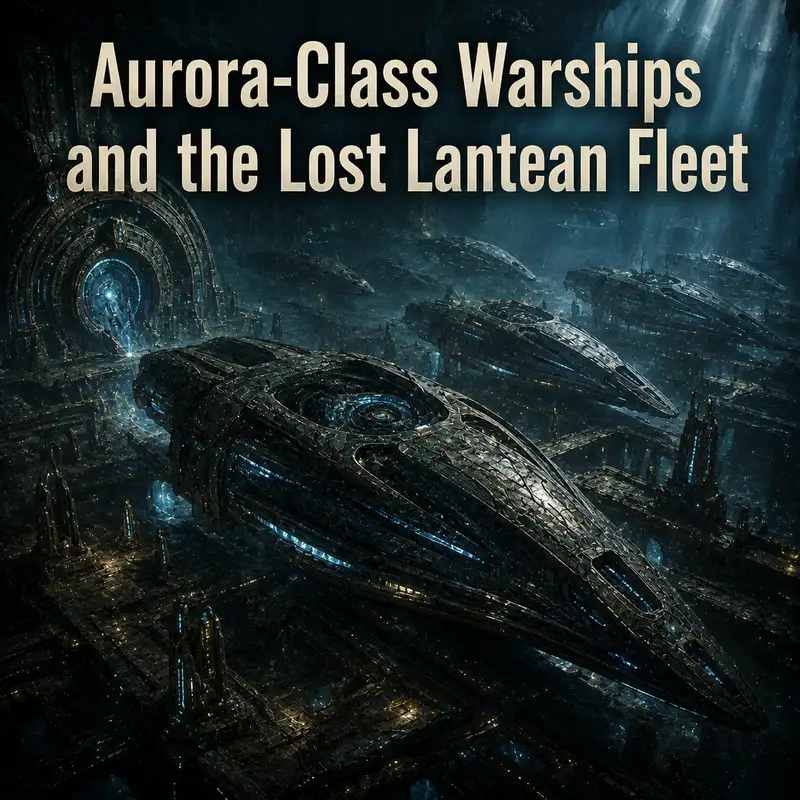
Aurora-Class Warships and the Lost Lantean Fleet
Major Evan Lorne ordered the Orion to fire, and nothing happened. The recovered Lantean warship had emerged beside the Daedalus with a Wraith hive ship bearing down on it, but its weapons remained silent while Radek Zelenka fought the power system. Shields, propulsion, and drone control all demanded energy the damaged vessel could not provide at the same time. When the drones finally launched, they tore one hive apart. The surviving hive shifted its fire, and the Orion died moments later.
That brief engagement captured the history of the Aurora-class warship. Properly powered and competently operated, one could destroy a Wraith capital ship with extraordinary speed. Damaged, under-crewed, and separated from the industrial civilization that built it, the same vessel could become an irreplaceable weapon with only one useful attack left. The Lanteans had designed a fleet for galactic war. Ten thousand years later, Earth found only isolated hulls, incomplete systems, and crews who were either dead or beyond rescue.
Atlantis personnel used Aurora-class as the designation for this family of Lantean battleships. The name came from the first surviving example they encountered, the warship Aurora, although the original Lantean class name is not clearly preserved in the screen record. Exact dimensions, crew tables, and weapon counts are not established well enough for a reliable specification sheet. What is established is the operational role. These were major fleet combatants built for long-range missions, reconnaissance, space control, and direct battle with Wraith ships.
An Aurora-class ship combined several systems that Earth still struggled to reproduce. It possessed advanced sublight engines, an interstellar hyperdrive, long-range sensors, subspace communications, powerful energy shields, hangar and life-support systems, stasis chambers, and a command architecture tied to Lantean neural interfaces. Its confirmed principal weapon was the drone, the same basic guided weapon used by Atlantis and the Ancient outpost in Antarctica. From a control chair, a compatible operator could direct a large swarm against selected targets.
The drones gave the class its most visible advantage. They could maneuver around defensive fire, alter course after launch, and penetrate targets that conventional missiles might fail to reach. Against a hive ship, a concentrated drone strike could bypass the value of sheer hull mass and attack critical internal structures. The Orion demonstrated this even while operating in a badly degraded condition. Once its launch system finally received power, one salvo destroyed a hive that had survived Daedalus missiles and heavy fire.
The ship’s shields were equally important, but they were not an abstract guarantee of survival. Shield endurance depended on available power, system integrity, and the competing demands of weapons and propulsion. The Orion could not keep every major function active. Its crew transferred power in an attempt to fire, leaving the vessel without shields when the surviving hive concentrated its weapons. The technology remained superior. The damaged power distribution system made superiority difficult to use all at once.
Control presented another limitation. Some Lantean systems responded only to people carrying the Ancient technology activation gene. John Sheppard could operate them with unusual ease. The Travelers later kidnapped him because they had found an Aurora-class ship but could not bring its command systems fully online. They were developing an interface that would imitate the neural input of a compatible operator. Until that work succeeded, possessing the ship did not mean controlling the ship.
This distinction mattered throughout the Atlantis expedition. Discovering an Ancient vessel, activating one console, understanding one subsystem, repairing the hull, training a crew, and fielding the ship in combat were separate achievements. Earth could sometimes move from the first step to the last under emergency conditions. It could not do so reliably, and it could not manufacture another Aurora-class battleship if the experiment ended badly. The device worked, which is excellent news in a laboratory and only the beginning of the discussion in a fleet headquarters.
The Lanteans had no such problem when the class entered service. Aurora-class ships belonged to a civilization with trained crews, drone stockpiles, repair facilities, databases, power technology, and a network of worlds supporting fleet operations. They were not isolated masterpieces. They were components of a larger war system. Their effectiveness depended on the support structure behind them, just as much as a modern warship depends on shipyards, ammunition, intelligence, communications, and personnel replacement.
During the war with the Wraith, that support structure contracted. Lantean ships were faster and individually more powerful, but the enemy could accept losses on a scale the Lanteans could not sustain. Wraith hives operated as mobile political and military centers. Their commanders dispersed, regrouped, and returned. When the Wraith captured three Lantean warships carrying zero-point modules, they used those power sources to operate a cloning facility that multiplied warriors in enormous numbers. The loss was more than three hulls. It altered the enemy’s force-generation capacity.
The surviving record does not identify those captured vessels as Aurora-class, and it would be careless to assume that every Lantean warship belonged to the same design. The class was prominent, not necessarily universal. The important point is that Lantean capital ships carried technology whose capture could have strategic consequences far beyond the battle in which they were lost. A ship could be destroyed, boarded, stripped for power, or studied for propulsion knowledge. Every disabled vessel became an intelligence and counterproliferation problem.
Aurora-class ships appear to have conducted missions well beyond the immediate defense of Atlantis. The Aurora itself had left Lantean space on reconnaissance during the final siege. Its captain carried a communiqué describing a weakness in Wraith technology that he believed could change the war. That mission shows a fleet still searching for an operational solution even as the defensive perimeter collapsed. It also shows the danger of sending critical intelligence through one damaged platform without a redundant channel.
The Aurora was found near the edge of the galaxy after Atlantis sent a return signal to surviving Lantean ships. It had suffered catastrophic damage. Its bridge was open to vacuum, life support was gone, and its crew survived only inside protected stasis chambers. Hundreds of pods remained active, linked through a virtual environment that allowed the crew to interact without recognizing how much time had passed. Their bodies had continued aging slowly. Removing them from stasis would kill them.
The virtual system had preserved identity and command cohesion, but it created a new attack surface. A Wraith boarded the derelict ship, killed the real first officer, entered a stasis pod, and infiltrated the simulation while impersonating her. The Wraith manipulated the captain into revealing work on Lantean hyperdrive modifications. The objective was not merely to steal one damaged ship. It was to learn how Wraith vessels might gain intergalactic range and reach Earth.
The infiltrator also erased the communiqué describing the Wraith weakness. The captain had compartmented the information for delivery to the Lantean council and could not simply reconstruct the lost record in time. Atlantis learned that a weakness existed, but not what it was. The episode is a nearly perfect intelligence failure. The Aurora completed the reconnaissance mission, preserved the message, and kept its crew alive for ten thousand years. One infiltrator inside the information system made all three achievements strategically useless.
Once Sheppard exposed the deception, the captain understood that his crew could not be rescued. Two Wraith cruisers were approaching, and the derelict Aurora could not fight them conventionally. He gave Sheppard the self-destruct code. The Daedalus withdrew, the cruisers closed on the wreck, and the Aurora detonated with enough force to destroy both. Its final act denied the Wraith the ship, the crew, and the propulsion knowledge they had sought.
The destruction was tactically successful and strategically incomplete. Two cruisers were removed, and Earth remained protected from the stolen hyperdrive work. The unknown Wraith vulnerability disappeared with the ship. The crew of the Aurora had survived long enough to make one final command decision, but the knowledge they had crossed the galaxy to deliver was lost. The first recovered example of the class became evidence of both Lantean technical endurance and Lantean information fragility.
The second major survivor was found on Taranis. Its Lantean name, Hippaforalkus, proved less popular with Sheppard, who renamed it Orion. The vessel had been badly damaged during the ancient war and placed inside an underground outpost for repairs that were never completed. The people of Taranis discovered it but lacked the knowledge and biological compatibility to restore its principal systems. It remained a dormant strategic asset beneath a civilization that could not use it.
A supervolcano forced the issue. The Stargate was lost, the planet was becoming uninhabitable, and hundreds of survivors needed evacuation. McKay tried to restore enough propulsion and shielding to launch the Orion through the eruption and open a hyperspace window. The ship escaped with seconds to spare. Its first modern mission was not a fleet engagement. It was an improvised civilian evacuation aboard a battleship emerging from a collapsing repair base.
Atlantis received the Orion in exchange for helping the Taranans relocate. Engineers worked on it for weeks, but the ship never became fully operational. During a tense encounter with a Wraith hive near Atlantis, the Orion remained outside sensor range while McKay tried to bring shields, hyperdrive, and drone control online. He could promise some functions, perhaps others, and not all at the same time. The vessel was technically available and operationally uncertain.
That uncertainty did not prevent its deployment when two hive ships threatened to reach Earth. The Daedalus could not reliably defeat both alone, and no other Earth vessel was close enough. Lorne commanded the Orion while Zelenka managed its Ancient systems. The plan used the damaged Lantean ship as the decisive striking arm while the Daedalus absorbed attention and launched missiles.
The Orion reached the battle, but its power transfer failed at the worst possible moment. Zelenka restored the drone system under fire. The salvo destroyed one hive, proving that the class retained enormous combat power even after ten thousand years of damage and hurried repair. The second hive then concentrated on the unshielded Orion. Daedalus transporters recovered the crew before the ship was destroyed.
The exchange was costly, but not irrational. The Orion was the only available platform with a credible chance of destroying the hive before it reached Earth. Preserving the ship for study would have been valuable. Preserving Earth was more valuable. The decision also revealed the difference between possession and readiness. Atlantis had recovered a Lantean battleship. It had not recovered the shipyard, power infrastructure, drone production, or trained Lantean crew that once made the class a dependable fleet unit.
The Tria represented a different kind of survival. Its hyperdrive had failed while the vessel was traveling between Pegasus and the Milky Way. The crew continued at near-light speed using sublight engines. Relativistic effects allowed the Lanteans aboard to survive a journey that consumed roughly ten thousand years outside the ship. The Daedalus detected the Tria in the intergalactic void and matched course long enough to establish contact.
Captain Helia and roughly a hundred surviving Lanteans transferred to the Daedalus and returned to Atlantis. They reclaimed the city as its original owners and ordered the Earth expedition to leave. Their authority came from living continuity with the civilization that had built both the city and the ship. The political claim was stronger than any archaeological argument Earth could offer, even if the timing was professionally inconvenient.
The Tria itself did not return to Atlantis. Its hyperdrive remained unusable, and the ship was left far outside normal operational reach. After the Asurans killed Helia and the other returning Lanteans, no trained crew remained to recover it. The screen record does not establish whether the Tria was later salvaged, destroyed, or simply continued drifting. It is one of the clearest reminders that lost does not always mean exploded. Sometimes it means located, identified, and still beyond practical recovery.
The Travelers found another Aurora-class vessel in a long elliptical orbit around a dwarf star. Its Lantean crew had abandoned it after Wraith damage caused the main drive to emit lethal radiation. They intended to return but never did. Thousands of years later, the Travelers could shield selected areas and study the logs, but they could not fully activate the command interface. Their own fleet was aging, crowded, and impossible to replace at the rate their population required.
Larrin’s people wanted the Ancient ship as a mobile home and strategic combatant. Sheppard’s gene provided the access they needed. After a struggle for control and a Wraith attack, he helped make the vessel operational enough to survive. The Travelers completed their interface and kept the ship. Unlike the Aurora and Orion, this vessel became part of a functioning Pegasus fleet rather than a one-mission Earth asset.
The ship later joined the combined attack on the Asuran homeworld. Traveler vessels, Wraith hives, the Daedalus, and the Apollo fought together while Atlantis personnel carried out the plan that destroyed the Replicator civilization. The Travelers lost a ship in the battle, but their Aurora-class vessel survived and returned with Larrin. It was the closest the modern era came to restoring an original Lantean warship as an enduring operational platform.
Its survival did not last. When the Attero device was activated, its interference destroyed Wraith ships entering hyperspace but also caused active Stargates to explode. A Traveler surface colony was devastated. Thousands died, and two ships were lost, including the Travelers’ Ancient vessel. A warship that had survived the Wraith, abandonment, radiation, and modern combat was finally destroyed by the unintended effect of another Lantean weapon.
The Asurans later built vessels based on the same general design, and their fleets included warships visually and operationally similar to the Aurora class. Those ships confirm that the design remained part of the technological inheritance copied from the Lanteans. They were not survivors of the original Lantean fleet. They belonged to a separate machine civilization with different crews, production methods, and strategic objectives. Counting them as recovered Ancient ships would confuse design lineage with political ownership.
The known survivors reveal a pattern rather than a hidden reserve. The Aurora remained because its crew entered stasis after catastrophic damage. The Orion remained because it had been concealed in an unfinished repair facility. The Tria remained because it was stranded between galaxies. The Travelers’ ship remained because its crew abandoned it in a remote orbit. These vessels survived the war precisely because they were no longer functioning parts of the Lantean fleet.
Any intact ships that continued fighting near Atlantis were more likely to be destroyed, captured, or stripped during the final campaign. The wrecks found ten thousand years later were products of survivorship bias. They were not representative examples waiting in storage. They were exceptions removed from the decisive battles by mechanical failure, distance, concealment, or abandonment. The better a ship remained integrated into the war, the less likely it was to survive for archaeologists.
The class also depended on ammunition that later users could not replace. Drone stockpiles were finite. A successful salvo could destroy a hive, but every launch reduced an irreplaceable reserve. Shields and hyperdrives required power systems that Earth could operate more readily than it could rebuild. Neural controls restricted the pool of operators. Organic knowledge was scattered among databases, damaged consoles, and a few surviving Lanteans who did not live long enough to establish a training command.
No evidence shows Earth constructing an Aurora-class vessel from the Atlantis database. Access to plans did not provide the materials science, industrial processes, component production, or workforce needed to reproduce the ship. Earth instead developed the Daedalus class by combining human engineering with Goa’uld, Asgard, and other recovered technologies it could integrate into a sustainable program. The result was less advanced than a pristine Lantean battleship in several areas, but it could be built, crewed, repaired, and improved by Earth.
That contrast explains why the lost fleet mattered without becoming Earth’s fleet. Aurora-class warships offered exceptional weapons, shields, sensors, and mobility. Each recovered hull created a temporary strategic opportunity. None created an industrial capability. Earth could borrow the surviving combat power of the past, but it could not base long-term defense on ships that disappeared permanently after one bad engagement.
The Lanteans lost their fleet through more than enemy fire. They lost ships to capture, failed intelligence, damaged logistics, depleted ammunition, shrinking repair capacity, and the need to defend too many worlds against a dispersed enemy. Aurora-class warships could win direct battles. They could not replace the civilization required to keep winning them. As the support network collapsed, every damaged ship became harder to recover and every surviving hull more precious.
The final record of the class is therefore a sequence of impressive last missions. The Aurora destroyed two cruisers and erased itself. The Orion destroyed a hive and was destroyed in return. The Tria delivered its crew but remained beyond reach. The Travelers’ vessel fought again before an Ancient device destroyed the colony beside it. The ships repeatedly proved their design. Their losses repeatedly proved that design alone was not enough.
The lost Lantean fleet was not waiting intact beyond one undiscovered gate address. It had been consumed by a century of attrition, scattered by mechanical failure, and separated from the institutions that gave its ships purpose. What remained were battleships without shipyards, weapons without replacement ammunition, and command systems waiting for people carrying the right gene. The Aurora class could still change a battle after ten thousand years. It could not bring back the fleet that had once made those battles part of a coherent war.