Ba’al’s Clones, Continuum, and the War’s Final Echo
The last Ba’al was already restrained when he explained that he was not the original. Tok’ra surgeons were preparing to remove the symbiote from its human host and end the life of the final known major System Lord. Ba’al treated the procedure as another briefing opportunity. Somewhere in history, he claimed, the original had prepared a fail-safe. The people in the chamber had heard similar boasts before. This one was already changing the past around them.
Ba’al’s final campaign cannot be understood as the last battle of a conventional empire. By then, the System Lords had lost their political order, the Free Jaffa controlled many of their former ships, and Earth had survived enemies more powerful than any ordinary Goa’uld ruler. Ba’al endured by abandoning the assumption that survival required one body, one throne, or even one timeline. His clones preserved command after decapitation. His time-travel operation tried to remove Stargate Command before it could ever become a threat.
That adaptability distinguished him from rivals who treated every setback as a temporary interruption to ceremonial rule. Ba’al used torture and religious authority as readily as any System Lord, but he also used corporate infiltration, brainwashing, stolen Stargates, false surrender, biological duplication, and captured scientific knowledge. He understood that Earth’s strength did not come from one ship or weapon. It came from institutions that learned, recovered technology, formed alliances, and returned after defeat. His final plan targeted the history that created those institutions.
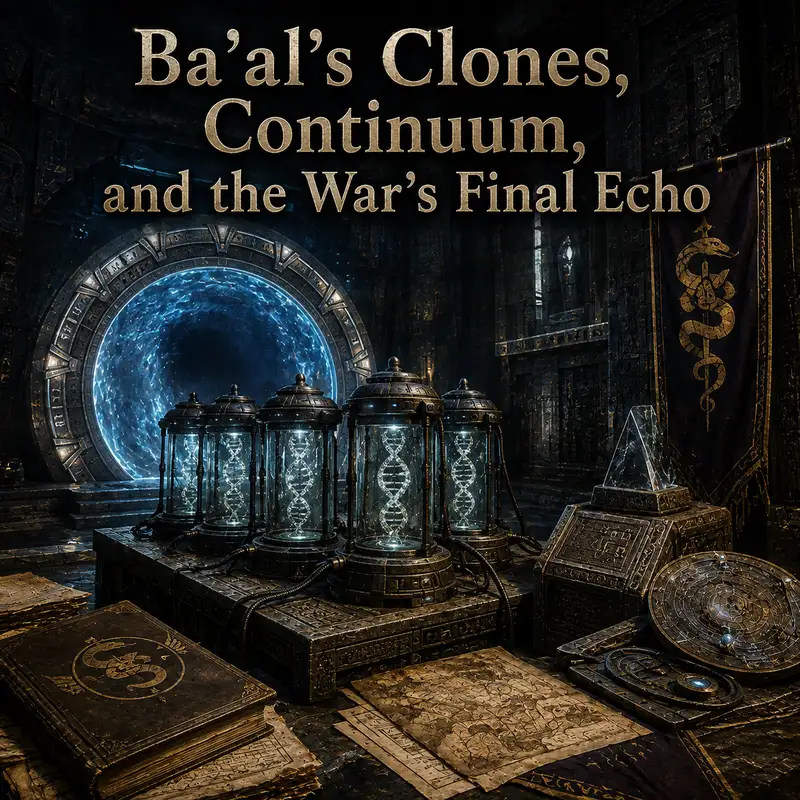
The clone program began as strategic redundancy. Ba’al produced multiple copies of both his human host and the Goa’uld symbiote within it. The copies shared his appearance, memories, mannerisms, and ambition at the time of creation. They were not remotely controlled bodies or parts of a common consciousness. Once separated, each accumulated different experiences and pursued its own interests. Killing one Ba’al removed one active commander. It no longer guaranteed that the policy, intelligence, or personal vendetta associated with him had disappeared.
The screen record never provides a complete manufacturing history for the clones. Ba’al had access to advanced Goa’uld laboratories and knowledge taken from other civilizations, but the exact equipment, production rate, and maintenance requirements remain uncertain. What is established is the operational result. The copies were convincing enough to deceive allies and enemies, independent enough to command separate operations, and similar enough that identifying the original became almost impossible. Continuity of personality had become a counterintelligence problem.
Operationally, the clones functioned as a reserve of senior command rather than a mass army. They could carry plans, passwords, technical knowledge, and political relationships into separate operations. They could not replace trained crews, laboratories, shipyards, or the populations needed to sustain those operations. Ba’al had multiplied the headquarters before rebuilding the force beneath it.
Cloning offered several immediate advantages. A Ba’al could appear publicly while another remained protected. One could negotiate, another could infiltrate, and a third could continue the mission if either were captured. The network complicated targeting because intelligence confirming Ba’al’s death might be completely accurate and strategically useless. It also allowed him to operate after the collapse of the territorial system that had once supplied him with a recognizable capital, court, and fleet.
His post-imperial campaigns reflected that change. One Ba’al established influence on Earth through Goa’uld infiltrators, the Trust, and corporate assets hidden inside the civilian economy. This was not an invasion fleet announcing itself above a city. It was access to money, communications, technology, political contacts, and organizations already operating behind legal identities. The same ruler who once commanded Jaffa from a throne now treated shell companies and compromised executives as instruments of imperial recovery.
Other clones worked against the Free Jaffa Nation. Ba’al used captured technology to alter memory, reshape loyalties, and influence Jaffa political leadership. The objective was not to restore universal belief in Goa’uld divinity overnight. It was to exploit the new nation’s weak institutions, personal rivalries, and dependence on commanders who had spent most of their lives inside hierarchical armies. The empire had lost formal control, but its methods remained useful wherever political authority was still being assembled.
The stolen-gate operation was even more revealing. Ba’al removed Stargates from inhabited worlds and attempted to create a private network under his control. A normal gate address connected into the wider Ancient system, where Earth, the Jaffa, and other powers could follow. A separate network promised exclusive movement, protected bases, and a logistics system no rival could enter without access to one of Ba’al’s relocated gates. He was trying to rebuild empire around transportation rather than continuous territory.
The plan also showed what the clones could not replace. A private network still required ships to move gates, technicians to install them, power to operate them, secure planets, loyal personnel, and supply systems. Copies of one commander did not create an industrial state. Ba’al could steal infrastructure and manipulate existing organizations, but he could not manufacture the broad political legitimacy or labor system once provided by millions of Jaffa and human subjects. His operations became more sophisticated as his material base became smaller.
The clones created internal weakness as well. Every copy carried the same ambition and little reason to accept another copy’s superiority. They could cooperate when their survival depended on it, but each also understood that eliminating the others simplified the question of who was Ba’al. The network therefore reproduced the central problem of the System Lords in miniature. Duplication prevented decapitation while multiplying succession disputes.
Earth repeatedly exploited that mistrust, though never with complete confidence. Captured clones accused one another, withheld information, attempted to manipulate interrogation teams, and treated detention as another operational environment. Stargate Command could hold several physically identical prisoners and still lack a reliable answer to which one possessed the newest intelligence. Biometric identification solved very little when the adversary had duplicated the body and the symbiote together.
The clone system should not be confused with resurrection. When one copy died, that individual was gone unless restored by a sarcophagus. Another Ba’al continued because it had already been created. This distinction matters strategically. The network did not preserve a single uninterrupted consciousness across every body. It preserved a set of commanders derived from the same earlier personality. Their shared history made them coherent enough to pursue Ba’al’s larger interests, while their diverging experiences made exact coordination increasingly difficult.
Ba’al’s boldest biological operation targeted Adria, the Orici who commanded the Ori armies in the Milky Way. After the old Goa’uld empire had fallen, he no longer tried merely to recover a few former worlds. He attempted to seize the leadership of the newer imperial force by implanting one of his symbiote copies into Adria’s body. If the operation succeeded, Ba’al would gain access to her authority, knowledge, and the armies that followed her.
The plan succeeded briefly. Ba’al controlled Adria and expected the Ori forces to recognize her body while obeying the mind within it. Earth and the Tok’ra intervened, removed the symbiote, and denied him that command. The extraction also helped trigger Adria’s ascension, preserving another enemy in a different form. Ba’al’s clone died, but the operation demonstrated the logic guiding his final years. When he could no longer rebuild the old empire, he tried to hijack the command structure of the new one.
By the time the Tok’ra captured the last known Ba’al, the clone network had been reduced through death, capture, betrayal, and failed operations. The Tok’ra planned an extraction that would save the human host if possible and destroy the symbiote. Jack O’Neill, Samantha Carter, Daniel Jackson, Cameron Mitchell, Teal’c, and Vala Mal Doran attended because this was expected to close the longest surviving branch of the System Lord war. Ba’al told them they were executing a clone.
His claim was difficult to verify because every surviving copy had reason to call another the duplicate. The important part was the second claim. The original Ba’al, or at least the version directing the final contingency, had already traveled into Earth’s past. The captive in the Tok’ra chamber did not need to escape. Its purpose was to remain visible until the hidden operation changed the conditions around it.
Ba’al’s time machine used Stargate technology and a controlled method of traveling through time. Stargate Command had encountered time displacement through rare solar-flare interactions and other exceptional circumstances, but it did not possess a routine system for selecting a date and sending personnel there. Ba’al had built such a capability at a hidden facility. It was unique, difficult to reproduce, and dangerous enough that its existence mattered more than any conventional fleet he still controlled.
He selected the year nineteen thirty-nine. The target was the Achilles, the ship transporting the excavated Egyptian Stargate to the United States. Ba’al boarded the vessel, killed Captain Mitchell, and planted an explosive intended to sink the ship with the gate aboard. The objective was not to destroy Earth. It was to remove the physical and historical conditions that later allowed the United States to establish the Stargate Program.
This was strategic prevention at its most direct. Without the recovered gate, there would be no modern Abydos mission, no S G One, no alliance with the Tok’ra and Asgard, no Jaffa rebellion supported from Earth, and no Tau’ri fleet growing from captured technology. Ba’al had spent years attacking the consequences of Earth’s rise. In nineteen thirty-nine, he attacked the cause before anyone understood what the buried device could do.
The operation changed the timeline while the Tok’ra extraction was underway. People and equipment began disappearing as the new history replaced the old. Teal’c vanished because the altered life that produced the rebel and member of S G One no longer existed. Vala vanished because Qetesh still controlled her body in Ba’al’s revised empire. O’Neill was killed during the collapse of the ceremony. Carter, Daniel, and Mitchell reached the Stargate and carried their memories into the altered Earth.
They emerged through the displaced Earth gate beneath polar ice and were recovered by a United States submarine. The rescue preserved their lives, not their official identities. The new Earth had never created Stargate Command. Carter had followed a different Air Force career. Daniel’s professional history had unfolded without the vindication provided by Abydos. Mitchell faced the deeper problem that his grandfather had died before the family history that produced him. He existed physically and almost nowhere on paper.
The government treated their account as an extraordinary intelligence claim supported by knowledge they should not possess. It also treated time travel as a proposal to risk the existing world for the restoration of one remembered by three people. That caution was reasonable. The altered Earth contained billions of lives shaped by the new history. Reversing the timeline might erase families, careers, and people who had no role in Ba’al’s attack. Strategic restoration and another form of mass disappearance were separated mainly by whose memories defined the legitimate past.
The altered world was an actual branch of history, not a vision or simulation. Carter, Daniel, and Mitchell remained the prime-continuity versions of themselves, carrying memories no record in that world could confirm. Teal’c and Qetesh belonged to the altered order shaped by Ba’al. This distinction matters because their later deaths did not occur in the restored timeline, yet the decisions were still real to the people who made them. The campaign was erased as public history, not rendered imaginary.
Ba’al had used the intervening decades far more effectively. With foreknowledge of Goa’uld politics, Earth’s capabilities, and the failures of his former rivals, he reshaped the empire. He removed major System Lords before they could oppose him, unified fleets that had once fought one another, and elevated Teal’c as his First Prime. Qetesh remained beside him in Vala’s body. The divided imperial order that Earth had exploited was replaced by a single ruler with decades of preparation.
His arrival over the altered Earth was therefore not a replay of Apophis’s first assault. Ba’al understood the planet’s industrial potential and preferred managed submission to indiscriminate destruction. He intended to present himself as the ruler who could bring Earth into a larger order while preserving enough of its population and infrastructure to be useful. The offer remained coercive. A fleet in orbit and a Goa’uld symbiote speaking through an enslaved host do not become a development program because the surrender document has polite language.
Ba’al’s revised empire was militarily stronger and politically no more durable. Qetesh resented his restraint, feared her place beneath him, and killed him when she saw an opportunity to seize command. His decades of planning ended through the same succession mechanism that had destabilized every System Lord coalition. The ruler died. The subordinate claimed the fleet. Personal empire changed ownership before the people below understood that negotiations had ended.
Qetesh ordered the attack Ba’al had hoped to avoid. Teal’c, whose loyalty had been directed toward Ba’al rather than the woman who replaced him, broke with the new commander and assisted Carter, Daniel, and Mitchell. The goal was no longer to defeat the altered Goa’uld fleet in conventional battle. Earth still lacked the forces required. The surviving members of the original timeline needed Ba’al’s time machine and the coordinates of the moment when he changed history.
The counteroperation cost nearly everyone involved. Carter and Daniel were killed before reaching the final objective. Teal’c died after helping Mitchell gain access to the time-travel facility. Mitchell became the last surviving member of the group carrying direct memory of the original timeline. He used Ba’al’s device to return to the Achilles in nineteen thirty-nine, creating one more branch in an operation already crowded with versions of the same people.
Mitchell reached the ship before Ba’al completed the sabotage. He killed the Goa’uld, saved Captain Mitchell, and prevented the explosive from destroying the Stargate. The original history reasserted itself. The Stargate reached the United States. The program eventually formed. S G One fought the wars Mitchell remembered. The alternate empire, Qetesh’s attack, and the deaths of Carter, Daniel, and Teal’c were erased as historical outcomes.
The restoration was not perfectly clean. The time-traveling Mitchell appears to have remained in the past and lived out his life without revealing the larger operation. A surviving photograph connected him to his own grandfather and provided the restored timeline with a quiet piece of evidence that someone had intervened. The prime version of Mitchell did not remember conducting the mission because, in the restored history, he never had to.
Back at the Tok’ra extraction, the ceremony proceeded without the alternate participants knowing how close the timeline had come to replacement. The captured Ba’al was removed from his host and the symbiote was destroyed. The version that had traveled into the past had already died aboard the Achilles. For once, the distinction between original and clone no longer affected the strategic result. No known Ba’al remained to continue the network.
The death did not remove every Goa’uld from the Milky Way. Minor Goa’uld, hidden symbiotes, compromised hosts, old laboratories, former Jaffa ships, and organizations shaped by imperial rule remained. The Trust had demonstrated that Goa’uld infiltration could survive inside Earth institutions. The Lucian Alliance and other regional powers inherited parts of the transportation, agricultural, and military economy left behind by the System Lords. Empire rarely disappears as neatly as the ruler’s body.
What ended was the last coherent attempt by a major System Lord to restore the old order under one recognizable command identity. Ba’al’s clones had allowed the ruler to survive the fall of his fleet, the liberation of the Jaffa, and repeated targeted operations. Continuum extended that logic into history itself. If another body could preserve Ba’al after death, another timeline could preserve his empire after defeat.
The strategy failed because redundancy could not solve legitimacy or trust. Every clone was another claimant. Every subordinate remained a potential successor. Every captured institution had to be controlled by people who might betray the controller. Ba’al could duplicate his body and revise the past, but he could not create an empire that functioned independently of his personal command. When Qetesh killed him in the altered timeline, decades of careful preparation became someone else’s invasion plan within minutes.
His final defeat also depended on the institution he had tried to erase. Mitchell succeeded because Stargate Command had produced officers capable of acting with incomplete support, using enemy technology, and accepting that mission success might require them to disappear from the history they restored. Ba’al targeted the gate’s recovery because he correctly identified it as the first link in that chain. He lost because one product of the later program reached backward and protected that link.
Ba’al’s clones, his private gate network, his attempt to seize Adria, and his time-travel campaign were the final echoes of the Goa’uld war because each separated imperial ambition from the empire that had once sustained it. He no longer needed a throne room to remain dangerous. He needed copied memories, stolen access, and a system whose owners believed the old enemy had already been defeated.
The last System Lord did not fall in a fleet engagement or a rebellion on a conquered world. One version died on a ship in nineteen thirty-nine. Another died under Tok’ra extraction decades later. Between those deaths lay an erased history in which Ba’al finally unified the Goa’uld and still lost control to the first ambitious subordinate standing within reach. The war’s final echo carried the same contradiction as the empire itself. It could survive almost any external attack, but never the struggle over who had the right to become its god.