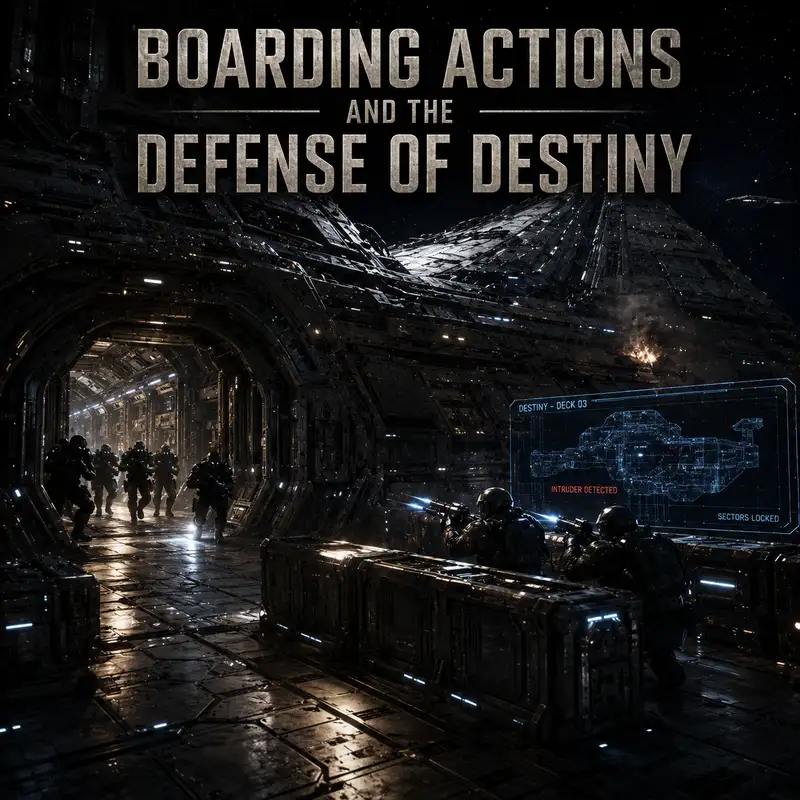
Boarding Actions and the Defense of Destiny
The incoming wormhole formed while Destiny’s defenders waited behind sealed doors. Colonel Everett Young’s plan was brutal but clear. Let the Lucian Alliance enter the gate room, lock them inside, and remove the atmosphere before they could spread through the ship. The first figure through wore Colonel David Telford’s body, although Nicholas Rush’s consciousness still occupied it. Transit broke the communication-stone link, returning Telford to his own body in the gate room and Rush to his elsewhere on Destiny. Young hesitated. In the seconds required to decide whether saving his people justified abandoning the plan, the attackers gained the foothold they needed.
Boarding actions aboard Destiny were rarely contests of simple firepower. The ship was more than a million years old, incompletely understood, and crewed by people who had not trained together for naval combat. Its shields could resist weapons in space, but an incoming Stargate connection appeared inside those shields. Its hull could survive a dive into a star, yet a specialized boarding craft could cut through it. Its doors could isolate attackers, but they could also trap defenders away from life support, medical care, or command. The central question was how a small and improvised expedition defended a vessel whose most useful systems could become weapons against everyone aboard.
Destiny had not been designed as a warship carrying a permanent security battalion. Its intended Ancient crew would have understood the controls, possessed authority recognized by the ship, and presumably boarded under planned conditions. The Icarus survivors arrived with a limited number of rifles and sidearms, a small military contingent, civilian scientists, technicians, administrators, and no replacement force. Lieutenant Matthew Scott could lead ship defense. Master Sergeant Ronald Greer could coordinate strike teams. Lieutenant Tamara Johansen could treat casualties. None of them had a complete deck plan, a damage-control organization, or enough personnel to post guards at every hatch, airlock, control room, and hull section.
The ship nevertheless provided a formidable defensive environment. Heavy doors divided corridors into compartments. Life support could be isolated or withdrawn. Kinos extended surveillance into spaces where a human scout might be ambushed. The Stargate could move friendly teams or hostile forces across impossible distances, but everyone emerged at one known point. Airlocks and spacesuits allowed defenders to bypass blocked corridors by crossing the hull. Control interfaces could shift power, lock doors, alter shields, and sometimes move the ship itself. Destiny was not a purpose-built fortress, but its internal systems gave a knowledgeable defender many of the advantages of one. The difficulty was knowing which control actually did what before someone started shooting.
The first major boarding action came from the blue-skinned aliens later called the Nakai. Their mothership demanded surrender, launched smaller craft, and attacked Destiny’s shields. Scott and Greer took the shuttle into the external fight while the ship’s weapon batteries engaged the approaching vessels. The defenders naturally concentrated on the visible battle. That was exactly what the attackers required. One smaller craft reached the hull, attached itself above an occupied corridor, and cut through several inches of Ancient structure. The ship had not been defeated in space. Its local security had been penetrated while command attention remained fixed on the larger threat.
Chloe Armstrong heard the cutting before the defenders understood what it meant. A circular section of the ceiling dropped into the corridor, opening a direct route from the boarding craft to the interior. An armed guard was nearby, but the Nakai did not attempt to seize a broad section of the ship. They abducted Chloe and withdrew. The action was closer to a special-operations raid than an invasion. The objective was a human source who could be interrogated, studied, and possibly altered. That narrow purpose reduced the time the boarders needed to remain exposed and denied Destiny’s defenders the prolonged corridor battle for which they had begun preparing.
Young ended the pursuit once he learned Chloe might be aboard one of the retreating craft. The decision showed how hostage collection could neutralize a defender’s space advantage. Destiny’s weapons and shuttle might destroy the escaping vessels, but doing so could kill the person the defense was intended to protect. The Nakai used a boarding action to convert a military engagement into a rescue problem. Rush and Chloe later escaped, but that outcome did not erase the security failure. The attackers had reached the hull, breached it, selected one person, and left before the expedition could form an effective internal response.
The next Nakai attempt began without a craft touching the hull. An alien consciousness exploited the Ancient communication stones and occupied Lieutenant Vanessa James’s body. Using a trusted human operator as access, the intruder sabotaged the faster-than-light drive and may have transmitted Destiny’s location. The attack bypassed shields, doors, and weapons because the hostile presence entered through a person already authorized to move around the ship. In practical terms, the expedition had been boarded through its communications system. The resulting defense therefore began with a counterintelligence failure rather than a warning from external sensors.
With propulsion disabled, the Nakai covered the available Stargate destination and approached with boarding craft. Young responded by assigning Scott overall responsibility for ship defense and Greer control of the internal strike teams. Military personnel deployed beneath likely landing points, while scientists attempted to restore the drive. Young told the entire crew that everyone might have to participate. This was not inspiring language added for morale. It was an accurate force assessment. Destiny did not carry enough armed personnel to defend every possible penetration point, move casualties, fight fires, maintain systems, and protect the command spaces at the same time.
Scott ordered Destiny’s weapons concentrated on the smaller vessels approaching to board. The enemy motherships were dangerous, but the immediate threat was not the platform firing from a distance. It was the craft capable of placing attackers inside the ship. That priority reflected sound anti-boarding doctrine. A capital ship can remain combat-capable while exchanging fire. Once hostile teams control its propulsion, gate room, armory, or life support, the outer battle becomes secondary. The best corridor fight is the one prevented before the cutting equipment reaches the hull.
The defense succeeded through an Ancient system no one could use safely. Doctor Jeremy Franklin, already severely injured by an earlier encounter with the neural-interface chair, entered it again and restored the faster-than-light drive. Destiny accelerated away as several boarding craft closed on the hull. Some were destroyed by the transition into faster-than-light travel. The Nakai lost their opportunity, and the ship escaped. Franklin disappeared from the chair and never returned to ordinary duty. The expedition prevented a boarding action by sacrificing one of the few scientists who had begun to understand the vessel. The ship was saved, but its defensive capacity became smaller afterward.
The Lucian Alliance attack was more dangerous because it used the Stargate and arrived with a plan for occupation. Telford’s recovered memory warned Young that the Alliance had located another naquadria-rich planet and was preparing to dial the nine-chevron address. The defenders knew where the enemy would appear. They had time to arm personnel, isolate the gate room, and prepare to remove its atmosphere. In most military operations, that would have been an extraordinary intelligence advantage. Destiny’s lack of an iris or comparable gate shield meant that forewarning did not prevent entry. It only created a brief opportunity to turn the receiving chamber into a containment zone.
The Alliance understood the strategic value of the gate room. Commander Kiva sent armed personnel, technical specialists, and equipment through in sufficient strength to seize the chamber and push outward. The attackers did not need to capture every compartment immediately. They needed the Stargate, access to ship controls, hostages, and enough corridor junctions to keep Young’s people divided. An incoming wormhole had delivered a force from the Milky Way directly into the center of an Ancient ship several billion light-years away. No shuttle approach, shield penetration, or docking maneuver was required. Strategic mobility had become strategic surprise inside the hull.
Young’s hesitation allowed the Alliance to escape the planned containment. Once troops moved beyond the gate room, Destiny’s compartmentation became an advantage for both sides. Kiva could seal routes, separate prisoners, and create defended zones. Young could hide personnel, preserve access to auxiliary systems, and organize counterattacks from sections the Alliance had not cleared. Neither side had enough people to control the entire vessel. The battle became a contest over corridors, doors, consoles, and human leverage rather than a continuous front line.
Kiva used hostages to compensate for incomplete control. Civilians and military personnel were separated, wounded people became bargaining assets, and Johansen’s medical ability was directed first toward Alliance casualties. Young attempted to use a delivery of medical supplies as cover for an assault. A shipwide power fluctuation disrupted the move, and Kiva killed a hostage in retaliation. The failed action demonstrated the danger of coordinating combat through machinery that could collapse without warning. On a modern warship, a blackout is an emergency. On Destiny, it could also erase the timing that distinguished a rescue attempt from an execution.
Camile Wray opened negotiations because force alone could not recover the prisoners. A hostage exchange produced limited movement and useful information, even though Kiva did not fully honor the agreement. The defenders learned that Eli Wallace and Chloe were not among the captives and could still be operating inside unsecured sections. That intelligence mattered more than the number of people physically exchanged. Two missing civilians with access to kinos, gate controls, and Ancient consoles represented an internal maneuver element the Alliance had not accounted for.
A binary pulsar then became a third participant in the boarding action. Radiation bursts were degrading Destiny’s shields and interfering with its faster-than-light capability. If the ship remained in the system, attackers and defenders would eventually die together. Rush determined that the shield could be concentrated on the side facing the pulsar, buying enough time to restore propulsion. The change required work outside the hull. Scott and Greer would have to pass through an Alliance-controlled section, enter spacesuits, and complete the task during the interval between radiation pulses. The boarding crisis had turned into a joint damage-control operation conducted by enemies who still expected to betray one another.
Kiva used access to the route as leverage and demanded control of the ship’s systems. Young accepted because the alternative was collective death, but Telford secretly proposed a deception. Once the transfer began, he would return control to Rush from within the Alliance-held zone. Scott and Greer went onto the hull with only about forty-six minutes between pulses. Their mission was not a side operation. If they failed, no faction would possess a ship worth controlling. Boarding actions are often decided by the people repairing the vessel while everyone else argues over who owns it.
The plan fractured when Kiva discovered Telford’s move. They shot each other almost simultaneously. Her subordinates found both commanders wounded and concluded that Young’s people had attacked. Dannic assumed control, halted the transfer, and refused to open the hatch for Scott and Greer. The two men remained outside with lethal radiation approaching. Their tactical success at the shield assembly had become irrelevant because the return route was controlled by an enemy commander more interested in retaliation than the ship’s survival.
Eli established contact from an unsecured area and directed Scott and Greer toward another entry point. They found limited shelter against the next radiation pulse and eventually reentered Destiny. Their hull movement demonstrated one of the ship’s most valuable defensive characteristics. A sealed corridor did not always end maneuver if personnel had suits, an airlock, and enough time to cross the exterior. It also showed the limits. Every exterior route depended on shield coverage, suit endurance, local access, and precise timing. Walking around the enemy is useful doctrine until the nearest star begins firing radiation through the deck.
Dannic tried to simplify the occupation by removing the people he did not need. Most of Young’s personnel were forced through the Stargate to a violent planet, while selected technicians, hostages, and wounded people remained aboard. Varro argued for restraint and later found himself exiled with the men loyal to him. The policy reduced the population Dannic had to guard but also removed the moderating part of his own force. He was left with fewer opponents aboard and fewer subordinates willing to tell him that controlling Destiny would be pointless if everyone died.
Rush, Eli, Chloe, and Adam Brody established a protected position in the hydroponics compartment and regained partial access to the ship’s systems. Scott and Greer moved through the occupied corridors, rescued personnel, and fought to reach Johansen and the infirmary. Their actions were disciplined but costly. A firefight in a medical space wounded people from both factions and further reduced the ship’s already limited ability to treat casualties. Ballistic weapons were effective in the corridors. They were also being fired around wounded personnel, pressure systems, and machinery no one could replace.
Rush finally used the pulsar as an internal defensive weapon. He began draining shield protection from most of the ship while preserving the hydroponics compartment, one of the best-protected areas available. His ultimatum was simple. The Alliance could surrender, or the next radiation pulse would kill almost everyone outside the protected zone. The plan also endangered Johansen, Wray, Scott, Greer, and other members of Destiny’s crew. Rush accepted those losses as the cost of preventing the Alliance from holding the ship. He had transformed environmental control into a weapon of last resort and made friendly casualties part of the firing solution.
Dannic refused to yield because possession of Destiny had become more important to him than the survival of the boarding force. Telford warned that Rush would carry out the threat. Ginn, one of the Alliance’s technical personnel, recognized that continued resistance meant death without victory. When Dannic turned his weapon on Telford, she shot him and offered surrender. The decisive act did not come from Young’s strike teams or Destiny’s main gun. It came from an enemy specialist who concluded that her own commander had become the greatest threat aboard.
Control returned to Young, and the personnel stranded on the planet were recovered. The tactical result was a successful defense. The Alliance failed to retain the gate room, failed to secure the ship’s control systems, and failed to preserve a unified command. The cost was substantial. Kiva died. Members of both groups were killed or wounded. Johansen was shot and, in the medical reality aboard Destiny, lost her child. The ship suffered additional damage while sitting under pulsar radiation. The surviving Alliance personnel became prisoners and, in selected cases, later members of the working community. Repelling the boarders did not remove them from the logistics problem.
The defense of Destiny revealed several priorities that no formal manual had provided. The gate room was decisive terrain because shields could not stop an established wormhole. The armory, communication-stone room, infirmary, life-support controls, bridge, and control-interface spaces required protection because any one of them could alter the balance of the ship. Kinos were valuable for reconnaissance, but they could not hold a corridor. Doors and atmosphere controls could contain an enemy, but only if the defenders were willing to accept who else had been contained. A plan built around perfect compartment isolation usually met a person the commander refused to abandon.
Knowledge proved as important as weapons. The Nakai could breach the hull but could not take full control of Destiny. The Lucian Alliance could occupy the gate room and hold most of the crew, yet still depended on Rush, Telford, Ginn, and captured technicians to operate the ship. Young’s military personnel could retake corridors but could not redirect shields or restore propulsion without the scientists. No faction possessed complete control because command of Destiny required physical access, technical understanding, and enough cooperation to keep the vessel alive. Capturing the bridge was not the same as possessing the ship.
The attackers also faced a strategic constraint that repeatedly favored the defenders. They wanted Destiny intact. The Nakai sought its systems and information. The Lucian Alliance wanted the Ancient vessel as a strategic prize. Neither could simply destroy it without defeating the purpose of the operation. That requirement limited bombardment, encouraged boarding, and exposed personnel inside terrain the resident crew was slowly learning to use. The defenders could threaten the ship more credibly than the attackers because they already lived with the consequences of losing it. Rush’s pulsar ultimatum worked because Dannic could not be certain that a man defending Destiny valued survival more than denial.
Destiny survived its boarding actions because its crew learned to defend systems rather than deck space alone. They used weapons against approaching craft, compartment doors against intruders, air and radiation as barriers, kinos as scouts, spacesuits as alternate routes, and scientific access as strategic leverage. Their methods were improvised, ethically dangerous, and often dependent on machinery they barely understood. They worked because the attackers needed time and technical control, while the defenders needed only to deny both until the ship could move again.
The quiet gate room after the Lucian Alliance surrendered looked much as it had before the attack. The Stargate still stood in the same place, ready to provide supplies, exploration, communication, or another invasion. Destiny had not gained an iris, a larger security force, or a reliable warning system. What changed was the crew’s understanding of the battlefield. The ship’s walls could be breached, its gate could be exploited, and even a trusted body could carry an enemy inside. Defense therefore began long before the first shot and ended only when control of access, information, life support, and command belonged to the same side.