Camelot and the Search for Merlin’s Weapon
Daniel Jackson was inside Merlin's library while the Milky Way's allied fleet assembled around a completed Ori Supergate. The strategic timetable had collapsed. Stargate Command needed to locate a weapon capable of neutralizing ascended beings, understand how it worked, and deliver it into another galaxy before the Ori sent their warships through. In front of Daniel was an Ancient control console. Outside was a village convinced the building was cursed. A holographic Black Knight had already killed the one local historian willing to help. Camelot was supposed to be the destination. It turned out to be the first page of a much longer search.
The search for Merlin's weapon was unlike a normal recovery mission. Stargate Command did not know the weapon's appearance, operating requirements, power source, range, or even whether it still existed. The available intelligence consisted of incomplete Ancient notes, one gate address, stories preserved as medieval legend, and a growing conviction that the Ori invasion could not be stopped by conventional force. Earth was searching for a strategic weapon while knowing almost nothing about the target except the category of beings it was meant to destroy. That is not an acquisition program. It is archaeology conducted under invasion conditions.
Merlin had begun life as Moros, an Ancient and the last known High Councilor of Atlantis before the Lanteans abandoned the city and returned to Earth. He later ascended, joining the higher plane occupied by many of his people. Ascension gave him knowledge of the Ori and of the threat they posed to both human civilizations and the ascended Ancients. Where the Others relied on concealment and noninterference, Merlin concluded that restraint would not be enough. He returned to human form while retaining knowledge gained after ascension and began developing a weapon capable of acting against beings who no longer occupied ordinary physical space.
The device was not a conventional bomb aimed at a visible target. Information recovered from Merlin's research suggested an energy-transfer system that would channel an effect into the plane occupied by ascended beings. The Asgard later compared the principle to destructive interference, with one energy pattern canceling another. The explanation was still an inference drawn from partial records, not a tested Earth design. If the weapon worked, it could eliminate the Ori. It could also affect ascended Ancients within its range. That made it strategically valuable to Earth, intolerable to the Ori, and understandably alarming to the beings whose rules Merlin had violated.
Merlin first had to hide the work from his own people. He developed the phase-shifting device later associated with Arthur's Mantle, which displaced matter into an alternate dimension while leaving the surrounding world visible but unable to interact with it normally. Stargate Command recovered the device from the Ancient chamber beneath Glastonbury Tor. When it was activated at Cheyenne Mountain, Samantha Carter and Cameron Mitchell disappeared from normal perception, while Daniel eventually entered the same shifted state and accessed Merlin's records. The machine was less a cloak than a sealed research compartment positioned beside ordinary reality.
The discovery produced only a narrow intelligence gain. Merlin's notes confirmed the purpose of the weapon and displayed the gate address to the world where he had continued his work. Before Daniel could recover the complete archive, the device's power failed permanently. Earth possessed an address, fragments of theory, and no assurance that the weapon would be waiting on the other side. At the same time, Vala Mal Doran had warned that Ori ships were ready to depart and that a working Supergate existed somewhere in the Milky Way. General Hank Landry divided the effort. Allied ships searched for the invasion corridor while S G One followed Merlin's address.
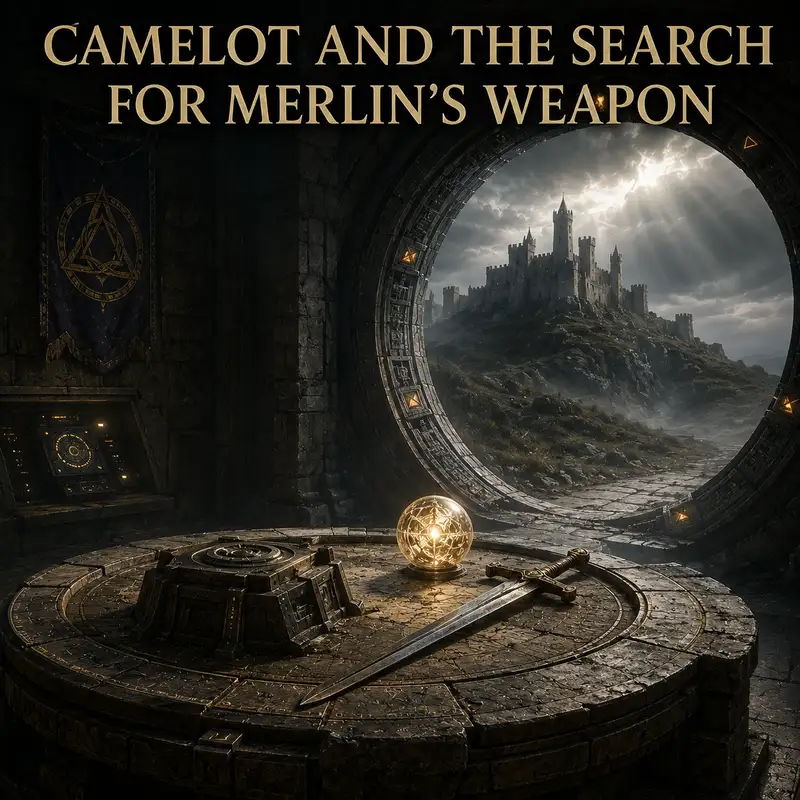
The gate led to a fortified settlement whose architecture, clothing, and social institutions resembled medieval Europe. A sword stood embedded in stone at the center of the village. The governor, Meurik, identified the place as Camelot. Local history differed from the version preserved on Earth. Arthur had defeated Mordred at Camlann rather than dying there, then departed with his knights on a quest for the Sangraal. The villagers expected him to return. Their stories were not simply folklore copied from Earth. They were cultural records of actual people, Ancient technology, and journeys through the Stargate.
That made Camelot an intelligence archive, but not one arranged for outside investigators. Arthur was honored. Merlin was feared. Villagers described him as a practitioner of dark arts whose private library remained sealed under a curse. The fear had preserved the building more effectively than a posted guard could have done. No one needed to understand the force field on the door or the technology inside. They needed only to believe that entering would bring the Black Knight. Merlin had converted cultural memory into long-term physical security.
Antonius, the village historian, possessed the key kept in the local archives. Daniel persuaded him that the library might contain information needed to stop a threat to countless worlds. The team entered at night, passed through the force field, and found manuscripts, artifacts, and a hidden chamber containing an Ancient control console. The environment looked medieval because the surrounding society was medieval. The system at its center was not. Camelot had spent generations living around an advanced installation without possessing the scientific vocabulary needed to describe it.
Activating the inner chamber triggered the security response. The Black Knight did not appear beside the intruders. It materialized elsewhere in the village and killed Antonius after he returned home with a book from the library. The placement was deliberate enough to suggest psychological deterrence. A guardian that killed only the trespasser would punish one person. A guardian that struck outside the sanctuary made the entire population enforce the prohibition. The design protected Merlin's work for centuries, but it did so by using civilians as examples.
Meurik ordered S G One to leave. His decision was rational from the information available to him. Strangers had dismissed a warning, opened a forbidden building, and been followed by the death of a trusted resident. Daniel knew the Black Knight was a technological projection. The villagers knew Antonius was dead. Scientific accuracy did not erase the causal chain. Stargate Command had entered another society to retrieve a weapon and had awakened a defense that society had successfully avoided for generations.
Before the dispute could be resolved, the Odyssey detected the completed Ori Supergate. The immediate defense of the galaxy now competed with the search for the one weapon that might end the war. The team split. Carter joined the fleet to help examine the gate. Teal'c went to seek Lucian Alliance assistance. Daniel and Mitchell returned to Camelot, expecting the new Russian ship Korolev to collect them later. The division was strategically necessary and operationally uncomfortable. Each branch depended on specialists who could not be in two places at once.
Daniel worked through Merlin's books until he identified a possible access sequence for the console. Mitchell prepared to contain the Black Knight. When the projection appeared in the village, P ninety fire passed through it without effect. Ordinary swords did the same. Valencia, a young villager, pulled Merlin's sword from the stone and threw it to Mitchell. That weapon could interact with the projection, buying Daniel time. The fight was not resolved by superior marksmanship. It was resolved by using the security system's own authorized tool while the archaeologist tried to shut down the program.
Daniel activated the console, received a holographic message from Merlin, and caused hidden treasure to appear. The Black Knight continued attacking. With Mitchell losing the fight, Daniel destroyed the console's control crystals with his sidearm. The method was inelegant but effective. Stargate Command had recovered the available data and then physically disabled the system when it could not be safely controlled. Ancient technology often encouraged reverence right up to the moment someone had to shoot the circuit board.
The treasure did not contain the weapon. Daniel instead noticed that every image of Merlin showed him wearing a small red pendant, including the holographic recording. A riddle referred to something hanging directly before the observer. Meurik identified the object as the Sangraal, or Blood Stone. Camelot's tradition also preserved the next stage of the route. Arthur and his knights had departed in search of it through three distant lands named Castiana, Sahal, and Vagonbrei.
Camelot therefore produced an intelligence success rather than a recovery success. The gate address had led to the correct historical network, but not to the final device. The weapon had become confused with the Holy Grail, and the Grail had become a cup in later Earth tradition. On Camelot, an older version survived as a stone carried on Merlin's body. The physical object was missing, but the local population supplied names absent from Earth's Ancient records. A village that could not operate Merlin's console still held information that the console alone had failed to provide.
The timing made the result feel inadequate. Daniel and Mitchell were beamed aboard the Korolev and taken directly to the Supergate, where four Ori warships emerged and shattered the allied formation. Earth had located the trail to a possible strategic countermeasure at the same moment conventional defenses proved unable to stop the invasion. The search was no longer an attempt to prevent war. It became a race to find the weapon before Ori forces converted enough worlds, destroyed the remaining fleets, or learned where Merlin had hidden his work.
Vagonbrei was the first of the three named worlds that Stargate Command could identify. The settlement was abandoned, its people killed by an organism that induced sleep and eventually death. Local accounts had transformed the event into another supposed curse associated with Morgan Le Fay. Daniel's examination of the surviving archive connected Morgan to the search and produced a reference pointing toward Atlantis. The mission did not find the Sangraal, but it established that Merlin's legendary rival had been involved in its disappearance.
That clue moved the investigation from the Milky Way to the Pegasus galaxy. Daniel and Vala traveled aboard the Odyssey to search the Atlantis database while Carter used the same mission to support an operation against the Supergate. The expedition's holographic teaching interface adopted the image of the Ancient woman Ganos Lal, remembered on Earth as Morgan Le Fay. The figure displayed knowledge beyond the programmed avatar and finally revealed herself as Morgan in ascended form.
Morgan explained that Merlin had returned to human existence with knowledge the Others believed no mortal should possess. They had sent her to observe him and stop the weapon if necessary. She provided the Ancient names and gate addresses corresponding to Castiana and Sahal. When Daniel pressed her to help against the Ori, she began to offer an additional warning but was removed by the ascended collective before she could finish it. Her intervention supplied critical intelligence while preserving uncertainty about what she had intended to say.
Searches of Castiana, Sahal, and Vagonbrei produced no weapon. Daniel continued examining Merlin's library and every surviving reference, while Ba'al and his clones pursued the same objective for their own reasons. Ba'al knew from Anubis that the device could threaten ascended beings and claimed that its destination lay among the thousands of addresses once placed in Stargate Command's database by the Ancient repository. The Goa'uld did not possess a complete solution, but his interest confirmed that the search had become a contest among several powers. Whoever found the Sangraal would possess leverage against the Ori, the Ancients, and nearly everyone dependent on either.
The breakthrough came from treating the three worlds not as destinations, but as components of a coded route. Their positions formed an equilateral triangle. When Camelot was added as the point of departure, the four worlds formed a three-dimensional tetrahedron. The geometry indicated deliberate design, but it did not reveal the final address by itself. Vala then dreamed of three becoming one and proposed that the symbols from the three destination addresses should be combined. Carter's computer found one matching gate address in the database.
The apparent inspiration was enemy manipulation. Adria had planted the dream in Vala because Morgan's safeguards prevented the Orici from reaching the weapon alone. Adria required Daniel, a former ascended being whom the defenses might judge worthy, to complete the path. She let Stargate Command solve the route, then followed it. The most important lead in the search was genuine, useful, and delivered by the enemy. Intelligence professionals prefer sources with less interest in exterminating the collection team, but campaigns rarely provide ideal conditions.
The new address led to a world that Ba'al's ships had failed to locate through normal navigation. Access through the Stargate was possible, while orbital detection was not. Morgan had created a protected search environment beyond easy attack from space. On the surface, towns and records preserved the language of chivalric quest. The route toward the Sangraal was guarded not by one lock, but by a sequence of trials based on prudence, wisdom, charity, kindness, and faith. The safeguards were technological, yet their operating logic was moral and cultural.
A time-distortion maze punished reckless movement. A treasure chest trapped anyone approaching through greed and released the group only when each person surrendered something of value. Other tests required aid to strangers, the solution of riddles, and willingness to walk through an apparently lethal barrier. The system did not merely verify possession of a code. It evaluated behavior. Morgan had designed access control for the kind of people Arthurian tradition described as worthy, though Ba'al's reluctant participation demonstrated that group authentication can occasionally admit a rather questionable member.
Ba'al had reached the route first and became trapped. Adria entered by disguising herself as a local archivist and staging an Ori attack to drive S G One forward. The search party therefore included Earth personnel, a Goa'uld System Lord, and the commander of the Ori crusade, each seeking the same device for incompatible purposes. Cooperation existed only because Morgan's defenses forced it. Every solved barrier moved the group closer to the weapon and closer to the moment when the temporary arrangement would collapse.
The final guardian appeared as a fire-breathing dragon. Conventional weapons and explosives caused little lasting effect. The key was not the creature's name, but the identity of the person who had created the entire system. Daniel spoke Ganos Lal, Morgan's Ancient name, and the guardian vanished. The answer reframed the quest. Morgan was not simply the sorceress who had opposed Merlin. She was the architect of the trail, the destroyer of the original weapon, and the person who had preserved the possibility that it could be rebuilt.
The apparent Sangraal was not the final prize. After the last defense was defeated, the team was transported to another hidden chamber and found Merlin alive in stasis. Morgan had destroyed his completed weapon because the ascended Ancients would not allow it to remain. She had also concluded that the Ori might eventually make the device necessary. Instead of killing Merlin or erasing his work, she preserved the one person capable of reconstructing it and surrounded him with safeguards intended to keep both enemies and the merely curious away.
The chamber itself moved through a concealed circuit of Stargates, shifting Merlin and his visitors from world to world. The arrangement made the site difficult to locate and protected it from a single orbital strike, but it also trapped anyone who could not override the automated route. This was strategic dispersal applied to one irreplaceable scientist. Morgan had not preserved an arsenal, production line, or instruction manual. She had preserved a unique human capability and built an elaborate security architecture around his body.
Merlin awakened after well over a thousand years, but stasis had not preserved him perfectly. His body was too weak to complete another Sangraal before Adria reached the chamber. He used an Ancient mental interface to begin constructing the device, then transferred the necessary knowledge into Daniel before dying. The search ended with no ready weapon to carry home. It ended with Daniel carrying Merlin's memories, technical understanding, and unfinished mission inside his own mind.
That distinction shaped everything that followed. Earth had discovered the creator rather than the artifact, and the creator had become information embedded in a vulnerable human operator. Daniel continued the construction, was captured by Adria, and used Merlin's knowledge to conceal his true intentions while appearing to serve the Ori. The completed Sangraal was eventually sent through the Supergate into the Ori home galaxy. The operation appears to have destroyed the ascended Ori, but it depended on a chain of one-time technologies, individual choices, and enemy mistakes that Earth could not reproduce as a standard weapons program.
Camelot mattered because it was never an armory. It was the index to a distributed security system built from Ancient machinery, Stargate geography, controlled myth, and human memory. Merlin hid the research. Morgan hid Merlin. Arthur and his knights became the first search party. The villagers preserved fragments of the route without understanding their military significance. Daniel reconstructed the chain because archaeology, linguistics, mathematics, and operational necessity were treated as parts of the same intelligence problem.
The search also carried a cost that the strategic result can obscure. Antonius died because outsiders activated a defense his community had avoided. Camelot's people lived for generations beneath a threat created to protect knowledge they could not use. Daniel risked his identity and life to carry Merlin's mind. The weapon that might save the galaxy could also kill ascended beings who were not Ori. Every layer of the quest asked whether the people seeking ultimate power were worthy, while the war kept reducing the time available to answer honestly.
Camelot's greatest contribution was not the sword, the treasure, or even the red stone in Merlin's image. It was a story durable enough to survive after the machines became magic and the engineers became legend. Stargate Command entered looking for a finished weapon. It left with three place names and a trail. That trail crossed two galaxies, passed through allies and enemies, and ended not with the recovery of an object, but with the resurrection of the one man who knew how to build it.