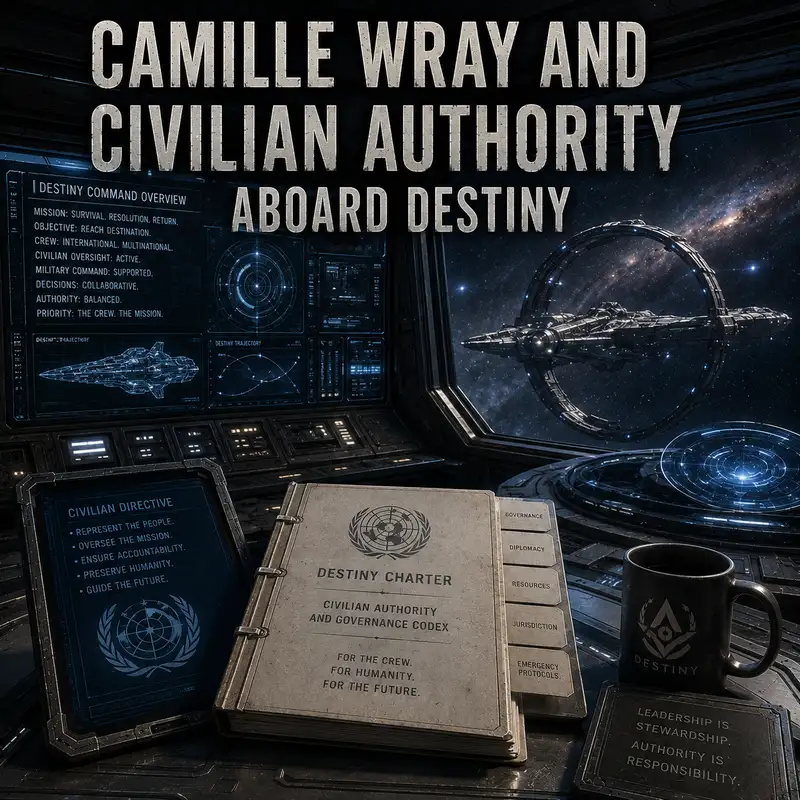
Camile Wray and Civilian Authority Aboard Destiny
Colonel Everett Young surrendered command of Destiny after a dead crew member’s pistol was discovered in his quarters. The ship had no police service, no courtroom, no judge advocate, and no legal code written for more than eighty people stranded several billion light-years from Earth. A crowd was forming, suspicion was spreading, and the military commander had become the principal suspect. Young placed authority in the hands of Camile Wray, the senior representative of the International Oversight Advisory aboard the ship. For a brief period, civilian oversight was no longer an office reviewing military decisions from Earth. It was the only barrier between an armed chain of command and a crew that no longer trusted it.
That transfer defined the problem Wray spent the entire voyage trying to solve. Destiny required immediate military discipline because the ship was damaged, hostile forces could appear without warning, and every planetary stop resembled an expedition into unsecured territory. It also carried scientists, technicians, administrators, and civilians who had never volunteered to serve under permanent martial control. Wray’s central argument was that survival did not erase civilian authority. Young’s answer was that authority without the ability to defend the ship, ration supplies, or enforce decisions was only a claim. Their conflict was not a simple contest between a competent officer and an obstructive bureaucrat. It was an argument over what legitimate government meant when the government was impossibly far away.
The surviving record provides little about Wray’s childhood or formal education. It establishes her as a human-resources executive, a strategically capable member of the International Oversight Advisory, and the organization’s principal representative at Icarus Base. That assignment placed her inside one of Earth’s most sensitive programs without placing her in the military chain of command. She handled personnel concerns, represented multinational civilian oversight, and reported into a political system that expected classified military activity to remain answerable to governments outside the United States Air Force. On Icarus, that authority operated through meetings, reports, access, and influence. It did not give her command of the base or its weapons.
The International Oversight Advisory existed because the Stargate Program had outgrown the idea that one national military service could operate it without broader political supervision. Foreign governments contributed personnel, resources, intelligence, and legitimacy. Civilian authorities had an interest in how alien technology was used, which alliances were made, and whether military officers could commit Earth to conflicts without meaningful review. The advisory’s record was not uniformly admirable. Its members could be political, intrusive, and more confident in procedure than in operations. Yet the underlying principle was difficult to dismiss. Extraordinary secrecy made oversight more necessary, not less. Destiny carried that institutional tension with it, even though the committee rooms, legal staffs, and secure communications networks did not make the trip.
Wray reached Destiny in the same disorder as everyone else. She emerged from the gate demanding to know why the evacuation had not reached Earth, then began helping clear the receiving area as more people and equipment came through. Within hours, she understood that Nicholas Rush was using technical knowledge to claim authority he had not been granted, while Lieutenant Matthew Scott was trying to command with Colonel Young incapacitated. Wray did not have a better map of the ship, a secure supply inventory, or a route home. What she possessed was an immediate awareness that information could become power. Rush controlled what the crew knew about Destiny. The military controlled weapons and movement. Civilians controlled neither, despite making up a large part of the population at risk.
Young’s recovery produced an emergency hierarchy that was practical but incomplete. He was the senior surviving officer from Icarus and had experience commanding personnel under threat. Scott and Master Sergeant Ronald Greer could organize searches, secure corridors, and lead gate teams. Rush and the science staff could interpret Ancient systems. Wray could represent the civilians and maintain contact with political authorities on Earth. The arrangement looked almost balanced when written as four functions. In practice, Young issued orders, the military enforced them, and everyone else depended on access to him. Wray’s objection was not that the expedition needed no commander. It was that an emergency chain of command was quietly becoming a permanent political system without anyone formally deciding that it should.
Ancient communication stones prevented Wray from becoming completely isolated from the organization she represented. By exchanging consciousness with people on Earth, she could report conditions aboard Destiny, receive political guidance, and speak with senior officials. The system restored contact without restoring normal government. Earth could give orders, but it could not send police, supplies, replacement leaders, or an appeals court. Every instruction therefore arrived with an enforcement problem. Wray could tell Young what the advisory wanted. Young still controlled the people who could carry out the decision. Distance had turned civilian supremacy from a settled constitutional principle into a negotiation conducted through borrowed bodies. Her superiors sometimes encouraged her to steer opinion toward Earth-backed plans, showing that civilian oversight could become political pressure from people who did not share the physical risk.
Wray’s relationship with Sharon Walker kept that problem human. Sharon was not an abstract member of the public whose interests appeared in an oversight memorandum. She was Wray’s long-term partner, left on Earth without any normal way to share a life with her. Communication-stone visits allowed them to meet, but one of them was always occupying another person’s body, making consent, privacy, and physical identity part of every reunion. Familiar voices, faces, touch, and privacy became conditional. Wray could report for duty aboard Destiny and appear at home for a few hours, yet neither place could fully claim that she was present. Her experience made her sensitive to the fact that the expedition’s casualties included families who were alive, informed, and still unable to recover the people they had lost.
The death of Sergeant Spencer transformed Wray’s political concern into direct authority. Spencer was found with a gunshot wound, but the pistol was missing. When the weapon appeared in Young’s quarters, the crew had reason to suspect that the commanding officer might be responsible. Young understood that simply ordering everyone to accept his innocence could produce a revolt. He ceded command to Wray while an investigation and trial were organized. The decision did not establish a permanent civilian government, but it did acknowledge a principle larger than rank. A commander accused of killing a subordinate could not remain the sole investigator, judge, and custodian of the evidence.
Wray improvised a justice process from almost nothing. She arranged the inquiry, allowed the search to continue, and accepted responsibility for the ship while Young defended himself. She also gave Rush greater access to the science team and to an Ancient neural-interface device Young had restricted. That decision reflected both practical necessity and Wray’s political alignment with the civilians. It was not risk-free. The chair had already injured a user, and Rush’s ambitions were not an adequate safety program. Acting command required Wray to make the same kind of incomplete technical judgments she had criticized when Young made them. Civilian control did not remove uncertainty. It merely changed who had to own it.
The proceeding never became a complete trial. New evidence, a planetary mission, and the discovery of an alien vessel interrupted the process. Rush’s later actions revealed that he had moved Spencer’s weapon and planted it in Young’s quarters as part of an effort to remove him. Wray had acted on false evidence, but her insistence on investigation was not therefore mistaken. The frame-up demonstrated why evidence had to be tested rather than accepted from the person who presented it. The weakness was that Destiny possessed no independent investigators, no protected chain of custody, and no institution separate from the factions competing for control. Justice existed because individuals agreed to attempt it, and could be manipulated by any individual who understood the gaps.
Young’s response to Rush created the crisis Wray had feared. After learning of the deception, he assaulted Rush during a planetary mission and left him behind when Destiny resumed its course. He then concealed what he had done. Rush eventually returned after being captured by hostile aliens, but the result did not make Young’s decision less abusive. Wray now had proof that the military commander could use isolation, force, and secrecy against a civilian adversary. Young remained operationally necessary, yet necessity had become the argument protecting him from accountability. For Wray, continuing to offer advice within the existing system appeared increasingly similar to accepting that the system had no meaningful limits.
Her answer was the most serious mistake of her own leadership. Wray joined Rush and a civilian faction in seizing control of key areas of Destiny. The group locked out military personnel, controlled access to the gate room, communications-stone room, food stores, and much of the ship’s usable space, then demanded that Young’s forces disarm and accept civilian authority. The grievance was legitimate. The method was coercive. No shipwide vote had authorized the takeover. Civilians who happened to be on the military side of the sealed barrier were not consulted, and some personnel aligned with Wray because Rush controlled the technical systems they needed. A coup does not become democratic because civilians conduct it.
The physical division of the ship exposed how little either faction could govern alone. Wray’s side held food, water, hydroponics, communications, and the Stargate. Young’s side retained life-support control, weapons, the shuttle, and the trained personnel needed to defend the hull. Each group possessed assets that could make the other suffer. Neither possessed a complete survival system. The resulting negotiation resembled a siege inside one pressure vessel, which is not an arrangement recommended by most naval architects. Eli Wallace recognized that the civilians could not maintain life support indefinitely. Young recognized that storming every compartment would risk damage and bloodshed. Their political dispute had become a technical countdown.
An external attack ended the experiment before either side could claim victory. Hostile aliens had placed a tracking device inside Rush, and their vessel returned while Destiny remained divided. Removing the device required medical cooperation, communication with Earth, and access to equipment scattered across both factions. Defending the ship required military control of weapons and scientific control of power. Wray and Young were forced back into the arrangement they had failed to negotiate voluntarily. The crisis did not prove that the military should rule without limits. It proved that civilian authority could not survive by treating operational competence as an enemy resource, just as military command could not survive by treating civilian consent as optional.
After the confrontation, Wray told Young that they had to find a way to work together. She also told him directly that leaving Rush on the planet had been wrong. Young did not dispute it. No formal charter emerged, and Wray did not become co-captain. The balance developed through practice instead. Young retained command of military operations and the ship’s immediate defense. Wray became the recognized civilian representative, participated in major decisions, carried grievances to the commander, and maintained contact with the advisory. The arrangement remained untidy because legitimacy aboard Destiny was not created by one document. It accumulated each time Young consulted her and each time she accepted that consultation was not the same as operational command.
The Lucian Alliance boarding action tested that working relationship under occupation. Wray was among the personnel used with the communication stones to bring medical specialists aboard after Lieutenant Tamara Johansen was wounded. She helped care for casualties while armed invaders controlled key sections of the ship. The episode revealed the practical meaning of civilian participation. Wray was not an infantry officer and did not pretend to be one. She could still manage people, relay information, preserve order among the unarmed, and support medical operations while Scott and Greer fought through the corridors. Civilian authority was not a substitute for defense. It was part of what defense was intended to preserve.
Victory created another political problem. The expedition now held a large group of Lucian Alliance prisoners while food, water, guards, and habitable space remained limited. Young initially favored removing the prisoners from the ship when a viable planet became available. Wray and Colonel David Telford supplied information to Earth that led the International Oversight Advisory to insist that selected prisoners be retained for intelligence and strategic reasons. Some, including Ginn and Varro, demonstrated a willingness to cooperate. Others remained dangerous. Wray’s role was not to excuse the attack. It was to prevent punishment, resource scarcity, and intelligence value from being collapsed into one angry decision.
The prisoner issue showed the more mature form of her authority. She had to consider the rights and safety of the existing crew, the responsibility of the attackers, the value of intelligence on the Lucian Alliance, and the possibility that cooperative prisoners could become useful members of an expedition with too few people. Permanent confinement consumed guards and supplies. Summary execution was unacceptable. Abandonment on an unsuitable planet could become a delayed death sentence. Integration carried security risks. No choice was clean. Wray’s contribution was to keep the decision political and administrative as well as military, forcing the command to ask not only whether a prisoner could be controlled, but what kind of community the crew intended to become.
Her human-resources background became more valuable as the emergency lengthened. On Earth, personnel administration could sound like the department responsible for forms no one wished to complete. Aboard Destiny, the entire personnel system consisted of the people already present, and there were no replacements. Skills had to be identified, work assigned, fatigue monitored, conflicts managed, and individuals protected from becoming disposable because their specialty was not immediately obvious. The scientists, military personnel, technicians, cooks, medics, and civilians all depended on one another. Wray understood that a crew was not merely a list of occupations. It was a network of people whose usefulness would collapse if fear, grief, or resentment made cooperation impossible.
That understanding appeared most clearly when Eli Wallace learned that his mother, Maryann, was deteriorating emotionally on Earth. Her medical care had been one reason Eli accepted recruitment into Project Icarus, and his disappearance had removed the person around whom much of her life was organized. Wray obtained special authorization for Maryann to use the communication stones and visit Eli aboard Destiny, despite the security complications. She later encouraged Sharon to support Maryann because both women were living with the same form of unresolved loss. The decision did not repair a shield or replenish a food store. It preserved the emotional stability of the scientist whose work repeatedly saved the ship.
Her partnership with Greer during the attack on Homeworld Command demonstrated how far she had moved beyond the early civilian-military divide. Wray and Greer used the stones to exchange with Senator Michaels and Doctor Andrew Covel just as a Lucian Alliance operation struck the facility. Trapped in borrowed bodies inside the damaged complex, they discovered radiation from a naquadria bomb and attempted to reach it before the device could destroy the command center and the surrounding area. Wray handled authentication, communication, and the rapidly changing political picture. Greer provided tactical judgment and force. Each performed the role the other could not, without pausing to reopen the argument over who represented the proper branch of authority.
The unstable stone connection repeatedly shifted Wray and Greer back to Destiny while Michaels and Covel returned to their endangered bodies on Earth. Varro supplied partial technical knowledge of the bomb, and the effort became a relay across billions of light-years among former enemies, civilians, soldiers, and political officials. The device was eventually neutralized, although Michaels and Covel absorbed lethal radiation while completing the work. The incident was a compressed model of Destiny’s government at its best. No faction possessed all the knowledge, authority, or capability required. Success came from combining them quickly enough that institutional suspicion did not consume the remaining time.
An alternate timeline provided the clearest evidence of what Wray’s political role could become. In that branch of history, an attempt to dial Earth displaced most of Destiny’s crew two thousand years into the past. The survivors founded a settlement that grew into the civilization of Novus. Historical recordings showed that Wray wrote its constitution, served two terms as mayor, and remained an honored public figure into old age. Those events did not occur in the prime timeline and cannot be treated as her inevitable future. They do reveal the direction of her abilities. Given time, land, and a population no longer trapped inside a military emergency, Wray converted informal representation into law, elected office, and durable institutions.
The Novus record also corrected a weakness in Wray’s earliest claims. Civilian authority requires more than announcing that the military serves civilians. It requires a defined constituency, rules for selection and removal, procedures for decision, limits on power, and institutions capable of surviving personal conflict. Aboard Destiny, Wray represented the advisory and spoke for many civilians, but she had not been elected by the crew. Her coup attempted to create civilian control without first creating civilian consent. The alternate Wray succeeded as a constitutional founder because the settlement could finally build the structures that the ship lacked. Authority became legitimate when it was organized into something more durable than her personal standing.
Wray remained capable of error. She could underestimate operational constraints, accept pressure from Earth, and treat the principle of civilian supremacy as though it automatically settled who should command during an immediate crisis. Her alliance with Rush gave a secretive scientist leverage over a political movement that claimed to resist unaccountable power. Her takeover divided a ship whose survival systems could not be divided safely. Yet the military alternative also failed whenever Young treated necessity as permission. Wray’s value came from refusing to let emergency authority become morally invisible, even when her own attempts to restrain it were sometimes reckless.
Camile Wray did not replace military command aboard Destiny, and the expedition would not have survived if she had. She forced that command to become political, accountable, and increasingly shared. Her greatest failure came when she tried to seize authority before building the institutions that could legitimize it. Her greatest achievement was recognizing that survival alone could not define the community. A ship may be kept alive by weapons, engineering, medicine, and rationing. A society requires rules governing who decides, who is heard, and what happens when the commander becomes the threat. Destiny never completed that constitutional work, but because Wray remained aboard, it could no longer pretend the work was unnecessary.