Catherine Langford and the Decades-Long Search
The film should have ended Catherine Langford’s search. Instead, it proved that the search had begun with a lie. On the screen, a young Ernest Littlefield stood before an active Stargate in nineteen forty-five, wearing a diving suit and connected to the laboratory by an air hose and rope. He stepped into the event horizon. The wormhole closed. The lines fell severed to the floor. Catherine had been told that Ernest died in an explosion. More than fifty years later, she learned that her father had concealed the first successful human journey through the gate, and that the man she had expected to marry might still be alive somewhere beyond it.
Catherine’s importance to the Stargate Program did not come from solving the final equation, commanding the first expedition, or designing the dialing computer. She preserved continuity across generations of secrecy, failure, changing administrations, and classified records that even later commanders did not know existed. She remembered that the ring mattered when the government treated it as an unsuccessful wartime project. Most decisively, she recognized the person who could solve the problem after established experts had exhausted the approaches they considered respectable.
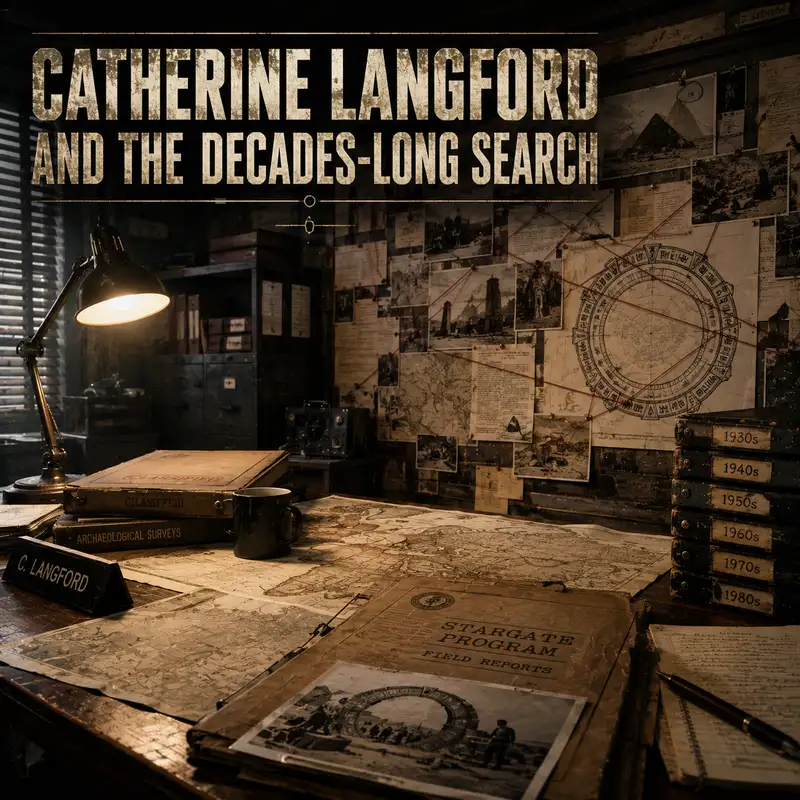
Her connection to the Stargate began at Giza in nineteen twenty-eight. Catherine was still a child when her father arrived at the excavation and watched workers raise the metal ring from beneath its cover stones. She also found the gold pendant marked with the Eye of Ra that would remain with her through most of her life. At that moment, the gate was not a transportation system, an invasion route, or the center of a future planetary defense command. It was an impossible artifact surrounded by Egyptian material and a warning that no one could interpret correctly. Catherine inherited the mystery before she was old enough to choose it.
That childhood experience gave her something later researchers could not acquire from technical reports. She had seen the gate in its original archaeological setting. She knew it had been deliberately buried and that the cover stones belonged to the problem. The pendant gave the discovery a personal symbol, but the more important inheritance was responsibility. Governments could move the artifact, classify it, or store it behind armed doors. Catherine remained connected to the question of what it was and why ancient people had hidden it.
By nineteen forty-five, the United States had turned that archaeological question into a wartime research program. Catherine’s father headed the effort, and Ernest Littlefield worked closely with him. Catherine was a young adult, scientifically capable, and personally close to Ernest, yet the project gave her little formal role. The military had limited interest in bringing a young woman into a highly classified laboratory, and her father did not treat her as a professional equal. She learned through conversations overheard at home and Ernest’s accounts of failed attempts. Exclusion did not prevent her from understanding the problem. It prevented the institution from using what she understood.
When Ernest described feedback strong enough to shake the room and damage a generator, Catherine suggested changing the electrical current used to charge the ring. The detail reveals the kind of participant she already was. She lacked full access, but listened, identified a practical failure mode, and proposed a testable correction. The official project regarded her as adjacent to the work. In reality, she was already contributing to it. The nineteen forty-five team was operating an alien machine without instructions while also limiting which qualified people were permitted to speak.
Ernest made the next conceptual leap. He concluded that the gate’s symbols represented destinations rather than combinations in an elaborate lock. The team found a sequence that activated the device. He then volunteered to cross before anyone had confirmed a return method. Catherine was not consulted. Her father feared that the so-called doorway to heaven might simply kill whoever entered it. Ernest believed the discovery justified the risk. The decision joined scientific courage to personal failure. He treated his life as his own to gamble, while leaving Catherine to bear consequences she had not been allowed to discuss.
After Ernest disappeared, Professor Langford told his daughter that an explosion had killed him. The explanation protected the classified project, prevented questions about an unreachable destination, and spared him from admitting that Ernest had chosen the experiment without speaking to her. It also deprived Catherine of the truth. Her grief was built around a false event, and her future research proceeded from an incomplete record. Her father gave her his notes, but removed the successful activation and Ernest’s passage. The person most committed to continuing the work was denied its most important result.
When the war ended, Catherine and her father were ordered not to discuss the project. The Stargate was placed in a Washington armory, protected by a government that no longer knew how to use it. The files were classified and dispersed. The United States possessed proof of interstellar travel and had administratively separated that proof from the people trying to understand the machine. Security prevented an adversary from learning the truth. It also prevented the truth from reaching its own future custodians.
Catherine began her own serious research in the late nineteen sixties. She understood that the ring required a second device to control it, even though the American project did not possess it. She also knew where the military had stored the Stargate, despite the government refusing to acknowledge it existed. Few people outside official custody could connect the Giza excavation, the wartime experiments, and the artifact’s postwar location. Catherine had no laboratory or command authority. She still had the thread connecting the pieces.
A strange incident in nineteen sixty-nine may have influenced that renewed effort. Samantha Carter and Daniel Jackson, displaced into the past by a gate interaction with a solar flare, visited Catherine while disguised as associates of one of her father’s former colleagues. They asked about a second control artifact and the location of the ring. Catherine guarded the information, shifted languages while domestic staff remained nearby, and revealed only what their knowledge persuaded her they were entitled to hear. Daniel later wondered whether the encounter helped inspire her research. The causal loop remains unresolved. Time travel already creates enough paperwork.
What followed was not one continuous government program. It was a long campaign for institutional attention. Catherine later recalled petitioning multiple presidential administrations to restart the work after roughly forty years had passed. The available record showed no usable result. The project had consumed resources, the science was uncertain, and the possible destination was unknown. Most damaging of all, the successful nineteen forty-five experiment had been hidden so well that later officials could evaluate the program without knowing it had ever worked.
Catherine’s task was partly scientific and partly political. She had to persuade senior officials that an artifact of unknown origin deserved classified funding, specialized personnel, heavy engineering support, and a secure military installation. She could not promise a weapon, destination, or activation. She could offer evidence that the ring was manufactured, its symbols had structure, and previous research had ended with unanswered questions. Catherine offered an immense strategic opportunity attached to a file that appeared to document repeated failure.
Her persistence eventually produced a revived project under General West. Catherine exercised substantial civilian authority while the gate remained a scientific problem. When activation appeared possible, Colonel Jack O’Neill arrived and placed operational security under military control. His explanation was blunt. He was there in case the scientists succeeded. Catherine had spent decades creating the opportunity. Once it might open onto a hostile world, the state’s priorities shifted from discovery to containment, reconnaissance, and destruction if necessary.
The revived team built mechanisms to rotate the ring, computers to control symbol selection, and power systems capable of energizing the chevrons. Yet after two years, it still could not identify the seventh symbol. Researchers treated the outer markings on the cover stone as words requiring translation. Their expertise reinforced the assumption, and more effort produced better versions of the same mistake. The project had hardware, funding, clearances, and military protection. It lacked someone willing to ask whether the symbols were language at all.
Catherine found Daniel Jackson after watching the academic establishment reject him. He argued that accepted chronology surrounding the pyramids was wrong and that scholars had to reconsider settled assumptions. His presentation did not win the room. It emptied it. That failure made him useful. Catherine did not recruit Daniel because she accepted every claim he made. She recruited him because he knew ancient languages, was comfortable with evidence that did not fit established models, and was free enough to accept a classified job more secure scholars might refuse.
She also understood how to recruit him. Daniel had lost grants, professional standing, and stable housing. Catherine offered translation work, travel, unique evidence, and the chance to prove his methods. This was not charity. It was talent acquisition based on accurate intelligence about the candidate. The project needed a linguist and archaeologist whose career had demonstrated a willingness to challenge consensus. Catherine matched the unsolved problem to the temperament required to approach it differently.
Daniel corrected the cover-stone translation and identified the unfamiliar outer symbols as constellations. Six defined a destination in three-dimensional space. A seventh represented the point of origin. Once he saw the Stargate, he recognized the missing symbol among its glyphs. He solved in days what the revived project had failed to solve in years, but his breakthrough did not diminish Catherine’s achievement. She created the conditions in which it could occur. In complex programs, finding the right expert is often the decisive act.
When the seventh chevron locked and the event horizon formed, Catherine’s advocacy became an operational capability. The government sent a probe, confirmed a compatible atmosphere, and saw another Stargate at the destination. The discovery also moved beyond her control. General West authorized reconnaissance, and O’Neill carried a nuclear weapon with orders to destroy the gate if he found a threat. Catherine reopened the road, but the state determined the rules for using it. Scientific success created a national-security problem before anyone understood the far side.
Before Daniel departed, Catherine gave him the Eye of Ra pendant she had found at Giza. She described it as lucky and expected him to return it. The gesture linked the child at the excavation to the scholar walking toward the wormhole. Catherine had invested her life in a question she could not answer from the control room, and placed a piece of that history with the person responsible for coming home. The pendant later helped Daniel establish initial trust with the people of Abydos, although neither could have predicted it.
The Abydos expedition killed Ra and returned most of the military team to Earth. Daniel remained behind. Officials still treated the gate as a route to one world, and O’Neill reported that the Abydos gate had been destroyed. Catherine had achieved what she spent decades pursuing, yet the program again moved away from her. When Stargate Command discovered the wider network and began regular operations, no one immediately brought her back. Six months passed before Daniel explained that thousands of gates existed and stellar movement affected their addresses.
Her anger was justified. Catherine had preserved the artifact’s history, revived the project, and recruited the person who unlocked it. The institution benefited from her knowledge, then excluded her once a permanent military command existed. Classification explained the decision without making it wise. Stargate Command protected an active war program by repeating an old pattern. People with the longest relevant experience were treated as security problems rather than institutional assets.
Daniel’s reason for visiting was more consequential than the network itself. The Pentagon had found boxes from the nineteen forty-five experiments and sent them to Stargate Command. Film showed an active wormhole and Ernest crossing it. Catherine believed she possessed all of her father’s notes, and General West probably never knew the files existed. No enemy deception was required. Classification, transfer, and neglect had concealed the first expedition from the second.
Watching the film forced Catherine to reinterpret her adult life. Ernest had not died in the accident she mourned. Her father lied because he believed the truth would hurt her more. Ernest chose the gate over their future together, but expected, however recklessly, to return. Catherine recognized the same consuming drive in Daniel and admitted it was one reason she believed he would solve the gate. The qualities advancing the program had also taken Ernest from her. Curiosity was not a virtue without cost.
Daniel isolated the chevrons in the old film and reconstructed Ernest’s destination. The planet was absent from the Abydos records, making the mission both a rescue and an intelligence opportunity. Its gate could prove that the Goa’uld had not built the network and might preserve older technology. General George Hammond approved the expedition primarily because Ernest might be alive. Catherine insisted on joining. After a lifetime outside the door, she would not accept another report written by someone else.
Her presence created a protocol problem. Daniel had revealed classified information to a civilian, and Hammond had reason to object. Yet Catherine had once run the research effort and was responsible for much of the modern program’s knowledge. She lacked current clearance and command status, but possessed unique history, a direct relationship to the missing explorer, and a legitimate claim against the institution that abandoned him. Hammond chose mission purpose over administrative tidiness.
Catherine crossed the Stargate more than six decades after seeing it raised at Giza. She found Ernest alive in a collapsing structure above a violent sea. The reunion was not a romance preserved untouched by time. Ernest had survived by imagining Catherine beside him. In his journals, they explored together and built the life isolation denied him. The real Catherine arrived after fifty years believing him dead. He had created forgiveness in her absence. She had never been given the chance to decide whether it was possible.
Her response was compassionate without surrendering the truth. She acknowledged what Ernest endured, but refused to pretend they had shared the life he remembered. Her father had lied, and Ernest’s decision had wounded her. Rescue could bring him home, but could not erase his choice or return the years taken from either of them. Catherine and Ernest demonstrated that physical recovery is only the beginning after half a century of isolation.
The planet also contained the greatest scientific discovery of Ernest’s life. A chamber preserved the writing of four advanced civilizations and used chemical elements as a common language. Catherine immediately helped interpret the display. She remained the intellectually engaged researcher who had challenged electrical assumptions in nineteen forty-five. Yet a damaged dial-home device and approaching storm turned the expedition into an evacuation. Knowledge that could not be carried away would soon be lost with the structure.
Ernest finally understood the lesson Catherine’s life embodied. Discovery has value only when it can be shared and preserved. Daniel wanted to remain with the archive. Ernest, who had spent fifty years possessing knowledge no one else could receive, forced him to leave. The team improvised power for the gate from the storm, escaped before the structure collapsed, and brought Ernest home. The archive was largely lost, but its existence changed Earth’s understanding of the gate builders and their allies.
Catherine’s search ended differently from the way she imagined. She did not recover a complete explanation of the gate. She recovered the man removed from her life by the first experiment. She did not retain control of the program she helped create. It became larger, more secret, and more dangerous than the research effort she revived. Public recognition was impossible while the achievement remained classified. Her reward was knowing the question had been real, her judgment about Daniel correct, and Ernest not left to die alone.
Her role is easy to underestimate because later Stargate Command possessed large budgets, dedicated teams, alien allies, and interstellar ships. None existed when Catherine began. She operated through memory, persuasion, professional judgment, and fragments others discarded. She was neither the gate’s inventor nor its final technical expert. She was the bridge between an excavation, a failed wartime experiment, a dormant artifact, and an operational program. Without that bridge, the pieces might have remained secure, separate, and completely useless.
Catherine Langford’s search succeeded because she refused to let institutional failure define the Stargate. She endured exclusion from her father’s laboratory, Ernest’s loss, a false account of his death, postwar suppression, vanished files, and government indifference. She responded by finding new sponsors and eventually a mind capable of seeing what the established project could not. The Stargate opened because Daniel identified the address. Daniel was in the room because Catherine had spent most of her life ensuring there would still be a project and a vital question waiting for him.
The final image is Catherine walking toward an active wormhole with Jack O’Neill and Daniel Jackson beside her. She had seen the ring as a child, watched adults turn it into a secret, and spent decades recovering the knowledge buried around it. When she finally crossed, she was not chasing an abstract mystery. She was retrieving a human being left behind by the first attempt. Catherine kept the door from being forgotten, and kept the people beyond it from becoming only missing pages in a classified file.