Chulak and the Fortress Worlds of the System Lords
The first Earth force to reach Chulak did not arrive with enough troops to seize a city, much less a planet. S G Two established a temporary base near the Stargate while S G One moved inland to find captives taken from Abydos and Earth. Hours later, the rescue column returned with refugees, a Goa’uld glider overhead, and a large Jaffa force closing through the trees. Claymore mines and a shoulder-fired missile kept the extraction route open just long enough. The mission escaped. Chulak remained under Apophis. That distinction is the first rule for understanding a Goa’uld fortress world: penetrating the gate was not the same as controlling the stronghold.
The Goa’uld never appear to use a formal category that translates neatly as fortress world. The term is useful shorthand for planets where a System Lord concentrated several kinds of power. A fortress world might contain a palace, a major Jaffa population, protected symbiote stocks, ship facilities, prisons, religious institutions, or command infrastructure. Some were capitals. Others were specialized military or industrial sites. Their defenses differed, but their purpose was similar. They converted territory into the ability to raise armies, move fleets, punish enemies, and preserve the ruler’s authority.
Chulak was the earliest and clearest example encountered by Stargate Command. It served as a principal base for Apophis and as the home of a large population of Jaffa devoted to his service. From Chulak, Apophis could draw guards, warriors, priests, administrators, and future recruits. Captives taken during raids could be brought there for confinement and selection as hosts. Orders issued from the palace moved outward through the First Prime, the priesthood, and the Jaffa military hierarchy. Chulak was not merely a defended camp surrounding a Stargate. It was a society organized to support imperial war.
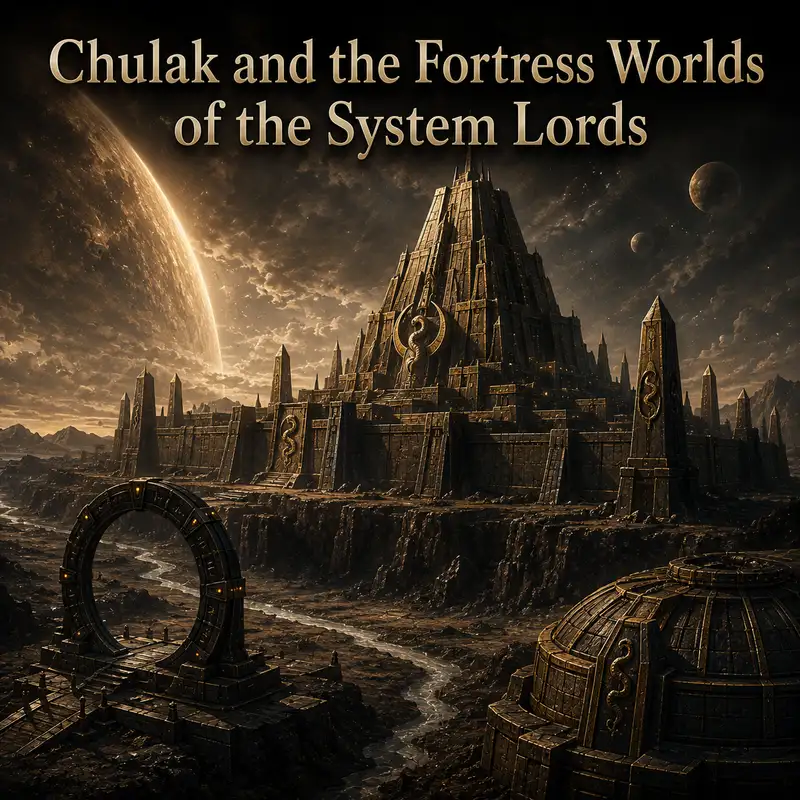
Its physical layout mattered. The Stargate stood outside the main urban center, surrounded by open ground, hills, and forest. The palace, temples, homes, and outcast camps lay farther away. This gave defenders room to observe arrivals and gather forces, but it also meant the gate was not protected by every soldier in the city. An incoming team could establish a perimeter before the main garrison responded. A departing team still had to cross exposed terrain while defenders converged. Chulak’s gate was both a strategic entrance and a dangerous gap in the fortress.
The first Tau’ri mission exploited that gap almost by accident. S G Two remained near the gate with supplies, radios, explosives, and the responsibility for withdrawal. S G One approached the city without understanding local language, security procedures, or political custom. Priests and residents mistook the newcomers for divine visitors and escorted them inward. That mistake was not simply comic confusion. It revealed an identification system built around symbols, confidence, and social rank. On a world where genuine gods were expected to arrive through the Stargate, people were trained to submit before they were trained to verify.
Apophis used Chulak as a processing center for human captives. Prisoners from Abydos and Earth were gathered, inspected, and separated according to their value. Some were potential hosts. Others were disposable witnesses or labor. The palace and its associated compounds provided secure rooms, guards, ceremonial spaces, and access to the ruler. Host selection was presented as religious transformation, but the operation required the practical functions of a detention facility, medical screening station, and personnel replacement center. Chulak helped turn raids on distant worlds into new bodies for the Goa’uld ruling class.
The planet’s Jaffa population made it more strategically important than an ordinary occupied world. Teal’c later explained that Chulak contained many hundreds of larval Goa’uld and was one of the few worlds with such abundance. That stock represented the continued health of existing Jaffa and the maturation of future Goa’uld. A larval reserve was therefore medicine, reproductive capacity, and military logistics in the same container. A System Lord who controlled Chulak controlled a source of replacement symbiotes for loyal warriors and a pipeline that could eventually produce new Goa’uld officers and administrators.
The security surrounding those larvae exposes how power worked on the planet. S G One found a small temple where symbiotes were kept with little obvious protection. Samantha Carter questioned the lack of guards. Daniel Jackson’s answer was practical: no one on Chulak was expected to steal one. Religious taboo, biological dependence, and fear of punishment had replaced part of the physical security system. The larvae were protected because the population had been taught that taking them was sacrilege, while most Jaffa also depended on continued access to the same supply. It was efficient security until outsiders arrived who did not share the belief.
Chulak also contained the social infrastructure required to sustain a warrior caste. Jaffa lived in houses, raised families, kept records, trained apprentices, and maintained relationships extending beyond individual units. The palace included administrative areas such as a hall of recording, while guard shifts and restricted wings followed routines that insiders could study. Priests supervised implantation and reinforced obedience. Senior warriors such as Bra’tac trained future commanders. The result was not a barracks with civilians attached. It was a military society in which domestic life, religious practice, and imperial service had been woven together.
That structure gave Apophis leverage over commanders who were far from the throne. Service brought housing, status, access to symbiotes, and protection for one’s family. Defection could bring exile, confiscation, and social death. After Teal’c turned against Apophis, his home was burned and his wife and son were reduced to the status of outcasts. They lived beyond the city among people excluded from normal protection. The punishment served two purposes. It hurt the traitor, and it warned every other Jaffa that military disobedience would be collected from the people they loved.
Fortress worlds rely on command and control as much as walls. On Chulak, the First Prime connected Apophis to the Jaffa army. Priests controlled rituals and access. Palace officials maintained records. Guards protected restricted rooms and carried orders. Households reinforced loyalty through reputation and obligation. This created a dense network around the ruler. It also created people who understood the system well enough to defeat it from within. Teal’c knew the gate approaches. Bra’tac knew the palace culture. Fro’tak knew the west wing and could draw a map.
Repeated Tau’ri penetrations of Chulak succeeded because insiders supplied what firepower could not. Teal’c returned disguised in Serpent Guard armor and presented S G One as scholars from the court of Apophis. The guards and priests accepted the explanation because his rank, manner, and symbols matched what they expected. On another mission, knowledge of a little-used entrance and the timing of a guard change allowed a small team to enter the palace. These operations did not prove that Chulak was weak. They proved that a fortress designed to resist enemies can remain vulnerable to people who understand its assumptions.
The first escape from Chulak showed the limits of a gate-centered defense. Apophis had aircraft, ring transporters, Jaffa formations, and enough authority to mobilize a battalion. Earth had two small teams, a limited supply of ammunition, and a firm deadline before its own iris codes would be locked out. The Tau’ri succeeded by keeping one force near the extraction point, using terrain, and applying modern explosives at the moment of pursuit. They did not defeat the Chulak garrison. They broke contact under pressure and moved refugees through a single doorway before the defenders closed it.
That tactical success had strategic effects out of proportion to the number of troops involved. Jaffa on Chulak heard that warriors from Earth had defied Apophis and survived. More importantly, the First Prime had defected in public. A fortress world is supposed to display the permanence of the ruler. Teal’c’s escape turned Chulak into evidence that the ruler could be disobeyed. The palace remained standing, but the story moved through the Jaffa population. In an empire sustained by religious confidence, rumor could damage defenses that no explosive had touched.
Apophis later demonstrated the other side of fortress-world control when his forces swept through Chulak searching for the Harcesis child. His army killed Jaffa who had worshipped him for generations. He possessed weapons capable of striking from space, yet the search was conducted on the ground because he needed information and a living target. The operation treated the population as both a resource and a suspect pool. Chulak was protected from outside enemies, but not from the ruler whose authority it sustained. For ordinary residents, the fortress could become a prison without any change in ownership.
Chulak was not the only model. Sokar organized his power around Delmak and its moon, Netu. Delmak served as his homeworld after conquest. Netu had once been an industrial colony, but Sokar transformed it into a penal environment modeled on his chosen image of the underworld. The atmosphere was made barely breathable, openings were blasted into the surface, and heat from the moon’s interior turned the remaining underground spaces into a controlled hell. There was no Stargate on Netu. Prisoners arrived by ship in descent pods, removing the easiest route of escape.
This was a fortress system built through separation. The capital remained on the planet while the prison, torture center, and political dumping ground occupied the moon. Environmental conditions did much of the guarding. A prisoner who escaped a cell still faced toxic air, volcanic terrain, orbital distance, and the absence of a gate. Sokar’s design reduced dependence on perimeter troops and made rescue difficult. It also concentrated his reputation for terror into one place. Netu was not simply where enemies were confined. It was propaganda visible from Delmak’s sky.
The arrangement was formidable but not invulnerable. Jolinar escaped through deception and access to a cargo ship. Years later, a covert rescue force entered by the same descent system used for prisoners. The Tok’ra then targeted the moon with a weapon powerful enough to destroy it, catching Sokar’s vessel nearby. Netu’s isolation had made conventional escape almost impossible, but it had also created a critical node whose destruction could disrupt the center of Sokar’s power. A fortress can be made harder to enter by reducing access. That same reduction may leave very few paths for evacuation when the attack comes from outside the expected plan.
Erebus represented a different type of stronghold. It was an industrial prison world used by Ba’al’s forces to compel captured Jaffa into mining and constructing Ha’tak motherships. The Stargate was protected by an energy shield that could be lowered with the correct signal. Guards controlled the camp, executed prisoners who could no longer work, and protected the unfinished ship. The world’s value did not come from a palace or large civilian population. It came from production. Erebus converted captive labor and raw material into fleet strength.
Its defense system joined access control with coercion. The shield denied an unauthorized gate assault. The labor camp kept skilled and physically resilient prisoners close to the work. Jaffa guards watched both the workers and the ship. Yet the site depended on a code, on critical machinery, and on the continued submission of the labor force. Once Stargate Command recovered the correct signal, S G One, S G Three, and Jaffa allies could enter. Sabotage against an anti-gravity system brought the unfinished Ha’tak down, drawing guards away and giving prisoners the opportunity to rebel.
Erebus illustrates why industrial fortress worlds presented different problems from capitals. Destroying the local commander did not matter unless the shipyard was neutralized. Rescuing a few prisoners did not end the threat if production continued. The operation succeeded because it linked infiltration, sabotage, outside fire support, and an internal uprising. The defenders had protected the gate and the camp, but they had not protected themselves from the people doing the work. Forced labor can provide immediate output. It also places technically informed enemies beside the machinery one most needs to preserve.
Anubis’s base on Tartarus was the most sophisticated specialized stronghold encountered in the Goa’uld war. A powerful sensor array watched the approaches to the planet. The Stargate stood inside the facility behind a force field. Internal sensors monitored movement. The base was positioned over volcanic terrain and difficult approaches. Inside, a queen produced symbiotes stripped of normal inherited personality, laboratories supported the process, and thousands of Kull warriors waited for deployment. Tartarus was not simply defended territory. It was a black-site production complex for a new army.
The defenses were layered to defeat both gate and ship infiltration. An unauthorized traveler should be destroyed by the force field. An approaching vessel should be detected before landing. Internal sensors should expose anyone who reached the corridors. Stargate Command and the Tok’ra overcame those layers by using captured enemy equipment. Jacob Carter, carrying Selmak, wore the armor of a Kull warrior and passed through the gate barrier. The infiltration team used radioactive isotopes to confuse internal detection, while a scout ship remained concealed until the planetary sensor array was disabled.
Tartarus shows the danger of authentication systems that recognize equipment more reliably than identity. The base accepted the armor because the armor was expected to belong only to Anubis’s soldiers. That assumption was reasonable until one of those soldiers was captured. Once the enemy possessed a valid technical signature, the strongest gate defense became an entry procedure. The same problem affected Chulak when Teal’c wore the proper armor and used the proper authority. One fortress trusted a uniform and social rank. The other trusted a technological profile. Both were penetrated through imitation.
Centralization created the second vulnerability. The queen, laboratories, conditioning systems, sensor controls, and assembled warriors were located within one complex because production was easier to supervise that way. The raiding force could not destroy the existing Kull army, but it could kill the queen and delay the manufacture of replacements. This was a limited operational success rather than the destruction of Tartarus as a military problem. Thousands of warriors remained. Still, a small infiltration team damaged the one component Anubis could not replace as quickly as armor or guards.
These examples reveal recurring layers in Goa’uld fortress design. The first was physical access: guarded gates, force fields, sensors, dangerous terrain, or ship-only approaches. The second was mobile defense: patrols, gliders, Ha’taks, ring transporters, and reinforcement. The third was political control: priests, family pressure, punishment, and claims of divinity. The fourth was productive capacity: larvae, hosts, mines, shipyards, laboratories, and trained labor. The strongest sites combined all four. A wall without a loyal population was only an obstacle. A loyal population without ships could still be bombarded from orbit.
The Stargate complicated every design decision. Placing it outside a city, as on Chulak, reduced the risk of an enemy appearing directly inside the palace but created distance between the gate and immediate reinforcement. Placing it inside a shielded facility, as on Tartarus, improved control but turned the gate room into a highly valuable single point. Protecting it with a coded barrier, as on Erebus, stopped ordinary intruders but made the code itself a strategic asset. Removing it entirely, as on Netu, limited escape and reinforcement while increasing dependence on ships.
A System Lord also had to defend against other Goa’uld, not only human raiders. Rival rulers possessed similar weapons, understood the same transport systems, employed spies, and could bribe or intimidate subordinates. This encouraged compartmentalization, personal guard orders, secret facilities, and harsh punishment. It also discouraged the free exchange of information that makes a military organization adaptable. A fortress commander who feared reporting a weakness might preserve his life for the day and lose the base later. Goa’uld security was often severe at the perimeter and politically fragile at the center.
Earth’s small teams were unusually well suited to exploit that fragility. They did not need to occupy a fortress world to damage its purpose. They could rescue a source, steal a code, sabotage a generator, destroy a queen, or turn a senior Jaffa. Such missions required precise intelligence and a credible extraction plan. When either was missing, the team could be trapped by the very gate that delivered it. The Tau’ri advantage was not unlimited firepower. It was the ability to combine local allies, technical improvisation, and a narrow objective before the larger garrison could concentrate.
The fortress worlds also reveal the limits of Goa’uld logistics. Advanced technology did not remove the need for labor, reproductive stock, trained personnel, and specialized sites. Ha’taks had to be built somewhere. Larvae had to be protected and incubated. Prisoners had to be guarded. Sensors required operators. Palaces required records and servants. Concentrating those functions made them efficient, but it also identified targets whose loss could not be repaired by issuing another proclamation. The Goa’uld could appear godlike at the point of contact while remaining dependent on very material supply chains.
Chulak mattered most because it joined nearly every function in one place. It was a garrison, political center, religious center, host-processing location, larval reserve, and home to the families who supplied Apophis’s armies. Its strength came from the density of those relationships. Its weakness came from the same source. Every Jaffa trained there could observe the gap between divine claims and command reality. Every punished family could become evidence of the system’s cruelty. Every insider knew a gate route, guard habit, or temple custom that an outside force could not have learned alone.
The decisive breach on Chulak was therefore not the hole blasted through a prison wall or the firefight at the Stargate. It was Teal’c’s decision that Apophis no longer deserved obedience. Once the First Prime crossed that line, the fortress produced its own enemy. Bra’tac preserved resistance within its military culture. Refugees carried the memory of escape. Later Jaffa heard that the Tau’ri had entered the stronghold and survived. Chulak remained dangerous, but the meaning of its defenses changed. They no longer proved that Apophis was a god. They proved how many soldiers he required to keep his own people in place.
The fortress worlds of the System Lords were strongest when gate control, military force, production, and belief reinforced one another. They failed when attackers separated those layers. Chulak’s gate could be held while its palace was infiltrated. Erebus’s shield could be bypassed while its labor force revolted. Tartarus’s sensors could be deceived while its queen was destroyed. Netu’s isolation could be turned into entrapment. The Goa’uld built worlds intended to make their rule permanent. The enduring irony is that the most important of them also concentrated the prisoners, workers, and warriors who understood exactly where that rule could be broken.