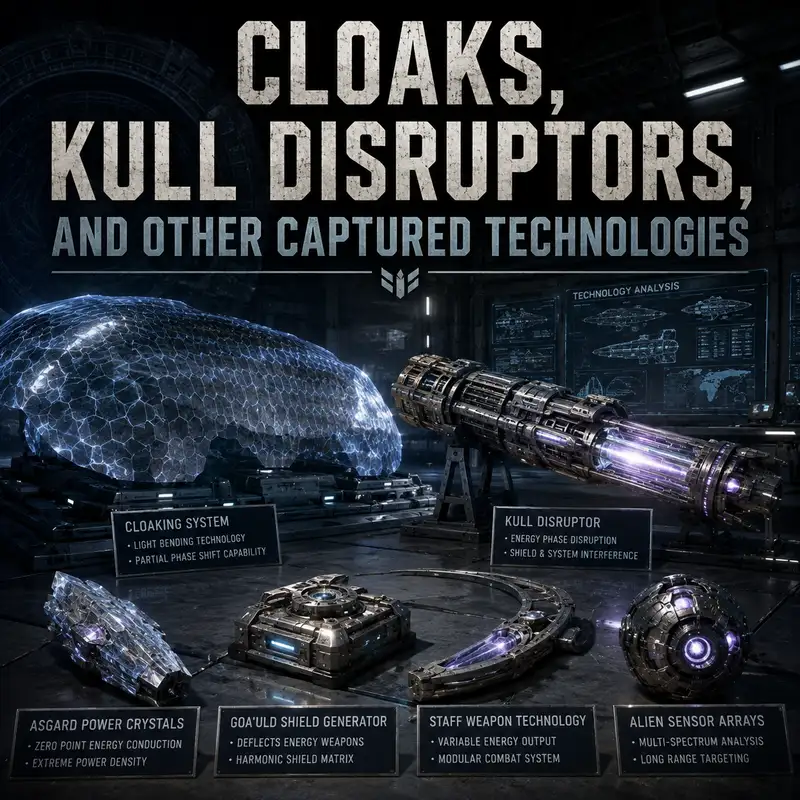
Cloaks, Kull Disruptors, and Other Captured Technologies
The cloaking device did exactly what Stargate Command wanted. A field team could disappear, observe a village without revealing itself, and return through the gate. Soon afterward, a docile herbivore on P nine J three thirty-three tore people apart. A similar creature appeared on P two R eight sixty-six. Then one began hunting in northern Minnesota. The common factor was not enemy action. It was an Earth safety modification. Engineers had shielded the Sodan cloak’s radiation to protect human users. The radiation had been protecting everyone else.
That failure defines the problem of captured technology. Earth’s teams recovered devices from battlefields, abandoned laboratories, defeated infiltrators, ruined temples, and alien ships. Some became standard equipment. Some worked once and vanished into storage. Some could be operated only by people with the correct biology. Others performed exactly as designed while concealing a function their new owners had mistaken for a defect. The central question was never simply whether Earth could turn a device on. It was whether Earth could understand, control, secure, reproduce, and employ it without importing the danger that came with it.
Stargate Command used several paths to acquisition. A zat gun taken from a Goa’uld guard was captured equipment. Merlin’s phase-shift device was recovered technology. Asgard transporters were allied transfers. The Sodan cloaks were inherited after a friendly civilization was destroyed. The Kull disruptor was derived from enemy biology and an Ancient artifact. The categories differed politically, but all entered the same practical pipeline: secure the object, determine what it does, identify who can use it, test hidden functions, and decide whether the advantage justifies the risk.
Urgency made that pipeline difficult to respect. The Goa’uld, Kull warriors, and Ori did not suspend operations while Area Fifty-One completed a multiyear safety review. A recovered system might be the only answer to an enemy already in the field. Commanders therefore accepted prototypes, incomplete intelligence, and components that could not be replaced. A device that survived one mission could become a requirement before anyone knew why it had survived. This produced major breakthroughs and several incidents difficult to explain to an ordinary accident board.
The Sodan cloak appeared to offer a nearly ideal special-operations capability. The Sodan were an isolated Jaffa society that had used Ancient technology for generations. Their personal cloaking devices made a warrior invisible and extremely difficult to detect. The effect was not merely optical camouflage. The device placed the wearer slightly out of phase with normal space-time, inside a pocket of subspace. Cloaked Sodan could see one another, move through the normal environment, and attack opponents who could not see them.
Operationally, that meant reconnaissance without exposing the observer, ambush without revealing the firing position, and movement through defended terrain with less chance of detection. The Sodan used the cloaks to protect their sacred territory. Stargate Command immediately recognized the value. Small teams survived through concealment, surprise, and the ability to reach the gate before the enemy organized. Personal invisibility strengthened all three.
After the Sodan were slaughtered during the Ori conflict, surviving cloaks were brought to Stargate Command and Area Fifty-One. Testing revealed substantial radiation around the active devices. The Sodan had been Jaffa, and their symbiotes may have protected them from exposure that would be dangerous to an ordinary human. Earth engineers therefore shielded the radiation and began issuing the modified cloaks for missions requiring covert observation. The modification appeared to improve safety without changing the desired effect. That is the sort of result that encourages a program manager to use the word mature.
Field reports soon became less reassuring. Large predators appeared on worlds where cloaked SG teams had operated. Autopsy showed that one had once been a harmless local animal. A leech-like organism entered its body and altered its genetic structure, turning it into an aggressive carnivore. Testing revealed that the parasites originated in another dimension and could bleed into normal space inside the cloak’s displacement field.
The original radiation had not been accidental waste. It repelled the parasites. By removing it, Earth preserved invisibility while disabling an ecological safeguard. Each activation created an opportunity for a parasite to cross over, enter a local animal, and begin changing it. The user usually departed before the consequences became visible. A mission report could describe successful reconnaissance while the host world inherited a predator it had never evolved to survive.
The problem reached Earth when a Trust operative used a Sodan cloak stolen from Area Fifty-One to spy near General Hank Landry’s remote cabin. The same mechanism released parasites into the surrounding environment. Stargate Command had acquired a surveillance tool, modified it, fielded it, and lost one to a hostile network. The creatures did not distinguish between off-world operations and northern Minnesota. Captured technology had become a counterintelligence failure and a biological incident at the same time.
The cloaks were recalled, and later use had to account for both radiation exposure and dimensional contamination. The episode established a hard rule for technical exploitation. A feature that appears harmful may still be performing a necessary function. Alien designers had balanced invisibility, radiation, and interdimensional risk for users with different biology. Earth changed one variable and assumed the rest of the system would remain stable. The cloak worked. The safety case did not.
Merlin’s phase-shift device, known through Arthurian legend as the Mantle of Arthur, demonstrated why even similar technologies could not be treated as interchangeable. The Sodan cloak shifted a wearer only far enough to conceal the person while preserving physical interaction with normal space. Merlin’s device moved people into another phase where they could see and hear the normal world but could not touch it. Its original purpose was not battlefield concealment. Merlin used it to hide his research from other ascended Ancients while developing a weapon against the Ori.
When Samantha Carter and Cameron Mitchell accidentally activated the device, they remained linked to it through subspace even after leaving the laboratory. The system contained an interface visible only in the shifted phase and carried a record pointing toward Merlin’s work. Earth recovered intelligence and a potential defensive technology from the same artifact, but its original power source was depleted. Any military use would require another energy supply and a much larger understanding of how the device tracked every molecule it displaced.
Carter later connected the device to naquadah generators and expanded the field from several people to structures. The modified system could move an entire village out of phase, hiding it from Ori forces. A minor power fluctuation collapsed the first field and triggered a failsafe that returned the village to normal space. After enemy fire damaged two generators, the remaining power could shift only one room. An Ori staff weapon crystal eventually supplied enough additional energy for one more full displacement.
The village survived, but the experiment did not create a routine cloak for bases and cities. The device required enormous power, continuous molecular tracking, an intact control link, and a failsafe able to restore everything after a disruption. An alternate Earth later shifted the entire planet by drawing on most of the continental United States power grid, but that did not establish a prime-timeline capability. A successful emergency remained an emergency, not a production standard.
The two cloaking systems therefore taught different lessons. The Sodan devices were compact enough to issue to teams, but contained a hidden environmental hazard. Arthur’s Mantle offered much deeper protection, but demanded power and control far beyond ordinary field equipment. Both used phase-shifting principles. Neither could be reduced to a general instruction labeled invisibility. The name of the effect described what an observer saw. It did not describe the engineering problem the operator had inherited.
The Kull warrior presented the opposite challenge. Earth did not need to conceal itself from the technology. It needed a way to kill it. The first warrior encountered by Teal’c and Bra’tac absorbed staff blasts and continued attacking until its engineered body suffered pulmonary failure. Later capture attempts showed that firearms, explosives, tranquilizers, and force fields were also ineffective. The apparent victory had been a medical defect. Without that failure, the warrior would probably have continued.
Examination of the body showed that the host had been grown in a laboratory and was less than a month old. It had been given life only after reaching physical maturity. Residual energy inside its cells resembled the effects of a Goa’uld sarcophagus, but a normal sarcophagus was not powerful enough to animate tissue that had never lived. Selmak recognized the signature as evidence of an older Ancient healing technology once found by the Goa’uld Telchak.
The captured warrior produced several kinds of intelligence. Its armor revealed an energy-absorption system that defeated projectile and energy weapons. A living specimen was seized with a ring transporter, isolated aboard a cargo ship, and questioned with a Tok’ra memory device. The images identified Tartarus, Anubis’s production base. Jacob Carter then wore captured Kull armor through its force field, allowing Carter, Teal’c, and Bra’tac to infiltrate and destroy the queen producing the drone symbiotes.
The armor became a disguise and access credential. The prisoner became an intelligence source. The synthetic body provided a biological signature. The production site revealed doctrine and scale. None of these uses required Earth to manufacture a Kull warrior or reproduce its armor. Captured equipment changed the campaign before a new weapon existed.
The search for that weapon led Daniel Jackson and Doctor Bill Lee to southern Honduras. Daniel’s grandfather had recorded evidence connecting a supposed Fountain of Youth to the Goa’uld Telchak. The artifact they found was the original Ancient healing device from which sarcophagus technology had been derived. It was powerful enough to affect human judgment, revive dead tissue, and repeatedly reanimate a body exposed to its field. Recovery required surviving both the device and armed men who believed it could make them invulnerable.
The artifact was brought into a joint Earth and Tok’ra research effort. Carter, Jacob, and Selmak did not attempt to copy the Kull armor or overpower it with a larger conventional weapon. They studied the energy that animated the synthetic host and built a device intended to counteract it. The approach targeted the condition that made the warrior possible rather than the armor that made it difficult to shoot.
Development took place at the Alpha Site, where Earth, Tok’ra, and Rebel Jaffa personnel were already operating under severe political strain. The first configuration was not reliable enough. A revised power unit and frequency modulator improved the effect. Before testing could be completed safely, Anubis attacked the base with Kull warriors and conventional forces. The installation was evacuated and destroyed to prevent capture. Carter escaped into the forest with the critical power component while one of the warriors pursued her.
A missile fired at close range stunned the Kull warrior and bought time. It did not kill it. O’Neill arrived with the prototype, attached Carter’s improved power unit, and fired again. The energy counteracted the reanimation system and finally neutralized the warrior. The weapon succeeded because it attacked a narrow, verified vulnerability. It did not need to duplicate the full Ancient device, penetrate the armor conventionally, or provide a general answer to every armored enemy.
The design was adapted into compact modules fitted to familiar Earth weapons, including the P ninety and the transphase eradication rod. Teams expecting Kull contact could carry a standard firearm and the specialized energy function on the same platform. The operator retained normal sights, handling, ammunition, and training while adding one capability against one enemy. Earth did not replace a proven weapon with an alien device whose maintenance history ended at Tartarus. The Kull weapon should not be confused with the later anti-Replicator disruptor. The two attacked entirely different systems.
The Kull disruptor altered ground combat. Anubis’s warriors had been designed to break Jaffa forces and ignore the weapons used throughout the Goa’uld system. Once Earth fielded a countermeasure, the Kull remained dangerous but were no longer unstoppable. The political cost was less encouraging. The Alpha Site attack deepened suspicion among Earth, the Tok’ra, and the Rebel Jaffa. A successful joint weapon emerged as the alliance that produced it began to fracture.
Why did the disruptor succeed where the Sodan modification failed? The development team had a defined target, a captured specimen, an identified energy signature, allied knowledge of the underlying technology, and a measurable battlefield effect. The weapon did not attempt to improve the Kull system. It attempted to cancel one function. Its purpose was narrow enough to test and its interface was adapted to equipment human forces already understood. Success came from reducing the problem rather than pretending to inherit the entire technology.
Other captured systems fell along the same spectrum. Zat’nik’tels became routine SG team sidearms because they were portable, self-contained, effective for incapacitation, and did not require naquadah in the user’s blood. The surviving record never establishes a human production line, but teams could operate captured examples without a special biological interface. In’tars, the Goa’uld training weapons recovered from young soldiers prepared by Apophis, entered Stargate Command training and offered adjustable nonlethal fire in familiar weapon shapes.
Staff weapons were powerful and durable, yet they did not replace human rifles. They were long, slower to aim, and served intimidation as readily as accurate small-unit fire. Earth learned from them, developed protection against them, and used them when circumstances justified it. The acquisition program did not require every alien weapon to displace a human equivalent. Sometimes the best exploitation was understanding what the enemy carried and preserving the weapon already better suited to Earth doctrine.
Goa’uld healing and ribbon devices revealed the importance of biological access. Both depended on naquadah in the user’s blood and on mental control. Samantha Carter could operate them only because she had once carried the Tok’ra Jolinar. Vala Mal Doran retained the same access after being a host to Qetesh. Most Air Force personnel could hold a captured hand device indefinitely without activating it. Possession did not create a general medical or weapons capability when the operator was part of the circuit.
The mimic devices recovered after the foothold infiltration created another kind of limit. The originals could project a convincing human appearance for extended periods. Area Fifty-One scientists produced copies that lasted only a few minutes because of electromagnetic interference. The program was eventually shut down. A scientist then stole the original devices and supplied them to the Committee, which used them in a political assassination plot and an attempt to frame O’Neill. The technology was more successful as stolen evidence of institutional weakness than as an approved field system.
The quantum mirror offered extraordinary intelligence and transportation possibilities by opening routes to parallel realities. It also admitted alternate versions of people, created entropic cascade problems, and lacked a reliable method for selecting a desired destination after the connection was lost. General Hammond ordered it destroyed. That decision belongs in the history of captured technology as much as any successful prototype. Control sometimes meant denying everyone further access.
Captured ships and transport systems occupied a middle ground. Tel’taks, Al’kesh bombers, rings, and Goa’uld control crystals gave Earth mobility it could not yet build. Their usefulness depended on Teal’c, Tok’ra personnel, former hosts, and others who understood the controls. A captured vessel could support one mission while remaining impossible to reproduce or repair. The X three-oh-one supplied the clearest warning. Human controls were attached to recovered death gliders, but a hidden recall system still answered to Apophis.
Every acquired device therefore created a security requirement as well as a technical one. Storage facilities needed physical protection, access logs, counterintelligence, and procedures for people who had legitimate clearances but illegitimate sponsors. The National Intelligence Department’s rogue cells, the Committee, and the Trust repeatedly diverted alien technology from official programs. A cloak could become a surveillance tool. A mimic device could become a political weapon. A transporter could remove guarded equipment without opening the door.
Maintenance imposed a quieter limit. Captured examples arrived with unknown service life, no dependable spare-parts chain, and manuals written for people who might not have been human. Power cells depleted. Control crystals cracked. Radiation accumulated. Software behaved according to priorities established by the original builder. A prototype could be kept alive by the scientist who understood its latest modification. An operational capability required another technician to repair the next unit without that scientist standing beside the workbench.
This is why Earth’s most durable advances were usually hybrids. The Kull disruptor attached an alien-derived effect to a human weapon. The F three-oh-two used alien principles inside a human-built aircraft. Battlecruisers integrated allied shields and transporters with human crews, missiles, procedures, and industrial support. Captured technology provided the missing physical principle. Earth supplied the doctrine, interface, training, security, and production system required to use it repeatedly.
The acquisition program also carried a diplomatic obligation. Some devices were taken from enemies. Others came from allies, refugees, dead civilizations, or populations unable to prevent removal. Treating every advanced object as available salvage would have reproduced the logic of the rogue National Intelligence Department. The question was not only whether Earth could use a technology. It was who owned it, who accepted the testing risk, and who lived with the consequences when an experimental cloak changed the biology of a local world.
Cloaks and Kull disruptors represented two ends of the same learning process. The Sodan devices were fielded because the visible function was understood, then withdrawn when an invisible safeguard was discovered too late. The Kull disruptor was built only after biology, intelligence, archaeology, and allied science identified a precise weakness. One program modified a system before understanding why it was dangerous. The other reduced an enemy system to the one function that had to be defeated.
Earth’s technological rise was not the story of collecting enough alien artifacts to become advanced. It was the creation of judgment around artifacts: when to copy, when to adapt, when to issue, when to lock away, and when to destroy. The most important captured technology was rarely the device sitting in the laboratory. It was the institutional ability to decide whether that device had become a capability or merely a new way for the next mission to fail.