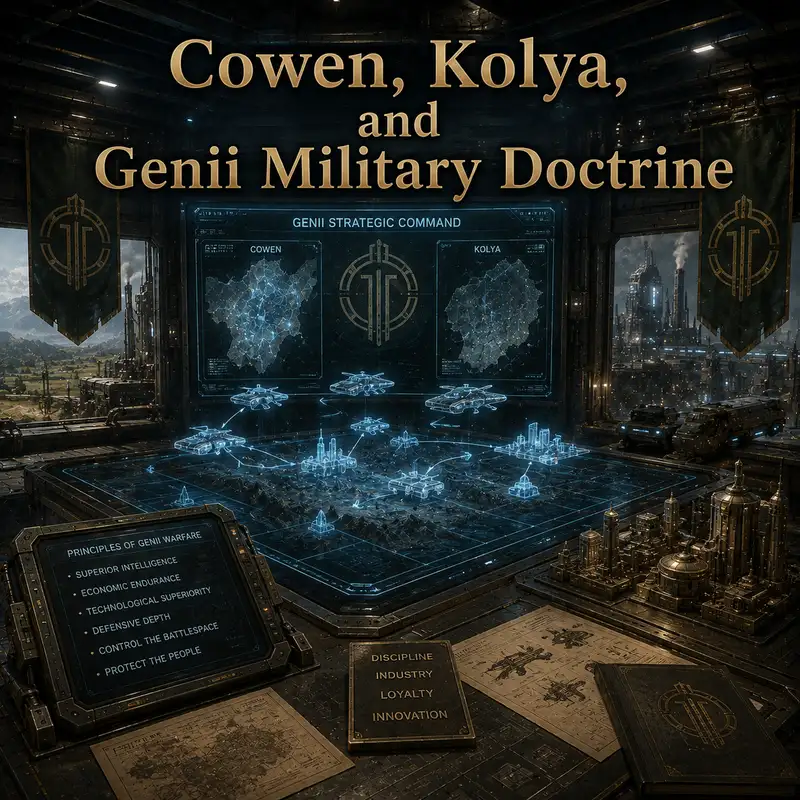
Cowen, Kolya, and Genii Military Doctrine
Chief Cowen had found the opportunity he had been waiting for. A planetary storm was forcing almost the entire Atlantis expedition to evacuate, leaving fewer than ten people inside the city. He ordered Commander Acastus Kolya to take a strike force through the Stargate, seize the control room, and remove the technology the Genii believed Atlantis had stolen from them. Kolya gave the answer professional commanders are paid to give and political leaders rarely enjoy hearing. His men were not ready. Cowen ordered the operation anyway.
That exchange defined Genii military doctrine under both men. Cowen thought in terms of national survival, secrecy, strategic weapons, and opportunities that might never return. Kolya thought in terms of readiness, surprise, force ratios, hostages, and the immediate mechanics of taking an objective. Together they made the Genii one of the most dangerous human powers in Pegasus. They also exposed the doctrine’s central weakness. A strategy built to survive the Wraith repeatedly turned possible allies into enemies.
The Genii had good reasons to distrust almost everyone. Their ancestors had belonged to a larger human confederation destroyed by the Wraith. Survivors withdrew into old bunkers and preserved enough scientific knowledge, military organization, and industrial capacity to rebuild beneath the surface. They did not restore visible cities. They created a concealed state. Farms, wooden buildings, and simple tools presented the image of an agrarian society. Underground, the Genii trained soldiers, refined uranium, operated laboratories, maintained communications equipment, and prepared for a war most of their trading partners did not know they were capable of fighting.
That survival method produced a highly militarized political culture. Research served defense. Agriculture supported concealment and mobilization. Intelligence was compartmentalized. Discovering the underground complex could be treated as a capital security breach. Cowen did not command a conventional open society that happened to possess an army. He governed a national resistance project whose citizens had spent generations preparing for one decisive campaign. Secrecy was not one policy among many. It was the institution that had kept the Genii alive.
Cowen’s strategic problem was severe. The Genii could build automatic weapons and atomic devices, but they had no fleet capable of challenging hive ships in open space. They could defend a bunker against human raiders. They could not stop orbital bombardment or a mass culling. Their doctrine therefore avoided a conventional contest. The Wraith had to be struck while hibernating, before their warriors mobilized and before their ships could disperse. Genii strategy was based on preemption because waiting for a fair fight meant waiting to lose.
A recovered Wraith Dart gave the Genii part of the intelligence required. Their scientists built an interface to the craft’s data-storage system and identified a dormant hive. The planned operation was to infiltrate sleeping ships, recover wider navigational information, and eventually place atomic weapons aboard as many hives as possible. The strikes would need to occur within a narrow period. Destroying only a few targets would awaken the survivors and expose the Genii homeworld. Their doctrine therefore demanded secrecy, patience, technical collection, and near-simultaneous attack on a galactic scale.
The plan was imaginative and operationally incomplete. The Genii could make a bomb before they could deliver one reliably into space. They needed gate addresses, transport, infiltration teams, current intelligence, and enough weapons for targets scattered across Pegasus. They also needed every unit to maintain security across years of preparation. One captured operative or one premature explosion could expose the entire campaign. The doctrine promised a decisive first strike because the Genii lacked the forces to survive a prolonged second one.
Atlantis appeared to supply what was missing. The expedition had cloaked Puddle Jumpers, advanced sensors, scientific expertise, explosives, medical supplies, and access to Ancient systems. It also needed food. When Sheppard’s team arrived to negotiate for crops, Rodney McKay detected radiation and uncovered the hidden complex. Cowen’s first response was not diplomatic embarrassment. It was a counterintelligence crisis. The visitors had discovered the state beneath the farms, and the normal Genii solution was to ensure that people carrying such knowledge did not leave.
Cowen chose cooperation because Atlantis offered capabilities worth the risk. McKay could improve the atomic program. Puddle Jumpers could reach space gates and approach Wraith vessels under cloak. Earth explosives could clear farmland and provide the trigger for the atomic program. The agreement remained coercive. The Atlantis team negotiated while surrounded by personnel who had considered killing them. Cowen was willing to call that an alliance because Genii doctrine measured relationships by access and utility more readily than by trust.
The timetable collapsed when Teyla forced Atlantis to admit that the Wraith had awakened early. Cowen had expected several more years before testing the first atomic weapon. Now active hives might detect the radiation McKay had already found from the surface. Cowen’s anger was rational. A foreign expedition had changed the threat environment for every human world in Pegasus and had done so before learning that the Genii existed. The Genii had built doctrine around a predictable culling cycle. Atlantis had removed the predictability.
The joint infiltration of a sleeping hive revealed how the Genii intended to operate once the war began. The mission emphasized stealth, intelligence collection, and strict obedience to the objective. When Teyla tried to free a human being held for future feeding, the Genii operative Tyrus stopped her. He believed one captive could not be allowed to compromise a campaign intended to save entire worlds. His decision to shoot the prisoner alerted the Wraith and destroyed the very stealth he was trying to preserve. It was doctrine at its harshest. The mission came before the individual, even when that sacrifice caused failure.
After the escape, Cowen attempted to seize the Wraith data and the Puddle Jumper. Sheppard had anticipated the move and kept additional cloaked craft in reserve. The Genii lost the intelligence they had helped recover and turned the expedition into an adversary. Cowen had treated control of the asset as more important than preserving the partnership that made the operation possible. It was a recurring Genii calculation. Cooperation could close a capability gap, but once the desired technology was within reach, taking it appeared safer than depending on an ally.
Cowen viewed Atlantis as both a prize and a strategic competitor. The city possessed Ancient databases, aircraft, medical knowledge, and a Stargate capable of supporting regional operations. It also occupied the symbolic center of Pegasus and could build alliances faster than the hidden Genii state. Cowen did not accept that newcomers from Earth had a stronger claim to those resources merely because they had arrived first. From his perspective, Atlantis was using technology from the Ancestors while the people who had survived the Wraith for generations remained exposed.
Kolya was the officer Cowen chose to correct that imbalance. He was an experienced commander and trainer, physically capable, disciplined, and far more realistic about tactical risk than his political superior. Cowen had commissioned him to turn guards and reconnaissance personnel into a strike force. When ordered to attack Atlantis during the storm, Kolya reported that the force was not ready. He explained that good training did not assume everything would go according to plan. This was a professional estimate of combat readiness, not reluctance to fight.
Cowen overruled him because the opportunity seemed too valuable to lose. That decision exposed the tension between Genii strategy and operations. Strategic secrecy produced rare windows for action. When one appeared, political leadership felt compelled to exploit it, even if the force designed for the mission had not completed its preparation. Kolya understood that surprise could compensate for weakness, but not for every weakness. Cowen understood that there might never be another moment when Atlantis was almost empty. Both were correct, which did not make the order sound.
The operation began with effective intelligence work. Smeadon of Manaria informed the Genii that Atlantis was evacuating. After Smeadon plied an Athosian farmer with alcohol, Genii personnel obtained his identification code and approached the gate posing as wounded evacuees. Atlantis lowered its shield. Kolya’s force entered, killed the gate guards, secured the control room, and captured Elizabeth Weir and McKay. A city protected from armies and orbital attack had been penetrated through its authentication procedure. The Genii did not defeat Ancient defenses. They persuaded the defenders to open them.
Kolya’s initial objectives were limited and practical. He demanded all of Atlantis’s C four, its medical supplies, the Wraith data device taken after the failed joint mission, and one Puddle Jumper. These items addressed immediate Genii requirements. Explosives supported mining and sabotage. Medicine protected a population exposed to radiation. The data supported anti-Wraith planning. The Jumper solved the delivery problem that weakened the atomic strategy. This was a technology-acquisition raid with a military purpose, not theft for prestige.
The mission expanded once Kolya saw Atlantis. A raid to recover material became an attempt to possess the city itself. Sora later reminded Ladon that the original purpose had been to retrieve what the Genii considered theirs. Ladon answered that a full company would be needed to control a facility of that size. Kolya requested reinforcements and began acting as an occupation commander. Mission creep had arrived before the first force had secured the objective, a development familiar to military institutions in several galaxies.
Kolya used hostages to compensate for insufficient numbers. Weir represented command authority. McKay possessed the technical knowledge required to save Atlantis from the storm. Kolya injured McKay, threatened Weir, and used both to pressure Sheppard into cooperating. He understood that the city itself was an enemy system. Its controls, generators, transporters, and gate shield could not be mastered quickly by Genii troops. Keeping the experts alive allowed him to use capabilities his force had not trained to operate.
Sheppard answered with an irregular defense. He hid the explosives, moved through the city using Ancient sensors and transporters, attacked isolated soldiers, and shut down power generators to force the Genii to disperse. Kolya recognized the method. Sheppard was dividing the invaders into manageable groups. Recognition did not solve the problem because Kolya still had to protect the control room, guard prisoners, recover supplies, repair power, and prepare for the storm. The city’s scale turned every additional mission requirement into another vulnerable detachment.
The reinforcement attempt became the operation’s decisive failure. Cowen sent a full company of roughly sixty personnel. Sheppard reached the control room as they began entering and raised the Stargate shield. Only five made it through before the connection ended. The others struck the barrier while Sora tried to stop the transmission. Kolya had lost more than sixty people in an operation he had warned was premature. The same chokepoint that enabled strategic surprise had converted the reinforcement route into a casualty mechanism.
Kolya did not collapse after the loss. He continued to use McKay and Weir to complete the storm-defense plan, repositioned his remaining troops, and eventually ordered an evacuation when the shield appeared to have failed. This was an important part of his command character. He could adapt, preserve survivors, and abandon an objective that had become impossible. He could also carry his personal conflict beyond the operational requirement. He tried to take Weir and McKay with him and used Weir as a shield during the final withdrawal. Sheppard shot him and forced him through the gate without the city.
The raid failed, but it demonstrated the strengths of Genii doctrine. Intelligence identified a temporary vulnerability. Deception bypassed the strongest fixed defense. A small force seized the command center of an installation vastly larger than its own base. Hostages allowed the attackers to exploit unfamiliar technology. Reinforcements were available through the gate. The doctrine produced tactical surprise and temporary control. It failed because intelligence about the target’s internal systems was incomplete, the force was undertrained, and political ambition expanded the mission beyond the available troops.
Kolya’s next operation returned to a narrower model. Genii intelligence placed an agent on Dagan and learned that Sheppard’s team was searching for a zero-point module. Kolya surrounded the excavation site, captured the team, and compelled McKay to complete the search. The objective was a portable strategic power source that might transform Genii capabilities. Once again, the method combined espionage, surprise, technical coercion, and acquisition. Sheppard used a concealed stun grenade to reverse the situation, recovered the team’s weapons, and left Kolya trapped rather than killing him.
That failure damaged Kolya’s standing. Ladon later explained that the failed Atlantis assault had already pushed him out of Cowen’s inner circle. Kolya believed Cowen’s rule had become corrupt and began considering a coup. Cowen retained Ladon because his scientific expertise remained necessary, while the commander who had challenged political judgment became increasingly expendable. The Genii state rewarded useful specialization, but its secrecy made disagreement look like disloyalty. A professional argument about readiness became part of a succession struggle.
Cowen’s later operation showed how far Genii doctrine had shifted from resistance toward expansion. Genii agents circulated rewards for Atlantis personnel carrying the Ancient technology activation gene. Major Evan Lorne’s team was captured, and false bodies were left to conceal the operation. Ladon approached Atlantis pretending to organize a coup and offered a depleted zero-point module as bait. Sheppard and other compatible personnel were drawn into a gas trap. Cowen then demanded all ten Puddle Jumpers and planned to use genetic samples to reproduce the Ancient interface trait.
The operation was sophisticated. It used technical intelligence, false casualties, political deception, human targeting, and a staged opposition movement. Its purpose was also revealing. Cowen was no longer seeking one craft for a specific anti-Wraith mission. He wanted the expedition’s entire Jumper force and the biological access required to operate it. Ladon claimed Cowen had become obsessed with uniting human worlds under one ruler because he believed only centralized control could defeat the Wraith. Whether every accusation was impartial is uncertain. Cowen’s conduct gave it credibility.
The same weapons program that strengthened Cowen’s government was poisoning Genii citizens through radiation exposure. Ladon’s sister and others sent to Atlantis for treatment became more than bargaining pieces. They were evidence that Cowen’s mobilization imposed costs on his own population while leadership continued demanding new assets. When Cowen refused to exchange prisoners and ordered Sheppard executed, Ladon completed a real coup inside the false one. He released the Atlantis personnel and detonated an atomic device beneath Cowen and his elite guard at an off-world facility.
Cowen died through the doctrine he had built. Compartmentalization allowed Ladon to conceal a second operation inside the first. Deception defeated the leader who relied on deception. An atomic weapon intended for the Wraith destroyed the Genii command group instead. Ladon described the change of government as bloodless because the explosion occurred away from the Genii homeworld, a definition that would have interested the people inside the blast radius. The state survived, but its doctrine had turned inward and settled a political dispute with the same preemptive logic intended for an alien enemy.
Kolya emerged from that struggle as a factional commander rather than an officer of the state. He believed Ladon had stolen the leadership that should have been his. His remaining network included loyal personnel and access to Genii identification codes. He ambushed Sheppard, held him with a captured Wraith, and demanded Ladon in exchange. At timed intervals, the Wraith fed on Sheppard while Kolya transmitted the results to Atlantis. The operation was carefully designed coercion. It was also strategically empty. A capable commander was spending trained personnel and intelligence resources to settle a claim of personal succession.
The plan failed because Kolya treated prisoners as tools while the prisoners developed interests of their own. Sheppard and the Wraith cooperated, escaped, and reached the Stargate area before Kolya’s forces could contain them. Ladon mobilized a brigade, and Atlantis used local intelligence to identify the base. Kolya withdrew rather than face a combined response. His tactical method remained recognizable: ambush, isolation, hostages, controlled communications, and a prepared escape route. What had disappeared was a credible national objective.
His final confrontation completed that decline. Kolya used a village and its inhabitants to bait Sheppard’s team, captured most of them, and again threatened executions to force Sheppard’s surrender. The operation had no connection to defeating the Wraith or protecting the Genii population. It was the warfare of a displaced commander whose personal enemy had become the objective. When the villagers resisted and his position collapsed, Kolya refused to surrender. Sheppard shot him before he could fire.
Genii doctrine was formidable when aligned with the conditions that created it. Concealment protected industry. Agricultural cover supported logistics. Intelligence networks compensated for weak sensors and absent starships. Gate infiltration allowed small units to strike beyond normal range. Atomic weapons offered a way to destroy hives without matching Wraith naval power. Commanders accepted long preparation because premature exposure could end the state. Few human societies in Pegasus combined industrial depth, strategic planning, and organized military force as effectively.
The weaknesses were equally structural. The Genii could seize a control room but not hold orbit. They could build atomic weapons but lacked a dependable delivery system. They could recruit informants across many worlds but struggled to maintain allies who knew they might be betrayed once their usefulness ended. Their doctrine assumed information must be controlled, technology must be captured, and vulnerability must be exploited before someone else did the same. That assumption protected the bunkers and poisoned diplomacy.
Cowen and Kolya represented two sides of the same military culture. Cowen was the strategic mobilizer who preserved a hidden industrial state and gave it an ambitious theory of victory. He also allowed opportunity, fear, and political control to turn defense into expansion. Kolya was the professional operator who understood readiness, surprise, and the use of limited forces. He also allowed coercion and rivalry to turn military skill into personal warfare. Each man saw part of the problem clearly. Neither could keep the doctrine inside the limits that made it useful.
The Genii survived because they knew that a visible army would be destroyed before it was ready. Their tragedy was that hiding an army for generations taught the state to treat every relationship as another concealed operation. Cowen built weapons to free human worlds and died beneath one of them. Kolya warned against committing an unready strike force, then spent his final years leading smaller forces into increasingly personal battles. The farms concealed a real military power. They could not conceal what that power had become.