Daedalus: The Lifeline to Atlantis
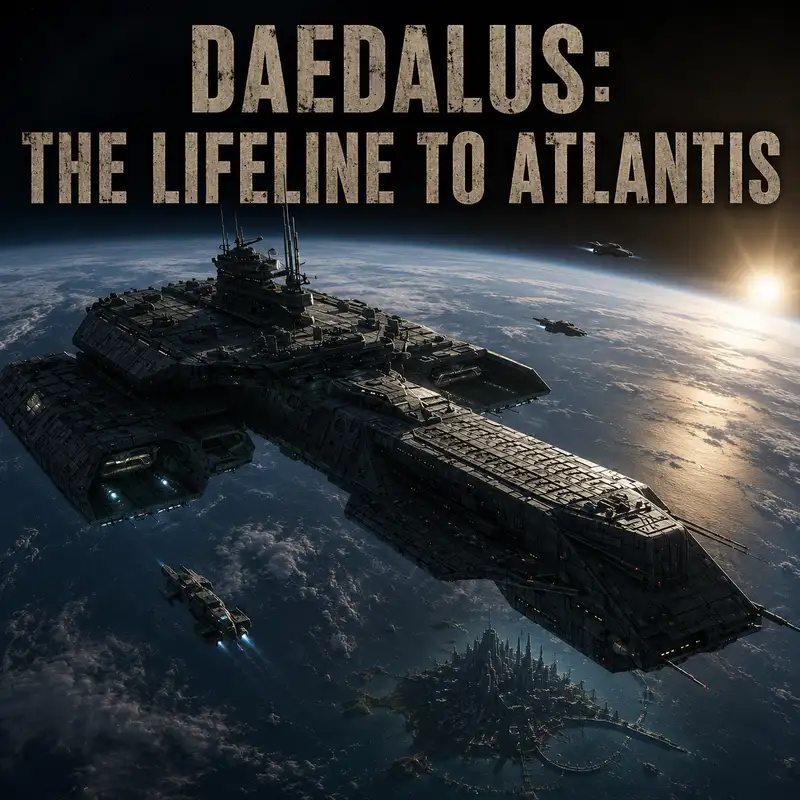
Daedalus emerged from hyperspace over Atlantis at the moment the expedition had begun to run out of ways to die slowly. Wraith forces were inside the city, another hive ship remained in orbit, and John Sheppard was flying a nuclear-armed Puddle Jumper toward a target he did not expect to survive. Colonel Steven Caldwell ordered Sheppard to decloak. The battlecruiser then pulled him out of the Jumper with an Asgard transport beam and delivered a zero-point module directly into Atlantis. The expedition’s one-way mission had just acquired a return address with engines.
The ship arrived as a warship, and its weapons mattered immediately. Its deeper importance was logistical. Daedalus connected an isolated expedition in the Pegasus galaxy to the personnel, industry, medicine, political authority, and military power of Earth. Before its arrival, Atlantis survived largely on what the original expedition had carried through the Stargate, what it could recover locally, and what its teams could negotiate from Pegasus societies. Afterward, the city remained distant and vulnerable, but it was no longer strategically alone.
That distinction defined the ship’s service. Daedalus was not merely assigned to Atlantis. It became the physical route by which Atlantis remained an Earth expedition rather than an independent settlement formed by accident. Its voyages moved more than crates. They moved replacements, orders, technical knowledge, classified reports, senior leaders, and the consequences of decisions made in another galaxy. Every departure created a gap. Every return changed what the city could attempt.
The original expedition had entered Atlantis with no guarantee of coming home. Earth could dial the city only with the extraordinary power of a zero-point module, and the module used to establish the first connection could not simply be sent through while sustaining the same wormhole. Once Atlantis reached the surface of Lantea, its remaining power reserves were barely sufficient to keep the city alive. The Stargate connected the expedition to nearby Pegasus worlds, but not routinely to Earth.
Isolation shaped everything. Ammunition had to be conserved. Medical supplies had to last. Damaged equipment could not be returned to the manufacturer, partly because several manufacturers did not know the equipment was being used in another galaxy. Personnel losses could not be replaced on normal schedules. A diplomatic error could not be referred to a larger embassy. Elizabeth Weir commanded an international expedition whose higher headquarters was almost three million light-years away and usually unavailable for comment.
The Wraith siege turned that inconvenience into an existential problem. Atlantis had awakened an enemy population far earlier than the normal culling cycle and had drawn hive ships toward the city. The expedition prepared to evacuate through the gate and destroy Atlantis rather than allow the Wraith to recover Earth’s location. A brief wormhole from Stargate Command brought Colonel Dillon Everett, Marines, railguns, nuclear weapons, and news that Daedalus was on the way. The defenders now had to survive long enough for a ship they had never seen to reach them.
The first journey was unusually fast because the zero-point module intended for Atlantis was temporarily tied into Daedalus’s power systems. With that additional energy, the ship crossed the intergalactic distance in roughly four days. Once the module was removed, normal travel took about eighteen days. The first rescue therefore depended on borrowing the city’s future power supply to accelerate the vessel carrying it. This was efficient, elegant, and not a procedure Earth could repeat whenever the schedule became inconvenient.
Delivering the module immediately reduced Daedalus’s own shield strength. Caldwell knew the trade. Atlantis needed the power source to raise its city shield, while the battlecruiser needed it to fight at maximum defensive capacity. The decision placed the strategic asset where the civilian population and Ancient database could survive. Daedalus accepted greater risk in orbit so the city below could remain in the war. Logistics is often described as moving supplies. In this case, it was deciding which command would be less protected after the delivery.
The ship’s Asgard transporters changed the battle before its conventional weapons did. Daedalus recovered Sheppard from his suicide mission, beamed the zero-point module into the city, and later placed a nuclear warhead inside a Wraith hive ship after Hermiod bypassed restrictions intended to prevent the transporter from becoming a weapons-delivery system. The Wraith adapted by interfering with the beam. The exchange established a pattern that would continue throughout the Pegasus war. Earth would introduce a new capability. The Wraith would survive long enough to study it.
Daedalus helped destroy the immediate attackers, launch fighters, and reinforce the city. It could not defeat every Wraith force moving toward Atlantis. The defenders still relied on the city shield, deception, and a staged nuclear detonation that made Atlantis appear destroyed. The first mission succeeded because ship, city, fighters, and expedition personnel acted as one force. Daedalus did not replace Atlantis’s defenses. It kept enough of them alive to make the deception credible.
Once the siege ended, the zero-point module stayed in Atlantis. That decision secured the city but returned Daedalus to its normal intergalactic pace. Eighteen days in hyperspace was an extraordinary achievement compared with every conventional form of transportation Earth had known. For a remote garrison awaiting spare parts, eighteen days remained eighteen days. A round trip consumed more than a month before loading, repairs, briefings, and delays were considered.
The voyage created a recurring operational clock. When Daedalus departed Atlantis, the expedition knew that major reinforcement could not reverse course instantly. When the ship left Earth, Homeworld Command committed a capital asset to a long corridor with limited opportunity for diversion. A crisis occurring shortly after departure might end before the ship could arrive. The battlecruiser shortened intergalactic distance without abolishing it, a distinction rarely appreciated by people submitting urgent requests after the cargo manifest had closed.
The first return journey after the siege demonstrated what the route would carry. Weir, Sheppard, Rodney McKay, Carson Beckett, and other senior personnel traveled to Earth for debriefing and for decisions about the expedition’s future. They participated in selecting new staff and discussed an increased military presence. Atlantis was no longer a group beyond practical supervision. Daedalus allowed Earth’s political and military institutions to review the mission, replace personnel, alter command arrangements, and send the expedition back with reinforcements.
That connection worked in both directions. Expedition members could return to Earth for limited leave, medical care, reassignment, or consultation. New scientists, technicians, physicians, and military personnel could join the city after receiving training and clearance. Equipment too large, delicate, or power-intensive for routine gate movement could travel aboard the ship. The screen record does not provide a complete cargo ledger, but the repeated voyages made sustained staffing and resupply possible in a way the original one-way deployment never had.
The ship also carried institutional culture. Caldwell commanded Daedalus through a United States Air Force chain of command. Weir led Atlantis as a civilian at the head of an international expedition. Sheppard commanded the city’s military forces while remaining subordinate to both local civilian authority and senior officers from Earth. Daedalus’s arrival therefore introduced a second command center with its own captain, mission, rules, and access to Washington. The lifeline supplied help. It also supplied arguments about who was authorized to decide how that help would be used.
Caldwell did not become Weir’s subordinate merely because his ship entered Atlantis orbit. Weir did not lose control of the expedition merely because a colonel arrived with stronger weapons. Their relationship required negotiation between operational commands. Caldwell controlled his vessel and crew. Weir controlled the city’s broader mission. Sheppard often stood between them, translating Pegasus experience into terms a ship commander could use and translating military necessity into terms a civilian leader could accept. Intergalactic logistics had acquired a command-and-control annex.
Daedalus gave Atlantis a mobile reserve that the city had never possessed. F three-oh-two fighters could be launched where Puddle Jumpers lacked the weapons or endurance for sustained combat. Transporters could retrieve personnel without landing. Sensors could search systems beyond the city’s immediate reach. The battlecruiser could remain in orbit while teams operated below, provide medical and engineering support, and extract survivors if the local Stargate became inaccessible. These capabilities made distant missions possible, but every sortie risked the same ship carrying the next month’s supplies.
The first routine return to Pegasus nearly converted that lifeline into an enemy delivery system. A Wraith computer virus had entered Daedalus during the defense of Atlantis. It remained concealed as the ship traveled to Earth and began acting during the eighteen-day voyage back. Two members of the technical staff died while investigating apparent malfunctions. What looked like sabotage by a person was actually an adaptive program protecting itself inside the ship’s connected systems.
The virus sought control of navigation and propulsion. If it could deliver Daedalus to the Wraith, they would gain access to an intergalactic hyperdrive, Asgard technology, the ship’s databases, and navigational information leading toward Earth. When it could not take full control quickly enough, it transmitted a distress signal intended to bring the Wraith to the ship. The first supply run had become a counterintelligence emergency with the location of the homeworld at stake.
McKay and Hermiod attempted a complete system shutdown using clean backups. Sheppard destroyed the long-range transmitter from an F three-oh-two when software control could not silence it. The virus then hid inside a fighter’s navigational computer, survived the reboot, and returned to the battlecruiser’s network. The same compatibility that allowed human fighters and Asgard-derived ship systems to operate together gave the hostile program another place to survive. Integration had improved capability and enlarged the attack surface.
The crew finally removed the fighter memory modules, isolated the remaining infected computer, and purged the system. Daedalus resumed its route, but the strategic meaning had changed. The corridor between Earth and Atlantis was not merely a supply line crossing empty space. It was an intelligence target. A compromised ship could reveal both galaxies, transport enemy code, or place advanced human and Asgard systems in Wraith hands. The lifeline had to be defended from inside as carefully as from outside.
Daedalus carried the information required to find Earth and the means to cross the distance. The Wraith did not need to capture Atlantis if they could capture the ship intact. Caldwell therefore had to consider destruction of his own vessel if control was lost. The crew responsible for delivering the expedition’s supplies might also be responsible for ensuring that one particular shipment never arrived.
The ship’s combat duties grew because threats to Atlantis rarely remained near Atlantis. After an attempted alliance with a Wraith faction collapsed, hostile hive ships obtained information about Earth and moved toward the Milky Way. Daedalus and the recovered Ancient warship Orion pursued them. Both Earth-aligned vessels entered the battle with limitations. Orion was not fully restored. Daedalus had already absorbed damage and could not assume that its shields would survive a prolonged engagement.
The interception stopped the immediate threat, but at high cost. Orion was destroyed. Daedalus was badly damaged. One hive was destroyed, and the remaining Wraith vessel was disabled and later captured through a combined operation involving Sheppard’s team and Michael. The outcome protected Earth and Atlantis, yet it also placed the primary supply ship out of normal service. Every battle damage report was also a logistics delay for the expedition waiting at the far end of the route.
That was the operational burden of making one ship perform several strategic roles. Daedalus was expected to escort, intercept, resupply, evacuate, transport officials, deploy fighters, and defend the city. A dedicated freighter could have carried more supplies. A dedicated warship could have accepted greater combat risk. Earth did not have enough intergalactic vessels to separate those missions. The battlecruiser became valuable because it was flexible and vulnerable because every task competed with every other task.
The long transit forced Atlantis to maintain local resilience. The expedition still needed Pegasus allies, off-world food sources, medical improvisation, local intelligence, and teams able to repair Ancient systems without waiting for Earth. Daedalus reduced isolation but did not remove it. A shipment could replace equipment. It could not instantly replace trust with the Athosians, knowledge of Wraith politics, or experience navigating the city’s database. The most important local capabilities remained people already in Pegasus.
The ship also changed the tempo of personnel life. By the later period, expedition members received limited leave on Earth, but the voyage itself consumed weeks. Two weeks at home could require three weeks aboard Daedalus for the return. Time away from duty therefore became a strategic resource, not merely a personnel benefit. Families on Earth saw people who lived in another galaxy for brief intervals separated by long classified absences. The ship carried them home, while reminding them how far home had become.
The McKay-Carter intergalactic gate bridge later offered a faster route for personnel and messages. A chain of Stargates positioned between galaxies reduced the journey to roughly half an hour when the system functioned. Daedalus supported the first test and monitored the midpoint. The bridge threatened to make the ship less important as a passenger service. It did not replace heavy transport, fighter carriage, rescue, orbital firepower, or the movement of equipment that could not pass easily through the gate system.
During that test, Daedalus detected an object moving between galaxies at nearly the speed of light. The contact proved to be Tria, an Ancient warship carrying Lantean survivors who had traveled for thousands of years after their hyperdrive failed. Daedalus intercepted the vessel and helped bring its crew to Atlantis. The supply ship had found the city’s original owners on the very route created to connect Earth with their abandoned base.
The encounter produced a political reversal. The surviving Ancients resumed control of Atlantis and ordered the Earth expedition to leave. Daedalus had not created their legal claim, but its patrol along the intergalactic route had brought the claimants home. A ship built to sustain the expedition had delivered the people who ended it. Logistics is politically neutral in the same way a transport aircraft is neutral. It carries the consequences of whoever appears on the passenger list.
When the Asurans attacked and killed the returned Ancients, members of the expedition retook the city in defiance of orders. Daedalus then resumed its familiar role. It returned people, equipment, and support to an installation whose legal status had changed several times without moving from the same ocean. The episode demonstrated why the ship mattered beyond combat. Atlantis could be reinforced, evacuated, reclaimed, and reconstituted because Earth possessed a vessel able to move an institution, not just a team.
The bridge itself was later destroyed during a Wraith incursion, restoring the importance of ship travel. Even when a faster personnel route existed, it depended on fixed gates, control software, a midpoint station, and security at both ends. Daedalus remained slower but more flexible. It could alter course, carry fighters, approach a world without a functioning gate, and fight its way through an interception. The gate bridge was a corridor. The battlecruiser was a corridor with a commander.
Daedalus also served as the expedition’s emergency recovery force. It could beam teams from collapsing facilities, search for missing craft, transport wounded personnel, and approach worlds whose Stargates were unusable. Not every rescue succeeded, and the vessel was often days away when the emergency began. Its value was the existence of an extraction route independent of the local gate.
That qualification mattered. Daedalus spent substantial time in transit, under repair, or on combat missions. Atlantis sometimes faced attack while the vessel was outside useful range. Commanders could request its return, but hyperspace still required time. The ship’s availability became part of every major plan. An operation conducted while Daedalus was in orbit had fighter support, transport beams, and a capital ship reserve. The same operation conducted a week later might have only Puddle Jumpers and an apology from Homeworld Command.
The ship’s regular presence tied Atlantis more closely to Earth’s policy. Reports, inspectors, and senior officials could move on a predictable route, allowing Homeworld Command and the International Oversight Advisory to exert greater control. Personnel in Pegasus understood Wraith politics that could not be managed from a conference room. Earth officials controlled the resources the expedition needed. Daedalus carried both perspectives, sometimes in adjacent compartments.
By the final years, other B C three-oh-four ships shared the Pegasus burden. Daedalus remained most closely associated with Atlantis because it had established the route and accumulated the crew experience required to operate there. It was no longer the only lifeline, but it was the vessel whose arrival had first changed isolated survivors into a sustained forward command.
The Wraith super-hive demonstrated the limit. Daedalus engaged the zero-point-module-powered vessel and was unable to stop it from beginning the journey toward Earth. Other Earth ships later attempted interception and failed. Atlantis itself had to pursue the threat. The ship that had connected Earth to Pegasus could not guarantee that danger discovered in Pegasus would remain there. A lifeline is also a trail, and sufficiently determined enemies can follow it in the opposite direction.
Daedalus mattered because it made endurance possible. Its weapons saved Atlantis during the siege, but its recurring voyages saved the expedition over years. The ship brought power when the shield was failing, people when the staff was depleted, and authority when Earth needed to reassert control. It also carried hostile code, political pressure, and the risk that Wraith intelligence would reach the homeworld. Every benefit crossed the same route as its corresponding vulnerability.
Atlantis survived not because Daedalus removed the distance between galaxies, but because its crew learned to manage that distance repeatedly. They scheduled departures, repaired combat damage, protected navigational data, loaded fighters, moved civilians, and returned to a city whose crisis had usually changed while they were in hyperspace. The expedition called the ship when it needed Earth. Earth sent the ship when it needed Atlantis to remain part of its strategy.
When Daedalus first appeared above the city, it carried the one power source that could raise the shield and the one transport beam that could save Sheppard. That arrival looked like rescue. The years that followed revealed something more demanding. Rescue happens once. A lifeline must keep returning, even after the enemy learns the route, the ship takes damage, and both ends begin placing more weight on the connection than one hull was ever designed to carry.