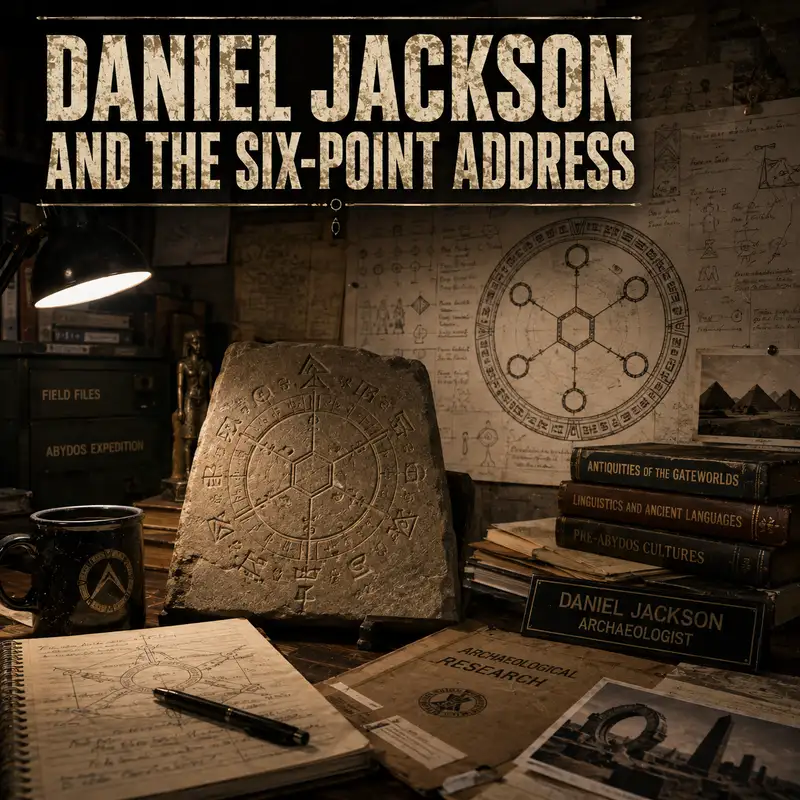
Daniel Jackson and the Six-Point Address
The gate had accepted six symbols and refused the seventh for two years. Project Giza could rotate the ring, energize the chevrons, and drive enough power into the device to make the entire underground complex tremble. The machinery was working. The problem was that no one understood what the symbols were doing. The United States had built an elaborate control system around an alien doorway and still lacked the one piece of information required to tell it where the journey began.
Daniel Jackson solved that failure by asking a question the project had stopped asking. Were the outer markings really words? The established team had treated them as an unknown script because they appeared beside Egyptian inscriptions on ancient cover stones. Daniel recognized that the assumption itself might be wrong. The marks were not a sentence waiting to be translated. They were constellations arranged as a navigation system. Six identified a destination. A seventh established the point of origin. The difference between those two functions turned a buried artifact into an operational route between worlds.
Catherine Langford recruited Daniel when his academic career was at its weakest. His public arguments about the age and builders of the pyramids had isolated him from mainstream archaeology. Grants had disappeared, professional support had collapsed, and even his lecture audience was prepared to leave before he finished. Catherine did not need to accept every one of his theories. She needed a linguist and archaeologist willing to test an unfashionable interpretation against physical evidence. The qualities making Daniel difficult to employ in ordinary academia made him unusually useful inside a classified program built around an impossible object.
The recruitment was not sentimental. Catherine knew he had been evicted, his funding was gone, and almost everything he owned could be carried in two bags. She offered translation work, transportation, and access to material no other scholar had seen. It was an intelligence-style acquisition of talent. She identified the candidate, understood his vulnerabilities, and offered the one incentive more powerful than professional security: evidence that might prove the accepted historical model incomplete. Daniel agreed before he knew the job was connected to the machine that had shaped Catherine’s life.
Inside the converted military facility, Daniel first saw the cover stones rather than the Stargate. That sequence mattered. The project’s engineers had spent years studying the ring as hardware. Daniel encountered the archaeological context that explained how ancient people had described and concealed it. He immediately corrected parts of the existing translation. The inscription did not describe coffins or a conventional doorway to heaven. It referred to something sealed and buried for all time, and to a Stargate associated with Ra. The project possessed a warning, but its translation had softened the warning into ritual language.
His correction demonstrated more than technical fluency. Daniel understood that a mistranslated noun could redirect an entire research program. Calling the object a religious doorway encouraged symbolic interpretation. Calling it a Stargate suggested function. The military wanted to know what the artifact could do. The archaeologists wanted to know what the inscriptions meant. Daniel showed that those were not separate questions. The ancient vocabulary was part of the operating picture, because the people who buried the gate had known enough about its purpose to fear its use.
The outer track remained the harder problem. Project specialists had compared the markings with known hieroglyphic, hieratic, cuneiform, and predynastic writing systems. Daniel initially did the same and found no match. The breakthrough came when he stopped treating the marks as characters with sounds and meanings. A familiar constellation pattern revealed that at least one glyph was a stylized star formation. Once Orion could be recognized, the other symbols no longer belonged in a linguistic catalogue. They belonged on a map.
This was the critical act of analysis. Daniel did not discover a missing piece of metal or uncover a forgotten file. He changed the category of the evidence. Organizations often fail in exactly this way. They gather accurate data, assign it to the wrong problem, and then become more confident as repeated analysis produces no result. Project Giza had excellent images of the symbols. It had experts, computers, funding, and years of labor. What it lacked was permission to say that the original framing had been mistaken.
Daniel presented the address as seven points defining a course. In the model he drew for General West and the research team, six reference points described a location within three-dimensional space. Paired across three axes, they enclosed or intersected at the destination. The seventh point identified where the traveler was starting. The explanation was simple enough for a briefing room and useful enough to guide the dialing computer. It was not a complete account of Ancient wormhole mathematics. It was the conceptual model Earth needed to operate the system.
The six-point portion answered the question, where is the destination? Each glyph represented a constellation used as a spatial reference. Taken together, the six symbols selected one region from the enormous volume of space available to the network. The Stargate did not need a human-readable planet name. It needed a coordinate pattern recognized by compatible gates. The address therefore survived political change, conquest, and the disappearance of the civilization that created it. A planet could be renamed a hundred times while its gate still answered to the same route.
The seventh symbol answered a different question. Where is the dialing gate? A course requires both destination and origin. Project Giza had repeatedly entered the six symbols carved inside the cartouche, then reached the same dead end because the sequence was incomplete. The gate was not rejecting the destination. It was waiting for the final instruction that placed Earth on the route. Six points told the system where to go. The point of origin told it from where.
The missing symbol was not truly missing. It was positioned below the cartouche rather than inside the six-symbol sequence. On the Earth installation, Daniel interpreted it as a pyramid with the sun directly above it, accompanied in the cover-stone image by figures on either side. The project had separated the image from the address because it did not look like the other constellation symbols and did not occupy the same frame. Daniel recognized that its difference was evidence of a different function, not proof that it was decorative.
That placement explains why experienced specialists overlooked it. Their work had become organized around the assumption that the cartouche contained the full code. The computer expected a seventh entry, but the archaeological team searched for it among the six matching symbols. The point of origin sat in plain sight while institutional procedure made it almost invisible. Daniel’s advantage was not that he knew more astronomy than every scientist present. It was that he could move between inscription, image, artifact, and operational requirement without treating the boundaries between disciplines as fixed.
When the blast shield rose and Daniel finally saw the Stargate, the theory could be tested against the machine. The point-of-origin glyph appeared on the ring. That physical match converted an interpretation into an actionable sequence. General West authorized the seventh symbol to be programmed. The chevrons locked one by one, the power demand rose, and the gate reached the point where every earlier attempt had stopped. Then the final chevron engaged.
The event horizon formed because Daniel had supplied one symbol, but the achievement belonged to a much larger system. Engineers had created mechanical rotation and power controls without a dial-home device. Computer specialists had built software to track glyphs and chevrons. Catherine had preserved the project and recruited the right analyst. Military authorities had funded and secured the facility. Daniel did not make the gate work alone. He supplied the missing concept that allowed years of technical preparation to become useful.
The operational consequences were immediate. Before the seventh chevron, the Stargate was a classified research object with possible weapons value. After it, the device was a transportation route to an unknown location. The chain of command had to consider reconnaissance, environmental hazards, hostile forces, return procedures, and the possibility that the far side offered a direct path back into the American facility. A translation problem became a national-security problem in the time required for the wormhole to stabilize.
A tracked probe crossed first and transmitted images of another gate, an enclosed chamber, and environmental readings compatible with human survival. The reconnaissance reduced some risks while revealing another. The receiving installation did not provide an obvious Earth-style point of origin, and the expedition would have to establish a new outgoing connection to return. The gate did not function like an open tunnel that remained available in both directions. Once the first connection ended, the team would need the local address components, power, and controls required to dial Earth.
Daniel claimed he could identify the return sequence. General West placed him on the mission because no one else could make that claim with any credibility. This was an unusual personnel decision. The expedition was military, carried weapons, and included a nuclear demolition option. Daniel had no combat training and had only recently learned that the Stargate existed. Yet without him, the team could reach the destination and might have no way home. Linguistic and archaeological expertise had become an extraction requirement.
His confidence exceeded the evidence. Daniel knew the six symbols for the outward destination and understood that a local point of origin should exist. He did not know what form that symbol would take on the far side or whether the receiving site preserved an intact record of Earth’s address. The mission accepted that uncertainty because the alternative was to abandon the first viable reconnaissance opportunity. The plan was therefore built around a specialist who understood the system better than anyone on Earth and still did not understand enough to guarantee recovery.
On Abydos, that gap became immediate. The team arrived safely, but the local gate markings did not provide Daniel with an obvious return solution. The six symbols used to define Earth’s location had to be recovered from local records, and the seventh had to identify Abydos as the origin. Daniel’s promise had helped secure approval for the mission. His inability to fulfill it on schedule meant the military team was stranded with limited supplies, an unknown population nearby, and a commander carrying orders that included destroying the gate.
This was not a simple academic embarrassment. Return navigation shaped every operational decision. Ammunition, batteries, food, medical support, and communications were finite. The team could not request reinforcement after the wormhole closed. Colonel O'Neill had planned to send most personnel back while remaining behind with the nuclear device if the destination proved dangerous. Without a return address, the entire force became part of the demolition problem. Daniel’s search for symbols was therefore as urgent as any patrol or security task.
His fieldwork began with people rather than machinery. The inhabitants of Abydos spoke a language related to ancient Egyptian forms, but centuries of separation had changed pronunciation and usage. Daniel used gesture, shared symbols, observation, and gradual linguistic reconstruction to communicate. The Eye of Ra pendant Catherine had given him initially caused the population to associate the visitors with Ra, creating both access and misunderstanding. Daniel’s value lay in recognizing that communication was not a secondary courtesy. It was the method by which the team could learn who controlled the world and where the return information might be hidden.
He also discovered that writing had been forbidden. Ra’s regime understood literacy as a security threat because written records could preserve the truth about occupation, rebellion, and the Stargate. That prohibition had direct operational consequences for the Earth team. The local population could not simply produce a manual or written address on demand. Information survived in concealed inscriptions, cultural memory, images, and symbols whose meaning had to be reconstructed under pressure.
A hidden chamber finally provided the six symbols required to locate Earth. The cartouche confirmed that the return route had been deliberately preserved, but the portion containing the seventh symbol was broken and worn away. Daniel had recovered the destination and lost the origin again. The same structural distinction that solved Project Giza now trapped the expedition. Six points could identify Earth perfectly. They were useless unless the gate also knew the journey began on Abydos.
The solution came from local knowledge rather than a recovered Ancient database. Skaara drew a pyramid beneath the world’s three moons while depicting the hoped-for victory over Ra. Daniel recognized the arrangement as a symbol. The image represented Abydos itself and therefore served as the local point of origin. The people of Abydos had preserved the answer in their sky and culture even though formal writing had been suppressed. Daniel found it because he treated a young man’s drawing as evidence rather than decoration.
This moment completed the logic of the address. The first six symbols were portable. They described the destination Earth from anywhere in the Milky Way network, subject to the network’s changing coordinates and technical corrections. The seventh was local. It told the gate which installation was dialing. Daniel had first identified Earth’s origin symbol below the Giza cartouche. On Abydos, he identified a different origin through the planet’s distinctive relationship between pyramid and moons. The destination remained Earth. The starting point had changed.
Once the local symbol was known, the team could dial home. That did not by itself defeat Ra or complete the mission. It restored freedom of maneuver. A force with an extraction route can choose whether to stay, withdraw, evacuate civilians, or commit to a final action. A force without one is operating under a shrinking clock. Daniel’s discovery changed the mission from involuntary isolation to a campaign in which return became possible if the gate, dialing mechanism, and surrounding terrain could be secured.
The address also altered Daniel’s role inside the team. He had entered as a civilian specialist whose principal task was translation. On Abydos, language led to political intelligence, intelligence led to the hidden history of Ra, and cultural observation led to the return route. He became the link between local population and military force. The soldiers could protect him, but they could not replace what he was collecting. Daniel could not defeat Ra’s guards alone, but without his work the expedition might never have understood whom it was fighting or how to leave.
After Ra’s defeat, Daniel remained on Abydos and continued studying the ruins. He eventually found a much larger collection of seven-symbol groups showing that the first address was not an isolated route. It belonged to a network extending across the galaxy. Earth teams initially failed to use the other combinations because the old coordinates no longer matched the current positions of stellar bodies. Daniel raised the possibility of drift. Captain Samantha Carter converted that insight into calculations the dialing computer could apply.
That partnership reveals why the six-point address mattered beyond one mission. Daniel could recognize that an ancient image was a map and that a failed address might reflect historical movement rather than false data. Carter could model the displacement, adapt the human dialing system, and turn archaeological information into repeatable navigation. Neither discipline was sufficient alone. The Stargate Program became viable when culture, astronomy, engineering, and military operations were treated as parts of the same problem.
Later understanding refined the early model. Dial-home devices handled power, symbol entry, and network functions that Earth’s substitute computer had to imitate. Gates used local points of origin, while the broader network compensated for changes its Ancient builders had expected. Eight-symbol and nine-symbol sequences would later reach beyond ordinary planetary travel, but the basic seven-symbol logic remained the foundation of Milky Way operations. Daniel’s briefing-room diagram was simplified, as most useful diagrams are. It was accurate enough to open the door.
The institutional lesson is less flattering. Project Giza possessed the ring, the cover stones, the six-symbol destination, and the physical point-of-origin glyph. It failed because those pieces were divided among specialists and interpreted through assumptions that had hardened into procedure. Daniel succeeded because he could challenge the categories protecting the error. His lack of status made that easier. He had fewer institutional investments to defend and very little career left to lose.
The military lesson is that navigation is command capability. A unit can possess weapons, communications, and courage, yet remain strategically helpless if it cannot identify its position and route home. The six symbols gave Earth a destination. The seventh gave Earth agency. It allowed commanders to send forces deliberately rather than merely activate a phenomenon. It also allowed stranded personnel to become a returning expedition instead of a lost patrol.
Daniel Jackson’s decisive contribution was therefore not simply translating an inscription. He demonstrated how the Stargate had to be understood: as technology embedded in history, geography, language, and political control. The ring did not separate science from archaeology or operations from culture. Project Giza had done that for administrative convenience, and the gate had remained closed. Daniel reunited the evidence.
The final symbol was a point of origin, but it also described Daniel’s place in the program. He began outside the military, outside accepted scholarship, and outside the technical team that had spent years trying to activate the gate. From that position, he could see what the established system had missed. Six points identified another world. The seventh identified where the journey started. Humanity reached Abydos only after Daniel Jackson taught the most secret project on Earth to understand its own location.