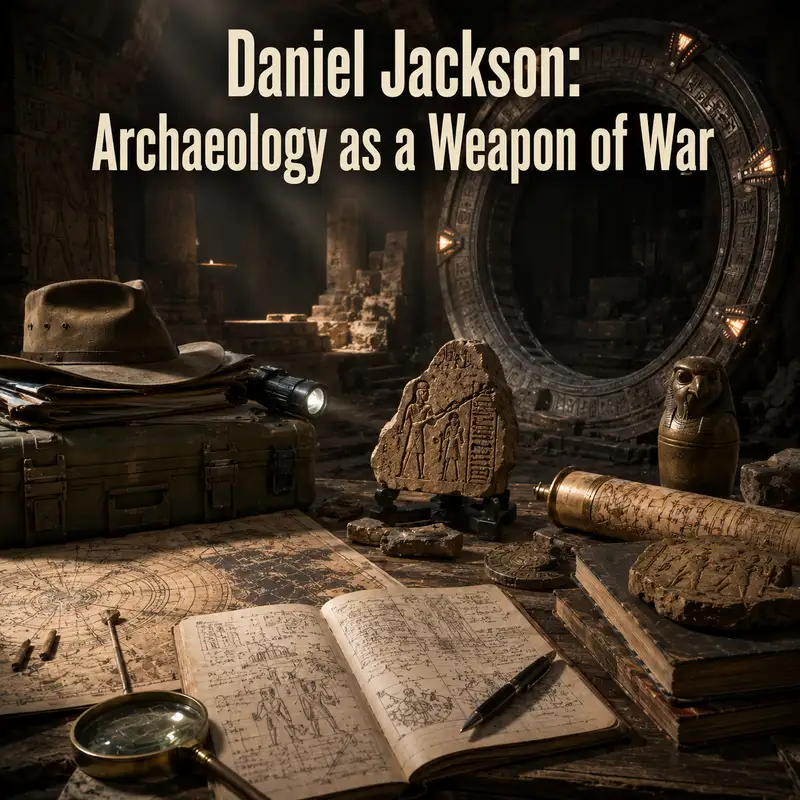
Daniel Jackson: Archaeology as a Weapon of War
The warning arrived as a broken alien message while an alternate Earth was already being conquered. Daniel Jackson translated the words, recognized that a sequence of numbers represented Stargate symbols, and reconstructed the address from which Apophis's invasion force had launched. He carried that intelligence back to his own reality. Stargate Command used it to place S G One aboard the approaching motherships, where a small team destroyed an attack that Earth's conventional weapons could not stop. The decisive act had not been a missile launch or a firefight. It had been the interpretation of language, symbols, and cultural context under pressure. An archaeologist had converted a dead civilization's warning into targeting intelligence, and Earth survived because he knew that six numbers could describe a place in space.
Daniel became one of Earth's most effective strategic assets without fitting the normal description of a warrior. He was not the team's primary tactician, engineer, or weapons specialist. His battlefield was meaning. He read inscriptions concealing gate addresses, recognized myths as distorted records of alien contact, identified political messages embedded in ritual, and understood that an artifact could be a weapon, a treaty mechanism, a prison, or all three. In the Gate War, archaeology was not merely the study of the past. It was intelligence exploitation. Ruins contained command systems. Religious stories preserved enemy history. Ancient languages controlled machines. Cultural memory could reveal an ally, expose a false god, or prevent a mining dispute from becoming a massacre. Daniel turned those fragments into choices commanders could use.
His path to that role began with professional isolation. Daniel was the child of archaeologists, and the death of his parents during the installation of an Egyptian artifact left scholarship as both inheritance and refuge. He became an Egyptologist and linguist, then damaged his academic career by arguing that accepted pyramid history did not explain all the evidence. His colleagues treated the theory as professional self-destruction. Catherine Langford treated it as a qualification. She brought him into the classified project studying the ring recovered at Giza because conventional approaches had failed. The military possessed the machine, electrical power, security, and technical experts. It lacked someone willing to question whether the markings were words at all.
Daniel translated the coverstone inscription and recognized that the unfamiliar symbols represented constellations. Six established a destination. A seventh identified the point of origin. That breakthrough allowed the dialing system to complete a connection to Abydos. It is tempting to describe this as a lone genius opening the Stargate, but the result was institutional. Engineers built the interface. Scientists studied the device. The Air Force supplied power, containment, and the expedition. Daniel supplied the interpretive key that made their work operational. This pattern repeated throughout his career. He rarely created the machinery. He explained what it meant, who had built it, what assumptions were hidden in its controls, and why the obvious use might be wrong.
Abydos transformed him from academic consultant into field operator. The expedition depended on him to find a route home, but the greater discovery was political. The people of Abydos were humans whose ancestors had been transported from Earth and held under Ra's rule. Their Egyptian language, labor system, and religious symbols were evidence of occupation. Ra's claim to divinity rested on technology, controlled history, and the prohibition of writing. Daniel's knowledge separated mythology from the machinery behind it. He learned the local language, formed relationships, uncovered the history of rebellion on Earth, and helped the expedition understand that destroying the population would not neutralize the threat. The mission changed from demolition to liberation because archaeology revealed who the apparent god was and who would pay for the original plan.
Daniel remained on Abydos after Ra's defeat, married Sha're, and spent the following year studying the planet. During that period he found a chamber containing a vast collection of Stargate addresses. The discovery overturned Earth's assumption that the device connected only two worlds. Samantha Carter later used the Abydos record as a reference while accounting for stellar drift, allowing more addresses to connect. That was among the program's most important intelligence recoveries. It provided the initial route structure for systematic exploration, reconnaissance, diplomacy, and technological acquisition. A carved wall became a strategic map. It also created risk. Every usable address was a possible ally, resource, epidemic, ambush, or invasion route. Archaeology expanded the battlefield faster than Earth could understand it.
Apophis's raid on Abydos made the war personal. Sha're was taken as a host for Amaunet, and Skaara became the host of Klorel. Daniel joined S G One partly to recover them. That motivation gave him persistence, but it also created bias. He could treat a remote clue as urgent because it might lead to Sha're, and he sometimes trusted cultural or spiritual possibilities his commanders could not verify. Yet his personal connection prevented Stargate Command from reducing hosts to enemy bodies. Daniel understood that a Goa'uld's face belonged to a captive person whose choices might still matter. The distinction shaped rescue attempts, interrogation, and the search for methods that killed a symbiote without killing the host. Scholarship and grief reinforced the same principle: identity could be occupied and hidden, but it was not erased.
Once S G One began regular operations, Daniel's knowledge turned mythology into strategic warning. The Goa'uld had adopted the names and symbols of human gods, but he did not assume every legend was a literal report. He compared language, ritual, technology, and local history to identify which parts preserved real contact. Norse traditions pointed toward the Asgard. Egyptian and Mesopotamian material helped distinguish rival Goa'uld identities and dynasties. Arthurian legend later preserved traces of Ancient activity. This was not a convenient dictionary in which every myth had one alien answer. It was analysis under uncertainty. A familiar name might reveal an enemy's preferred image, political lineage, or method of control. It might also be incomplete, altered, or attached to the wrong being. Daniel treated myth as evidence rather than proof.
At the ruined meeting place later called Heliopolis, that method expanded Earth's understanding of galactic politics. Daniel and the team found records associated with four advanced peoples: the Ancients, the Asgard, the Nox, and the largely unknown Furlings. The site did not provide a functioning arsenal. Its greater value was historical. It proved that powerful civilizations had once cooperated and created institutions beyond Goa'uld control. Earth was not limited to choosing between isolation and submission. Potential allies existed, although finding them and earning their trust were separate problems. Daniel was so absorbed by the archive that he resisted leaving as the structure collapsed. O'Neill forced the extraction. The incident exposed a recurring command tension. Knowledge could change a war, but an intelligence officer buried with the archive could not brief anyone.
Cimmeria provided a direct example of cultural interpretation producing combat power. S G One had destroyed Thor's Hammer to free Teal'c, unintentionally removing the planet's defense against Goa'uld infiltration. When Heru'ur invaded, Daniel and Carter followed local legend to the Hall of Thor's Might. The hall offered tests rather than weapons. Passing them established contact with Thor in his true Asgard form. The resulting Asgard intervention removed the occupying forces and restored protection to the planet. Daniel did not operate the warship that ended the invasion. He understood the belief system well enough to find the communication mechanism, then explained why Earth had damaged the defense and why help was required. A mythological quest became a call for allied fire support.
These successes can make archaeology sound like a reliable path to superior technology. It was not. Ancient sites were damaged, mistranslated, booby-trapped, or built for users with knowledge Earth lacked. A symbol could be ceremonial rather than operational. A device could respond to genetics, mental state, or an unavailable power source. Even correct translation did not guarantee correct intent. Daniel argued that context mattered because military organizations naturally focused on what could be activated, transported, or weaponized. His caution did not come from hostility to defense. He had seen too many artifacts remain dangerous after their builders vanished. A laboratory can isolate a mistake. A Stargate team often discovered the mistake after the room sealed and the device began drawing power.
His work with the Unas showed that the same skills could prevent combat. After being captured by Chaka, Daniel learned enough of the Unas language and social behavior to recognize intelligence behind a species many humans regarded as primitive. That relationship became strategically important when an Earth mining operation encountered another Unas population on a world containing a major naquadah deposit. The mineral was essential to Earth's growing space program. The local commander saw a hostile obstacle near a vital resource. Daniel saw territorial warnings, sacred history, and a people whose ancestors had been forced by the Goa'uld to labor in the same ground. Those interpretations produced entirely different courses of action.
The mining crisis approached a colonial war. Earth personnel had been killed. The Pentagon wanted the deposit secured. The Unas had the numbers to overrun the expedition, while the expedition possessed weapons capable of severe casualties. Daniel brought Chaka as an intermediary, entered negotiations without weapons, and established that the dispute concerned ownership and memory rather than mindless aggression. The final arrangement allowed mining through Unas participation instead of forced removal. It was not a perfect settlement. Earth still wanted the resource, and the unequal technology remained. Yet the agreement preserved access to naquadah, avoided a battle, and recognized the Unas as political actors. Daniel protected personnel, preserved a strategic resource, and prevented Earth from repeating the coercive pattern it claimed to oppose.
Archaeological work also exposed threats that survived because they looked like relics. An Egyptian expedition involving Daniel's former colleagues recovered canopic jars containing dormant Goa'uld symbiotes. One of them, Osiris, escaped and took Sarah Gardner as a host. The incident showed that an artifact could be a biological containment system and that opening it was equivalent to releasing a prisoner no one knew was alive. Daniel's expertise helped identify what had happened, but expertise could not reverse the loss of the host. The past in the Stargate Program was rarely dead. It was often waiting for power, a compatible body, or someone curious enough to break the seal.
Osiris later placed Daniel inside the political center of the Goa'uld system. The Tok'ra selected him to infiltrate a summit of major System Lords because he spoke Goa'uld, understood court ritual, and could pose as Lord Yu's senior human attendant. His mission was to release a poison that would kill the assembled symbiotes. This was archaeology converted into clandestine access. Daniel had to read status, etiquette, fear, and ambition while carrying a weapon capable of eliminating much of the enemy leadership. When Osiris arrived in Sarah's body, the operation became personally unbearable. He delayed, then learned that Osiris represented Anubis and that killing the gathered rulers would leave the more dangerous rival a clear path to dominance. The mission was aborted. Cultural intelligence opened the door, but strategic judgment determined that taking the shot would worsen the war.
That decision showed why Daniel was more than a translator. A translator converts language. Daniel interpreted systems. At the summit, he learned what the rulers feared, how they viewed human servants, and why they might accept Anubis despite distrusting him. He recognized that leadership decapitation is not automatically victory. Removing competing System Lords could simplify the enemy's command structure for the one adversary absent from the room. The result frustrated the immediate objective but produced intelligence on Anubis's return, intentions, and strategy. It also erased the clean distinction between scholar and operative. Daniel carried poison, deceived guards, attempted to capture Osiris, and escaped under fire. He had become a cultural intelligence specialist able to act on his own analysis.
His command of Ancient language later helped Earth locate the outpost that saved the planet from Anubis's fleet. The search began with incomplete tablets, disputed terms, and a belief that the Lost City of the Ancients contained weapons. Daniel corrected earlier interpretations and identified Praclarush Taonas, a ruined Ancient settlement on a world consumed by its dying sun. The team recovered a charged zero-point module there. That power source activated the Ancient defensive installation beneath Antarctic ice, allowing Jack O'Neill to destroy the attacking fleet. Daniel did not fire the drones. His translation linked a damaged text to a location, the location to a power source, and the power source to a planetary defense system. The chain was archaeological, logistical, and military at once.
Even that success required correction. Praclarush Taonas was not Atlantis, and the Antarctic site was an outpost rather than the lost city the team had sought. The operation succeeded because the evidence led to something useful, not because every assumption was correct. Later work produced the address of Atlantis and opened the Pegasus expedition, with consequences Earth could not anticipate. Daniel had spent years seeking the Ancients as potential allies or teachers. What Earth usually found were abandoned systems, damaged archives, and the results of decisions made by a civilization no longer present to explain itself. Archaeology supplied access to power, but rarely ownership of the knowledge required to use that power safely.
Daniel's ascension complicated his relationship with the past. After receiving fatal radiation exposure while preventing a catastrophe on Langara, he accepted Oma Desala's help and entered an ascended state. He gained access to a wider reality, but not unrestricted authority to intervene. When Anubis attacked Abydos seeking the Eye of Ra, Daniel warned O'Neill and attempted to resist within rules imposed by the ascended Ancients. He failed to save the planet from destruction, although Oma helped the Abydonians ascend. The experience showed that greater knowledge did not remove political constraint. The ascended community possessed power beyond Earth or the Goa'uld, yet enforced noninterference even when one of their own failures threatened whole populations. Daniel returned to human form with incomplete memory, having learned that moral responsibility could not be delegated to a supposedly wiser civilization.
The Ori war began with another archaeological discovery and another unintended consequence. Daniel and Vala Mal Doran activated an Ancient communication device and projected their consciousness into people living in a distant galaxy. Their investigation exposed them to Origin, the Priors, and the Ori. By revealing the Milky Way and populations outside Ori control, they helped bring the crusade to Earth's galaxy. The discovery was not malicious, and the Ori were responsible for the invasion they chose to launch. Still, the sequence demonstrated the hazard of exploration. Archaeology can uncover an enemy that did not know the explorer existed. Curiosity is not aggression, but it can change the intelligence picture for both sides.
Daniel then became central to finding the Sangraal, Merlin's weapon against ascended beings. The search required him to interpret Arthurian names as fragments of Ancient history, distinguish legend from deliberate camouflage, and navigate tests designed to screen for judgment rather than force. When Merlin was recovered from stasis, Daniel persuaded him to resume work. Merlin's failing body could not complete it, so he transferred his consciousness and knowledge into Daniel. Captured by Adria and transformed into a Prior, Daniel used the access and abilities forced upon him to finish the device, deceive the Ori leadership, and send the Sangraal through the supergate into their galaxy. His body became the final repository in an archaeological chain stretching from medieval stories to an intergalactic weapon.
The Sangraal removed the ascended Ori, but it did not end their crusade. Armies, Priors, institutions, and believers remained. Daniel's final campaign therefore centered on the Ark of Truth, an Alteran device designed to compel those exposed to it to recognize a truth encoded by its creators. He concluded that the Ark had been left in the Ori galaxy and led the search for it. Exposure of the Doci broke the Priors' ideological network there. The Ark was then used against a Prior on Earth to collapse Ori authority in the Milky Way. Militarily, it accomplished what fleet action had not. Morally, the solution was deeply uncomfortable. The Ark defeated coercive belief through another form of coercion, and Daniel objected when Earth moved it into storage for study.
Across these campaigns, Daniel changed without becoming what his critics expected. Early in his career he resisted military thinking because he feared force would destroy people and knowledge before anyone understood them. Experience taught him that refusing force could also abandon victims. He carried weapons, fought Jaffa, conducted deception, and accepted lethal missions. He also challenged commanders when tactical necessity became an excuse for dispossession, collective punishment, or technological theft. His arguments with O'Neill were productive because each represented a danger the other could miss. O'Neill understood that delay could kill the team. Daniel understood that speed could turn an ally into an enemy or make Earth the latest foreign power claiming someone else's sacred ground.
His record includes failures, misjudgments, and costs no successful translation can erase. He could become obsessed with an artifact or possibility. His search for Sha're shaped risk decisions. His faith in ascension exceeded what the ascended Ancients deserved. His discoveries opened routes to enemies as well as allies. He sometimes revised translations when new evidence appeared. None of this weakened his discipline. It demonstrated why the discipline mattered. The past was not a fixed code waiting for the correct scholar. It was a contested intelligence environment shaped by propaganda, missing records, altered languages, and civilizations with reasons to conceal what they built.
Daniel Jackson made archaeology a weapon of war by refusing to treat knowledge as decoration. He turned a coverstone into access to another world, a cartouche into a galactic route network, a warning into the location of an invasion fleet, a legend into contact with an ally, a language into entry at an enemy summit, and sacred history into a ceasefire around a strategic mine. He also understood that every discovery changed relationships among living people. His most important weapon was not an Ancient device or a Goa'uld poison. It was interpretation disciplined by empathy and tested against consequences. On battlefields dominated by machines older than humanity, Daniel proved that the side able to read the past could shape the future, provided it remembered that ruins are evidence, artifacts are power, and neither belongs only to the people carrying the guns.