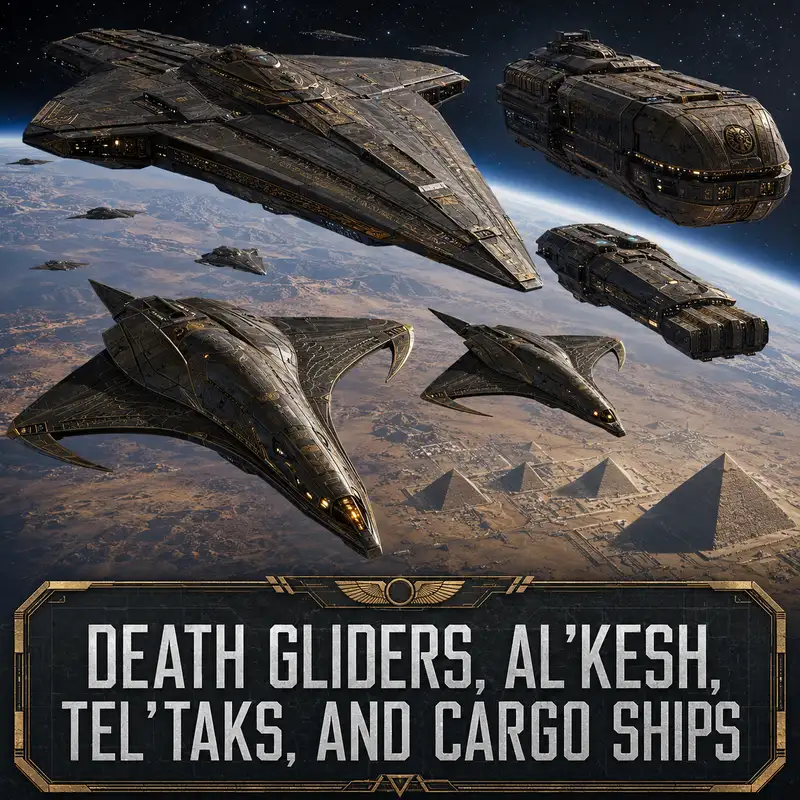
Death Gliders, Al’kesh, Tel’taks, and Cargo Ships
The X three-oh-one climbed above Peterson Air Force Base as the first apparent success of Earth’s effort to turn captured Goa’uld hardware into a planetary-defense fighter. Teal’c flew from the forward seat. Jack O’Neill handled weapons behind him. Then the controls stopped responding, the craft accelerated into orbit, and a hidden recall device aimed the prototype toward the homeworld of Apophis. Earth had copied enough of a Death Glider to make it fly. It had not understood enough to know where the ship intended to go.
A Tok’ra scout ship eventually reached the disabled craft and used transport rings to recover its crew. That rescue joined two very different parts of the Goa’uld fleet in one incident. The Death Glider was fast, local, and dependent on a larger support system. The Tel’tak was slower in combat terms but capable of hyperspace travel, covert movement, cargo carriage, and rescue. Between them sat the Al’kesh, large enough to bomb fortified positions and move troops, but small enough to operate without committing a Ha’tak mothership.
These smaller ships were the working machinery of Goa’uld power. Ha’taks carried rulers, armies, fighters, and heavy weapons between star systems, but a capital ship could not chase every reconnaissance team, deliver every intelligence officer, land beside every village, or remain hidden near every target. Death Gliders controlled immediate airspace. Al’kesh bombers attacked defenses and moved assault forces. Tel’taks carried agents, prisoners, equipment, and commanders through the spaces between gates, planets, and fleets. The empire depended on all three because conquest is less about arriving once than moving the right people and weapons afterward.
The terminology can be confusing. Tel’tak is the name most often associated with the familiar Goa’uld scout and cargo ship. Characters also call that vessel simply a cargo ship or scout ship. Other craft, especially the Al’kesh, could carry troops and freight as well. Cargo ship is therefore both a plain-language description and, in many cases, a reference to the Tel’tak class. The screen record does not provide a perfectly standardized naval registry, which is probably appropriate for an empire whose admirals routinely tried to murder one another.
The Death Glider was the smallest regular combat craft in the Goa’uld order of battle. It could fly in atmosphere, enter space, hover, and maneuver rapidly enough to support raids or defend a mothership. A normal cockpit seated two Jaffa, with one flying and the other handling weapons, though one operator could manage the craft when necessary. Two forward-firing staff cannons gave it substantial power against people, vehicles, buildings, and other small craft. Its shape and sound also made it an effective instrument of intimidation over populations that possessed no air defense at all.
Operationally, the glider functioned as fighter, interceptor, reconnaissance platform, and attack aircraft. Ha’taks launched groups of them to screen the fleet, harass enemy ships, and contest local airspace. Planetary garrisons used them to search for fugitives, pursue S G teams, and strike targets near a Stargate. Their ability to move from atmosphere to orbit allowed the same squadron to support Jaffa on the ground and then return to a ship above the planet. That flexibility mattered more than any single performance figure the continuity never consistently establishes.
The design favored speed and maneuver over endurance. Death Gliders had no normal hyperdrive and depended on a carrier, base, or nearby world for support. They could sustain life for a limited period, but they were not intended for independent interstellar patrol. They are also not shown relying on the kind of heavy shields that allowed a Ha’tak to absorb major missile strikes. A glider pilot survived by avoiding fire, using numbers, and staying close enough to friendly support that damage did not become a very long walk home.
The weapons were equally specialized. Fixed forward cannons made a glider dangerous during a strafing run or head-on attack, but they required the entire craft to be pointed toward the target. Against a village, that was more than sufficient. Against a maneuvering fighter, the pilot had to create the firing solution through positioning rather than a flexible turret. Jaffa skill compensated for some of this limitation, but the design reflected an empire accustomed to attacking opponents who rarely possessed aircraft of their own.
Ra used gliders over Abydos to terrorize miners and strike the uprising around his pyramid. Apophis and Klorel carried them aboard the Ha’taks sent against Earth. Bra’tac and Teal’c later used two of those craft to escape the doomed ships, leaving Earth with damaged examples that could be studied. Those captures were strategically valuable because they gave engineers access to alien propulsion, control systems, and materials. They also encouraged the belief that possession and understanding were roughly the same thing. The X three-oh-one corrected that misunderstanding with admirable efficiency.
The prototype combined salvaged Goa’uld components with Earth controls, stealth features, and conventional missiles. Samantha Carter understood that the drive did not work like an ordinary jet or rocket. It appeared to reduce the effects of inertia rather than simply pushing against it. What the engineering team missed was the security architecture installed after Teal’c’s rebellion. Apophis had placed recall systems inside his gliders so stolen craft would return to him while killing the disloyal crew during the journey.
Once activated, that system overrode flight controls, reaction thrusters, and ejection. The glider had enough support for O’Neill and Teal’c to remain alive for days, while the trip to its programmed destination would take centuries at sublight speed. The weapon was therefore not a practical recovery system from Earth’s location. It was a punishment device and a warning to every Jaffa who considered theft. Earth had reverse-engineered a vehicle and inherited the politics embedded inside it.
The failure helped push Earth toward the F three-oh-two, a fighter constructed through a better-understood mixture of human and recovered technologies. That distinction was essential. The X three-oh-one was largely a captured machine wearing an American designation. The later fighter represented an attempt to integrate what Earth could reproduce, maintain, and train crews to operate. The Death Glider accelerated Earth’s learning, but the first lesson was that an enemy aircraft can contain commands, assumptions, and loyalties that do not appear on the airframe.
Not every glider followed the standard pattern. Apophis used a larger transport variant equipped with ring transporters during early raids. Bra’tac later produced an unusual craft narrow enough to pass through an active Stargate and attack the defenses around Hathor’s position. That vessel was a specialized exception, not proof that regular Death Gliders could routinely fly through the gate. Confusing a one-time platform with a fleet-wide capability is how experimental equipment becomes a requirement before anyone has located a second example.
The Al’kesh occupied the next level of Goa’uld air and space power. Teal’c identified it as a medium-range bomber, a useful term describing its role rather than a precise endurance figure. It was larger and more heavily armed than a Death Glider, yet far smaller than a Ha’tak. It could travel through hyperspace, operate in atmosphere or space, and carry enough weapons to attack positions that fighter cannons could not reliably destroy. It also had room for personnel, equipment, and a ring-transporter compartment.
Cloaking was one of its most important advantages. A concealed Al’kesh could approach a target, wait near a planet, or ambush a larger vessel without announcing its presence. Tanith used a cloaked bomber against the captured Ha’tak supporting the Tok’ra evacuation from Vorash. The attack demonstrated how a relatively small ship could threaten a capital vessel when surprise compensated for size. It also demonstrated the limitation of stealth. Once detected and engaged, an Al’kesh could be damaged by weapons much smaller than those mounted on a mothership.
Its bombing role was more direct. At Revanna, Al’kesh repeatedly struck the ground around the Stargate and collapsed sections of the Tok’ra tunnel network. The bombardment killed personnel, destroyed medical facilities, cut communications, and prepared the way for Jaffa infiltration. This was combined-arms doctrine in a form the Goa’uld understood well. Bombers disrupted fixed defenses and buried positions. Death Gliders contested the air and attacked exposed targets. Ground troops entered after the defenders had been disorganized.
The Al’kesh could also fight in space. During the battle over Antarctica, bombers and Death Gliders attacked the Prometheus and Earth’s F three-oh-twos while Anubis’s capital ships engaged from above. The smaller vessels forced Earth to divide attention between fleet defense, fighter combat, and protection of the Ancient outpost below the ice. Their presence did not decide the battle, but it made the larger fleet’s attack operationally complete. A Ha’tak without escorts and strike craft would have been a powerful ship performing several missions badly at once.
The bomber’s weapons included energy cannons for direct fire and heavier plasma attacks suited to surface targets. The screen record varies by individual vessel, and shield capability should be treated as configuration-specific rather than universal. Cloaking is better established across important examples. The practical point is that the Al’kesh relied on a mixture of surprise, maneuver, armament, and mission flexibility. It could punish a world without bringing a System Lord’s primary mothership into range, which was useful for rulers who valued both terror and personal survival.
Its internal volume made it a transport as well as a bomber. Jaffa could be carried for ground operations, cargo could be stored around the ring room, and specialized loads could be moved between planets or ships. Later operators used Al’kesh for salvage, towing, clandestine movement, and the transportation of unusually large equipment. A bomber becoming a freighter may appear inelegant, but military organizations have been assigning cargo to whatever still has working engines for a very long time.
The Trust’s use of Osiris’s former Al’kesh showed how dangerous the platform became outside Goa’uld control. The vessel remained cloaked near Earth and had been modified with Asgard-style beaming technology. Trust operatives used it to remove the Stargate from Cheyenne Mountain, carry the gate aboard the ship, and launch weapons containing symbiote poison against Goa’uld-controlled worlds. The beaming system was an exceptional modification, not a standard Al’kesh feature. The ship itself provided the concealment, mobility, cargo space, and hyperdrive needed to turn stolen technology into a strategic campaign.
Another damaged Al’kesh became central during the theft of the Prometheus. A distress signal drew the Earth ship toward an Al’kesh and a separate cargo vessel drifting together. The apparent survivors used transport rings to move most of the Prometheus crew onto the bomber, leaving the capital ship vulnerable to capture. General Hammond’s people then repaired enough of the Al’kesh to restore mobility and weapons, using it against other Goa’uld craft while recovering their ship. Salvage value was not theoretical. Even a damaged bomber could become a functioning combat asset if the right technicians and compatible crystals were available.
That incident also exposed the maintenance reality behind Goa’uld technology. Energy fire had damaged life support, propulsion, weapons, and internal systems. Personnel moved between the Al’kesh and the cargo ship to retrieve crystals and restore functions. In the confined cargo vessel, residue from staff blasts contributed to dangerous air conditions when circulation failed. Advanced propulsion did not make ventilation optional, and an alien ship still became uninhabitable when the systems responsible for moving air stopped doing their jobs.
The Tel’tak was less glamorous and, for intelligence work, often more valuable. It served as scout ship, courier, transport, and cargo vessel. Its compact bridge could be operated by a small crew. A hyperdrive allowed interstellar travel without a carrier. The cargo area commonly included transport rings, creating a direct link to compatible ships and ground platforms. Many examples also carried cloaking technology, though different operators and hulls should not be assumed to share every modification.
Unlike the Al’kesh, the Tel’tak was not normally selected for heavy combat. Its standard value came from avoiding the fight or arriving where the enemy did not expect one. It carried Tok’ra operatives into hostile territory, moved equipment between hidden bases, recovered agents, and supported missions that would have been compromised by a Ha’tak’s appearance. Goa’uld subordinates, bounty hunters, Jaffa, smugglers, and later regional powers used similar craft because the design was useful well beyond formal imperial service.
Aris Boch’s cargo ship demonstrated the platform’s independent utility. The vessel could conceal itself near the surface, confine prisoners behind an internal force field, communicate with a distant mothership, and use escape pods when a staged destruction became useful. Its self-destruct system depended on removable crystals, which allowed Boch to create the appearance of losing the ship while preserving himself and Teal’c. The craft was not a frontline warship. In the hands of a bounty hunter, it became a mobile prison, command post, and negotiating tool.
Tok’ra use of the Tel’tak reflected their strategic condition. They lacked the fleets and industrial territories of the System Lords. Their cells survived through secrecy, infiltration, and rapid movement between temporary locations. A scout ship that could cloak, travel through hyperspace, carry several people, and use rings was better suited to that war than a large vessel demanding a substantial crew and announcing political ownership wherever it appeared. The Tel’tak was not powerful enough to conquer a world. It was powerful enough to keep an intelligence network alive.
The rescue at Netu showed what that meant under operational pressure. A Tel’tak carried the team toward Sokar’s prison moon, remained concealed in the moon’s shadow, and launched the weapon intended to destroy Netu’s core. When the prisoners reached the ring platform below, Teal’c flew the cargo ship into the path of the matter stream linking the moon to Sokar’s mothership. The vessel had to stop at the correct point. Missing part of the stream would have killed the people being transported.
The maneuver succeeded, and the Tel’tak accelerated away while Netu and Sokar’s Ha’tak were destroyed behind it. The small ship could not penetrate the mothership’s shields or defeat its weapons. It did not need to. Its value lay in position, timing, rings, and enough speed to escape after completing the extraction. That is the difference between combat power and mission capability. The craft with the largest gun is not always the one that decides whether the team comes home.
A Tel’tak also rescued O’Neill and Teal’c from the runaway X three-oh-one. The Tok’ra ship could not take control of the glider, and radio delay made coordinated action difficult. It could, however, reach the crippled craft through hyperspace, position itself nearby, and ring the two men aboard after they left the cockpit. The glider continued into deep space. The crew survived because a scout ship carried the right transporter and arrived before life support failed.
Transport rings tied all these vessels into one operational system. A small craft could move personnel to a surface platform, transfer prisoners to a Ha’tak, board another ship, or intercept an existing matter stream. Ring rooms doubled as cargo spaces because movement and logistics were inseparable. The same compatibility enabled rescue and infiltration. Vala used rings to remove most of the Prometheus crew. Teal’c used them to recover prisoners from Netu. Goa’uld standardization created convenience for the empire and opportunities for anyone who captured the controls.
Cloaking created a similar double effect. It let Al’kesh and Tel’taks approach without detection, hide near worlds, and compensate for limited defensive strength. It also meant a stolen craft could remain inside a supposedly secure area while hostile operators prepared an attack. Sensors, locator beacons, and knowledge of likely hiding places became essential countermeasures. A ship that disappears visually has not ceased to require power, maintenance, communications, and a crew capable of avoiding mistakes.
The smaller classes also reveal the industrial depth of Goa’uld rule. Death Gliders had to be built in numbers, stored, armed, and repaired. Al’kesh required hyperdrives, cloaking systems, weapons, rings, and crews trained for bombing and transport. Tel’taks needed crystals, life support, navigation data, and secure facilities for maintenance. The empire’s scientific culture may have depended heavily on stolen knowledge, but its shipyards could produce and sustain a wide family of useful spacecraft.
After the System Lords collapsed, the ships did not disappear. Free Jaffa, Tok’ra, the Trust, the Lucian Alliance, bounty hunters, and independent operators continued using captured or inherited craft. Al’kesh became strike ships, transports, and improvised freighters. Tel’taks continued moving cargo and agents. Death Gliders remained useful wherever a carrier or base could support them. The transfer of ownership proved that the technology had practical value independent of Goa’uld religion.
A typical Goa’uld assault depended on the classes working together. A Ha’tak brought command, heavy firepower, and the main Jaffa force into the system. Death Gliders launched to control nearby airspace and suppress exposed resistance. Al’kesh struck hardened positions, tunnel systems, or defensive concentrations, then moved troops and equipment toward the surface. Tel’taks carried scouts, intelligence personnel, prisoners, supplies, or senior leaders where a capital ship was unnecessary or too visible. The fleet was layered because the mission was layered.
That organization also reduced the cost of empire. A System Lord did not need to park a Ha’tak over every tribute world. A cargo ship could collect an official or valuable shipment. An Al’kesh could punish a settlement or reinforce a garrison. Death Gliders could search the countryside and remind the population that resistance had consequences from above. Smaller craft allowed a thin ruling class to maintain presence across many worlds without concentrating its most valuable ships at every local dispute.
Their limitations explain many Goa’uld failures. Death Gliders needed support and lacked interstellar independence. Al’kesh could inflict severe damage but remained vulnerable once surprise was lost. Tel’taks could move intelligence and personnel but were poor substitutes for capital combatants. All depended on crews whose loyalty could change, crystal systems that could be sabotaged, and maintenance networks built on coerced labor. The same modular fleet that extended imperial reach also provided rebels with vehicles they could steal and understand one system at a time.
The Ha’tak was the symbol of Goa’uld power, but these smaller ships made that power usable. Death Gliders turned orbital presence into immediate air control. Al’kesh converted reconnaissance into bombardment and bombardment into ground assault. Tel’taks connected hidden bases, agents, prisoners, cargo, and extraction routes. The empire could lose a ruler and continue fighting because the ships remained. It could lose control of the people flying them and discover that the same fleet architecture worked just as well in reverse.