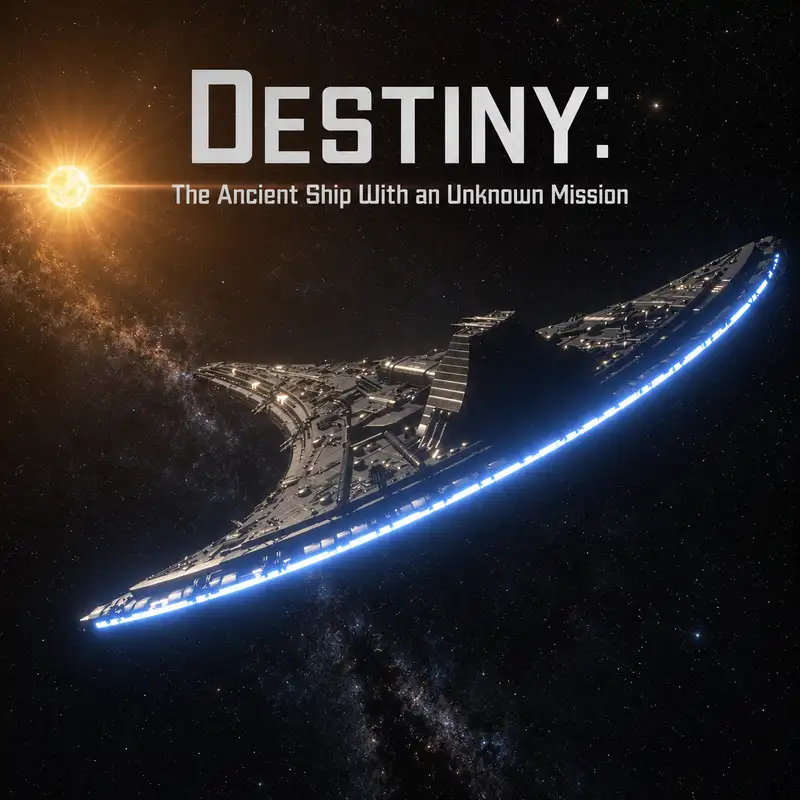
Destiny: The Ancient Ship With an Unknown Mission
Destiny’s first unmistakable act of command was to ignore every human aboard and fly directly into a star. Power reserves were nearly exhausted. Most systems had shut down, and Colonel Everett Young had selected a small group to escape in the only working shuttle. No one could steer the vessel or even determine why it had chosen the system. Then solar scoops deployed beneath the hull, the shields held against the heat, and the ship began replenishing its power cells. What looked like a final mechanical failure was a routine survival maneuver. Destiny had not lost control. The people aboard had never possessed it. That contradiction defined the Ancient ship from the beginning: it knew where it was going, but its accidental crew did not know why.
Destiny was an automated intergalactic research vessel, a mobile observatory, a carrier for an expedition that never arrived, and eventually the only home available to the survivors of Icarus Base. Its enormous age made it look derelict, yet the ship was still following instructions written before human civilization existed. It navigated between galaxies, responded to data from vessels sent ahead, selected opportunities for planetary exploration, preserved its remaining power, and continued a scientific mission that even its new occupants could not initially identify. The central question was not whether Destiny still functioned. It was whether the humans aboard could understand a machine whose route had continued long after its builders abandoned the journey.
The Ancients launched Destiny more than a million years before the Icarus evacuation. It belonged to a much earlier phase of their technological history than Atlantis and the mature Lantean systems later encountered in the Pegasus galaxy. The ship’s architecture was recognizably Ancient, but older, less refined, and built around different assumptions. Later Lantean devices frequently used a genetic control system that recognized authorized operators. Destiny predated that approach. Its designers expected trained Ancient personnel with complete technical knowledge to board the vessel when the time was right. They did not design it for strangers who would arrive under fire carrying rifles, field medical kits, and whatever food they could grab on the way to the gate.
Destiny was only one element in a much larger project. The Ancients sent unmanned seed ships ahead of it to survey distant galaxies, gather resources, manufacture Stargates, and place them on potentially useful worlds. Those ships relayed information back to Destiny so that it could follow a route supported by reconnaissance and gate access. The arrangement combined deep-space navigation with a distributed exploration network. Destiny did not need to carry every landing party from orbit to the surface. Once it reached a region prepared by the seed ships, its crew could use the Stargate to examine nearby planets, collect supplies, and study environments selected years or centuries earlier.
The plan depended on a delayed crew arrival. Destiny carried a Stargate with a unique nine-chevron address, allowing the Ancients to dial the moving vessel rather than calculate its changing position as though it were a planet. The ship could therefore begin the longest part of the voyage without exposing a biological crew to the entire transit. When Destiny had traveled far enough, the Ancients intended to open a wormhole and step aboard. That moment never came. Their civilization changed, their priorities moved toward ascension and other projects, and the expedition was left running without the people meant to complete it. Destiny became a mission platform waiting for a crew that had ceased to exist as an institution.
The human arrival was therefore not the delayed boarding the ship’s designers had anticipated. The evacuees from Icarus Base possessed the correct address and enough planetary power to establish the connection, but they had no mission orders from the Ancients, no operating manuals, and no preparation for the vessel itself. The ship recognized the incoming wormhole and activated enough systems to receive them. That did not mean it recognized them as commanders. They entered through the proper door without inheriting the authority, knowledge, or logistical system that had once been intended to accompany the journey. In military terms, they occupied the platform before they possessed the command architecture.
The Stargate network along Destiny’s route gave the ship extraordinary reach while imposing severe limitations. These older gates had much shorter operating ranges than the later Milky Way network. A handheld Ancient remote displayed only the addresses currently accessible from the ship’s position. Destiny normally dropped out of faster-than-light travel near worlds seeded with gates, opened a limited window for exploration, and then resumed its course. A countdown clock turned every planetary mission into a timed operation. If a team failed to return before Destiny departed, the ship would continue without it. The gate created mobility, but not a stable supply line, and certainly not the freedom to remain on a promising world until the paperwork was complete.
Destiny’s route was also an intelligence product, and intelligence deteriorates with time. A planet judged useful when a seed ship passed could be hostile, barren, or geologically unstable by the time Destiny arrived. Some gates appeared locked out, and others were marked as nonfunctional or dangerous. The crew inferred that the ship received at least some updated information through the network, but the surviving record never established that every warning was current or complete. Destiny could narrow the choices. It could not guarantee a safe landing, a friendly population, or the resource the expedition hoped to find. Even an Ancient reconnaissance system could not make a million-year-old plan immune to changing conditions.
The vessel’s automation was more sophisticated than a conventional autopilot and less understandable than an artificial commander. Destiny monitored power, atmosphere, structural integrity, navigation, and nearby gate opportunities. It sealed damaged compartments, locked out destinations judged unsafe, allocated energy toward life support, and sometimes altered its behavior after the crew reported a crisis. It could also make decisions that appeared incomprehensible because the humans lacked its data. Flying into a star was one example. Passing some planets while stopping near others was another. The ship was not necessarily conscious in the human sense. It was, however, operating from a mission logic that remained largely hidden from the people depending on it.
The true purpose of that logic emerged only after Nicholas Rush broke Destiny’s master code and gained access to its deeper archive. More than a million years earlier, Ancient researchers had detected a complex structure within the cosmic microwave background radiation, the faint relic signal associated with the early universe. They believed the pattern possessed coherence that could not be explained as a natural accident. It might have been a message, evidence of design, or the trace of an intelligence existing near the beginning of time. Destiny had been launched to investigate that possibility by gathering pieces of information across the enormous breadth of the universe.
This did not mean the Ancients had proven that a creator had left a signature in the cosmos. The surviving record established a discovery, a hypothesis, and an expedition built to test it. The source of the pattern remained unknown. Its meaning remained unknown. Even the idea that it represented intelligence was an interpretation supported by Ancient analysis, not a final answer. Destiny’s mission was therefore both precise and open-ended. It was searching for evidence connected to one extraordinary question, but no one aboard knew where the decisive observation would occur, how long the search would take, or what would count as completion.
That uncertainty explains why Destiny was built for endurance rather than speed alone. Its faster-than-light drive did not use the familiar hyperspace windows employed by later Ancient, Goa’uld, Asgard, and Earth vessels. The ship used a different method, maintaining a continuous voyage between brief stops. It could cross interstellar and intergalactic distances, but the journey still consumed enormous spans of time. The design assumed that the ship might operate for ages without returning to a base. Every major system had to support survival across a route extending far beyond any established political territory or maintenance network.
Power was the foundation of that endurance. Destiny did not rely on a replaceable zero-point module. It replenished large power cells by diving into suitable stars, using its shields and deployed collectors to survive the passage and absorb energy. This made the ship less dependent on fuel shipments, which was essential for a vessel traveling where no friendly port existed. It also created a predictable strategic vulnerability. The ship eventually had to approach a star it considered suitable, and enemies who understood that requirement could wait at likely refueling points. A self-sustaining power system reduced logistics. It did not eliminate them. It simply made the stars part of the supply chain.
Destiny carried powerful shields and energy weapons, but its known purpose was scientific rather than imperial. The main weapon could strike targets in space or deliver controlled fire against a planetary structure. Smaller batteries could engage fighters, drones, and incoming threats. The shields allowed the ship to survive combat, atmospheric stress, faster-than-light travel, and stellar recharging. These systems made Destiny dangerous, but not invulnerable. Repeated attacks damaged emitters, opened hull breaches, and forced the crew to choose between propulsion, weapons, shields, and life support. The ship could win engagements. It could not replace destroyed components from an Ancient industrial base that no longer supported it.
The vessel also carried shuttles, kinos, spacesuits, medical systems, a botanical dome, stasis chambers, laboratories, and extensive internal compartments. Each capability supported the intended expedition. Shuttles provided local movement when no gate was available. Kinos served as compact reconnaissance devices, environmental probes, and recording platforms. Stasis offered a way to preserve personnel during long or dangerous transits. The botanical dome suggested that food production and biological research were expected parts of the voyage. Destiny was not a narrow instrument built around one telescope or sensor array. It was an expeditionary ecosystem designed to keep a scientific crew functioning while the ship carried them between observation points.
Age had reduced that ecosystem to a collection of partially functioning advantages. When the Icarus survivors arrived, damaged sections were sealed behind bulkheads, a shuttle was losing atmosphere, and the carbon dioxide scrubbers were failing. Power reserves were dangerously low, access to core systems was restricted, and the crew occupied only a fraction of the available space. The vessel had survived more than a million years, but survival did not mean good repair. Destiny was closer to an ancient installation maintained by automation than a ship ready for immediate service. The difference became clear whenever someone opened the wrong door and discovered why the ship had kept it closed.
The ship’s automated protections repeatedly saved the crew while also reminding them that they were not fully in command. Destiny diverted its last reserves to life support when other systems failed. It sealed damaged compartments and sometimes prevented access to areas it considered dangerous. It chose gate stops that might provide materials needed for air, water, or repairs. Yet the same automation could leave teams behind, refuse a course change, or conceal the reason for a maneuver until the result became obvious. The crew often interpreted this behavior as hostility or indifference. More often, they were confronting a machine executing priorities written for Ancient operators who would have understood them.
Human control developed in stages. At first, the survivors could use local consoles, the gate room, communications, and a limited selection of ship systems. They remained locked out of navigation, propulsion, and the complete database. The vessel’s actual bridge was hidden and inactive, separate from the control room where the scientists first worked. Another possible interface, an Ancient chair capable of transferring information directly into a user’s mind, carried the risk of neurological injury or death. The ship offered access methods intended for people who spoke Ancient fluently and understood the design. The newcomers had neither advantage, which made every successful command look a little like unauthorized maintenance.
Rush eventually solved the master code and gained control over navigation, propulsion, weapons, and the archive. His achievement transformed Destiny from an automated prison into a platform the expedition could steer. It also created a serious command crisis because he concealed the breakthrough. Rush believed the ship’s mission required commitment that Young and many others did not share. By withholding control, he protected the voyage from decisions he considered short-sighted. He also placed strategic authority in the hands of one scientist without oversight. Destiny’s unknown mission was not merely a technical mystery. It became the justification for secrecy inside a crew already divided over who had the right to decide their future.
The accidental expedition was poorly matched to the vessel it inherited. Young commanded military personnel trained to defend a base, not operate an Ancient intergalactic ship. Rush, Eli Wallace, Dale Volker, Lisa Park, Adam Brody, and the other scientists brought essential expertise, but none had completed an Ancient qualification course because no such course existed. Tamara Johansen became the senior available medical authority despite not being the physician intended for the mission. Camile Wray represented civilian oversight without a functioning civilian government aboard. The crew had enough skill to improvise and enough disagreement to make every improvisation political.
Destiny’s planetary stops became the expedition’s principal logistics system. Teams searched for water, food, medicinal plants, minerals for life-support filters, and materials that could substitute for unavailable parts. Every mission began with reconnaissance through a kino, continued under a countdown, and ended with the requirement to return through the same gate before the ship resumed faster-than-light travel. There was little room for prolonged negotiation, extensive surveying, or a conventional rescue plan. The ship’s route created opportunities, but it also imposed tempo. A world could be scientifically remarkable and still be useless if the crew could not carry what it needed back before the clock expired.
Communication with Earth did not solve that problem. Ancient communication stones allowed members of the expedition to exchange consciousness with people in the Milky Way, preserving contact with Homeworld Command and families. They could request expertise, report discoveries, and receive political direction. They could not transmit food, medicine, ammunition, replacement shield emitters, or a qualified Ancient engineering team. Destiny remained several billion light-years away, and the planetary power source used to reach it had been destroyed. The expedition could talk to headquarters, but it could not be sustained by headquarters. It was connected strategically and isolated logistically, an arrangement almost designed to produce arguments.
The ship’s military value made those arguments larger than the crew. Destiny contained Ancient knowledge, a functioning intergalactic drive, stellar power technology, weapons, shields, neural interfaces, medical devices, and records from galaxies Earth had never reached. The Lucian Alliance considered access valuable enough to infiltrate the Icarus program, construct its own dialing effort, and send troops to seize the vessel. Yet possession of Destiny did not automatically create a usable strategic capability. The ship was far from any supporting industry, damaged, difficult to control, and tied to a mission route no modern faction fully understood. Capturing the bridge would have been easier than building the civilization needed to maintain what it controlled.
The deeper conflict aboard Destiny concerned the meaning of mission itself. Young’s first duty was to keep the survivors alive and seek a way home. Rush believed returning home could mean abandoning the most important scientific investigation ever attempted. Both positions were defensible, and neither answered the question of consent. Most people aboard had not volunteered for an Ancient expedition. They had evacuated a collapsing base. Completing Destiny’s mission might justify extraordinary risk from the perspective of knowledge, but that did not give one scientist the moral authority to spend other people’s lives. Survival and discovery were not competing departments. They were claims upon the same limited power, time, and human endurance.
Even after the archive revealed the purpose, the mission remained unknown in the most important sense. The crew understood the question but not the answer. They knew Destiny was following data gathered across the universe, yet they did not know the final destination, the required observation, or whether the original Ancient assumptions were correct. The ship’s name expressed confidence that the journey led somewhere meaningful. Its records did not provide certainty that the meaning would be understandable to humans, or even to the Ancients who began the search. The expedition inherited a direction, not a conclusion.
Destiny mattered because it represented a different kind of Ancient legacy. Atlantis was a city that could be occupied, defended, and eventually connected to Earth. Ancient outposts offered weapons or power systems with recognizable tactical uses. Destiny offered a question and a moving platform built to pursue it. Its greatest capability was not any single weapon, gate, or engine. It was the ability to continue gathering knowledge across time and distance after the civilization that launched it had withdrawn from the mission. The ship endured because its designers expected the problem to outlast ordinary political and biological horizons.
Destiny was therefore neither a derelict warship nor a simple lifeboat. It was an autonomous deep-space research expedition built to investigate evidence of intelligence near the foundation of reality. Its mission remained unknown because the intended Ancient crew never boarded, the accidental human crew lacked access to its command systems, and the objective itself pointed toward an answer no one had yet found. The people from Icarus did not take command of a ship waiting to serve them. They entered a voyage already more than a million years underway and began repairing the machine around them while it carried them toward a question older than the stars.