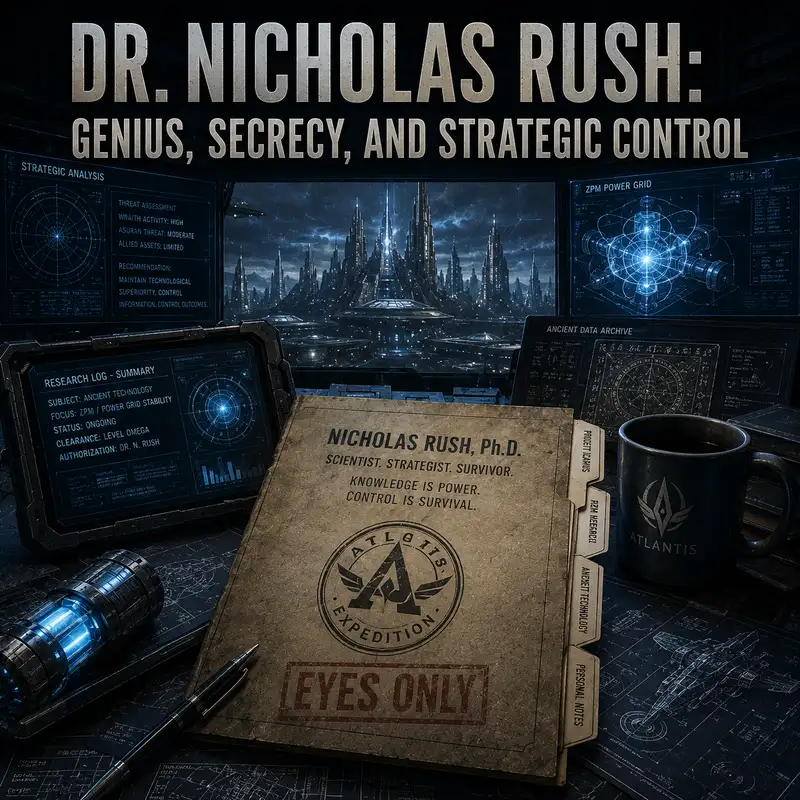
Dr. Nicholas Rush: Genius, Secrecy, and Strategic Control
The first time Nicholas Rush gained full control of Destiny, he concealed it from everyone aboard. He had broken the master code, found the ship’s hidden bridge, and gained access to navigation, propulsion, weapons, and the deeper Ancient archive. He did not call Colonel Everett Young. He did not summon Eli Wallace or the science team. He turned the autopilot back on, opened his notebook, and began learning the controls alone. A less subtle man might have seized the command chair and announced himself captain. Rush did something more consequential. He kept the keys while preserving the appearance that no one possessed them.
That moment explains the contradiction at the center of Nicholas Rush. His intellect repeatedly saved the expedition. His secrecy repeatedly endangered it. He understood systems that nobody else could interpret, recognized patterns other scientists missed, and accepted personal risks few people would tolerate. He also treated information as a form of strategic control, releasing it only when he believed others had earned the right to act. The central question is not whether Rush was a genius. The evidence settles that quickly. The harder question is why he believed genius entitled him to decide what everyone else was allowed to know.
The surviving record says little about Rush’s early life or formal education. It establishes him as a university professor, a mathematician of exceptional ability, and a man already accustomed to working beyond the pace of those around him. He could move from abstract mathematics to Ancient systems engineering with unusual speed. He was not equally talented at explaining his reasoning to ordinary colleagues. Impatience became part of his method. If another person failed to follow, Rush often concluded that the explanation was not worth the time. That habit was unpleasant in a university office. On an isolated starship, it became a command problem.
His marriage to Gloria revealed both the depth of his attachments and his tendency to retreat from pain into work. When her cancer returned, Rush continued pursuing equations while she faced treatment and decline. He loved her, but love did not make him emotionally available. After her death, he appears to have converted grief into professional hardness. The clearest evidence came from Rush’s own subconscious while he was connected to Destiny’s neural interface. The Gloria created from his memories accused him of using her death to justify becoming callous. Because the exchange occurred inside Rush’s mind, it cannot be treated as Gloria’s independent testimony. It can be treated as evidence that Rush knew exactly what he had become.
Daniel Jackson recruited Rush into the Stargate Program while the ninth-chevron problem remained unresolved. The project required far more than mathematical elegance. Earth needed to interpret a fixed Ancient address, identify the correct point of origin, and provide a power source strong enough to establish an unprecedented connection. Rush became the intellectual center of Project Icarus because he was willing to stay with the problem long after reasonable people would have requested another assignment. His interest extended beyond transportation. He was drawn to the Ancients’ pursuit of ascension and to questions that conventional science could not yet answer. Persistence was one of his greatest strengths. It was also the quality that made retreat, cancellation, and compromise feel to him like personal defeat.
Rush did not solve the ninth chevron alone. Eli Wallace completed a mathematical problem hidden inside an online game and later recognized that Earth, not the Icarus planet, had to serve as the final symbol in the address. Rush immediately understood Eli’s value, helped bring him into the classified program, and relied on his insight when the base came under attack. Their relationship began with a pattern Rush would repeat. He identified rare talent, drew it close, and then tried to control the conditions under which it operated. Eli was useful as a protégé so long as Rush remained the person defining the problem.
The destruction of Icarus Base turned that instinct into a decision affecting everyone present. Colonel Young ordered an evacuation to Earth. Rush stopped the sequence and dialed the nine-chevron address instead. He argued that energy from the failing naquadria-rich core might translate through the wormhole and threaten Earth. The concern was plausible, but it did not require selecting Destiny. An uninhabited world remained another possibility. Rush chose the destination that preserved the purpose of his life’s work. He saved the base population from the explosion, but he also committed them to an unknown voyage without command approval or informed consent.
The first minutes aboard Destiny showed how naturally Rush converted knowledge into authority. While medics treated casualties and military personnel cleared the gate room, he moved toward the Ancient consoles. Soon afterward, he used the communication stones to contact Earth and then told the survivors that General Jack O’Neill had placed him in charge. That claim was false. Rush understood that the crew needed a chain of command, but he also understood that most people could not independently verify what Earth had said. He filled the information gap with himself. It was an efficient solution to confusion and an early warning of how he intended to govern.
Young’s recovery restored the military chain of command, but it did not remove Rush’s practical leverage. The colonel could issue orders. Rush often controlled the technical picture on which those orders depended. During the first life-support crisis, he helped identify the failure of the carbon dioxide scrubbers. When Destiny lost power, he correctly recognized that its reserves were exhausted and later understood that the ship was deliberately diving into a star to recharge. He interpreted gate access, power allocation, and navigation while working with little sleep and almost no documentation. The crew had good reasons to distrust him and even better reasons to keep him alive.
This created a divided command system. Young possessed lawful authority, responsibility for the crew, and control of the armed personnel. Rush possessed specialized knowledge, access to the ship’s systems, and the ability to determine which options appeared technically possible. Young judged success by survival and eventual return. Rush increasingly judged survival by whether it preserved Destiny’s mission. Each man believed the other might sacrifice the expedition for the wrong objective. Young feared that Rush would spend lives for discovery. Rush feared that Young would abandon an irreplaceable mission to reduce an immediate risk. Neither fear was imaginary.
Rush’s attempt to remove Young crossed from strategic maneuver into criminal deception. After Sergeant Spencer died by suicide, Rush moved the weapon and concealed it in Young’s quarters. His purpose was to force the colonel from command by making him appear responsible for a killing. Rush later admitted that he had concluded Young was unfit and believed the crew needed different leadership. Even under emergency conditions, framing a commander for murder was not oversight or political resistance. It was an effort to capture authority through manufactured evidence. Rush did not merely withhold information. He created false intelligence and attempted to make the entire expedition act upon it.
Young answered with his own abuse of power. He assaulted Rush during a planetary mission and left him behind when Destiny departed. The act nearly killed the scientist and deprived the ship of its most important technical specialist. Hostile aliens recovered Rush, interrogated him through neural devices, and implanted a transmitter near his heart that later helped them find Destiny. Young’s retaliation does not excuse Rush’s frame-up, and Rush’s deception does not excuse abandonment. Together, the two decisions demonstrate how quickly personal conflict at the top can become a strategic vulnerability. The expedition’s enemies did not create its command fracture. They exploited what its leaders had already done to each other.
After his rescue, Rush supported Camile Wray and a civilian faction in an attempt to seize key sections of Destiny from the military. Their grievances were not invented. Young had concealed what he had done, and civilian personnel lacked meaningful protection from arbitrary command action. The coup was still dangerous. It divided the ship while hostile aliens were tracking Rush’s implant and preparing another attack. Rush helped create the fragmentation he claimed only strong leadership could prevent. When the aliens arrived, scientific and military personnel had to cooperate again because shields do not recognize whether the hand operating them belongs to the preferred political faction.
Rush’s search for control was not based only on ambition. He repeatedly risked his own life to obtain it. He modified Destiny’s neural-interface chair and entered it despite knowing that an earlier user had been left severely injured. The chair buried him inside reconstructed memories while feeding him information from the ship. Rush endured cardiac stress and the reliving of Gloria’s death long enough to identify a clue associated with human genetic structure. That clue opened a path toward the master code. He was willing to gamble his own brain for the expedition’s future. The problem was that he often treated willingness to risk himself as permission to risk others without the same consultation.
Amanda Perry represented a rare exception to Rush’s isolation. She was a trusted colleague with the expertise to improve Destiny’s damaged faster-than-light drive, and she understood the intellectual world Rush inhabited without being intimidated by him. Their relationship showed that he was capable of tenderness, loyalty, and genuine collaboration. It also showed how selective his trust remained. Rush would share sensitive information with one person he considered qualified while withholding it from the actual commander and the rest of the science team. His private circle could be humane. It was still a private circle controlling public consequences.
Rush finally broke the master code after the Lucian Alliance boarding crisis. He discovered the hidden bridge and learned that Destiny’s systems could be directed rather than merely observed. His first decision was to keep the discovery secret. He changed the ship’s course, manipulated stops, and studied the archive without informing Young. Figures appearing to Rush as Gloria and Doctor Jeremy Franklin, whether generated by Destiny or by his exhausted mind, warned that one person could not do the work of an Ancient crew. Rush continued anyway. His secrecy gave him freedom from interference, but it also removed the review that might have caught his errors.
One of those errors sent a shuttle toward a planet inaccessible by Stargate. Rush had altered Destiny’s course because he believed the world offered valuable resources. His calculations relied too heavily on the shuttle’s original specifications and not enough on the accumulated damage of a vessel more than a million years old. The shuttle crashed in violent atmospheric conditions. Sergeant Riley was eventually trapped beneath the wreckage and died. Rush had not intended that outcome, and the planet might genuinely have helped the expedition. The loss still demonstrated the operational cost of one-man analysis. No genius can challenge assumptions that he has not allowed anyone else to see.
The secret bridge was exposed when Rush and Young became stranded aboard another vessel. To recover them, Rush contacted Perry through the communication stones and gave her concealed instructions for steering Destiny. Eli recognized the coded message, followed the evidence, and found the bridge. Young then learned that Rush had possessed control while the crew continued believing the ship was making every navigational decision. The discovery nearly produced another violent break between the two men. It also forced Rush to reveal the reason he regarded control as more than personal authority.
Destiny had been launched to investigate a structure detected within the cosmic microwave background radiation. Ancient researchers believed the pattern might indicate intelligence associated with the earliest period of the universe. The conclusion was not proven, and the meaning of the signal remained unknown. To Rush, the possibility made Destiny the most important scientific instrument humanity had ever encountered. Returning home, surrendering the ship, or allowing the mission to be redirected could erase an opportunity that no later expedition might recover. He did not see himself as guarding a research project. He saw himself as protecting a question with civilizational significance.
That belief gave Rush a coherent strategic logic. Governments might politicize the evidence, suppress it, or redirect Destiny toward a nearer military objective. Commanders responsible for frightened people might choose a risky route home rather than continue the voyage. Scientists without full understanding might damage the ship while seeking quick access. Rush therefore treated knowledge as compartmented intelligence. He released it according to mission need and kept decisive capabilities under his own control. In a hostile intelligence service, compartmentalization can protect an operation. Aboard Destiny, where a small crew shared one life-support system, it also created fatal single points of failure.
The problem was not simply that Rush kept secrets. It was that he appointed himself the authority who decided which secrets the lawful commander could be trusted to receive. That reversed the normal relationship between expert advice and command. A technical specialist may identify danger, recommend limits, and refuse to falsify evidence. The specialist does not ordinarily acquire private control of propulsion and then decide whether the commanding officer deserves to know the ship can be steered. Rush’s brilliance made the arrangement temporarily possible. It did not make it legitimate.
His own emotions repeatedly broke the logic he used to justify control. When Simeon murdered Perry and Ginn through the communication-stone connection, Rush pursued him across a planet despite orders to preserve him for intelligence questioning. Simeon possessed information about a planned Lucian Alliance attack on Earth. Rush understood the strategic value and continued the hunt. He killed Simeon through an improvised ambush rather than return him for interrogation. The same man who expected others to subordinate grief to Destiny’s mission abandoned that principle when the grief was his. Gloria’s death had not removed his capacity to care. It had made caring something he feared until loss forced it into the open.
Rush was also frequently correct when others most wanted him to be wrong. He opposed an attempt to dial Earth while Destiny recharged inside a star because the energy environment was unstable and the consequences of a failed wormhole could be catastrophic. The arrival of another Rush from a displaced timeline confirmed that the procedure had produced catastrophic time displacement, sending one group two thousand years into the past while another version of Destiny moved only hours backward. The episode did not prove Rush infallible. It proved why dismissing him because of his personality was as dangerous as trusting him without review. A damaged source can still provide accurate intelligence.
After the bridge became common knowledge, Rush’s role slowly changed. He remained abrasive, guarded, and convinced that Destiny’s mission deserved extraordinary priority. He also began operating inside a broader technical team. Eli, Perry, Brody, Volker, Park, and even Chloe solved problems he could not solve alone. During the drone campaign, survival required bridge crews, gate teams, shield management, decoys, reconnaissance, and calculations conducted under attack. Rush could interpret the Ancient systems and propose high-risk maneuvers, but execution depended on people whose abilities he had once treated as secondary. Strategic control became less useful than coordinated control.
His relationship with Eli provides the clearest measure of that change. Rush discovered him, mentored him unevenly, exploited his admiration, and repeatedly underestimated his independence. Eli gradually became the scientist most capable of challenging Rush on technical grounds. He devised the plan to place the crew in stasis and send Destiny on a three-year crossing beyond the drone blockade. Rush resisted because the ship would skip part of the galaxy and might miss data essential to the Ancient mission. His objection was intellectually serious. It also revealed that he still regarded mission completeness as a claim upon every life aboard.
When the crew found itself one functioning stasis pod short, Rush volunteered to remain awake and repair it before life support consumed the power needed for the crossing. Young refused because he could not trust Rush to shut the system down and die if the repair failed. Eli then volunteered, arguing that he had the best chance of solving the problem. Rush tried to dissuade him and finally acknowledged his exceptional potential. Then Rush entered a pod and allowed Eli to take responsibility for the ship, the sleeping crew, and the mission. The man who had spent the voyage hoarding decisive knowledge surrendered control because another scientist had grown beyond his shadow.
Nicholas Rush was indispensable because his genius was practical under impossible conditions. He could turn fragments of Ancient data into operational choices, detect purpose inside machinery that appeared irrational, and remain with a problem after exhaustion had defeated almost everyone else. He was dangerous because he confused superior understanding with superior authority. His secrecy sometimes protected Destiny’s mission from panic, politics, and reckless interference. Just as often, it denied the crew the information required to challenge bad assumptions, prepare for risk, or hold him accountable.
His strategic objective never changed very much. He wanted control of Destiny so that the voyage would continue long enough to answer the question the Ancients had left behind. What changed was his understanding of how that control had to be exercised. One brilliant man could discover the bridge. He could not crew it, maintain the ship, defend the gate, treat casualties, govern civilians, or carry the mission across a hostile galaxy alone. Rush’s final act before stasis was not another secret calculation. It was an act of trust. For perhaps the first time, the survival of Destiny depended on knowledge he no longer controlled, held by a person he could no longer direct.