Eli Wallace: The Civilian Who Solved the Ninth Chevron
Eli Wallace’s final operational decision aboard Destiny was to remain awake while everyone else entered stasis. Automated drones had blocked the ship’s supply route, and the only viable escape required a three-year crossing to another galaxy with life support shut down. One chamber failed before the last three people could be suspended. Colonel Everett Young was prepared to stay behind. Nicholas Rush volunteered as well. Eli rejected both choices. He argued that he had the best chance of repairing the pod, then placed the expedition’s commander and its senior scientist into stasis. The unemployed gamer recruited from his mother’s living room had become the only conscious human responsible for an Ancient starship.
That transformation is what makes Eli more than the civilian who solved one mathematical problem. He entered the Stargate Program without rank, clearance, field training, or a completed scientific career. He ended the recorded voyage as an expedition planner, systems analyst, gate operator, archivist, and trusted adviser whose calculations affected every life aboard. His importance came from exceptional intelligence, but intelligence alone does not explain his rise. Eli became indispensable because he combined mathematical intuition with curiosity, emotional awareness, and a willingness to work across the military and civilian divisions that repeatedly threatened Destiny.
Before Project Icarus, Eli looked like the sort of talent a conventional recruiting system could easily miss. He had studied advanced mathematics but left formal education without completing the career his ability appeared to promise. He was twenty-five, unemployed, living with his mother, and spending much of his time on a computer. Maryann Wallace had contracted H I V while working as a nurse, and her illness shaped the family’s finances and Eli’s responsibilities. His father had left years earlier. Eli’s stalled career did not show a lack of ability. It showed that ability does not always arrive with a polished résumé.
The online game Prometheus became an unconventional talent search. Stargate Command embedded a genuine Ancient mathematical problem inside entertainment software and allowed the public to attack it without knowing what it represented. Most players encountered a difficult puzzle. Eli recognized a structured problem worth sustained effort. He worked through unfamiliar symbols, abstract relationships, and a challenge that had resisted the cleared specialists assigned to Project Icarus. The method expanded recruitment beyond universities, laboratories, and government contractors without revealing the Stargate Program. The applicant pool did not know it was applying, which is one way to reduce paperwork.
Solving the game did not mean Eli had accidentally pressed the correct combination of buttons. The embedded problem tested whether someone could absorb a foreign mathematical language, recognize its internal logic, and produce a valid proof. Those were precisely the skills needed for Ancient technology, where a console might be readable only after the operator understood the scientific assumptions behind the symbols. Eli succeeded because he did not inherit the Icarus team’s habits. He approached the problem as a system to be explored rather than a doctrine to be obeyed. That independence would remain his greatest advantage and occasionally become his greatest risk.
Nicholas Rush and Lieutenant General Jack O’Neill arrived at the Wallace home soon after the solution was detected. Their recruitment approach combined opportunity, secrecy, and coercion. Eli was asked to sign a nondisclosure agreement before receiving a meaningful explanation. When he hesitated, he was transported aboard the George Hammond and shown that the impossible was already operational. Rush then offered the consideration most likely to overcome his resistance. The Air Force would ensure that Maryann received medical care. Eli accepted because the project promised intellectual purpose and protection for his mother. The bargain was real, but it was not made between equal parties.
Aboard the Hammond and later at Icarus Base, Eli was visibly outside the institution that had recruited him. Military personnel possessed rank and clear duties. Scientists had credentials, offices, and years of classified experience. Eli had a borrowed place at the table and an ability nobody could conveniently replace. His humor helped him manage the difference. He called himself “Math Boy,” asked blunt questions, and reacted to starships with the enthusiasm of someone who had not learned to pretend extraordinary things were routine. That lack of professional polish sometimes irritated Rush. It also kept Eli willing to question assumptions that the established team had stopped noticing.
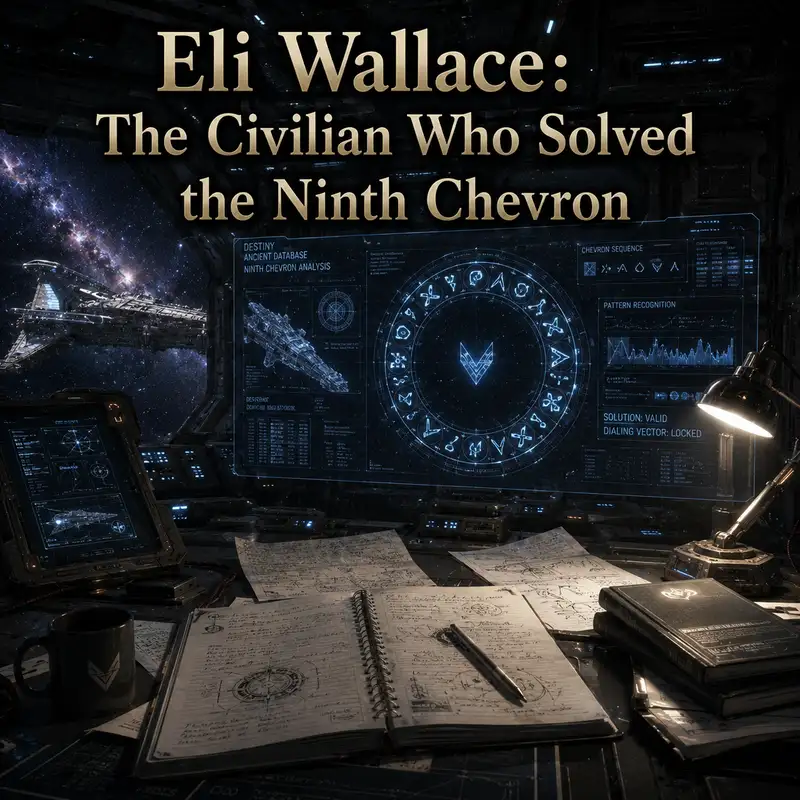
The ninth-chevron problem had several layers. Stargate Command possessed a nine-symbol sequence from the Ancient database and had found a planet whose naquadria-rich core could provide the required energy. Eli’s game solution helped regulate and interpret the power calculations needed for the attempt. Yet the address still failed to complete. During the Lucian Alliance attack, while the base shook and the planetary core moved toward destruction, Eli challenged the final assumption in the dialing sequence. The Icarus team had been using the local point-of-origin symbol. Eli proposed that Earth itself had to serve as the final symbol because the sequence was a fixed code rather than an ordinary coordinate address.
That insight allowed Rush to complete the dial. It also requires careful credit. Eli did not build Icarus Base, discover the naquadria planet, recover the Ancient address, or independently engineer the entire power system. Rush and a large scientific team had spent years assembling those pieces. Military personnel defended the installation long enough for the gate to activate. Eli supplied the correction that turned the accumulated work into a successful connection. The title “the man who solved the ninth chevron” is therefore accurate as a description of the decisive breakthrough, not as a claim that one civilian completed an interstellar program alone.
The success immediately became a human disaster. Rush used the address as the evacuation route when Icarus Base could no longer be saved, sending the survivors to Destiny rather than Earth or another known world. Eli had helped open the door but had no authority over the decision to use it. He crossed with everyone else and discovered that his solution had stranded him several billion light-years from his mother. The first strategic consequence of his brilliance was isolation. Project Icarus had recruited him to solve a transportation problem. It had not prepared him for the possibility that the destination would become his permanent home.
Destiny rewarded the same habits that had brought Eli into the program. He learned interfaces by experimentation, translated technical concepts for people outside the science team, and treated Ancient devices as tools rather than sacred artifacts. He quickly adopted the floating reconnaissance spheres found aboard the ship and named them kinos. Using their remote interface, he explored corridors, inspected inaccessible areas, and recorded the crew. The devices became camera, scout, and institutional memory. Eli could recognize how an unfamiliar system might be useful before anyone had established procedures for it.
The kinos gave the expedition a reconnaissance capability suited to a damaged ship and dangerous planets. They could inspect a room before personnel opened a sealed door, pass through a Stargate ahead of a team, record environmental conditions, and extend observation where radios or human access were limited. Eli also used them to create a documentary record. At first, that project looked like a young man preserving messages because he feared everyone might die. Over time, it became something more important. Destiny had no public-affairs office, archive staff, or reliable institutional history. Eli preserved evidence of decisions, relationships, mistakes, and discoveries that would otherwise depend on memory.
His first gate mission showed that technical ability did not keep him safely behind a console. On the desert world selected to provide material for Destiny’s failing air scrubbers, the team faced a fixed departure countdown and an uncertain return. When Scott and Greer struggled to reach the gate with the needed mineral, Eli used his own body to prevent the wormhole from shutting down. The proposed safety behavior was not established doctrine, and Rush could not guarantee it would work. Eli accepted the risk because the ship needed the material and two men were still outside. The civilian mathematician became part of the extraction mechanism, which is not a standard duty in most research appointments.
A later crisis demonstrated why his recording habit mattered. A kino recovered on a jungle world contained footage from a future version of the expedition. The recording showed a disease spreading aboard Destiny, the failure of the first response, and evidence that venom from local creatures could provide a treatment. The crew survived because information moved backward through an extraordinary gate anomaly. Eli’s contribution was not that he created the anomaly. It was that the expedition had developed the habit of recording, reviewing, and treating visual evidence as operational intelligence. A camera carried for documentation became an after-action report delivered before the action occurred.
Eli’s value became even clearer when he was cut off from Destiny. Trapped with Scott, Greer, and Chloe Armstrong after the ship resumed faster-than-light travel, he devised a plan to move from gate to gate and intercept the vessel’s route. The idea depended on understanding the limited local network, estimating Destiny’s trajectory, and accepting that each wrong jump consumed time and options. The team initially moved in the wrong direction. Eli kept recalculating rather than treating the first failure as proof that the concept was impossible. The eventual recovery required cooperation from Destiny, information from an alien star map, and several narrow timing windows. It was navigation by inference, not luck alone.
Colonel Young came to trust Eli in a way he trusted few civilians. Eli could explain Rush’s work without fully sharing Rush’s agenda, and he could move between the scientists, military personnel, and civilian leadership without being identified completely with any faction. Young sometimes used the kinos to improve internal awareness, placing Eli in the uncomfortable position of collecting information about people who considered him a friend. The assignment revealed the political cost of technical access. A surveillance tool does not become neutral because its operator is likable. Eli understood the difference between capability and legitimacy.
His relationship with Rush remained the most important professional relationship of his life. Rush recognized Eli’s talent immediately, but often treated him as an assistant whose purpose was to confirm the older scientist’s conclusions. Eli admired Rush’s intellect while distrusting his secrecy. The difference between them was not simply age or personality. Rush accumulated information to control decisions. Eli usually expanded information so that others could participate. That made Eli less efficient in the short term and more reliable in a community where no scientist could be allowed to become the only person who understood the ship.
The hidden bridge exposed that difference. Rush had gained control of Destiny’s navigation and concealed the discovery from the command. When he later sent coded instructions through the communication stones, Eli reviewed the available kino evidence, reconstructed where the messages were leading, and found the bridge. He did not solve the problem because Rush explained it. He solved it because Rush’s secrecy left patterns in the record. The discovery changed the balance aboard Destiny. Young learned that the ship could be steered, the science team gained access to systems Rush had monopolized, and Eli proved that he could audit the man who had recruited him.
Eli was not a solitary genius replacing the rest of the science staff. His best work usually came through collaboration with Rush, Adam Brody, Dale Volker, Lisa Park, Chloe, and later Ginn. Brody and Volker understood systems Eli had not studied. Park brought engineering expertise of her own. Chloe’s alien-altered cognition temporarily allowed her to solve equations beyond her earlier ability, although relying on that condition carried serious medical and security risks. Eli’s strength was his ability to connect those contributions. He was often the person who could translate one specialist’s result into a plan the bridge, gate team, and command could use.
His friendship with Chloe gave that work an emotional center. Eli developed romantic feelings that she did not return in the same way, while Chloe formed a relationship with Scott. He sometimes responded with jealousy or withdrawal, but he continued to protect her when her alien transformation made others see her primarily as a threat. Their friendship mattered because Eli’s intelligence did not isolate him completely from the crew. He wanted recognition, companionship, and a place in the community. Those needs occasionally distorted his judgment, yet they also prevented him from adopting Rush’s belief that the mission could be separated cleanly from the people carrying it.
Maryann remained the clearest measure of what the mission cost him. The communication stones allowed Eli to visit Earth in another person’s body, but secrecy and the physical mismatch made reassurance almost impossible. His mother saw a stranger claiming to speak for her absent son. As her health and depression worsened, Camile Wray obtained permission for Maryann to use the stones and visit Destiny herself. She finally saw the ship, the work, and the community that had replaced the life Eli left behind. The visit did not solve their separation. It showed Maryann that her son had become essential to people who could not return him.
Ginn challenged Eli in a different way. She had been forced into the Lucian Alliance and possessed mathematical knowledge connected to its own ninth-chevron research. After the boarding crisis, she worked with Eli on a plan to draw power from a star and dial Earth. Ginn identified factors his model had not fully incorporated, including the relationship between the star’s properties and the calculation. Their partnership became romantic, but its scientific importance was separate. Ginn demonstrated that Eli’s work improved when another capable mathematician challenged it. Numbers did not care which side of the boarding action their analyst had entered from.
Simeon murdered Ginn while her consciousness was linked to Earth through the communication stones. The unusual connection prevented her identity from disappearing in an ordinary way, and Eli later helped recover evidence that her consciousness remained associated with Destiny’s systems. His response to the loss differed from Rush’s response to Amanda Perry’s death in the same attack. Rush pursued vengeance. Eli concentrated on whether Ginn could still be found and preserved. Grief did not make him passive, but it directed him toward recovery rather than punishment. That choice reflected the part of his character that treated information as a means of keeping people present.
The attempt to dial Earth while Destiny recharged inside a star tested the limits of his mathematics. Eli and Ginn’s work made the attempt appear possible, but Rush warned that the variables remained too dangerous. A duplicate Rush then arrived from another timeline with evidence that the procedure had produced catastrophic temporal displacement. One version of the crew had been thrown thousands of years into the past, while another Destiny had shifted only hours. Eli had solved enough of the problem to make action possible without solving every consequence. The event reinforced a lesson the Icarus Project had taught in harsher form. A working equation is not automatically a safe operational capability.
The displaced crew founded the civilization later known as Novus, and the records recovered from that society gave Eli an unusual view of what his life might have become. An alternate Eli helped preserve the settlement’s history, built a family, and became associated with an educational legacy carried by his descendants. Prime Eli watched those recordings and added them to his documentary. The alternate record did not establish his inevitable future. It revealed the consistency of his purpose. Whether aboard Destiny or on a settled world, Eli used knowledge to connect generations rather than merely accumulate private authority.
By the time automated drones closed the route ahead, Eli had moved from gifted assistant to strategic planner. He and Rush developed a system for tracking the command ships controlling the drone formations. The resulting picture was grim. The machines occupied the gates and stars Destiny needed for food, water, repairs, and power. Fighting through every position would eventually destroy the ship. Eli proposed bypassing the remainder of the galaxy entirely. Destiny could stay at faster-than-light speed, cross the intergalactic void, and reach the next seeded network if the crew entered stasis and shut down life support.
The plan translated mathematics into campaign design. Eli had to account for power, transit time, stasis capacity, an early shutdown, and supplies after revival. Success would preserve the expedition while conceding an entire galaxy and any data Destiny might have gathered there. Rush objected because the Ancient mission would lose part of its intended survey. Young had to weigh that scientific cost against near-certain destruction in continued combat. Eli’s recommendation prevailed because it answered the strategic problem rather than merely offering another tactical victory over drones.
Then one stasis chamber failed. The ship could support an awake person for only a limited period before the remaining life-support demand endangered the crossing. Young did not trust Rush to sacrifice himself if the repair proved impossible and prepared to remain behind. Eli refused to accept the colonel’s death as the default solution. He assessed the technical problem, his own abilities, and the consequences of failure. Then he chose to stay. His confidence no longer depended on Rush’s approval or the label assigned to him at Icarus. He understood that he had become the scientist most likely to solve the problem and the person most willing to let everyone else sleep while he tried.
The core live-action record leaves Eli at the observation window as Destiny moves into darkness. It does not establish whether he repaired the chamber, found another survival method, or died after preserving the crew’s chance to reach the next galaxy. That uncertainty is appropriate to his history. Eli entered the program because he could solve a problem without knowing what the solution would open. He ended the voyage facing another sealed system, again with limited time and no guarantee that success was possible. This time, however, the decision was his.
Eli Wallace solved the ninth chevron because he saw the assumption that years of institutional expertise had missed. He became more important than that breakthrough because he learned how mathematics, reconnaissance, memory, trust, and command fit together aboard a ship with no replacement crew. Rush showed him that knowledge could control people. Young showed him that decisions could spend lives. Eli’s contribution was to make knowledge serve the community without pretending that intelligence removed risk. The ninth chevron opened because he could see beyond one equation. Destiny endured because he eventually learned to see every person inside it.