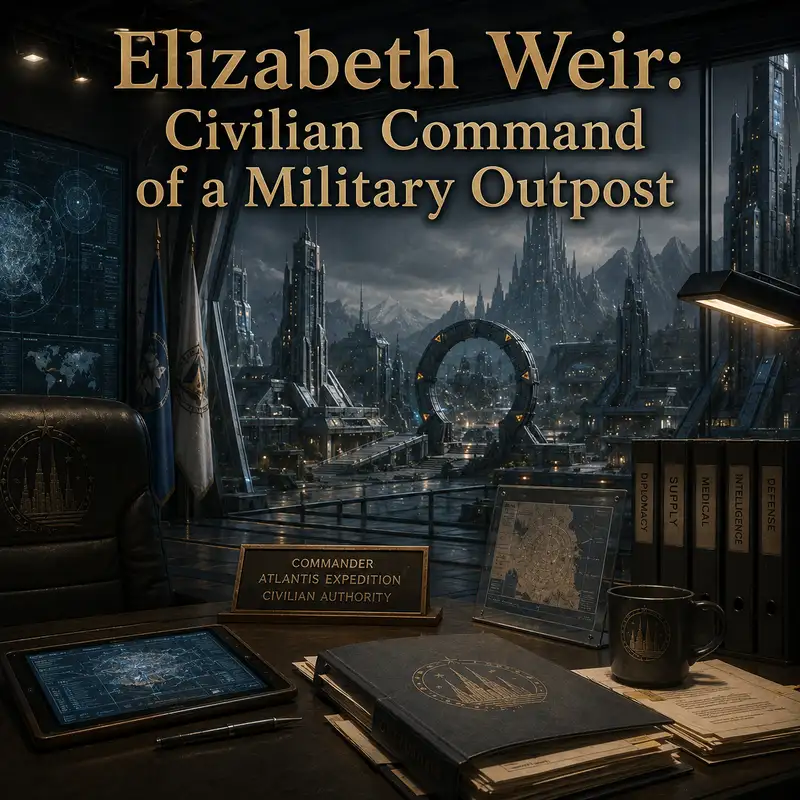
Elizabeth Weir: Civilian Command of a Military Outpost
Colonel Dillon Everett arrived in Atlantis with reinforcements, railguns, nuclear weapons, and orders that left no room for interpretation. He relieved Elizabeth Weir of command. Earth had finally reopened the intergalactic Stargate, but its first major intervention was not to praise the civilian who had kept the expedition alive. It was to place the city under a combat officer for the approaching Wraith assault. Weir accepted the order, stepped aside, and then immediately became indispensable to the defense Everett had been sent to direct.
That moment captures the contradiction of her entire command. Atlantis was a military outpost facing an enemy that harvested human populations, yet its leader was a diplomat with no rank, no uniform, and no authority derived from a service chain of command. She could authorize armed missions, negotiate with hostile governments, discipline scientists, accept refugees, and order the destruction of the city. She could also be relieved by a message from Earth. Her power was extensive, but never simple.
Weir had been selected because Atlantis was never intended to be only a base. Before the expedition, she had briefly led Stargate Command during a sensitive political transition and had participated in negotiations involving the Asgard and the Goa’uld System Lords. Her professional identity was rooted in international relations, diplomacy, and political judgment. Those qualifications mattered because the expedition included personnel from many countries, carried civilian researchers into unknown territory, and represented Earth before societies that had never heard of the United States Air Force.
A conventional commander could protect the gate room and direct a firefight. Atlantis required someone who could also decide whether a newly encountered government was an ally, whether an Ancient device should be activated, whether a scientific discovery belonged to one nation or all participating nations, and whether the expedition’s survival justified intervention in another society. Those were not secondary questions. They determined which wars Atlantis entered, which enemies learned its location, and which populations came to regard Earth as protector, rival, or threat.
The original command arrangement divided responsibility. Weir led the expedition. Colonel Marshall Sumner commanded its military personnel. The division resembled a civilian chief of mission supported by a senior defense officer, except that the embassy was an abandoned Ancient city beneath an ocean and the receiving government had been gone for ten thousand years. Sumner controlled security and armed operations. Weir set the expedition’s broader policy. Their relationship was never given time to mature.
Within hours of arrival, Atlantis began losing the power needed to hold back the sea. Weir authorized reconnaissance through the Pegasus gate network in search of shelter and energy. That decision brought the expedition into contact with the Athosians and into the path of the Wraith. Sumner was captured during the first culling. The city rose to the surface, but its military commander was gone, refugees were pouring through the gate, and the expedition had almost no reliable intelligence on the enemy.
Weir then made the decision that defined the opening phase of her command. She authorized a rescue mission led by Major John Sheppard. The operation recovered prisoners and ended Sumner’s suffering, but it also killed the Wraith Keeper and contributed to the early awakening of additional hives. Tactically, the mission saved lives. Strategically, it accelerated a threat the expedition did not yet understand. Weir’s first major use of force demonstrated a pattern that would follow her. The morally immediate choice often carried consequences across the entire galaxy.
Sheppard became the senior surviving military officer in Atlantis, although his appointment was based more on necessity and Weir’s confidence than on an orderly personnel process. Their partnership became the operating center of the expedition. Weir approved missions, defined political limits, and decided what risks the city could accept. Sheppard translated those decisions into reconnaissance, rescue, and combat operations. He challenged her openly when he believed a team or ally was being abandoned. She challenged him when instinct threatened to become policy.
The arrangement worked because neither pretended the other’s expertise was ornamental. Weir did not direct small-unit tactics from the control room. Sheppard did not assume that destroying an enemy patrol settled the diplomatic problem. Their arguments were part of the command system, not proof that the system had failed. Atlantis often survived because scientific, military, and political advice reached the same decision-maker before anyone opened fire or activated the Ancient device. Occasionally it survived after both had already happened, which was less efficient but increasingly traditional.
Weir’s authority depended on legitimacy more than coercion. Most expedition members were civilians who could not be managed as though they were soldiers. Many represented governments that expected access to discoveries and influence over policy. Scientists such as Rodney McKay and Radek Zelenka possessed expertise the commander could not replace, while medical personnel could halt operations through quarantine decisions. Weir had to make people accept limits without convincing them that military security had swallowed the mission they came to perform.
The Athosians further complicated the structure. They were not expedition employees, yet their knowledge of Pegasus was essential. Teyla Emmagan understood local societies, Wraith behavior, and gate routes that no Earth database could provide. Weir supported Teyla’s integration into Sheppard’s team and treated her as an adviser rather than a subject. That choice improved intelligence and diplomacy, but it also required Atlantis personnel to accept that authority and expertise did not always arrive through an Earth government or a military rank.
Trust was tested when security personnel suspected that the Athosians were revealing Atlantis operations to the Wraith. The actual cause involved a tracking device hidden within Teyla, but suspicion damaged relations and helped drive many Athosians to the mainland. Weir had to protect the city without turning every local ally into a permanent counterintelligence target. The incident exposed a recurring burden of civilian command. Security measures could be operationally reasonable and politically destructive at the same time.
The Genii provided a harsher test. During a planetary storm, Atlantis evacuated most of its population while Weir and a small technical group remained to preserve the city. Commander Acastus Kolya exploited the evacuation route, seized Atlantis, and held Weir, McKay, and Zelenka. Weir could not defeat the Genii force herself. Her weapons were time, information, and the attacker’s need to keep the city intact. She negotiated, delayed, and looked for divisions while Sheppard conducted a one-man counterattack through flooded corridors and darkened control spaces.
The crisis showed that Weir’s diplomacy was not an alternative to force. It was one part of the defense. Her resistance bought Sheppard room to maneuver. His resistance gave her bargaining position. Neither could have retaken Atlantis alone. Kolya regarded Weir as leverage because she was the recognized commander, even though Sheppard was the immediate military threat. Civilian authority therefore had battlefield value. The enemy understood that controlling the person who could order surrender, evacuation, or destruction might matter more than controlling one corridor.
That same distinction appeared during the first Wraith siege. Everett arrived with authority to direct the battle and formally displaced Weir. His orders made sense from Earth’s perspective. Atlantis faced imminent attack, and headquarters wanted an experienced combat commander in charge. Yet Everett possessed little knowledge of Pegasus politics, Genii weapons, Athosian capabilities, or the expedition’s improvised systems. Weir’s local experience could not be delivered with the ammunition shipment.
While Everett organized the defense, Weir traveled unarmed to negotiate for Genii nuclear prototypes. She secured the weapons despite the Genii’s hostility and returned in time for them to become part of the battle plan. She then addressed the expedition, retained responsibility for evacuation, and accepted Sheppard’s decision to fly a nuclear-armed Puddle Jumper toward the hive ships on what appeared to be a suicide mission. Everett held tactical command. Weir still carried the political responsibility for whether Atlantis would be abandoned or destroyed.
Her decision to let Sheppard go was not passive approval. It was command acceptance of a subordinate’s probable death because the alternative was the loss of the city and everyone still inside it. When the plan seemed likely to fail, she armed Atlantis’s self-destruct with McKay. A civilian commander had reached the same final contingency any military commander would have faced: deny the enemy the base, the database, and the route to Earth. The difference was not willingness to use force. It was the framework through which she judged when force served the mission.
After regular contact with Earth was restored, Weir’s position became more politically vulnerable, not less. Colonel Steven Caldwell commanded the Daedalus and was a plausible choice to become Atlantis’s senior military officer. Earth authorities questioned whether Sheppard had sufficient rank and experience. Weir defended him and insisted that Atlantis already had a military commander. She preserved a structure in which Caldwell commanded his ship, Sheppard commanded expedition forces, and Weir remained above both for matters affecting the city and mission.
That arrangement prevented Atlantis from becoming the private possession of whichever Earth service controlled the largest ship. It also produced overlapping jurisdictions. Caldwell could arrive with orders from Earth. Sheppard could act on intelligence gathered locally. Weir could approve or reject missions from the city. The International Oversight Advisory expected multinational accountability, while American military authorities remained responsible for most of the expedition’s armed power. The chain of command worked, but it occasionally resembled a wiring diagram completed by several governments using different colors of ink.
Weir’s hardest decisions did not always concern combat. Scientific programs could endanger Atlantis as effectively as an enemy fleet. When McKay pursued the Ancient power project known as Arcturus, he believed he was close to solving the city’s chronic energy shortage. Weir authorized continued work because a safe, abundant power source could transform the expedition’s position. The experiment instead destroyed a solar system and killed personnel. Her responsibility was not to understand the equations. It was to decide when expertise had become overconfidence and when a scientist’s promise justified institutional risk.
Medical research created an even darker problem. Carson Beckett developed a retrovirus intended to suppress the Wraith characteristics in their genetic structure. The strategic attraction was obvious. If Wraith could be transformed into humans, Atlantis might reduce the enemy without exterminating an entire species. Weir approved testing the treatment on a captured Wraith, erasing his memory and presenting him with a human identity. The subject became Michael.
The experiment failed ethically before it failed operationally. Michael discovered the deception, escaped, and became one of Atlantis’s most persistent enemies. Weir had approved an involuntary biological intervention and a fabricated identity because the possible military benefit appeared enormous. Her diplomatic background did not prevent her from authorizing coercive science. It may have made the rationalization more sophisticated, but sophistication does not restore consent. The decision remains one of the clearest limits of her command judgment.
A later alliance with Michael’s hive repeated the same strategic temptation at a larger scale. The Wraith offered intelligence and cooperation in exchange for a weaponized version of the retrovirus. Weir and her senior staff accepted the risk because success might turn rival hives against one another and reduce the pressure on human worlds. The alliance was a deception. Wraith code compromised Atlantis systems, and the enemy used the relationship to pursue information about Earth.
The failure did not prove that negotiation with the Wraith was always irrational. Atlantis lacked the forces to defeat every hive and needed divisions within Wraith society. It did prove that Weir’s willingness to search for negotiated leverage could be exploited by an adversary that treated cooperation as another collection method. Diplomacy requires a possible overlap of interests. Intelligence work requires assuming that the other side may be manufacturing that overlap for access.
Her dealings with the Genii were equally ambiguous. When Ladon Radim claimed to be organizing a coup against Cowen, Weir did not simply accept his account. She investigated, tested his claims, and tried to protect Atlantis personnel. Ladon still manipulated the expedition, used hostages, and carried out a violent seizure of power. He later became a more workable Genii leader than Cowen, but the method of his rise left Weir with an uncomfortable partner. Civilian command meant dealing with the government that existed after the shooting, not the government Atlantis would have preferred.
Weir’s greatest strength was her ability to keep military victory subordinate to political purpose. She repeatedly asked what a mission would create after the target was destroyed. Her weakness was a tendency to believe that dialogue, intelligence, or a technological workaround could convert an impossible conflict into a manageable one. Sometimes that belief saved lives. Sometimes it gave an adversary access. Sometimes it produced Michael. The line between creative statecraft and dangerous optimism was rarely visible before the decision.
The expedition’s enemies also understood that Weir herself was a center of gravity. When alien consciousnesses took control of her and Sheppard, Caldwell had to assume command and treat both leaders as internal threats. Their authority, access, and knowledge made possession more dangerous than the loss of ordinary personnel. The incident illustrated a basic security problem in small commands. Concentrating trust in a few people creates speed and cohesion. It also ensures that compromising one of them can bypass layers of defense designed to stop an external attack.
The Asurans confronted Weir with another version of Ancient power and political absolutism. She attempted to negotiate with Oberoth and argued that Atlantis did not seek conflict. The Asurans regarded the expedition as inheritors of the Lanteans who had created and tried to destroy them. Weir’s diplomatic language could not erase that history. The encounter nearly ended with the expedition’s destruction and confirmed that some conflicts could not be resolved by proving present intentions when the opposing side defined the dispute through ancient grievance.
When surviving Lanteans later reclaimed Atlantis, Weir surrendered the city. From a narrow possession standpoint, the expedition had occupied an abandoned installation built by them. From a strategic standpoint, handing over Atlantis removed Earth’s strongest foothold in Pegasus and exposed human allies to renewed danger. Weir accepted the transfer because she recognized the builders’ claim and because Earth lacked a lawful or practical basis for resisting them by force. Civilian command required knowing when authority ended, even inside a city she had helped save.
The sharpest judgment on her position came with the Apollo’s preemptive strike against the Asuran homeworld. Colonel Abraham Ellis arrived under Earth orders to attack a fleet believed to threaten Atlantis and Earth. Weir questioned the intelligence and warned that the strike might provoke an enemy the expedition did not fully understand. Ellis proceeded under higher authority. The bombardment damaged Asuras but did not eliminate the Asurans.
Their retaliation trapped Atlantis beneath an energy beam transmitted through an orbiting Stargate. Weir attempted negotiation, then authorized increasingly radical measures to preserve the city. Atlantis descended beneath the ocean to attenuate the beam and finally launched into space when remaining in place became impossible. The city escaped, but the beam struck the control tower during departure and critically injured Weir. A military operation she had opposed created the crisis that ended her command.
Doctors used dormant Asuran nanites in her body to repair the damage. The treatment saved her life but made her a security and political risk. Weir understood that the same technology restoring her brain could be influenced by the Asurans. She accepted safeguards, including the possibility that her own people might have to deactivate the nanites if she lost control. The commander had become both patient and potential vulnerability, a condition no organizational chart had anticipated.
During the mission to recover a zero-point module and disable the Asuran threat, Weir used her altered connection to their network. When the team became trapped, she left the Puddle Jumper and allowed herself to be captured so the others could escape. Sheppard had to authorize an attempt to shut down the nanites inside her, reversing the pattern that had defined their partnership. The military officer now made the life-or-death decision concerning the civilian commander who had made so many such decisions for him.
The screen record does not provide a simple final fate for the original Weir. A later Replicator entity carried her memories and identity, but whether it represented uninterrupted personal survival, a copied consciousness, or something between those categories remains uncertain. What is clear is that Elizabeth Weir’s tenure ended through injury, technological transformation, and sacrifice rather than through a finding that civilian leadership had failed.
Her record was not clean. She authorized deceptive experimentation on Michael, accepted alliances that exposed Atlantis to betrayal, and sometimes allowed the promise of a scientific or diplomatic solution to outrun the available safeguards. She also held together a multinational expedition with limited supplies, protected local allies, resisted attempts to reduce Atlantis to a purely American military command, and made evacuation and destruction decisions under direct attack. Her mistakes were command mistakes, not evidence that a civilian had wandered into responsibilities beyond her understanding.
Civilian command worked in Atlantis because the city was never merely a fort. It was a research institution, diplomatic mission, intelligence center, refugee haven, strategic base, and symbol of Earth’s presence in Pegasus. A purely military commander could defend it and still lose the relationships, legitimacy, and scientific purpose that made it worth defending. Weir supplied the political judgment that gave armed operations direction, while relying on Sheppard and other officers to turn that direction into action.
The arrangement remained fragile because her authority depended on appointment, trust, and continued political support from Earth. Everett could temporarily replace her. Caldwell could challenge the command structure. Ellis could execute higher orders over her objections. The International Oversight Advisory could review her performance from another galaxy. Civilian supremacy existed, but it was exercised through negotiation even within Earth’s own chain of command.
Elizabeth Weir did not prove that diplomats make better battlefield commanders. She proved that a military outpost engaged in exploration, alliance building, scientific recovery, and regional war requires more than battlefield command. Her leadership succeeded when it joined political purpose to military capability. It failed when hope in negotiation or technology obscured coercion, deception, and risk. Atlantis survived her command because she understood that force had to serve a larger mission. She lost that command when forces beyond her authority made a strategic decision, and she remained at the center of the consequences.