Enemy at the Gate: The Wraith Assault on Earth
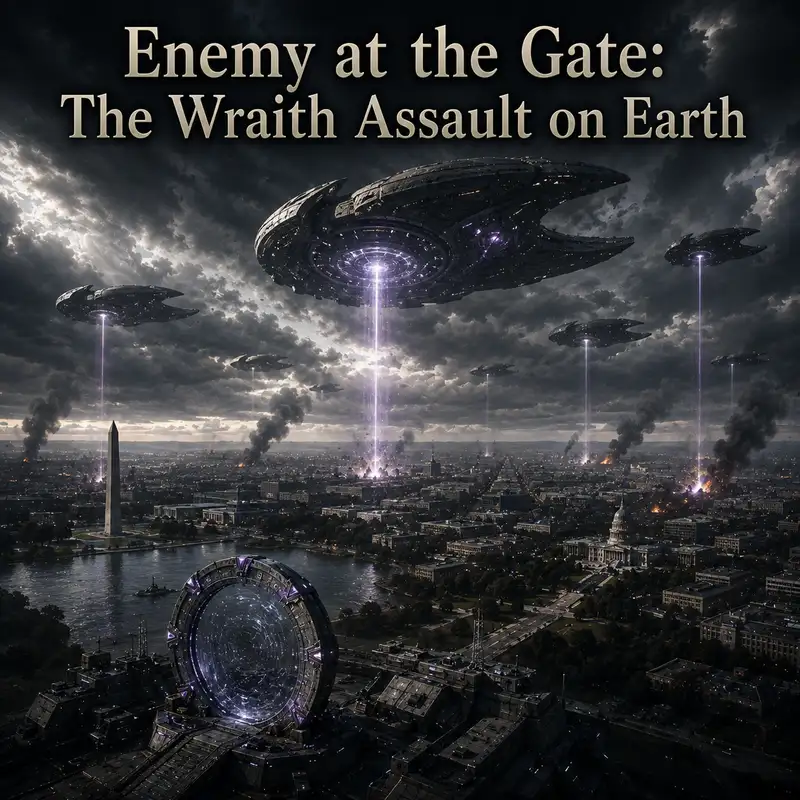
Stargate Command tried to open a wormhole to the Alpha Site and received no lock. Alternate evacuation addresses failed as well. At almost the same moment, Atlantis dialed Earth and found Wraith energy returning through the connection. The explanation was worse than a damaged gate. The enemy had carried a Pegasus-model Stargate into Earth orbit. Because that gate took precedence over the Milky Way model inside Cheyenne Mountain, every attempted connection was being redirected into the Wraith ship. Earth had not merely been reached. Its principal escape route had been captured without one soldier entering the mountain.
The Wraith assault on Earth was the result of several separate failures converging at once. A stolen zero-point module had produced a hive ship capable of defeating Earth’s battlecruisers. A weak signal from an alternate reality disclosed Earth’s coordinates and defenses. International negotiations had moved the Ancient control chair to the one facility named in that signal. Earth’s warships were dispersed, damaged, or unavailable. The attack was stopped only when Stargate Command, the Atlantis expedition, and an Ancient city-ship combined several improvised operations under a timetable measured in minutes. The question is why Earth’s strongest defenses failed in sequence, and why Atlantis itself became the final reserve.
Warning came from Todd, the Wraith commander whose alliances with Atlantis had repeatedly mixed useful intelligence with carefully managed omissions. He reported that a rival faction possessed a hive powered by a zero-point module and that the vessel was still growing into its new capability. Todd’s own history made the report uncomfortable. He had stolen several modules during the destruction of Asuras and had concealed how many survived. One had entered the experimental program that created the new ship. Todd was warning Atlantis about a genuine strategic threat partly produced by technology he had recovered for his own political advantage.
The Daedalus carried Sheppard’s team toward the prototype before its transformation could be completed. A cloaked Puddle Jumper approached first, expecting normal Wraith sensors to miss it. The hive detected the craft, fired accurately, and damaged its controls. Colonel Steven Caldwell moved the Daedalus between the Jumper and the incoming fire, then answered with the Asgard plasma beam that had destroyed other major warships. The direct hit caused minimal damage. The hive returned a massive broadside, collapsed the Earth ship’s combat capability, and destroyed its hyperdrive controls. Earth’s best available battleship had learned the target’s strength by becoming unable to pursue it.
The super-hive could have finished the Daedalus. Instead, it broke contact and entered hyperspace. A sensor team later found the reason in a weak Wraith-coded transmission surrounded by radiation associated with another reality. The message had crossed from a parallel Earth where a Wraith was trying to broadcast that planet’s location. It carried the coordinates of Earth and intelligence about its Ancient defenses. The prime Wraith had not captured an expedition officer, stolen a database, or decoded Atlantis’s records. They acquired the most valuable address in two galaxies because an enemy in another reality had transmitted through the wrong boundary.
That intelligence changed the mission from a Pegasus interception into defense of the homeworld. The Daedalus could not move. The Odyssey was away on an operation so compartmented that even Caldwell lacked details. The Apollo and the Sun Tzu were the only battlecruisers positioned to intercept. They attacked during the hive’s expected journey, but the ship defeated them as decisively as it had the Daedalus. The Sun Tzu was crippled and venting atmosphere. The Apollo took aboard survivors but lost its engines. The super-hive continued with little apparent damage. Earth’s interstellar fleet existed, but it did not exist in one place when Earth needed it.
The failure revealed the limits of technological growth. Earth had advanced from one secret Stargate to an international fleet in little more than a decade, yet each battlecruiser remained a scarce strategic asset with obligations across two galaxies. A ship on patrol, under repair, supporting Atlantis, or conducting a classified mission could not instantly become part of a homeworld defense line. The Stargate allowed rapid movement of people, not damaged capital ships. The Wraith had brought one exceptional vessel. Earth had several capable vessels scattered across an exceptional operating area. Fleet size on an organizational chart and combat power in Earth orbit were not the same measurement.
Atlantis became the only remaining platform with enough potential firepower to matter. Moving it required three functioning zero-point modules. The city possessed one. Todd finally disclosed the location of two more that he had hidden, and Major Evan Lorne’s team recovered them while Rodney McKay verified they were genuine. The modules restored a full power complement for the shield, stardrive, and drone weapons. Their source was another strategic irony. Todd’s stolen Asuran technology had helped create the super-hive, and Todd’s concealed reserves now made the city capable of opposing it. The same manipulation had armed both sides of the final battle.
John Sheppard did not remain aboard Atlantis for the intergalactic flight. Earth needed the expedition’s most experienced Ancient-chair operator and one of the few pilots with extensive combat experience against Wraith Darts. Carson Beckett took the control chair and lifted the city from the ocean while Richard Woolsey commanded from the control room. Teyla and Ronon were offered the chance to remain in Pegasus before the city crossed beyond the galaxy. Both refused. Earth was not their homeworld, but the people defending it were their team. Alliance had become personal enough to survive the distance between galaxies.
At Stargate Command, Colonel Samantha Carter temporarily directed the response while General Hank Landry led a task force in Washington. Major Paul Davis represented Homeworld Security inside a briefing room converted into an operations center. The red mark showing the Wraith ship appeared near the Moon far earlier than planners expected. The vessel had crossed the intergalactic distance weeks ahead of the estimate and was still completing upgrades in lunar orbit. That pause gave Earth a narrow interval to act. It also placed the enemy close enough to scan the planet, launch Darts, and destroy fixed defenses before approaching the atmosphere.
Earth’s surviving Ancient defense depended on the control chair and drone weapons once based in Antarctica. That installation had stopped Anubis’s fleet and remained the strongest known planetary weapon available. International negotiations had recently moved the chair to Area Fifty-One because its presence in Antarctica violated the relevant non-proliferation agreement. The political reasoning had not been frivolous. No single state was supposed to retain unrestricted control of a weapon capable of destroying fleets. The relocation nevertheless concentrated the interface, personnel, and support infrastructure at a facility identified in the alternate-reality signal less than a month after the move.
Sheppard initially proposed arming F three-oh-two fighters with nuclear weapons and striking the hive before its upgrades finished. Earth Defense maintained a squadron on alert, but those aircraft had been configured for interception rather than attacks on capital ships. The nuclear refit required time. The Wraith used that time to launch a large Dart formation toward Nevada. Their target selection showed that they understood the intelligence they had received. They did not begin with random culling or symbolic bombardment. They moved to eliminate the one ground-based system capable of launching Ancient drones against the hive.
The F three-oh-twos met the Darts in the atmosphere and were badly outnumbered. Sheppard and the Earth pilots destroyed several attackers, but the Wraith did not need every Dart to survive. Two broke away and accelerated toward Area Fifty-One on deliberate collision courses. Sheppard pursued, lost another pilot, and took damage to one engine while trying to intercept. The two Darts reached the facility and destroyed the control chair. The Ancient drones may still have existed in their remote storage location, but Earth had lost the interface required to direct them. A small sacrificial strike had removed the planet’s strongest weapon before the hive entered orbit.
The attack also exposed the cost of fixed strategic infrastructure. The chair was immensely powerful when protected, powered, and operated by someone with the Ancient gene. It could not maneuver, disperse, or survive once an enemy knew its location and sent enough targets through the fighter screen. Earth’s political system had spent years deciding who should control the weapon. The Wraith needed only a few minutes to make the jurisdictional dispute irrelevant. Strategic weapons do not become less vulnerable merely because several governments agree that no one government should possess them.
Sheppard converted the delayed nuclear refit into a one-aircraft penetration mission. His F three-oh-two carried a warhead large enough to destroy the hive if detonated internally. He climbed toward orbit, shut down nonessential systems, and waited along the projected path of the approaching vessel. External attack had already failed. The new objective was to cross the enlarged hull, place the weapon behind its protection, and accept that extraction might not exist. The plan required the Wraith to overlook one quiet fighter after monitoring a planet filled with military emissions. It also required Sheppard to enter a living ship whose crew was preparing to attack billions of people.
Atlantis was moving toward Earth under equally unfavorable conditions. Even with three zero-point modules, the city’s hyperdrive had not operated at full intergalactic power in roughly ten thousand years. It failed near the edge of the Milky Way and dropped the city into normal space far short of Earth. The expedition had launched its strongest asset, crossed between galaxies, and become stranded while the battle began without it. McKay worked on the hyperdrive. Zelenka considered a more dangerous alternative derived from an Ancient system abandoned because its calculations and power demands left almost no tolerance for error.
Before using that alternative, Atlantis tried to contact Earth through its Stargate. The wormhole opened, but Stargate Command did not answer because the connection had terminated aboard the super-hive. Wraith doctrine normally denied a planet’s gate by maintaining an incoming connection. Intergalactic range made that method impractical here. The attackers instead carried a Pegasus gate close enough to supersede Earth’s local Milky Way model. The system blocked evacuation from Cheyenne Mountain and intercepted help from Atlantis. The blockade was elegant, automatic, and based on rules the expedition had previously encountered at Midway Station.
The same blockade provided a boarding route. Atlantis personnel rolled grenades through the event horizon to clear the Wraith guards. Teyla, Ronon, McKay, and Lorne followed as a small sabotage team. Woolsey considered sending more Marines, but a large assault would have moved slowly through a vast ship whose crew knew the interior. The four-person element could use surprise, McKay’s understanding of Wraith systems, and the gate as a temporary foothold. Their mission was not to capture the hive. It was to damage key systems, preserve an escape path, and create time for the defenses around Earth.
The boarding action almost ended immediately. Wraith patrols converged through the organic corridors, forcing the team into close-range firefights. Ronon was stabbed from behind after defeating two attackers, and the blade damaged a lung. Teyla and the others had to leave him when additional Wraith approached. For a brief period, Ronon was dead. A Wraith later restored his life and bound the wound so he could be interrogated. The same feeding ability normally used to kill had preserved a prisoner whose knowledge might expose the other boarders. Ronon survived because the enemy considered him more useful alive.
Sheppard entered through a different opening. He powered the F three-oh-two, fired a missile into the Dart bay, and flew through the breach before the defenders could close it. Once inside, he parked near an internal platform and began arming the nuclear device. He expected no extraction and asked Stargate Command to relay a farewell when Atlantis arrived. McKay’s team reached him before detonation and revealed that the hive’s onboard gate could still provide a route out if its dial-home controls were reconfigured for local addresses. The suicide mission became a timed sabotage-and-escape operation, provided the Wraith did not begin firing first.
The Wraith commander was not preparing an immediate, indiscriminate culling. The ship completed a surface scan and began powering weapons for a deliberate attack sequence. Carter expected military installations to be struck first, followed by the power grid. Panic and infrastructure failure would precede the release of Darts. This was conquest doctrine adapted to an advanced human planet. Earth’s population was the objective, but its military and political systems had to be paralyzed before that population could be harvested. The Wraith had reached the richest feeding ground they knew and were disciplined enough not to rush the meal.
At the edge of the Milky Way, Zelenka proposed activating the wormhole drive. The system treated the city’s movement more like gate travel than conventional hyperspace and promised nearly instantaneous transit across an enormous distance. It also required calculations so precise that a small error could destroy Atlantis immediately. Woolsey authorized the attempt because conventional repair would arrive after Earth’s defeat. Medical teams prepared for the possibility that the city might appear directly inside a combat zone. The drive activated. Atlantis vanished from deep space and reappeared near Earth within seconds. The prototype worked once, which was exactly the number of successful uses the crisis required.
Inside the hive, Sheppard’s team found Ronon alive and moved toward the Stargate. McKay estimated that reaching the gate and recalibrating its controls would take longer than Earth had before the ship fired. Carter informed Sheppard that the attack sequence had begun. He prepared to detonate the warhead with everyone still aboard. Then sensors detected another vessel. Atlantis emerged between the hive and Earth under full shield, and Beckett launched Ancient drones. The city’s arrival did not destroy the enemy. It interrupted the firing schedule and gave the boarding team the minutes it needed to escape.
The orbital engagement became a contest between incompatible weapons and limited power. Atlantis’s drones struck the super-hive hard enough to disrupt operations, but the Wraith vessel answered with sustained fire against the city shield. The impacts pushed Atlantis into a lower orbit where atmospheric drag drained the shield even faster. Beckett could use available power to climb or continue launching drones, not both at full effect. Woolsey ordered him to keep firing. The decision accepted the possibility of losing Atlantis to prevent the hive from turning its weapons on Earth or the team still fighting toward the onboard gate.
McKay reached the Wraith dial-home device and reconfigured it for a local destination. The team selected the Alpha Site, moved Ronon through the active gate, and continued firing until the last person crossed. Sheppard left the nuclear detonator on a timer before backing into the wormhole. The warhead aboard his F three-oh-two armed on the internal landing platform. Moments later, the super-hive exploded. The vessel that had resisted Asgard beams, crippled three battlecruisers, destroyed Earth’s Ancient control chair, and contested Atlantis did not survive a nuclear weapon placed behind the armor by the aircraft it had failed to detect in time.
The destruction of the hive did not end the emergency. Wraith fire had pushed Atlantis too low, and the city no longer had enough control authority to recover orbit. Its shield was already weakened by the duel. Beckett guided the city into atmospheric reentry while the remaining protection absorbed heat that would otherwise have broken the structure apart. Stargate Command temporarily lost communications. Commercial vessels in the North Pacific reported a giant fireball crossing the sky, which was accurate enough to concern several agencies and not especially helpful to a program built around secrecy.
Atlantis reestablished contact after surviving the worst of reentry. Beckett brought the city over the Pacific while naval authorities prepared for a splashdown that could not be described in any ordinary maritime warning. The expedition activated the cloak before approaching populated areas and landed in the ocean near San Francisco. A naval quarantine concealed the city while its damaged systems were assessed. The Wraith assault had carried Atlantis farther than any previous deployment and returned the Lantean capital to the planet its builders had left thousands of years earlier. It arrived as a combat casualty rather than a ceremonial homecoming.
Earth survived, but the defense network had paid heavily. The Daedalus remained crippled in Pegasus. The Sun Tzu was badly damaged, and the Apollo had lost propulsion while rescuing its crew. The Ancient control chair at Area Fifty-One was gone. Atlantis had exhausted power, suffered combat damage, and could not simply launch back toward Pegasus. Ronon required medical care after dying and being restored. Todd remained a prisoner whose zero-point modules had saved Earth from a ship his concealed research helped create. Tactical victory left almost every available strategic asset damaged, displaced, or politically complicated.
The Wraith assault succeeded as far as it did because one faction combined stolen power, intelligence from another reality, and an understanding of Earth’s defensive seams. It bypassed the fleet through superior performance, removed the chair through expendable Darts, blocked the Stargate through model precedence, and approached Earth without a supporting armada. That last strength was also a weakness. The super-hive had no escort, reserve, or second wave. Once the single ship was penetrated and destroyed, the assault ended. A Wraith faction had built enough power to reach Earth, but not enough political unity to turn that breakthrough into a sustained intergalactic campaign.
Earth’s victory did not come from one decisive superweapon. It came from connecting systems that had never been designed as one defense plan. Todd supplied intelligence and power modules. The Daedalus provided the first reconnaissance and warning. The Apollo and Sun Tzu forced the hive to reveal its superiority. Stargate Command coordinated fighters and planetary intelligence. Atlantis supplied the gate assault, the wormhole drive, drones, and the shield that protected Earth during the final minutes. Sheppard’s nuclear fighter exploited the ship’s interior. Success depended on institutions and allies improvising across two galaxies after every planned layer had already failed.
Enemy at the gate described the strategic condition more accurately than a normal invasion warning. The Wraith were not merely above Earth. They had reached the interfaces through which Earth defended and evacuated itself: the fleet route, the Ancient chair, the fighter screen, and the Stargate network. Atlantis stopped the assault by becoming the final moving layer of planetary defense and then falling out of orbit in the process. Earth was saved, but Pegasus lost its city, its strongest base, and much of its expeditionary power in one movement. The Wraith failed to cull Earth. They still forced Earth’s greatest intergalactic outpost to come home.