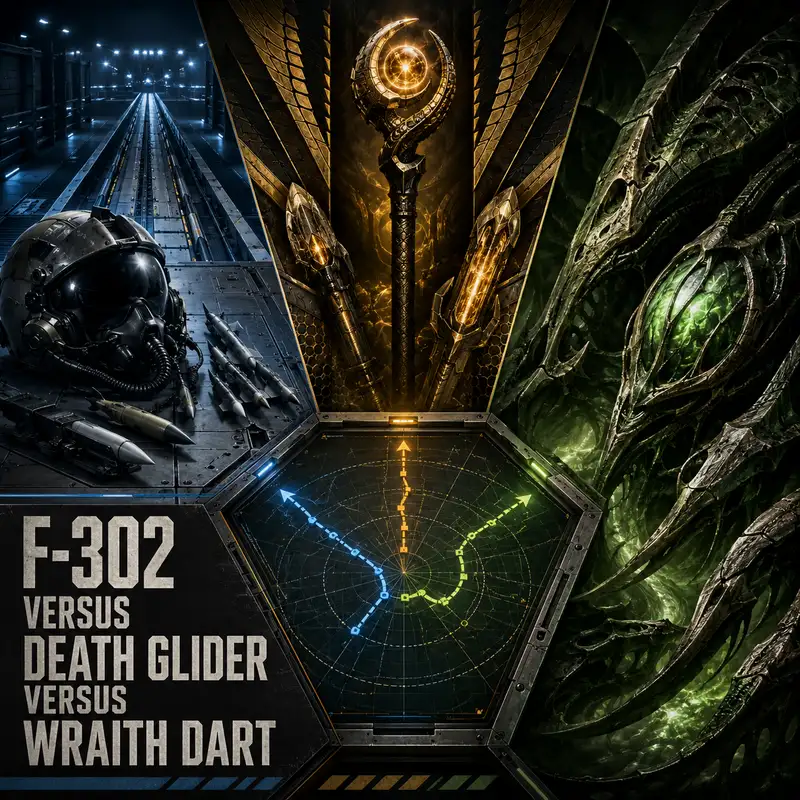
F-302 Versus Death Glider Versus Wraith Dart
Two Wraith darts broke away from the dogfight over Nevada and pointed their noses toward Area Fifty-One. Lieutenant Colonel John Sheppard and another F three-oh-two pilot turned after them, but two more darts dropped in behind the Earth fighters. The second F three-oh-two was destroyed. Sheppard’s starboard engine was hit, and his aircraft fell into a flat spin. He recovered only a few moments before impact. The two Wraith craft did not recover at all. They struck the installation in a deliberate kamikaze attack and destroyed the Ancient control chair Earth had hoped to use against the super-hive in orbit.
That engagement provides the best answer to the question implied by any comparison of the F three-oh-two, the Goa’uld death glider, and the Wraith dart. The superior fighter does not always win the mission. Earth’s aircraft could engage the darts, destroy some of them, and survive damage that would have ended a less forgiving design. The Wraith still achieved their objective because they had numbers, surprise, a protected carrier in space, and pilots willing to convert themselves into the final guidance system. A technical comparison matters. Doctrine, logistics, command, and mission design matter more.
Among the three craft, the F three-oh-two was the clearest attempt to build a true multirole interceptor and precision strike aircraft. The death glider was an imperial fighter designed to escort, strafe, patrol, and display Goa’uld power. The Wraith dart was a fast attack craft built around the requirements of culling, capture, and hive defense. All three could fight in atmosphere and space. None should be treated as a miniature capital ship. They were lightly protected, dependent on carriers or bases, and most effective when operating as part of a larger system.
The death glider came first. Goa’uld forces had used the design for a very long time before Earth entered the interstellar war. It served as the standard fighter aboard Ha’tak motherships and could also operate from planetary installations. A normal crew consisted of two Jaffa, one flying and one handling weapons. Its armament was a pair of forward-firing staff cannons, larger versions of the same energy technology carried by Jaffa infantry. The glider could move between atmosphere and orbit, but it lacked an independent hyperdrive. Its strategic movement therefore depended on a mothership, a local base, or another means of transport.
The design reflected Goa’uld military priorities. A death glider could conduct low-level strafing attacks against exposed troops and settlements, intercept small craft, escort bombers, and add numbers to a fleet defense. Its energy weapons did not require the pilot to manage a small magazine of missiles, although the screen record never establishes an exact endurance. A Ha’tak could launch groups of gliders quickly and recover them into dedicated racks. The fighter was therefore part of an imperial package. The mothership supplied transportation, maintenance, command, and protection. The glider supplied reach inside the atmosphere and concentrated fire where a capital ship’s main weapons were excessive or poorly placed.
Its limitations were equally visible. The two staff cannons fired directly forward. To hit a target, the pilot had to point the entire aircraft at it and maintain the correct line long enough to fire. The surviving record does not show the kind of sophisticated human-style radar display, missile cueing, or flexible weapons management later built into the F three-oh-two. Skilled Jaffa could compensate with experience, formation tactics, and repeated passes. The weapon still rewarded a direct approach. Against troops with no air defense, that was enough. Against a maneuvering opponent armed with guided missiles, it became a serious disadvantage.
Earth’s first attempt to create an orbital fighter began by modifying captured Goa’uld technology. The X three-oh-one combined parts from two death gliders with human controls and weapons. It flew impressively until a concealed recall program activated and began carrying Jack O’Neill and Teal’c away from Earth. That failure was more than an engineering embarrassment. It demonstrated that recovered hardware could contain command functions Earth had not detected. Possessing a vehicle did not mean controlling it. The next design had to be human-built, even if many of its operating principles remained alien.
The X three-oh-two, later fielded as the F three-oh-two, was that answer. Its propulsion system combined air-breathing jets, high-altitude aerospikes, a rocket booster, and a compact hyperspace generator. In theory, that combination allowed runway operations, atmospheric flight, orbital insertion, and a brief hyperspace transition. In practice, the naquadria powering the hyperspace system was unstable. The craft could open a window for a very short interval, but it could not cruise between star systems like a battlecruiser. The capability was tactically extraordinary and strategically limited, which is a familiar outcome when a prototype is asked to become doctrine before the fuel chemistry has become cooperative.
That mobility carried a logistical price. An F three-oh-two could launch from Earth, deploy from a battlecruiser, or operate from a prepared off-world runway, but it did not pass through a Stargate as an assembled fighter. Earth moved aircraft between planets by breaking them down and rebuilding them on the far side. A Wraith dart could enter a gate intact and take captured people with it. A death glider normally depended on its mothership or local facilities. The dart therefore held the advantage in immediate gate-borne raiding. The F three-oh-two required more infrastructure, even when its brief hyperspace jump solved one very specific tactical problem.
The F three-oh-two was usually configured with two seats, although later missions showed that one pilot could operate it. A second crew member could handle sensors, targeting, or a specialized technical task while the pilot concentrated on flying. It also included inertial dampeners, life support, an autopilot, safety systems, and an ejection capability rooted in Earth aviation practice. None of those features made the fighter invulnerable. They made it recoverable. Earth had invested in the pilot, the training pipeline, and the knowledge carried back from each mission. Designing a way for that pilot to survive was therefore part of combat effectiveness, not an optional courtesy.
Its most clearly established weapons were guided missiles, including specialized warheads when the mission required them. That gave the F three-oh-two a precision advantage over the death glider’s fixed staff cannons. The pilot could engage at range, attack a specific subsystem, and use missile guidance rather than holding the aircraft directly on the target throughout the shot. The tradeoff was finite ammunition. During the battle over Antarctica, Earth’s fighters eventually exhausted their weapons and had to withdraw. An empty missile rail is an admirably straightforward engineering condition. It is also difficult to negotiate with during combat.
The F three-oh-two’s first operational strike showed what the design was really for. Jack O’Neill and Samantha Carter attacked Anubis’s flagship over Vis Uban, fought through death glider opposition, and used the craft’s brief hyperspace capability to bypass the ship’s defensive shield. Their target was not the entire mothership. It was a cooling shaft supporting Anubis’s superweapon. One precisely placed attack caused the weapon to overheat when fired. The fighter did not defeat a capital ship by matching its firepower. It converted intelligence about one vulnerable subsystem into access, timing, and a guided strike.
That mission also established the limits of one-on-one comparisons. The F three-oh-two succeeded because Daniel Jackson and Jonas Quinn transmitted targeting information from inside the enemy ship. Carter translated that intelligence into coordinates and timing. O’Neill flew the attack. Allied ground forces kept the wider operation alive. The aircraft was the delivery platform at the end of an intelligence chain. Without the internal source, it would have been a highly advanced fighter circling a shielded target with no useful place to put its missile.
The Battle of Antarctica provided the clearest confrontation between F three-oh-twos and death gliders. General George Hammond brought Prometheus and Earth’s available fighter force over the ice while S G One tried to reach the Ancient outpost below. The Earth fighters engaged death gliders and Al’kesh bombers in atmosphere and near space. Cameron Mitchell’s squadron took serious losses while preventing enemy aircraft from destroying the cargo ship working over the target area. The F three-oh-twos did not defeat Anubis’s fleet. They bought time until O’Neill activated the Ancient drone weapons.
That is still a victory for the fighter force, just not the kind usually shown on a tally board. Its operational objective was protection, not annihilation. The F three-oh-twos disrupted attack runs, forced enemy pilots to defend themselves, and preserved the one platform carrying the people who could activate the planetary defense. The death gliders remained dangerous in numbers and under capital-ship cover. Their energy weapons could destroy an Earth fighter, and the Al’kesh added heavier fire. The evidence suggests that the F three-oh-two held the advantage in precision and pilot systems, while the Goa’uld held the advantage in mass and supporting fleet power.
The Wraith dart belonged to a different war. A hive did not send darts merely to bomb a human settlement. It sent them to collect people. The dart’s defining system was its culling beam, which dematerialized targets, stored their patterns, and allowed them to be transferred or rematerialized later. The same system could work in reverse to deploy Wraith troops. One small craft therefore combined fighter, raider, assault transport, and prisoner-recovery functions. A death glider could terrorize a village. A dart could remove much of that village from the battlefield without landing.
That capability shaped Wraith strategy across the Pegasus galaxy. Darts could sweep low over settlements, collect people at speed, pass through a Stargate, and return to a cruiser or hive ship. They were normally flown by a single Wraith and carried forward energy weapons in addition to the culling system. Some operations also showed them dropping explosive ordnance. Their independent strategic range was limited, so hives acted as carriers, repair bases, command centers, and destinations for captured humans. Like the death glider, the dart made the most sense when examined as one component of a larger predatory system.
The culling beam was not merely a transport device fitted onto a fighter. It changed what success meant. A dart did not have to destroy a defensive position if it could remove the crew. During the siege of Atlantis, darts swept personnel away from railgun positions and later deposited Wraith soldiers inside the city. They could penetrate the battlespace, collect targets, and create infantry where no conventional landing zone existed. That gave the Wraith an assault capability Earth fighters could not reproduce. The F three-oh-two could control airspace. It could not turn one low pass into a platoon appearing behind the defender’s line.
The dart also displayed a willingness to be expended. Wraith pilots made kamikaze attacks against Atlantis’s shield and later against Area Fifty-One. This did not mean every dart was treated as disposable or every pilot was eager to die. It meant Wraith command accepted one-way missions when destroying a strategic target justified the loss. The craft’s speed and small profile made that option difficult to stop once enough darts entered the defensive zone. An interceptor can shoot down several attackers and still fail if the remaining two reach the installation.
In pure maneuver combat, the dart was a serious opponent. When four F three-oh-twos launched from Daedalus against two hive ships, large numbers of darts divided and pursued the Earth fighters. Guided missiles destroyed groups of them, and the F three-oh-two flight maintained formation long enough to make attack runs against the hives. One Earth fighter lost a generator. Sheppard’s aircraft was struck hard enough to shear away part of a wing. He survived only by attaching the damaged fighter to a hive before it entered hyperspace, which was an excellent improvisation and not a maintenance procedure anyone hoped to standardize.
That engagement suggests the F three-oh-two had the stronger individual air-combat system. Its missiles could break up clustered darts, its cockpit supported coordinated wing tactics, and its damage tolerance allowed at least some chance of recovery after a hit. The dart offset those strengths with speed, numbers, and immediate support from the hive. A Wraith commander did not need every dart to win its duel. The swarm had to keep the Earth fighters away from the carrier, force them to expend missiles, and create openings for the hive to complete its mission.
The F three-oh-two also proved more flexible as a precision support platform. During the rescue of Teyla from Michael’s cruiser, Earth fighters attacked the vessel to force its dart bay doors open. A cloaked Puddle Jumper used that opening to enter while the F three-oh-twos damaged major weapon systems. The fighters were not expected to destroy the cruiser alone. They created access for a boarding operation and reduced the threat to the rescue force. This was conventional airpower adapted to an alien target: suppress, distract, open the route, and let another element exploit it.
Death gliders could perform a similar escort or suppression role, but their fixed energy cannons made precise subsystem attack more demanding. Their great advantage was continuity. Jaffa pilots already knew how to fly them. Ha’taks already carried them. Goa’uld bases already supported them. When the System Lords weakened, rebel Jaffa and successor powers could continue using the aircraft they inherited. A fighter does not become obsolete merely because another design wins a demonstration. If it is available in quantity, can be maintained, and fits the existing carrier, it remains military power.
The dart’s equivalent advantage was integration with Wraith biology and hive operations. It could cull, deploy, fight, scan, and return captured matter to the larger vessel. Earth could capture and even fly individual darts under unusual conditions, but it could not build or sustain a dart force. The expedition lacked the Wraith industrial system, the internal knowledge, and the carrier infrastructure that made the design routine. The same was true in reverse. A Wraith pilot could steal an F three-oh-two, but that would not provide the missile factories, trained ground crews, software support, and spare engines behind Earth’s squadrons.
Sensors and command relationships further separated the designs. The F three-oh-two was built around human aviation concepts: instruments, radio communication, target tracking, wingmen, and coordination with a carrier or ground command. Death glider crews communicated with one another and their motherships, but their tactics often relied on direct visual attack and massed approach. Darts behaved as coordinated swarms under hive control and could respond rapidly to threats near the carrier. The screen record does not provide enough data to rank every sensor system. It does show that information and control were distributed differently.
Pilot quality could reverse any technical expectation. Teal’c and Bra’tac used death gliders with skill because they understood the machine and Jaffa tactics. Sheppard used an F three-oh-two aggressively because he was an exceptional pilot with experience against Wraith behavior. Wraith pilots had spent generations conducting cullings and defending hives, although their individual training system remains largely unseen. A weak pilot in the best aircraft is still a weak pilot. A veteran in an older platform can turn familiarity, terrain, and timing into an ambush that makes the specification sheet irrelevant.
None of the three craft possessed the protection needed to ignore defensive fire. Death gliders were shot down by missiles, ground weapons, and other fighters. Darts were destroyed by rockets, railguns, Ancient drones, Puddle Jumpers, and F three-oh-twos. Earth fighters were lost to staff-cannon fire, Wraith weapons, crashes, and larger ships. No consistent fighter shield is established for any of them. Their survival depended on maneuver, formation, warning, and keeping the enemy busy. The safest fighter was usually the one whose carrier had already won control of the surrounding battlespace.
The final attack on Earth demonstrated the complete comparison. F three-oh-twos met the incoming darts and killed some of them, but the Wraith achieved local superiority through numbers. Darts destroyed the Ancient chair by sacrificing themselves. Sheppard then used his damaged F three-oh-two for a mission no dart or death glider was positioned to stop. He carried a nuclear weapon into orbit, shut down most systems to avoid detection, blasted through the super-hive’s dart bay, and flew the bomb inside. His team arrived through the hive’s Stargate, rigged remote detonation, and escaped before the weapon destroyed the ship.
The F three-oh-two did not win because it was faster than every dart or more powerful than the hive. It won because Earth could combine a fighter, a nuclear payload, pilot initiative, intelligence from inside the enemy vessel, and a separate extraction route. The same battle also proved the dart’s strategic value. Without the kamikaze strike, Earth might have used the Ancient chair and drones before the hive became an immediate threat. Individual darts were destroyed during the interception, yet the force still changed the entire defense plan.
A direct verdict therefore requires several answers. As a pure interceptor and precision strike aircraft, the F three-oh-two was the strongest of the three. Its guided weapons, pilot systems, flexible crew arrangement, damage tolerance, and integration with Earth command gave it the best evidence of winning controlled engagements. The death glider was the least sophisticated in that comparison, but it remained an effective imperial patrol and attack craft when fielded in numbers from a Ha’tak. The Wraith dart was not the best conventional fighter. It was the most operationally disruptive because it could fight, capture, infiltrate, deploy troops, pass through gates, and become a weapon itself.
The decisive advantage belonged not to the airframe, but to the military system around it. Death gliders carried Goa’uld rule from orbit to the ground. Darts turned Wraith mobility into culling and assault. F three-oh-twos converted Earth’s industrial base, pilot culture, recovered alien science, and precision weapons into a fighter that could challenge both. In a fair duel, the F three-oh-two was usually the aircraft to choose. Stargate wars were rarely fair duels. The real winner was the side that understood what its fighter was for, supported it properly, and made the enemy fight the wrong battle.