First Primes, Guard Orders, and the Goa’uld Chain of Command
Lord Yu’s fleet was in position to ambush Anubis when a new order arrived from the throne. The fleet was to abandon the operation and travel across the galaxy. Yu’s First Prime understood immediately that the command made no military sense. The enemy was exposed, the coalition plan depended on timing, and departure would sacrifice the best opportunity the System Lords had received. Teal’c urged him to refuse. The First Prime answered that he had no choice. He knew the order was disastrous. He also knew that his office existed to make the will of a god executable, not correct.
That exchange captures the central problem in the Goa’uld chain of command. First Primes could direct armies, command ships, enter the presence of System Lords, and speak with an authority denied to almost every other Jaffa. Guard formations could seize a Stargate, secure a palace, collect hosts, or enforce an occupation with little warning. Yet the entire structure remained personal. Authority flowed from the Goa’uld ruler, and no staff process, legal code, or professional military institution could reliably overrule that ruler. The system moved commands quickly. It did not move truth upward with the same efficiency.
The Goa’uld did not possess one unified imperial army. Each major ruler maintained a personal military establishment of Jaffa, ships, fortified worlds, subordinate Goa’uld, priests, technicians, laborers, and human subjects. Alliances could combine fleets against a common enemy, but the participating forces remained loyal to their own masters. What appeared from a distance to be a single empire was closer to a collection of armed dynastic households sharing technology, political customs, and an interest in keeping everyone else subordinate.
At the top of each household stood the Goa’uld ruler. The System Lord decided war aims, appointed commanders, selected targets, and determined punishment. Orders could pass directly from throne room to bridge, or from palace to First Prime. This shortened the chain during crises, but it also collapsed strategic, operational, and tactical decisions into one personality. A ruler could redirect a fleet, destroy a village, seize a host, or execute a subordinate without consulting separate military or civil authorities.
Below the ruler, the exact structure varied. Some domains included offspring, trusted Goa’uld lieutenants, or lesser rulers with Jaffa of their own. A Goa’uld commanding a ship or world normally outranked the Jaffa there because political authority belonged to the symbiote class. The screen record shows commanders, guards, priests, pilots, and ordinary warriors, but not a standardized galaxy-wide rank table. Rank was often a relationship to a ruler, not a credential recognized by an impersonal service.
The First Prime was the highest Jaffa expression of that personal relationship. He was chief warrior, senior field commander, personal guard commander, enforcer, emissary, and visible proof that the ruler commanded the strongest Jaffa available. Teal’c served Apophis in this role. Bra’tac held it before him. Ro’nak, Teal’c’s father, had served Cronus. Oshu served Lord Yu, while Herak became the principal Jaffa commander of Anubis. Their duties differed with the needs of their masters, but each stood close enough to the center of power to translate a ruler’s intent into military action.
The title carried enormous prestige within Jaffa society. A First Prime bore the symbol of his god in gold upon the forehead, turning rank and allegiance into a permanent public mark. The emblem announced authority to friendly troops and identified the wearer to every rival. It also made retirement, defection, and political neutrality difficult. Teal’c could change loyalties, clothing, and mission, but the mark of Apophis remained visible. The empire placed its chain of command directly on the commander’s face, which was efficient for recognition and rather less helpful for anyone hoping to begin a quiet second career.
Selection depended on combat reputation, demonstrated loyalty, and the ruler’s confidence. Bra’tac trained Teal’c in weapons, fieldcraft, discipline, and independent observation. Apophis then tested Teal’c’s willingness to carry out orders, including commands designed as much to measure obedience as to achieve a military purpose. Advancement did not require the candidate to be ignorant of Goa’uld deception. Bra’tac and Teal’c both came to understand that Apophis was not divine. The dangerous requirement was to behave as though he were, especially when witnesses were present and the ruler’s authority needed reinforcement.
A First Prime’s responsibilities reached far beyond palace ceremony. Teal’c led battalions in wars against rival Goa’uld, conducted punitive operations, selected human captives for implantation, supervised Jaffa guards, and accompanied Apophis through the Stargate. Herak coordinated searches, reported the results of ground operations, directed guards aboard Anubis’s ship, and relayed the progress of fighter engagements. Oshu controlled Yu’s fleet in practice when the aging System Lord could no longer manage events reliably. These men were not decorative champions. They were command nodes connecting political intent to ships, gates, and formations spread across several worlds.
That authority remained derivative. A First Prime could issue commands because the troops understood that he spoke for the god. If the ruler withdrew favor, the office provided little protection. Ro’nak was ordered by Cronus to fight an enemy he could not defeat. When the battle was lost, Cronus blamed and executed him, then exiled his family. The episode taught Teal’c the actual rule of Goa’uld command. A commander was expected to achieve the impossible, die attempting it, or provide the ruler with a body upon which failure could be placed.
The same lesson shaped reporting. Subordinates in a personal dictatorship learn quickly that accurate information can be interpreted as disloyalty. A Jaffa commander who reported weak forces, damaged ships, or an impossible timetable risked appearing cowardly. One who questioned an order challenged not only judgment but divinity. The safest report was often the one that confirmed the ruler’s expectations. This did not mean Goa’uld commanders lacked intelligence systems. They used spies, reconnaissance, sensors, captured prisoners, and informants. The weakness lay in analysis and transmission. Information had to survive the political danger of being unwelcome.
Teal’c experienced that danger even while rising through the ranks. After killing large numbers of Apophis’s enemies in battle, he spared one Jaffa and concealed the decision. Later, as First Prime, he burned a village because Apophis had ordered the destruction of people associated with a rival. The act eliminated witnesses and demonstrated obedience, but it also killed civilians and a warrior Teal’c had previously saved. The operation had tactical simplicity and strategic poison. It protected Teal’c’s position while deepening the shame that eventually made continued service impossible.
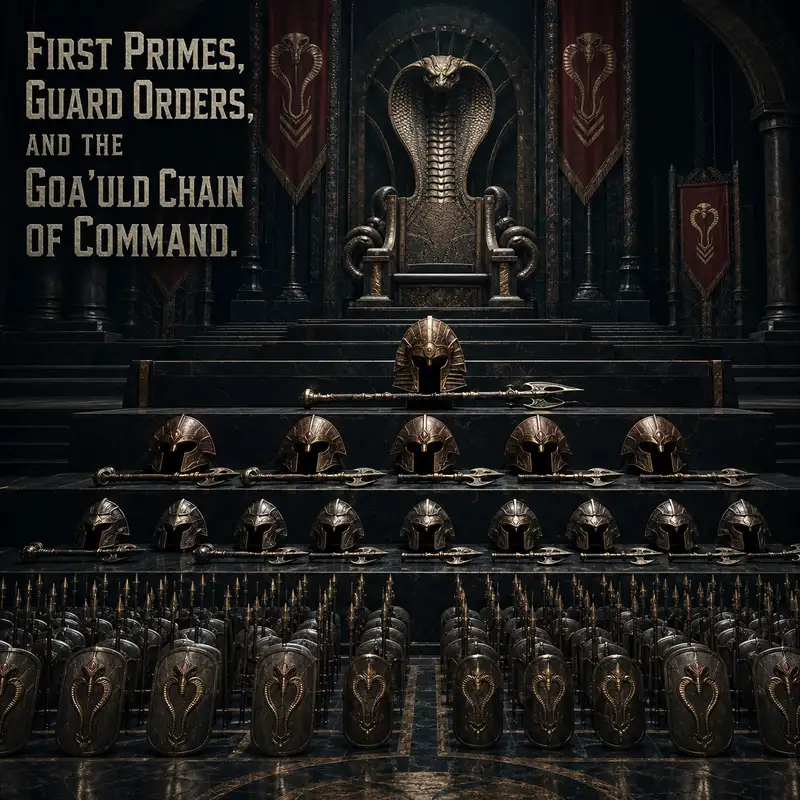
Guard orders gave this command system its visible military identity. Apophis was protected by Serpent Guards whose helmets resembled cobras. The family of Ra used Horus Guards with falcon-like helmets. Setesh maintained guards associated with his own animal symbol. Other rulers used distinct armor, badges, colors, or ceremonial designs even when their forces were not given a formal order name on screen. These formations were not branches of one imperial service. They were household troops whose appearance announced which divine claim, ruling family, and command chain had entered the area.
The helmets protected the head, amplified intimidation, and transformed human-looking Jaffa into symbols of the ruler’s mythology. They also provided rapid identification in a political environment where armies with similar weapons regularly fought one another. A Serpent Guard at a gate signaled the authority of Apophis. A Horus Guard suggested Ra’s line or a ruler claiming that inheritance. For trained observers, the design could reveal a change in control, an alliance, a deception, or a force assembled from unusual remnants.
Stargate Command learned this through visual intelligence. When Teal’c encountered a mixture of Horus and Serpent Guards, he recognized the combination as abnormal before he knew which Goa’uld they served. The blended formation pointed toward a ruler gathering personnel from more than one political lineage. Armor that looked theatrical to Earth personnel was therefore an order-of-battle indicator. The helmet did not merely tell an observer what the soldier wished to resemble. It helped identify the patron, likely rivals, probable equipment, and political history of the unit.
Guard duties included far more than standing near a throne. Elite Jaffa secured palaces, guarded prisoners, controlled access to Stargates, escorted rulers, protected queens and heirs, boarded ships, and participated in raids for hosts. They enforced ceremonial distance between a Goa’uld and everyone else. In combat, they could form the ruler’s immediate protective force or lead less prestigious warriors. Because they were close to sensitive locations, guard loyalty mattered as much as tactical skill. A guard who defected possessed access, routines, and knowledge that an ordinary soldier might never receive.
Teal’c’s defection on Chulak showed how quickly that access could become a strategic threat. As First Prime, he controlled the armed men surrounding prisoners selected for implantation. He knew the layout, the local chain, the weapons, and the expectations of the other guards. When he turned his staff weapon on fellow Serpent Guards and helped the captives escape, Apophis lost more than several soldiers. He lost the commander who understood how his security system worked. Earth gained an experienced source who could interpret Goa’uld behavior rather than merely describe its equipment.
That intelligence was valuable but not unlimited. Teal’c knew Apophis’s forces, rivalries, customs, and methods from decades of service. He did not know every System Lord, secret facility, or change made after his departure. Rival domains compartmentalized information, and a First Prime could remain ignorant of a subordinate Goa’uld’s hidden project. Earth sometimes treated Teal’c as a map of the empire, but the empire had no single map that remained accurate for long.
Below the First Prime, command became less clearly defined in the surviving record. Jaffa commanders led patrols, guarded gates, directed groups of warriors, and operated ship systems. Some were trusted with independent missions. Priests and priestesses controlled ceremonies, access to symbiotes, and religious discipline, giving them authority that did not fit neatly into a battlefield hierarchy. Ship crews answered to the officer or Goa’uld commanding the vessel. Ground troops followed local commanders and the First Prime. The system worked through recognized status and personal allegiance rather than a standardized set of insignia comparable across every army.
Orders themselves were often delivered orally and reinforced through ritual. The ruler commanded. The First Prime acknowledged. The Jaffa obeyed. Formality reduced ambiguity about who possessed authority, but it also discouraged discussion. A modern staff might test assumptions, calculate fuel and ammunition, compare intelligence estimates, and present alternative courses of action. A Goa’uld court could perform some of those functions through experienced individuals, yet the final exchange remained personal. When the god had spoken, further analysis could become a medical hazard for the analyst.
This structure was effective during raids and punitive operations. A First Prime could gather guards, move through a Stargate, seize captives, crush resistance, and withdraw without a long authorization process. The troops shared training, religious language, and clear allegiance. Against isolated defenders, speed and intimidation often mattered more than staff work. In an emergency, everyone also knew whose survival had priority. It was the ruler’s, followed by whatever people and assets the ruler considered useful.
Long campaigns exposed the weaknesses. Rival System Lords concealed capabilities from one another and treated allied success as a future threat. Their fleets could assemble under a common political decision without becoming an integrated force. Each contingent retained its own commander, communications, and loyalty. A coalition leader could propose a plan, but individual rulers could withdraw, delay, or redirect forces for private reasons. The failure was not simply poor cooperation among officers. It began above them, where alliance warfare required sovereign personalities to accept limits on their freedom of action.
Lord Yu’s campaign against Anubis illustrated the problem. Yu held enough standing to lead a combined effort, but his mental decline made his commands unreliable. Oshu recognized the deterioration and its strategic consequences. He could not openly remove his master without destroying the legitimacy that gave him command. Instead, he worked with Teal’c and helped shift practical leadership toward Ba’al. It was an emergency workaround by a senior subordinate trying to preserve a coalition while maintaining the fiction that authority still flowed from the throne.
Herak represented a different model of First Prime. Serving Anubis, he acted as an aggressive executive commander who reported intelligence, supervised prisoners, directed ground troops, and enforced his master’s decisions without visible hesitation. Anubis possessed technologies and ambitions that exceeded those of most System Lords, but his chain still relied on a Jaffa intermediary to turn remote commands into action. Herak’s access made him powerful. It also made him responsible for policies he did not control, including the destruction of populations after military objectives had already been achieved.
The First Prime could therefore function as both commander and moral shield. The ruler gave the order, the First Prime made it happen, and ordinary Jaffa saw the command embodied by one of their own. This reduced the distance between divine authority and battlefield violence. It also redirected anger toward the senior Jaffa who selected targets, led raids, and punished disobedience. Teal’c carried responsibility for acts committed under Apophis even after rejecting him. The Goa’uld remained the author of the system, but the chain ensured that enslaved people participated in enslaving others.
Family pressure reinforced obedience. A First Prime’s household could receive status, property, and protection. The same family could be exiled or deprived of access to symbiotes when the commander fell from favor. Ro’nak’s execution condemned his wife and child to displacement. Teal’c’s later defection endangered Drey’auc and Rya’c on Chulak. The ruler did not need to watch every commander continuously. The possibility of punishment extending to parents, partners, and children made the chain of command operate inside the home.
Bra’tac quietly subverted that system from within. As First Prime, he taught Teal’c to rely on observation, judgment, and skill rather than blind faith. He preserved enough outward loyalty to survive while planting doubt in a future commander. This was dangerous work because a First Prime was observed precisely because of his access. Bra’tac could not issue an open manifesto from Apophis’s palace. He could train warriors to notice contradiction, spare selected lives, build relationships, and wait for an opportunity when disobedience might produce more than an immediate execution.
That opportunity came because the office concentrated trust. Teal’c stood close enough to Apophis to see the limits of his power and high enough within the Jaffa hierarchy to make his rejection meaningful. An ordinary prisoner claiming that Apophis was a false god could be dismissed as desperate. The gold-marked First Prime turning his weapon on the Serpent Guard was harder to explain. He had received the highest honor the system offered and rejected it publicly. His act converted private doubt into evidence.
The death of guards and senior commanders also carried political consequences. After Apophis lost major ships and much of the Serpent Guard loyal to him, his position on Chulak weakened. Rival Goa’uld could interpret military losses as proof that a ruler no longer deserved territory or followers. Guard strength therefore represented more than available manpower. It measured control of the palace, access to the population, and the ruler’s ability to survive a challenge. A depleted household force invited rebellion from below and predation from other Goa’uld above.
The Jaffa rebellion spread through the same command relationships the Goa’uld had created. Senior warriors knew where units were stationed, which commanders were disillusioned, how guards communicated, and which symbols marked old enemies. Bra’tac, Teal’c, and their allies recruited across household lines, turning service networks into resistance networks. A Horus warrior and a Serpent warrior had been trained to see one another as enemies because their gods were enemies. Rebellion required them to recognize a common condition beneath the different helmets.
Old habits did not vanish with new allegiance. Rebel Jaffa remained attracted to decisive warrior leaders, personal honor, and sacrifice. Imhotep exploited that culture while posing as Kytano, building a force around his own authority and sending followers on missions that strengthened his position. The episode revealed the institutional challenge facing liberation. Removing the Goa’uld from the top of the chain did not automatically create accountable command. The Jaffa still had to learn how to challenge a respected leader without interpreting disagreement as cowardice or betrayal.
Former First Primes remained influential after the System Lords fell. Their prestige, networks, and command experience made them natural political leaders, but the office also carried old assumptions into the Free Jaffa Nation. Gerak, once First Prime to a minor Goa’uld, became an advocate for traditional authority. The old system had trained men to command and survive court politics, not to share power comfortably.
For Earth, understanding the Goa’uld chain of command changed targeting and diplomacy. Killing a System Lord could fracture a domain, but it could also trigger succession warfare. Turning a First Prime could open gates, release prisoners, expose defenses, and influence entire Jaffa formations. Identifying guard symbols could reveal which ruler controlled a site. Capturing a ship did not guarantee the loyalty of its crew, and defeating guards near a Stargate did not remove the ruler’s forces in orbit. The chain had to be analyzed as political infrastructure, not merely a list of enemy ranks.
The system’s strength was speed backed by belief. A command from the throne could move through a trusted First Prime to disciplined guards without committees, public debate, or concern for law. Its weakness was that the same chain carried delusion as efficiently as sound judgment. No protected professional authority existed to tell Cronus that a battle could not be won, Apophis that collective punishment created rebellion, or Yu that his fleet was abandoning the decisive point. The commander could understand the truth and still be required to execute the error.
First Primes stood where Goa’uld power became Jaffa action. Guard orders made that power visible and carried it from throne rooms to villages, ships, and Stargates. The office gave one warrior access to nearly everything except the protected right to refuse. That was why the chain held an empire together for thousands of years, and why the defection of a First Prime mattered so much. The Goa’uld assumed their strongest Jaffa would always obey. Teal’c proved that the link trusted to carry the greatest weight could also break the chain.