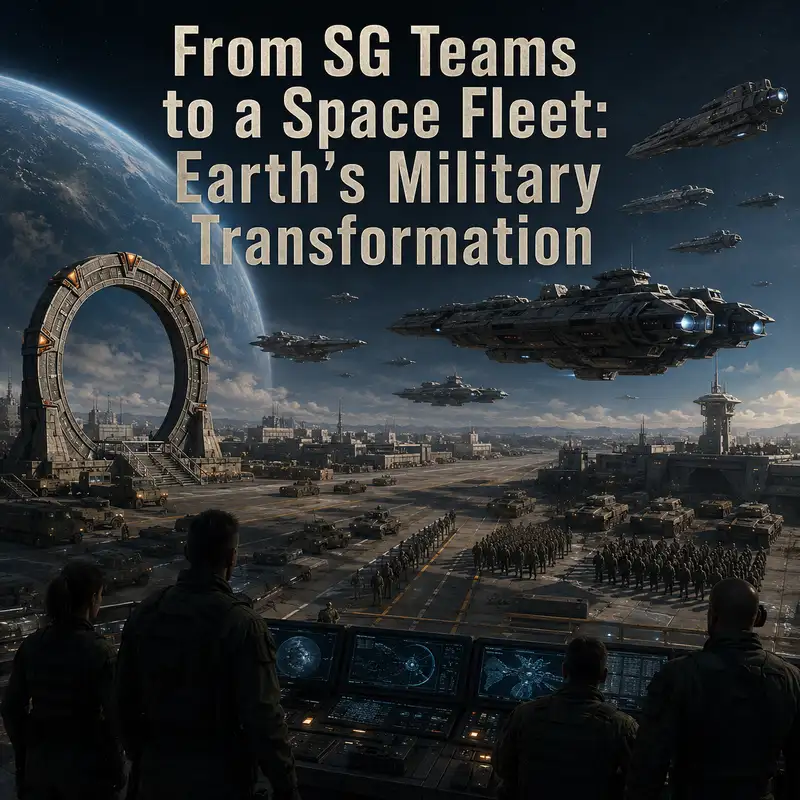
From SG Teams to a Space Fleet: Earth’s Military Transformation
General George Hammond sent Prometheus and a force of F three-oh-two fighters toward Anubis’s fleet knowing they could not win the battle by themselves. Their mission over Antarctica was to keep the sky open long enough for S G One to reach an Ancient outpost beneath the ice. A few years earlier, Earth’s entire interstellar order of battle had consisted of small teams walking through one Stargate with rifles, radios, and a return address. Now a human-built battlecruiser and aerospace fighters were engaging Goa’uld warships above the planet. The change looked sudden from the cockpit. It had been anything but.
Earth’s military transformation was not a simple progression from infantry patrols to larger ships. It was the creation of a new kind of force, one that combined gate teams, intelligence networks, off-world bases, aerospace fighters, capital ships, alien allies, and an industrial program hidden from nearly everyone it was meant to defend. The central question is not merely how Earth built a fleet. It is how a reconnaissance command, operating through a single vulnerable doorway, learned to conduct planetary defense and interstellar war without abandoning the small-team system that had made the expansion possible.
At the beginning, Stargate Command had strategic mobility but almost no strategic depth. An SG team could cross the galaxy in seconds, yet it could carry only what would fit through the gate and what its members could move on the far side. Reinforcements had to use the same entrance. Casualties had to be brought back through the same entrance. If the destination gate was buried, guarded, disabled, or held under fire, the team’s extraction route disappeared. The Stargate was an extraordinary transportation system, but militarily it was also a chokepoint with a very expensive address book.
That limitation shaped the early force. SG teams were optimized for reconnaissance, diplomacy, scientific collection, sabotage, and raids rather than occupation. Four specialists could assess a world, contact a local government, recover an artifact, or destroy a critical target. They could not hold a continent, defend an orbit, or move a large civilian population. Stargate Command therefore fought asymmetrically. It looked for weaknesses in Goa’uld command systems, exploited rivalries, supported resistance movements, and used precise action where a conventional army would have required divisions, airfields, and supply lines that Earth could not send through the gate.
The first major Goa’uld attack on Earth exposed the cost of that asymmetry. Apophis approached with Ha’tak motherships protected by shields that Earth’s existing weapons could not reliably defeat. The planet possessed nuclear arsenals, aircraft, and large conventional forces, but almost none of them could reach or survive against an enemy in orbit. S G One stopped the attack from inside the enemy formation, not because Earth had won control of space, but because a small team infiltrated the ships and destroyed them. It was a brilliant tactical success and a devastating strategic warning. Earth had survived an invasion without possessing a credible planetary defense.
From that point forward, technology acquisition became more than scientific curiosity. It became force development. Every recovered glider, cargo ship, control crystal, shield component, sample of naquadah, and piece of trinium represented a possible answer to a military problem. Stargate Command located the technology. Area Fifty-One and associated research programs tried to understand it. Engineers attempted to reproduce what they could, adapt what they could not reproduce, and determine which devices were safe enough to place near human crews. That final category was smaller than procurement briefings sometimes preferred to admit.
The process depended on several different kinds of access. Some systems were captured from the Goa’uld. Others were studied through damaged vessels or temporary control of alien equipment. The Tok’ra provided knowledge and occasional hardware while protecting their own secrets. The Asgard supplied assistance selectively, especially when a shared threat justified it. Friendly human civilizations contributed materials, concepts, or examples of alternate development. None of this amounted to receiving a complete shipbuilding industry. Earth was collecting pieces of several technological traditions and trying to make them work together under combat conditions.
The X three-oh-one demonstrated why that distinction mattered. Engineers combined human systems with two recovered death gliders to create an interceptor intended to attack Goa’uld ships. On its test flight, a hidden recall device in the captured hardware took control and sent the craft away from Earth. Colonel O’Neill and Teal’c nearly died before a Tok’ra rescue became possible. The aircraft had performed according to an enemy design feature that the human builders did not know existed. Earth had acquired a weapon platform, but not full control over its engineering history.
The failure changed the objective. The next aircraft could not simply be a captured machine with familiar controls attached. It had to be human-built, understood well enough to maintain, and integrated into an Earth command system. That did not mean every component had to originate in a human laboratory. It meant human engineers had to own the design, production, training, and safety decisions. The difference between possessing alien technology and fielding a military capability was becoming institutional rather than cosmetic.
The X three-oh-two was the result. Its systems were reverse-engineered from Goa’uld principles, but the craft itself was constructed by humans. It could operate in the atmosphere, climb into space, maneuver without crushing its pilots, and attempt a hyperspace transition. Naquadria made the compact hyperspace generator possible, but its instability prevented reliable navigation. The prototype failed to reach its intended interstellar destination. It later opened a hyperspace window long enough to carry an overloaded Stargate away from Earth before detonation, an exceptional emergency use rather than proof of dependable fighter-sized interstellar travel.
Once placed into service as the F three-oh-two, the aircraft gave Earth something more valuable than a dramatic prototype. It provided a repeatable aerospace combat platform. F three-oh-twos could defend ships, escort vulnerable craft, attack orbital targets, and deploy from runways or carrier bays. Their brief hyperspace capability could be used in specialized circumstances, but their normal value came from being aircraft that Earth could build, crew, arm, repair, and employ in numbers greater than one. The military transformation began when successful experiments became units with pilots, maintenance schedules, spare parts, and mission planning.
Fighters alone could not solve the larger problem. Earth still needed a vessel that could move independently of the gate, carry personnel and aircraft, survive in deep space, and contest enemy control of orbit. The X three-oh-three, named Prometheus, was the first serious answer. Built in secrecy beneath Nevada, it combined human construction with materials and systems derived from years of off-world recovery. It was not purely Goa’uld, Asgard, or human. It was a hybrid because Earth’s strategic position allowed no time to wait for a clean technological lineage.
Prometheus also revealed that building a ship was only one part of creating a fleet. Before it had completed normal operational testing, rogue personnel connected to the National Intelligence Department seized the vessel. The incident exposed the security risks created by extreme compartmentalization. A program hidden from the public and compartmented across government, the military, and allied nations still had to rely on contractors, technicians, guards, scientists, and intelligence organizations. Secrecy reduced public exposure. It did not automatically produce internal control.
Once recovered, Prometheus expanded Earth’s options immediately. It could carry F three-oh-twos, travel between star systems, transport teams without using a destination Stargate, place personnel on a planet by ring transporter, and provide sensors and firepower in orbit. It offered an extraction route when the gate was blocked. It could move equipment too large or politically sensitive for a normal gate mission. It could also show an alien government that Earth’s diplomacy was no longer backed only by four people standing beside a dial-home device.
Yet Prometheus remained a prototype with the vulnerabilities of a prototype. Its early hyperdrive was unreliable, and Asgard assistance became essential to improving its performance. Its crews had to learn procedures for systems assembled from different technological families. Its commanders had little inherited doctrine for taking a United States Air Force vessel into interstellar combat. Naval language, aerospace practice, special-operations requirements, and alien engineering all met on the same bridge. The ship worked, but it also served as a traveling catalogue of everything Earth had not yet standardized.
The Battle of Antarctica showed both its importance and its limits. Prometheus and the F three-oh-twos could engage Anubis’s forces, protect S G One’s approach, and absorb enemy attention. They could not defeat the invading fleet. The battle was won when O’Neill activated an Ancient defense system beneath the ice. Earth’s new space forces created the time and access required for that one-time advantage to be used. They were not yet the decisive weapon. They were the force that prevented defeat long enough for the decisive weapon to appear.
Prometheus later died against an Ori-designed satellite over Tegalus. Its weapons could not penetrate the target’s defenses, while the satellite’s return fire cut through the ship. Most of the crew escaped, but the vessel and those still aboard were lost. The destruction mattered because it ended any illusion that entering space had made Earth a peer of every advanced enemy. A capital ship could be strategically valuable and still be tactically outclassed. The first lesson of fleet warfare was the same as the first lesson of gate operations. Capability did not equal security.
The B C three-oh-four class represented the move from demonstration to production. Daedalus was not merely a larger Prometheus. It incorporated the lessons of the earlier ship and was designed around more reliable Asgard-supported systems, including advanced shields, sensors, transport beams, and an intergalactic hyperdrive. Human weapons, human crews, and F three-oh-two squadrons remained central. The result was a vessel Earth could assign repeatedly to combat, transport, rescue, and sustainment missions rather than treating every departure as another experimental test.
Daedalus proved its value in the Pegasus galaxy. Atlantis had begun as an isolated expedition dependent on local resources, uncertain power supplies, and a Stargate connection that could not routinely carry personnel home across galaxies. The arrival of an Earth ship changed the expedition’s logistical position. Daedalus could bring people, ammunition, medical supplies, replacement equipment, and a zero-point module. It could evacuate personnel, engage Wraith vessels, and connect a distant scientific outpost to Earth’s military system. The ship did not end Atlantis’s isolation, but it made that isolation manageable.
The construction of additional B C three-oh-fours turned a single capability into a fleet. Odyssey gave Stargate Command another major combat and transport platform. Korolev placed a Russian-crewed vessel into the same strategic system. Apollo supported operations in Pegasus. Sun Tzu reflected Chinese participation, while the later George Hammond continued the class after earlier losses. The exact number of available ships remained small, and not every vessel carried the same upgrades at the same time. Even so, Earth had crossed an important line. Losing one ship no longer meant losing all independent access to space.
That fleet could not remain solely an American project in political terms. Russia had already used control of a second Stargate to negotiate access, technology, and a role at Stargate Command. Britain, France, and China were later briefed because the evidence of alien activity and the scale of the threat had become too large to contain within a bilateral secret. The International Oversight Advisory emerged as a multinational mechanism for supervision, funding influence, and political participation. Agreement on planetary defense was usually easier than agreement on who commanded the assets.
Institutionally, Homeworld Security and later Homeworld Command reflected the widening mission. Stargate Command still operated gate teams and defended the Cheyenne Mountain facility. The broader organization had to coordinate planetary warning, starship operations, off-world bases, international partners, Atlantis, intelligence collection, and responses to threats that might arrive through a gate, through hyperspace, or from inside an Earth government. The command problem had expanded from controlling one room with one doorway to managing military activity across more than one galaxy.
Ships did not replace the Stargate because the two systems solved different problems. A gate offered nearly instantaneous movement between known addresses with comparatively little transport infrastructure. A ship could reach places without a usable gate, move far more equipment, remain in orbit, conduct surveillance, and fight other vessels. Gates were fast but fixed. Ships were flexible but scarce. A gate connection could be denied by an iris, a shield, enemy control, or a damaged dial-home device. A ship could bypass that obstacle, provided it had the time, power reserves, intelligence, and survivability to reach the destination.
The most effective doctrine therefore combined them. SG teams found allies, surveyed resources, identified enemy installations, and gathered the intelligence needed to direct a ship. F three-oh-twos protected the larger vessel and performed tasks that did not justify risking the capital ship. The B C three-oh-four provided transport, command and control, heavy weapons, medical support, and an alternate extraction route. Off-world bases extended warning and staging. Each element compensated for weaknesses in the others. Earth was not building a conventional navy in space. It was building a joint force around the geography of the Stargate network.
Intelligence remained the limiting factor. A battlecruiser could cross interstellar distances and still arrive with an obsolete understanding of the political situation. Wraith hives moved, alliances shifted, Goa’uld territories fragmented, and local governments concealed information. Sensors could locate ships and energy sources, but they could not explain who would honor an agreement or whether destroying one target would unite several enemies. The original SG-team skills of language, diplomacy, cultural analysis, and close reconnaissance remained as important to fleet operations as shields and hyperdrives.
The wars against the Wraith and the Ori accelerated fleet development while demonstrating its limits. Daedalus-class ships could fight Wraith vessels, defend Atlantis, and rescue teams that would otherwise be unreachable. Against the first Ori warships entering the Milky Way, however, the allied fleet suffered catastrophic losses. Korolev was destroyed, and other ships survived only with severe damage or favorable circumstances. Earth had become capable of participating in fleet battle. It had not become capable of dictating the outcome of every fleet battle.
The final Asgard technology transfer altered that balance. Before ending their civilization, the Asgard installed a computer core, new power systems, accumulated knowledge, and advanced weapons aboard Odyssey. The new energy weapons could destroy an Ori warship, something earlier Earth armaments had struggled to accomplish. The transfer was the most significant single increase in Earth’s naval combat power, but it also created an immediate vulnerability. The integrated technology produced an energy signature the Ori could track through subspace. The gift that made Odyssey more dangerous also made it easier to find.
Earth eventually retrofitted other B C three-oh-fours with Asgard plasma beam weapons. Daedalus and Apollo used them in the campaign against the Asurans, where the ships fought as part of a larger coalition rather than as an isolated pair. The weapons changed tactical engagements, but they did not eliminate the need for planning, allies, and a method of preventing enemy escape. Superior firepower helped create the conditions for victory. It was not a substitute for an operational concept.
The fleet’s most persistent enemy was not always an alien warship. It was scale. Each capital ship required specialized construction, rare materials, trained crews, secure facilities, replacement crystals, aerospace maintenance, life support, ammunition, and technicians able to work across human and alien systems. Asgard equipment could be operated by human personnel, but understanding every principle behind it was another matter. A damaged component might be repairable aboard one ship and impossible to manufacture on Earth without further research. The maintenance manual for inherited civilization-level technology was often shorter than the list of assumptions.
Scarcity forced strategy. Earth could not station a B C three-oh-four over every friendly world, escort every SG team, defend every off-world base, and maintain a permanent guard over the Solar System. Commanders had to decide which threats were credible, which allies justified risk, and whether a ship should be used for defense, exploration, transport, or preemptive action. A fleet of a few highly capable vessels gave Earth global and interstellar reach, but it also created commitments larger than the available force.
The political consequences were equally important. Starships turned the Stargate Program from a secret exploration effort into an instrument of power projection. Earth could now enter another planet’s orbit, deploy fighters, threaten infrastructure, and conduct strikes without controlling the local gate. The preemptive attack on the Asuran shipyards showed both the attraction and the danger. Apollo destroyed a fleet under construction, but the retaliation nearly destroyed Atlantis. The tactical mission succeeded. The political and operational consequences were far less tidy.
That was the central contradiction of Earth’s transformation. The fleet made Earth less helpless, but it also gave Earth the ability to create larger problems at greater distance. It encouraged allies to expect protection that could not always be provided. It encouraged officials to consider military options before the diplomatic situation was fully understood. It made secrecy harder, oversight more contentious, and mistakes more expensive. A four-person team could compromise a village. A battlecruiser could compromise a planetary system.
Earth did not advance because SG teams became obsolete. It advanced because their discoveries were converted into institutions, factories, training pipelines, alliances, and doctrine. The teams supplied access, intelligence, and relationships. The fighters supplied local aerospace control. The capital ships supplied mobility, endurance, and orbital power. Homeworld Command supplied coordination, although coordination in a multinational classified program remained an aspiration as often as an accomplished fact.
Above Antarctica, Prometheus and the F three-oh-twos could not defeat Anubis’s armada, but they could buy the minutes S G One needed beneath the ice. Later Earth ships crossed galaxies, sustained distant bases, destroyed capital vessels, and fought as part of multinational and interspecies coalitions. The transformation from SG teams to a space fleet was therefore not a change from small operations to large ones. It was the integration of both. Earth’s ships were built from alien discoveries, human industry, allied trust, and repeated failure. Their decisive advantage still began with people willing to walk through a gate, learn what was on the other side, and return with something Earth could finally turn into strategy.