Gate Addresses, DHDs, and How the Network Works
The first sign that the Stargate network had failed was not an explosion. It was a chevron that refused to lock. A virus designed to disable one Goa’uld mining world had spread through the dial-home devices, corrupted their coordinates, and stranded teams across the Milky Way. Stargate Command could still dial outward because Earth did not possess a normal dial-home device. Almost everyone else was cut off. Ba’al, who had modified the virus, immediately attacked rivals cut off from gate travel. One software failure had changed the balance of power across the galaxy.
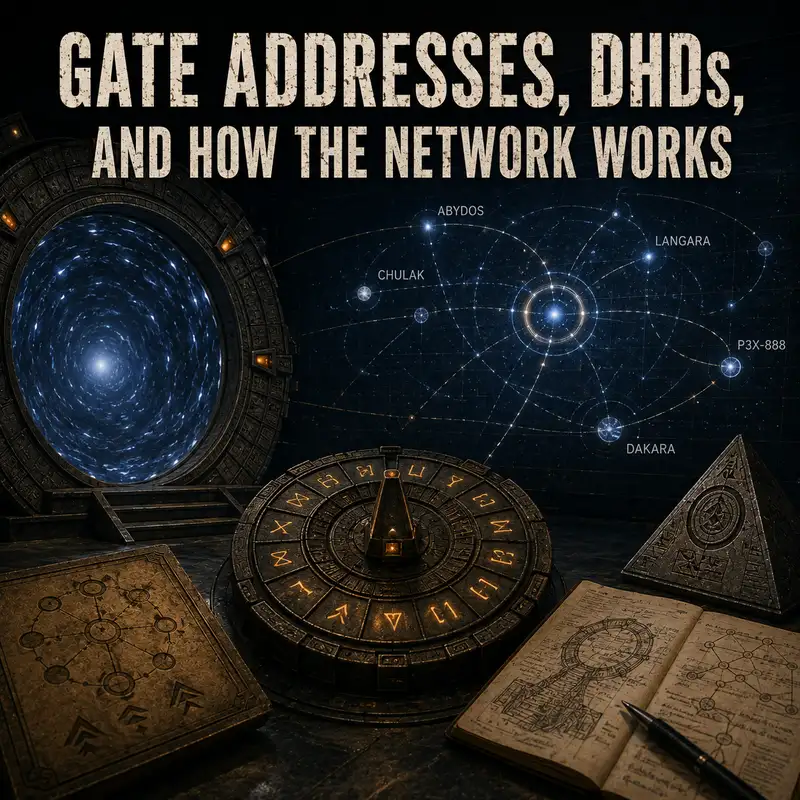
That crisis exposed the real structure of Stargate travel. The ring is only the most visible component. An address tells the system where to connect. A dial-home device supplies power, translates the symbols, manages safety functions, and communicates with the wider network. The network links thousands of endpoints into strategic infrastructure. Remove any one of those elements and the Stargate may remain physically intact while becoming militarily useless. Earth had recovered one terminal from a transportation system whose navigation, software, and normal control equipment were missing.
The Ancients built the Milky Way network over an immense period, placing gates on worlds they settled, studied, or considered useful. The result was a distributed system rather than a central station directing every journey. Each gate could connect directly with another valid endpoint when given the correct address and sufficient power. That architecture helped the network survive long after its builders departed. It also meant no surviving authority had to approve a journey. The machine recognized coordinates, not borders, treaties, or ownership. A world could change rulers while its address remained open to anyone who knew it.
A standard Milky Way Stargate carries thirty-nine glyphs. Daniel Jackson first explained seven-symbol dialing through a simple geometric model. Six symbols identify a destination in three-dimensional space, while the seventh establishes the point of origin. Project Giza needed to understand why six symbols were not enough and why the separate mark beneath the Abydos cartouche completed the route. The model opened the gate. It was not a complete statement of Ancient mathematics, and later operations showed that the symbols function as entries in a dynamic navigation system rather than as permanently fixed lines drawn between motionless stars.
The constellations are therefore an interface, not a promise that the sky will remain unchanged. Stars move. Planets orbit. Entire systems drift over thousands and millions of years. A route carved into stone during the Ancient era would become inaccurate if the network treated the symbols as unchanging physical coordinates. Dial-home devices compensate by maintaining current location data and translating familiar glyph sequences into the positions the gates actually occupy. The address remains recognizable to the user while the machinery quietly corrects the astronomy underneath it. That quiet correction is one reason the system appears simple to civilizations that did not build it.
The dial-home device is best understood as a combined control panel, power supply, navigation computer, and network router. Its glyphs allow the user to enter a sequence. Its internal crystals exchange instructions with the gate. Its naquadah-based power source provides the energy normally required to establish the wormhole. It also stores operational data, applies safety checks, and participates in automatic updates with other devices. Pressing symbols on the pedestal looks less sophisticated than entering coordinates into a modern computer. Most of the calculation is performed by systems the operator never sees.
Earth’s first gate program had no such pedestal. The Giza dial-home device had been separated from the Stargate and eventually entered Soviet possession. American engineers therefore built motors to rotate the ring, electrical systems to energize the chevrons, and computer software to imitate signals the original controller exchanged with the gate. Samantha Carter later described the effort as fifteen years and three supercomputers devoted to producing a minimally functional substitute. It was impressive reverse engineering, and the interstellar equivalent of replacing a missing flight computer with laboratory equipment and considerable confidence.
A normal dialing sequence begins when the outgoing gate receives the symbols for a destination. Each accepted entry is assigned to a chevron. When the route is complete and the system confirms a viable connection, the gate establishes an artificial wormhole. The opening surge produces the unstable vortex often called the kawoosh. That burst destroys ordinary matter directly in front of the ring. It then collapses into the stable event horizon through which travelers and equipment can pass. The dramatic opening is not decoration. It is a dangerous part of the machinery’s normal operation and one more reason gate rooms need clear space and disciplined procedures.
Travel through the event horizon is not movement down a visible tunnel. The outgoing gate converts matter into an encoded energy pattern, transmits that pattern through the wormhole, and the receiving gate reconstructs it. Before reassembly, the destination gate temporarily holds the complete pattern in an internal buffer. That safeguard allows the system to confirm that all information has arrived before returning a person or object to physical form. Under unusual failures, a pattern can remain trapped in that buffer. Teal’c survived such an event only because Stargate Command recovered a compatible dial-home device and forced the receiving gate to complete the process.
Matter normally travels in only one direction, from the gate that established the wormhole to the gate that received it. Radio signals and other forms of energy can pass both ways. This rule shapes off-world operations. A team can talk with headquarters after dialing Earth, but it cannot send a wounded person backward through an incoming connection established from Earth. Reinforcements cannot simply walk both directions at once. The dialing side controls physical movement until the connection ends. What appears to be a doorway behaves more like a one-way transport corridor with two-way communications.
The wormhole also has a normal maximum duration of roughly thirty-eight minutes under nonrelativistic conditions. Most connections close sooner, especially when nothing continues entering from the outgoing side. Thirty-eight minutes is a ceiling, not a standard window. Black holes, enormous external power sources, and specialized attacks have forced gates to remain open longer, but those are exceptional conditions. They do not create routine unlimited access. Commanders planning around the ordinary network must assume that the connection will end, that the gate will need to be dialed again, and that everyone still on the wrong side will remain there.
Only one active connection can use a gate at a time. A destination already connected cannot accept another wormhole. An incoming activation can also interrupt an incomplete outgoing dialing sequence. Enemies repeatedly exploited this rule by dialing a planet’s gate and holding the connection open, preventing defenders from escaping or receiving reinforcement. The tactic required only a valid address, enough power, and timing. The network’s mobility could be reversed into a blockade conducted from another world.
A valid address is not a guarantee that a wormhole will form. The destination gate may have been destroyed, moved outside the expected region, or already active. A completely buried or obstructed gate usually cannot provide enough open space for the event horizon and opening vortex. Some partial obstructions can be cleared by the unstable surge, a feature best tested from a considerable distance. Civilizations that wanted to deny access often buried their gates because attacking the ring itself was difficult. They defeated Ancient engineering by changing the room around it.
The Stargate network contains no normal political authentication system. A receiving gate does not ask whether the traveler has permission from the local government. Earth created its own defensive layer with the iris, identification transmitters, and gate-room security. Atlantis used a shield serving the same purpose. These defenses block physical arrival after the wormhole forms, but they exist outside the original address system. The gate can connect while the receiving command still refuses entry. Navigation and access control are separate problems, a distinction that becomes especially important when an enemy captures a transmitter or a friendly traveler returns under hostile control.
Dial-home devices apply protections that ordinary users may never realize are present. They can refuse routes predicted to create dangerous conditions, account for network changes, and prevent some forms of unsafe dialing. Earth’s computer reproduced the functions its engineers understood and sometimes bypassed the ones they did not. When Stargate Command forced a connection to K’Tau after the normal protocols resisted, the wormhole passed through the planet’s sun and altered it. The local civilization nearly paid for Earth’s technical improvisation. A control system that says no may be protecting more than the operator’s convenience.
The network’s automatic correlative updates are one of its most important hidden functions. Dial-home devices periodically exchange revised coordinate information so that the same symbolic addresses continue reaching the correct gates despite stellar drift. The system is decentralized. Neighboring devices can pass changes outward until the network adopts them. That is efficient, resilient, and dangerous. During the Avenger incident, a program meant to scramble one target’s coordinates triggered the update mechanism. Ba’al altered the code so the corruption propagated across the galaxy. The network behaved like linked computers because, operationally, that is what it was.
Earth’s missing dial-home device became an advantage during that failure. The improvised dialing computer did not participate in the infected update and could still establish outgoing connections. Stargate Command became the only known gate facility able to dial through the disruption, although teams reaching other worlds could not dial back. The command had to repair the network by physically accessing the infected pedestal on a Goa’uld-controlled planet. The incident demonstrated that compatibility creates shared capability and shared vulnerability. A device outside the standard architecture may be inefficient on ordinary days and indispensable when the standard architecture fails everywhere at once.
Multiple gates on the same planet create another layer of network behavior. Only one normally serves as the active destination. A gate connected to a functioning dial-home device generally takes precedence over one controlled by improvised equipment. This allowed a second Earth gate to redirect incoming traffic away from Stargate Command. Later experience established that a Pegasus-model gate usually takes priority over a Milky Way model in the same area. The Wraith exploited that rule by carrying a Pegasus gate aboard a hive ship near Earth, causing a wormhole intended for Stargate Command to terminate on the enemy vessel instead.
The Pegasus network represents a later generation of Ancient design. Its gates use a different visual interface and can be placed in orbit as space gates. Those locations have no convenient stone pedestal standing on the ground. Puddle Jumpers carry integrated dialing controls, allowing crews to select an address while approaching the ring in space. This changes the tactical environment. A planetary gate can be fortified with trenches and weapons. A space gate requires a craft, navigation, and control of the surrounding orbital volume. The network remains a chokepoint, though the surrounding terrain may be vacuum rather than a village square.
Ordinary seven-chevron routes remain within the gate’s configured galactic network. An eighth chevron allows a gate to seek a destination outside its galaxy, but the energy requirement rises dramatically. Jack O’Neill first reached the Asgard home galaxy only after Ancient knowledge enabled him to construct an extraordinary power source. The Atlantis expedition required a zero-point module to open the route from Earth to Pegasus. Knowing the address was only half the solution. Intergalactic dialing transformed power generation from a technical detail into the decisive logistical requirement.
Nine-chevron dialing serves a still more specialized purpose. The address that reached Destiny did not point to an ordinary planet waiting at fixed coordinates. It locked onto a unique Ancient ship traveling far beyond the known galactic networks. In practical terms, the sequence functioned less like a conventional map reference and more like a unique destination code. Establishing that connection required energy on a scale normal gate facilities could not provide. Icarus Base drew upon an unstable naquadria-rich planetary core, which worked once and then helped destroy the planet. The connection succeeded. The supply line did not.
A gate can sometimes be operated without its normal controller. Personnel have manually rotated rings, supplied power from naquadah generators, redirected energy from ships, and used other emergency methods. These events demonstrate the machine’s flexibility, not a substitute for a functioning dial-home device. Manual dialing is slow, exposed, and dependent on knowing how to lock each symbol. External power may bypass protections or damage equipment. Lightning can be a power source in an emergency. It remains a poor entry in a maintenance manual.
Damage to the dial-home device can turn a successful arrival into a permanent deployment. The ring may remain intact while the controller has lost power, shattered a crystal, or been destroyed. An S G team can carry a portable power source and still lack the correct interface or time needed to build a substitute. For this reason, the pedestal is not background scenery. It is part of the extraction route. Securing the gate while ignoring its controller is similar to holding an airfield after someone has removed the control tower, fuel system, and runway lights.
Addresses are also intelligence. The Abydos cartouche transformed Earth’s program by revealing that the first route belonged to a much larger network. Ancient repositories later added more destinations. Goa’uld records, Tok’ra knowledge, captured computers, and dial-home device histories allowed commanders to map political and military activity. An address could identify a mining world, prison, laboratory, allied capital, or abandoned outpost. It could also be obsolete, compromised, or deliberately planted. A seven-symbol sequence is more than navigation data. It is a claim about what exists at the far end and whether the source supplying that claim can be trusted.
The network changed logistics without abolishing them. Personnel, small vehicles, weapons, medical supplies, and equipment can cross interstellar distances in seconds. Everything still has to fit through the ring and be handled on the far side. Only one connection can use the gate at a time. A sustained flow occupies the sole route and announces activity at both ends. Heavy armor, large aircraft, bulk fuel, and industrial machinery remain difficult to move. The Stargate produces extraordinary strategic mobility with the throughput of one narrow loading point.
That limitation turns every gate into terrain. A force holding the ring controls the easiest route on or off the planet, not necessarily the world itself. An enemy ship in orbit can bombard the gate area, move troops elsewhere, or carry the ring away. A resistance movement may control villages while a Goa’uld garrison controls the pedestal. A team may reach the correct planet and still find its extraction zone watched, mined, buried, or locked behind an incoming wormhole. Address knowledge puts a force in the theater. It does not secure the objective.
The network also creates a counterintelligence problem. Captured addresses reveal allies and bases. Captured transmitters can threaten a defended gate. A compromised officer may carry valid codes while serving an enemy. A hostile power can monitor recent dialing information or watch the gate physically. Stargate Command therefore changed codes, limited address distribution, used alternate sites, and sometimes routed teams through off-world bases rather than directly to Earth. Address secrecy resembles airfield security, except the runway reaches another planet and may open inside headquarters.
The same infrastructure supported occupation, resistance, diplomacy, trade, evacuation, and scientific work. The Goa’uld used gates to move Jaffa, human populations, and extracted resources. Rebel movements used them to connect cells and escape local rulers. Earth used them to send reconnaissance teams and build alliances. Civilian societies used them as roads between communities. The ring favored neither liberation nor empire. It rewarded whoever possessed the address, power, local access, and information needed to use it before the other side could respond.
Earth eventually modified the concept by constructing an intergalactic gate bridge between the Milky Way and Pegasus. A chain of gates placed across the void used forwarding software to hold travelers in each gate’s buffer and pass the matter stream along to the next node. The system reduced a journey of weeks by ship to roughly half an hour without consuming a zero-point module for every trip. It also created new points of failure. When Wraith forces compromised the bridge and seized Midway Station, the same efficiency that moved friendly personnel allowed an enemy assault to cross between galaxies.
The network endures because it is decentralized. There is no single surviving master station whose destruction shuts down every ordinary route. Gates can continue operating after governments collapse and builders vanish. Devices exchange updates, endpoints can be replaced, and local users need only enough knowledge to enter addresses. That endurance explains why Ancient infrastructure became the foundation of Goa’uld power and later Earth exploration. It also explains why no civilization fully owns the system. Control is temporary, local, and always vulnerable to someone arriving with the same coordinates.
Its weaknesses follow from the same design. The gate is a predictable chokepoint, and the dial-home device a valuable target. Addresses can be stolen. Software updates can be corrupted. Exceptional power can force the system beyond normal limits. A physically intact ring can be useless because its controller is gone, and a secure world can become exposed because an enemy learned seven symbols. The network solves distance with extraordinary reliability. It does not solve access, trust, or command.
Earth’s decisive insight was that operating a Stargate required more than making the ring spin. The address is the language of destination. The dial-home device translates that language, powers the connection, applies protections, and keeps the endpoint synchronized with a changing galaxy. The network turns those endpoints into strategic geography. Together they created a transportation system durable enough to outlive the Ancients and flexible enough to serve almost every power that followed them.
The defining image is an off-world team beside a dial-home device while enemy fire approaches the gate. One person enters the symbols. Another watches the perimeter. Headquarters waits beyond a route that does not yet exist. If the address is correct, the controller is functional, the destination is free, and the wormhole locks, the team can cross the galaxy in seconds. If any one of those conditions fails, the great Ancient road is only a ring of stone and metal, and the people standing beside it are exactly as far from home as the stars suggest.