Gate-Room Security: Defending the Most Dangerous Door on Earth
The code-red signal arrived while S G One was still under fire. General Hammond ordered a defense unit and medical team into the gate room before the iris opened. The team came through wounded and moving fast. A spear followed them out of the wormhole and struck the floor near the general. The attackers never crossed, but their weapon did. In a few seconds, the room had functioned as an extraction point, casualty collection station, and active combat zone. That was a fairly normal bad day at Stargate Command.
The gate room was the most dangerous door on Earth because it was never only a door. It was a border crossing inside a military headquarters, a launch point for reconnaissance teams, a receiving area for allies and refugees, and a direct route for enemies who knew Earth’s address. Defending it required more than armed guards facing the ramp. The challenge was keeping the doorway useful without allowing its speed to turn Cheyenne Mountain into the shortest invasion route in human history.
Cheyenne Mountain had been created as a hardened command center against attacks approaching from outside. Its depth, controlled tunnels, guarded checkpoints, and protected communications made it an excellent place to conceal Project Giza. The Stargate reversed the logic of the installation. A hostile force did not need to defeat the mountain’s surface defenses. It could appear on level twenty-eight, inside the protected perimeter, within sight of the control room. Granite remained useful. It was less impressive when the enemy entered from the wall.
The first hostile raid found almost no meaningful gate-room defense. The Stargate was covered, the program was being reduced, and the airmen assigned to the room regarded the post as a dead end. When Apophis activated the gate from Chulak, his Jaffa emerged with weapons ready. They killed the defenders, seized an airwoman, and withdrew before the quick-reaction force reached the room. The failure was not simply that the guards were surprised. The installation had no barrier over the event horizon, no authentication procedure, and no doctrine for an incoming force.
That raid established the basic security requirement. Stargate Command had to separate wormhole formation from physical entry. The iris accomplished that by closing almost directly against the event horizon, preventing incoming matter from reintegrating safely. It transformed an unscheduled activation from an automatic breach into a request for access. The iris was the critical mechanical layer, but it was never the entire security system. A barrier can stop a body. It cannot decide whether the body should be admitted, whether the person still controls it, or whether the danger is matter at all.
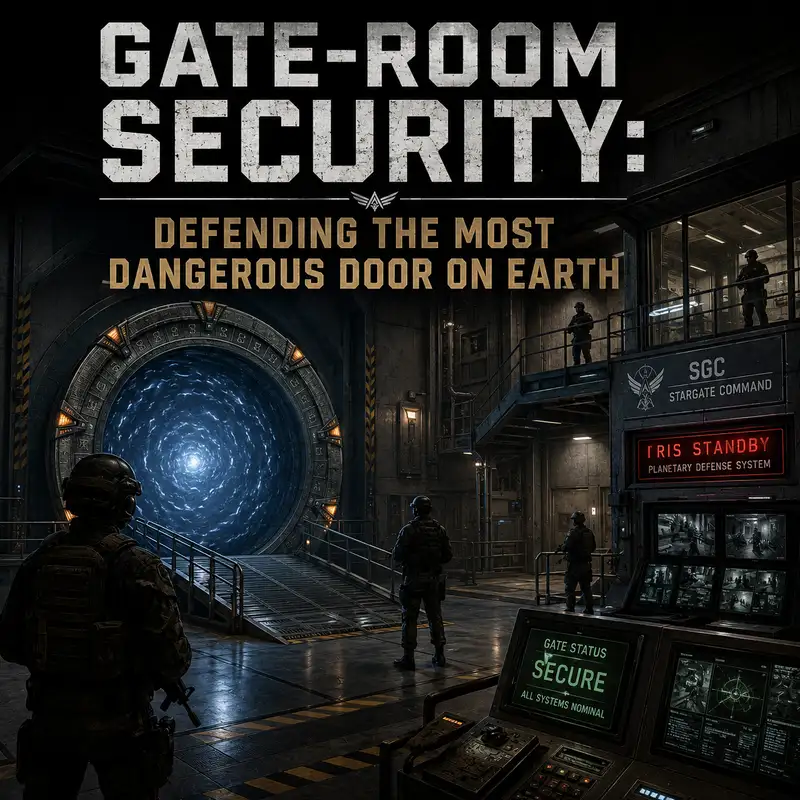
The gate room was designed around a predictable axis. The Stargate stood at the top of a ramp, with security personnel positioned below and to the sides. Access corridors could be sealed. The control room overlooked the chamber behind protective glass and a descending blast barrier. This geometry created a compact engagement area. Anyone emerging had to move down a narrow route under multiple weapons. The arrangement favored defenders, provided they still controlled the iris, doors, computers, and consoles.
An unscheduled off-world activation triggered a rehearsed sequence. Alarms sounded. The iris remained closed. Defense teams moved into position with weapons aimed at the gate. Technicians checked for an identification signal and reviewed the destination information available from the dialing system. The commanding officer decided whether to open the iris, communicate through the wormhole, or keep the barrier shut. The procedure compressed intelligence analysis and lethal authority into seconds. The machine could identify a valid code. Only the command could decide whether the situation around that code made sense.
Returning teams carried remote transmitters commonly called G D Os. The device sent an identification code through the active wormhole, allowing Stargate Command to match the signal with an authorized team or ally. Codes could be changed or disabled after a transmitter was lost. The limitation was familiar from ordinary checkpoints. A credential proves that someone possesses it. It does not prove that the right person remains loyal, healthy, and in control.
Expected return times provided another layer of context. A code arriving at the scheduled hour from the expected address carried less risk than the same code appearing days early from an unexplained connection. A code-red transmission indicated that the team was under attack and needed immediate support. Defense personnel and medics assembled together. The iris had to open soon enough for wounded personnel to cross and close soon enough to stop pursuit. Security became a timing problem measured in footsteps and radio calls.
Hot extractions were particularly dangerous because the receiving side could not see the approach to the off-world gate. Headquarters heard gunfire over the radio and watched the identification signal, but it did not know exactly how close the enemy was. A projectile could follow the team, as Hammond’s encounter with the spear demonstrated. On another return, a pursuing Jaffa crossed before the iris closed and shot Teal’c. Every extra second protected a friendly straggler and increased the chance of admitting a hostile one. There was no perfect closing time, only a decision made with incomplete information.
The armed personnel in the room were therefore not ceremonial guards. They covered the event horizon whenever the iris opened under uncertain conditions. Their first obligation was to identify a threat without firing into their own returning team. That was harder than it sounds. Smoke, wounded personnel, refugees, alien clothing, and panic could fill the ramp in seconds. The defender had to distinguish a pursuer from an ally while everyone moved toward the same doors. Rules of engagement remained simple only when the enemy was considerate enough to arrive alone and visibly hostile.
The arrival of multiple versions of S G One demonstrated the authentication problem at its most unusual. One team returned early with a valid code. Another arrived at the scheduled time using the same identity. Defense teams aimed weapons at personnel who looked, sounded, and tested exactly like the officers already inside. The response was not to assume one group must be false and begin firing. It was to control the room, separate the arrivals, and let medical and scientific investigation determine what the access system could not.
Physical control extended beyond the ramp. Armed personnel guarded access points and the nearby armory. Doors and checkpoints restricted movement toward level twenty-eight. Blast doors could isolate the gate room from the control room and adjoining corridors. During ordinary operations, these measures controlled weapons, visitors, and unauthorized staff. During a crisis, they created compartments that could be defended separately. The price was that every door could also trap people on the wrong side, delay a rescue team, or become part of the enemy’s containment plan.
The blast barrier over the control-room window proved its value during the foothold invasion. Alien infiltrators had taken the base, copied personnel, and used the gate room as their escape route. When their withdrawal failed, they detonated themselves inside the chamber. O’Neill lowered the barrier before the blast reached the control room. The gate room was scarred, but the command personnel behind the shield survived. The barrier did not stop the infiltration. It prevented the final act of the infiltration from destroying the people restoring control.
The control room was the most important terrain around the gate. Its consoles could dial addresses, move the iris, receive identification codes, monitor probes, control doors, and communicate with teams. An enemy holding the ramp but not the control room had gained a chamber. An enemy holding both had gained access to the network and a route out. The system needed rapid human control, which meant anyone who captured the operators or imitated their authority could turn the security architecture against the base.
Major Charles Kawalsky exposed that weakness almost immediately. He returned from Chulak as an authenticated American officer and passed every physical gate defense. A Goa’uld symbiote had entered his body during the retreat. It gained access to his memories, security knowledge, and command habits. Kawalsky could move through the base, enter codes, activate the self-destruct sequence, and attempt to dial Chulak because the institution recognized the host even when the host no longer controlled his actions.
The fight that ended in the gate room demonstrated both the strength and limit of physical security. Teal’c stopped Kawalsky from escaping, and O’Neill terminated the wormhole while the symbiote was partly inside the event horizon. The immediate threat was removed. The larger lesson was more serious. The iris had performed correctly. The guards had performed correctly. The enemy had crossed as part of a friendly unit. Gate-room defense had to begin with medical screening, quarantine, and counterintelligence before an authorized returnee reached the next checkpoint.
The Reetou challenged the system from another direction. An invisible Reetou entered the base, observed how personnel operated the iris, and later opened it for a human child. The computer appeared to receive a normal command because the infiltrator could manipulate equipment while remaining outside ordinary visual detection. Stargate Command added palm authentication to the iris controls. The change improved protection, but the incident revealed a broader truth. Procedures can be compromised simply by watching them, especially when the observer can stand inside the room without being seen.
The foothold attackers used imitation rather than invisibility. They rendered personnel unconscious, copied their appearance, and occupied command positions while the real staff remained hidden. Their control of the computer system prevented the defenders from simply closing the iris during escape. S G One had to retake the control room and shut down the gate while security forces recovered the installation. The attack showed that gate-room security could not be isolated from identity management across the base. Once senior officers and technicians were duplicated, every order and access badge became suspect.
Replicators showed what happened when a threat entered as recovered technology rather than an invading formation. Reece was brought into the facility for study. The machines she created spread through corridors, disabled cameras, penetrated the computer network, and forced security personnel to fight inside the base. The gate-room doors had to be cut open. Hammond and Carter prepared the self-destruct locally because the main computer was compromised. The perimeter around the Stargate had not failed. The threat had been carried across it under friendly control and activated after admission.
The Entity incident made the same point without a physical passenger. An electronic life-form traveled through the outgoing wormhole as a signal, entered Stargate Command’s computer system, and fused the circuits controlling the gate and iris. The radio path had to remain open because teams depended on two-way communication. That necessary channel became an attack route. Gate-room security therefore included network isolation, redundant controls, and the ability to recognize that an apparent equipment failure might be an intelligent act.
Anubis’s survival as a partially ascended presence forced the base into full containment. He moved between human bodies, making identity and location uncertain. The command divided the facility into controlled zones, restricted movement, and tried to deny access to the Stargate. No uniform, rank, or medical appearance could be trusted completely. The plan eventually allowed the possessed officer to reach a gate connection, but Carter redirected the destination to a frozen world rather than the location Anubis intended. The security victory came from controlling the address when control of the body had failed.
Later, Khalek seized the gate room from inside the base. He sealed its doors, took control of the dialing system, and escaped to the off-world facility where he had been held. Carter used a prepared call-forwarding trap to send him back, but the iris remained disabled. Armed defenders engaged him on the ramp and discovered that his advanced abilities could stop bullets in flight. A kill zone is useful only when its weapons can defeat the person who arrives.
Some of the worst gate-room emergencies involved no invading person at all. Connections transmitted radiation, gravitational effects, particle streams, and energy intense enough to threaten the iris and surrounding levels. A damaged or manipulated Stargate could remain open and begin to overload. In those cases, weapons aimed at the ramp were irrelevant. Security required engineers, evacuation procedures, remote monitoring, and the authority to suspend all gate operations. The most dangerous object in the room could be the Stargate itself.
A training exercise built around a simulated foothold demonstrated this point brutally. A cadet disabled gate controls as part of the scenario. An unexpected wormhole then opened, the iris could not be closed, and the room appeared to fill with lethal radiation. Hammond ordered level twenty-eight evacuated while another cadet crossed the sealed boundary to reach the manual iris control. The event was simulated, but the institutional test was real. Security plans had to assume that automation might fail and that someone might need to operate the barrier locally under conditions no one should survive.
Redundancy was therefore physical as well as electronic. Manual controls existed because computer access could be lost. Alternate security stations could monitor the gate room when the main control area became unsafe. Technicians could isolate power, while engineers worked directly on motors, circuits, and doors. Local controls created recovery options, but they also created additional access points that needed protection. Every bypass added resilience and another place an infiltrator might attempt to use.
Lockdowns divided the base into zones, sealed corridors, and restricted elevators. Security teams could contain a suspected intruder while command reviewed cameras and personnel records. Two-person actions, keys, codes, and physical presence protected the most destructive systems. These measures slowed an attacker and created decision points. They also slowed defenders and depended on accurate information about which side of the door was safe. A lockdown is only as intelligent as the person ordering it and the network reporting where the threat has gone.
The nuclear self-destruct was the final denial measure. If an enemy seized the base, if Replicators were about to escape, or if the Stargate threatened Earth with an uncontrollable event, the command could destroy the installation and bury the ring beneath the mountain. The device was not guaranteed to destroy the Stargate itself. Ancient engineering had endured worse. Its purpose was to deny the enemy the base, the dialing systems, the records, and an open route to the surface. It was a planetary-defense option that required sacrificing the personnel still underground.
Self-destruct authority was deliberately difficult to exercise. Senior officers used separate controls, keys, and confirmation. The countdown allowed evacuation, reconsideration, or cancellation if the threat was neutralized. Those safeguards reduced accidental use, but no procedure could remove the moral burden. Setting the device meant accepting that friendly teams off-world might lose their route home and that people inside the mountain might not reach the surface. Gate-room security ended where command responsibility became irreversible.
The safest response to a questionable gate was sometimes to stop using it. After an unexplained dialing error, General Landry ordered off-world teams to return through the Alpha Site and suspended activity at Earth’s gate. Missions were delayed and supply schedules changed. That was still preferable to treating a malfunctioning interstellar transporter as a minor discrepancy. A gate that delivers personnel twelve thousand light-years from the selected address has earned a pause.
Gate-room security also had a diplomatic dimension. Tok’ra representatives, rebel Jaffa, foreign officials, and even captured or negotiating Goa’uld entered the same chamber used for combat returns. The defense teams had to shift from aiming at an unknown arrival to providing controlled protection for visitors whose weapons, biology, and loyalties differed from Earth norms. Granting an iris code was a political decision as much as a technical one. It allowed an ally to request direct access to the most sensitive room on the planet.
The commanding officer remained the center of the system. Technicians reported the code and gate status. Security teams held the ramp. Medical and scientific personnel advised on hazards. The commander ordered the iris opened, the level evacuated, the gate shut down, or the self-destruct armed. This was not because one officer understood every technical detail. It was because the defense required one accountable decision before the machine’s timing removed the opportunity to debate.
Training and discipline mattered more than the room’s hardware suggested. The guards needed weapons proficiency, restraint, and familiarity with unusual allies. Technicians needed to recognize abnormal signals rather than dismiss them as faults. Medical teams had to begin treating casualties while preserving quarantine. Engineers had to repair systems under armed protection. The first airmen killed by Apophis had been guarding an artifact. The later defense force protected an active border and trained accordingly.
Even a perfectly defended gate room could not secure Earth by itself. Goa’uld ships could approach through space. A second Stargate on Earth could redirect incoming traffic. Phase-shifting technology could bypass solid barriers, while energy and information could pass through an active wormhole without ordinary matter. The iris, guards, and blast doors defended one avenue. Planetary defense eventually required ships, sensors, off-world warning, international coordination, and control of every usable gate on Earth.
The gate-room system survived through layers, not invulnerability. The iris denied routine entry. Codes, schedules, and mission reports supplied context. Armed teams controlled the ramp. Doors compartmented damage. Medical screening and counterintelligence searched for threats inside trusted personnel. Manual controls preserved function when computers failed, while lockdowns and self-destruct measures limited the consequences of defeat. Every layer failed at least once. Stargate Command endured because another often remained available, and because personnel adapted before the final measure became necessary.
The defining image is not an iris closing on an anonymous enemy. It is a defense team aiming at an open Stargate while medics wait behind them and a valid identification code glows on the control-room screen. The people coming through may be wounded colleagues, copied infiltrators, refugees, or something wearing a familiar face. Earth’s most dangerous door had to open for the program to exist. Gate-room security succeeded when it gave commanders enough control to open it without pretending that recognition and trust were the same thing.