Giza 1928: The Stargate Is Found
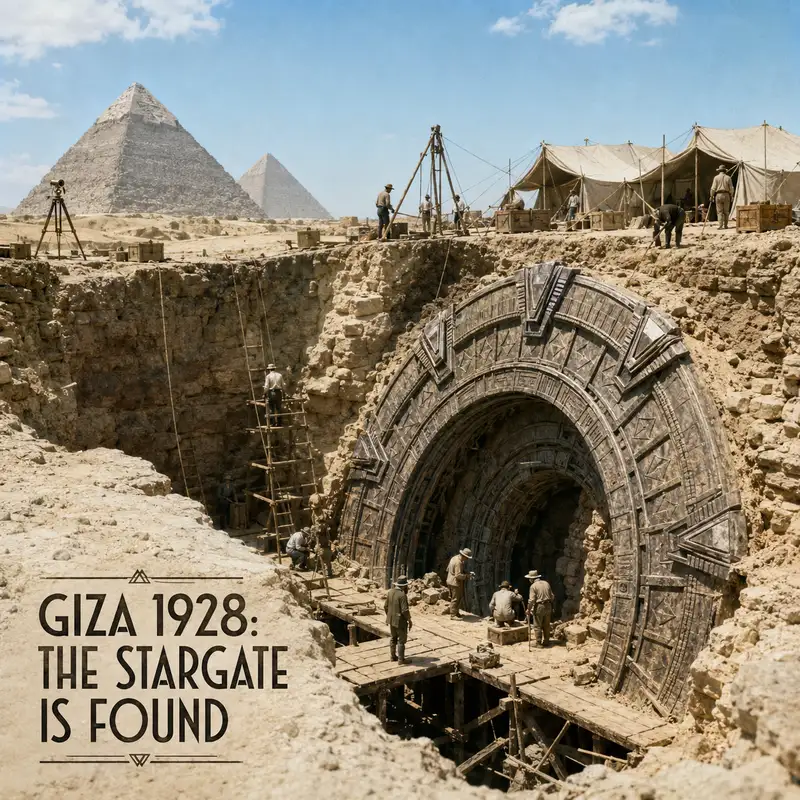
The first warning was already on the ground when Professor Langford reached the excavation. Beneath the sand near Giza lay a set of massive cover stones describing an object connected to Ra and deliberately sealed away. The excavation team did what archaeologists are trained to do. They exposed the stones, documented the markings, and lifted what had been buried. Then ropes tightened, laborers pulled, and a metal ring rose into the Egyptian sun. Professor Langford looked at a machine no known ancient society should have been able to build. His young daughter Catherine watched from the edge of the dig. Neither of them knew that the excavation had just reopened the physical remains of Earth’s first interstellar occupation.
The discovery in nineteen twenty-eight poses a useful intelligence question. Why did humanity possess a functioning Stargate for more than six decades before anyone understood what it was? The answer was not a lack of intelligence or effort. The artifact arrived without its operating system, without an instruction manual, and without the historical context needed to interpret it. Archaeologists saw an impossible object beneath Egyptian cover stones. Engineers saw a ring with moving components and unknown material properties. Military planners later saw a potential weapon. Each group held part of the answer. No one held enough of it at the same time.
The expedition was led by Professor Langford on the Giza Plateau. The surviving account does not identify every institution, sponsor, or labor organization involved, and it does not provide a complete excavation log. What it does preserve is the moment of discovery. Workers first exposed the circular cover stones. Nearby artifacts were catalogued on tables. Catherine found a gold pendant bearing the Eye of Ra, an object she would keep for most of her life. Then the dig team raised the much larger ring that had been concealed below.
The ring did not resemble a tomb door, a ceremonial disk, or an ordinary piece of architecture. It was a manufactured mechanism built from a material Catherine later described as unlike any mineral known on Earth. Around its circumference were symbols and locking points whose purpose was not obvious. The structure had survived burial for thousands of years with its basic form intact. Even before anyone understood its function, the artifact presented an engineering contradiction. It was ancient by context, industrial by construction, and apparently beyond the manufacturing capabilities of the civilization associated with the site.
The cover stones made the contradiction more severe. Their inner markings used recognizable Egyptian forms, but the outer sequence did not behave like ordinary writing. Early researchers treated the unfamiliar symbols as another script and attempted to translate them as words. That was a reasonable archaeological assumption. It was also wrong. The symbols represented constellations arranged as coordinates. Until someone stopped reading them as language and began reading them as navigation, the central clue remained visible and useless.
The inscription on the stones referred to Ra, deliberate burial, and a Stargate sealed for all time. That wording should have raised a security concern, although it did not explain the danger. The people who buried the device had not concealed treasure for later recovery. They had denied access to an enemy transportation system. To the expedition, however, Ra belonged to ancient religion and the word Stargate had no technical meaning. The warning survived. The knowledge required to understand the warning did not.
Dating added another problem. The early American project accepted testing that placed the cover stones at roughly ten thousand years old, a result that did not fit conventional Egyptian chronology. Later Stargate records placed the rebellion against Ra much closer to three thousand B C. The surviving record never fully reconciles those figures. The safest historical conclusion is that the excavation established extreme antiquity and deliberate burial, but not a single uncontested date for every element of the site.
The absence of the dial-home device was even more important. A normal Stargate installation includes a separate control pedestal that supplies power, selects symbols, and manages numerous safety functions. The nineteen twenty-eight excavation found the ring without that controller. Later records established why. The Giza dial-home device had been discovered by Germans in nineteen oh-six, more than two decades before Langford’s team uncovered the gate, and it was eventually taken by the Red Army at the end of the Second World War. Earth had recovered the two halves of a transportation system in different years, through different national channels, and then kept them apart.
That separation shaped everything that followed. With a dial-home device, the ring would have presented an interface. Its symbols could have been selected in sequence, its power systems engaged, and its network functions tested through equipment designed for the purpose. Without one, the gate was an enormous machine with no obvious controls. Researchers had to infer how to rotate the inner track, how to energize the chevrons, how much power to apply, and what sequence might produce a response. It was like recovering an aircraft engine without a cockpit, fuel specifications, maintenance manual, or any reason to believe the machine was meant to fly.
The split custody created an extraordinary strategic accident. Before the end of the Second World War, Germany held the control device while the United States held the gate. After the war, the Soviet Union possessed the dial-home device and the United States retained the ring. No government had the complete system, and none appears to have understood that the two artifacts belonged together. Rival states had divided an interstellar transportation network between them without realizing they were holding complementary components.
The dig also created a major custody problem that the surviving record leaves unresolved. An artifact found in Egypt eventually entered United States military control, but the surviving record does not provide a clean legal or diplomatic chain for that transfer. It does not explain which agreements authorized removal, which government offices approved shipment, or when the object crossed from archaeological possession into national-security custody. That silence matters. The most consequential artifact ever recovered on Earth changed jurisdictions before anyone understood what it could do.
Moving the gate would itself have been a substantial operation. The ring was too large for ordinary museum handling and too unusual for routine conservation. It required rigging, heavy transport, secure storage, and specialists able to protect an unknown material from damage. Every movement risked separating the object from its original context. Soil layers, stone placement, nearby artifacts, and the orientation of the burial might have preserved clues about how the rebels disabled it. Once the ring became a classified piece of hardware, the excavation site and the machine entered different institutional histories.
Unearthing the ring also removed the protection created by burial. A receiving Stargate does not normally need a local dial-home device or external power source. Under ordinary conditions, the outgoing gate provides the energy needed to establish the wormhole. Once the Giza gate stood unobstructed, an off-world power with Earth’s address could theoretically have reached it even while human researchers remained unable to dial outward. Storage inside a close-fitting crate or behind physical barriers could prevent activation, but the surviving record does not show that anyone understood this as a defensive requirement in nineteen twenty-eight.
Professor Langford remained the essential bridge between those histories. He was an archaeologist responsible for an object that increasingly attracted military interest. Catherine grew up around the unresolved problem and inherited both his curiosity and his incomplete access. The pendant she carried was not a key and did not control the Stargate, but it linked the discovery to Ra long before the project understood Ra as an alien ruler. It became a small piece of evidence whose emotional importance exceeded its technical value.
By the Second World War, the United States government had moved from archaeological study to weapons assessment. President Franklin Roosevelt authorized research because officials suspected the device might have military use. That conclusion was speculative, but not irrational. The ring was made from unknown material, contained moving and energy-responsive components, and had been hidden beneath an inscription associated with a powerful ruler. In wartime, an unexplained machine is rarely allowed to remain only an academic question.
The research team headed by Professor Langford had no dial-home device and no reliable theory of operation. Soldiers manually turned the inner ring while technicians applied external electrical power. The process caused feedback, violent shaking, and at least one generator failure. These experiments were primitive compared with later Stargate Command procedures, but they demonstrated an important fact. The ring absorbed energy and responded when its symbols were aligned. The artifact was not a passive monument. It was a dormant system.
Ernest Littlefield made the conceptual advance that the original excavation had not. He concluded that the symbol combinations were destinations rather than a conventional lock. In January nineteen forty-five, the team established a stable event horizon to another world. Littlefield entered wearing protective equipment and connected to Earth by a line. The connection closed, the line was severed, and he was stranded. The researchers had achieved the first successful modern activation of the Stargate and immediately demonstrated why experimentation without a return plan is not the same thing as operational travel.
The nineteen forty-five test also revealed how little operational planning surrounded the technical breakthrough. The surviving record shows no reconnaissance probe, no radio contact with the destination, no confirmed atmospheric survey, no receiving team, and no independent way to dial home. Littlefield crossed because the project needed a human observer and had no unmanned system capable of doing the job. It was a wartime experiment in which courage substituted for information. The gate opened successfully, but every unanswered question had been transferred to the man inside the diving suit.
The program then collapsed under secrecy, fear, and institutional embarrassment. Catherine was told that Ernest had died in a laboratory accident. Her father concealed the successful activation and the true cause of his disappearance. The records were classified, the work was halted, and the gate eventually sat in an old Washington armory. The machine had functioned exactly as designed. The project treated the result as failure because it could not recover the traveler, explain the destination, or admit what had happened.
That decision preserved security at the cost of knowledge. The film from nineteen forty-five, the coordinates used, Langford’s notes, and the human consequences of the test were not assembled into a complete institutional memory. Catherine believed she possessed everything her father had left. Decades later, she discovered that critical files had been separated and buried inside the national-security archive. The Stargate was physically protected while its history was administratively fragmented, a condition familiar to any organization that classifies information faster than it can preserve context.
After the war, Catherine and her father were ordered not to discuss the project. By nineteen sixty-nine, the gate was stored in Washington and officially unacknowledged. Catherine knew where it was, but not that it had worked or that Ernest had survived on the far side. She later petitioned several presidential administrations to revive the research. Her persistence kept the problem alive, although the effort still lacked the missing dial-home device and the correct interpretation of the cover stones.
A renewed program eventually replaced the absent controller with computers, power systems, and mechanical equipment built on Earth. That achievement required years of work because human engineers were reconstructing functions the original dial-home device performed automatically. The substitute could rotate the gate and energize chevrons, but it did not initially reproduce every safeguard built into Ancient technology. Earth was not learning to operate a familiar machine. It was creating an improvised interface for an alien network while still uncertain that a network existed.
The final breakthrough came when Catherine recruited Daniel Jackson. The project’s established experts had spent two years treating the outer symbols on the cover stone as language. Daniel recognized them as constellations and understood that six symbols described a destination while a seventh established the point of origin. He also corrected the inner inscription, replacing the idea of a mystical doorway with the name Stargate. The answer had been present since nineteen twenty-eight. It required the right combination of archaeology, linguistics, and spatial reasoning to become usable.
Daniel’s success also changed control of the project. Military leaders had allowed civilian researchers to work toward activation, but they prepared for the possibility that the gate would open onto a threat. Once the dialing sequence appeared viable, Colonel Jack O’Neil took operational authority under General West. The first mission carried a nuclear weapon as a demolition option. The artifact discovered by an archaeological team had become a strategic access point, and the response reflected the uncertainty surrounding it. Earth did not know what was on the other side, so it prepared to destroy the route if necessary.
The nineteen twenty-eight discovery therefore created three separate intelligence problems. The first was identification. Investigators had to determine what the ring was. The second was function. They had to learn how to make it operate. The third was context. They had to understand who built it, who had used it, why it had been buried, and what might still be waiting at another address. Earth solved the first two before it solved the third. That sequence allowed travel, but it also ensured that the first expedition entered an imperial system it did not know existed.
The discovery also demonstrates the difference between possession and capability. The United States could guard the Stargate, move it, classify it, and apply power to it. None of those actions meant the country could use it safely. Safe use required symbols, coordinates, astronomical correction, environmental reconnaissance, communications, return procedures, medical support, and an understanding of hostile control on the far side. An artifact can be in a secure warehouse and still remain outside the owner’s effective control.
The separated dial-home device adds a second lesson. Advanced systems are often distributed across components, software, procedures, and external infrastructure. Recovering the most visible piece does not mean recovering the system. The gate drew attention because it was enormous. The control pedestal was smaller, less dramatic, and already gone. Yet the missing device contained the interface and safety architecture that would have made the ring comprehensible. Earth recovered the doorway after another power had taken the handle.
The political consequences began before the first wormhole opened. The artifact moved from an Egyptian dig into American custody, became a wartime research project, disappeared into classified storage, and later reemerged under Air Force control. Each transition narrowed the number of people allowed to ask questions. Secrecy protected the object from public exposure and foreign access, but it also excluded scholars, concealed a fatal test, and separated Catherine from the evidence required to understand her own father’s work.
Catherine’s role is central because she connected periods that otherwise would have remained isolated. She witnessed the excavation, preserved the Eye of Ra pendant, understood the importance of a missing control device, remembered the wartime project, petitioned for renewed research, and recruited the scholar who finally interpreted the symbols correctly. She did not solve the physics of the gate or command the first mission. Her achievement was institutional endurance. She kept an abandoned question alive until science, military resources, and the right expertise finally converged.
The dig itself revealed almost none of the larger strategic picture. It did not identify the Ancients as the gate builders. It did not expose the Goa’uld political order. It did not reveal that Ra had used the gate to move human populations between worlds. It did not reveal the network, the existence of a second gate in Antarctica, or the security risks of opening an incoming wormhole. The excavation recovered infrastructure, not intelligence. Most of the meaning attached to the site would be learned only after Earth began using the device.
That delay explains why the discovery was both fortunate and dangerous. Had the gate been activated immediately in nineteen twenty-eight, Earth would have possessed fewer communications systems, weaker medical controls, no modern computing, and almost no ability to respond to an off-world threat. The missing controller and the failure to interpret the symbols postponed contact until Earth had greater technical capacity. Ignorance acted as a temporary security measure, though no responsible defense plan would recommend relying on it.
The discovery also reversed the intention of the people who buried the gate. Their objective had been access denial. They did not destroy the device. They removed it from use and concealed it beneath a warning. Langford’s team did not merely uncover an archaeological object. It dismantled a planetary defense measure created after Ra’s occupation. The workers at Giza reopened the possibility of interstellar travel without knowing that the route had once carried soldiers, captives, and imperial authority.
Giza in nineteen twenty-eight was therefore the beginning of the modern Stargate era, but not because the ring opened that day. It began because Earth recovered a piece of strategic infrastructure and started the long process of assigning meaning to it. The excavation produced no wormhole, no alien contact, and no immediate military capability. It produced a custody chain, a research problem, a classified legacy, and a child witness who refused to let the mystery disappear.
The final image is not the activated gate under Cheyenne Mountain. It is the ring hanging from ropes above the sand while workers struggle to hold it upright. Around them are cover stones stating that the device had been buried deliberately. The warning was accurate, the machinery was intact, and the expedition had no way to understand either one. Humanity’s path to the stars began by excavating a sealed invasion route and mistaking the absence of an immediate reaction for safety.