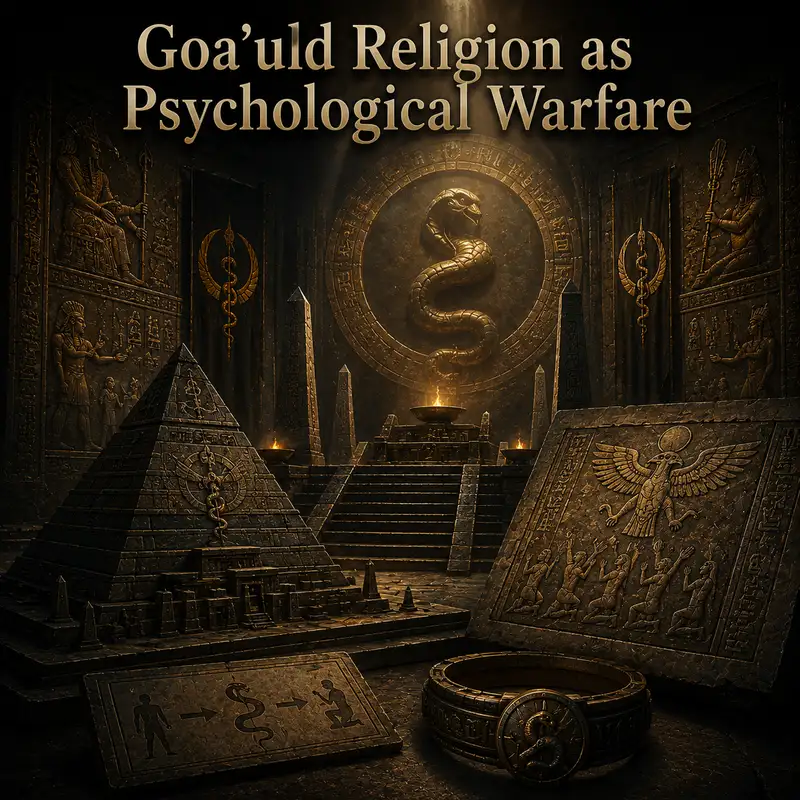
Goa’uld Religion as Psychological Warfare
The Stargate opened on Abydos, and the people who had once overthrown Ra reacted to Apophis with a mixture of confusion, fear, and recognition. He arrived in a human body, surrounded by Serpent Guards whose helmets transformed soldiers into creatures of myth. His eyes flashed. His voice carried the resonance associated with a Goa’uld. A hand device threw armed defenders aside without visible effort. In a matter of minutes, the visitors had presented themselves not as raiders from another world, but as beings standing above ordinary human resistance.
The military question is not why an isolated village might fear such an arrival. The more important question is how a small species of parasites used the same performance to control populations across the Milky Way for thousands of years. Goa’uld religion was not decorative mythology attached to an empire that would have functioned without it. It was an operational system. It shaped how subjects understood authority, how Jaffa interpreted obedience, how enemies assessed risk, and how entire worlds decided whether resistance was possible before the first weapon was fired.
Psychological warfare attempts to influence perception, emotion, reasoning, and behavior in support of political or military objectives. By that standard, the Goa’uld claim of divinity was one of the most successful psychological campaigns in galactic history. It did not need every subject to possess sincere theological conviction. It needed communities to behave as though the claim were true. Some worshipped. Some doubted privately. Some obeyed because their children required symbiotes, their village lacked weapons, or a Ha’tak waited in orbit. The result looked like faith from the throne.
The Goa’uld built that claim by occupying identities already meaningful to human societies. Ra, Apophis, Hathor, Sokar, Cronus, Yu, Ba’al, and many others presented themselves through names, symbols, and stories associated with gods and rulers. The screen record does not establish every step by which each human myth developed, and the relationship was not identical on every world. What is clear is that the Goa’uld used cultural familiarity as an entry point. They did not arrive as unknown administrators requesting recognition. They arrived wearing a language of sacred authority their subjects had been taught to understand.
That identity was then reinforced at the point of contact. A Goa’uld ruler rarely appeared alone. Guards formed ranks. Priests announced the god. Captives were forced to kneel. Architecture directed attention toward a throne, altar, or arrival platform. The ruler stood physically elevated while everyone else occupied assigned positions below. These details were not incidental ceremony. They created a controlled environment in which every movement communicated hierarchy. The subject did not merely hear that the Goa’uld was divine. The subject entered a space where the claim had already organized every body in the room.
The host itself became part of the message. The symbiote’s presence could produce glowing eyes and an altered voice, signs that distinguished the ruler from an ordinary human. Those signs were useful because they were dramatic, repeatable, and difficult for an isolated population to explain. They were also controllable enough to be concealed when infiltration required a less theatrical approach. The Goa’uld could therefore display otherness before worshippers and suppress it before targets. Divinity was presented when it increased obedience. Humanity was imitated when it increased access.
Advanced technology supplied the miracles. Ribbon devices could hurl a person across a room or inflict pain without a visible projectile. Healing devices could close wounds. Ring transporters allowed a ruler to appear or disappear in columns of light. Force shields stopped weapons that should have killed. Energy weapons struck with sound, heat, and spectacle. None of this was supernatural, but a farmer, miner, or conscript did not have access to a laboratory capable of demonstrating the distinction. The gods were machinery operators, and the machinery was kept carefully out of public hands.
The sarcophagus made the central claim even harder to challenge. It healed terrible injuries, extended the life of a host, and under some conditions restored the recently dead. A ruler who survived for centuries could point to personal continuity as evidence of immortality. A ruler who returned after apparent death could turn an assassination attempt into a religious demonstration. Repeated sarcophagus use carried severe psychological costs, but those costs were borne by subjects as cruelty and instability. From below, the ruler still appeared to have defeated age, disease, and occasionally the grave.
The built environment reinforced the same lesson. Pyramids served as landing platforms for Goa’uld ships. Temples contained ring systems, hidden chambers, holding cells, and technological controls. Palaces joined government, religion, military headquarters, and theater in one structure. When the ship descended over the pyramid or the ruler materialized inside a sanctuary, sacred architecture and strategic mobility became indistinguishable. The effect was efficient. It also meant that a maintenance failure could become a theological emergency, a difficulty the priesthood presumably preferred not to discuss in public.
Control of knowledge protected the illusion. On Abydos, Ra’s prohibition on writing helped separate the population from the record of earlier rebellion. Elsewhere, subject worlds were frequently kept at low levels of military and industrial development while their rulers monopolized ships, shields, and gate travel. The policy did not require universal ignorance. It required enough inequality that explanations could not easily become capabilities. A person might suspect that a hand device was technology. Suspicion alone did not provide the materials, education, or access needed to build one.
This information control also shaped memory. Defeats could be hidden, blamed on treachery, or reframed as temporary trials. Victories could be turned into sacred proof. Rival gods supplied a permanent explanation for hardship. Crops failed because an enemy god threatened the world. Taxes and naquadah quotas became necessary tribute for protection. Military mobilization became service in a cosmic struggle. The political advantage was considerable. A ruler did not need to explain poor administration when every crisis could be attributed to hostile divinity and every sacrifice presented as defense of the faithful.
Local intermediaries made the message sustainable between royal visits. Priests, village leaders, favored families, and Jaffa officers translated distant imperial power into daily rules. They collected tribute, organized ceremonies, identified dissidents, and taught children which symbols deserved fear. Some were sincere believers. Others gained status from the arrangement or judged cooperation safer than revolt. The Goa’uld did not need to supervise every conversation. They needed enough people with an interest in repeating the official story.
The Jaffa guard orders made theology visible in military form. Serpent Guards, Horus Guards, and other household formations wore armor tied to the identity of the ruler they served. Their helmets intimidated civilians, identified allegiance, and transformed human warriors into extensions of a divine image. Forehead marks carried the same message permanently. The symbol told a village which god claimed authority, told rival Jaffa which chain of command had arrived, and told the wearer that military identity and sacred ownership were the same thing.
The staff weapon demonstrated how deeply psychological effect influenced equipment. It was lethal, durable, and useful in many conditions, but it was also long, bright, loud, and visually unmistakable. Jack O’Neill’s comparison between the staff and the P ninety was blunt. The staff excelled at intimidation. The compact automatic weapon excelled at placing repeated accurate fire on a target. That did not make every staff carrier tactically incompetent. It showed that Goa’uld doctrine had optimized a common infantry weapon for domination of frightened populations as well as combat against organized enemies.
Ceremony extended into command language. Jaffa were expected to announce loyalty, accept orders with ritual formality, and treat a ruler’s preference as divine intent. Questioning an operation could therefore become more than professional disagreement. It could be sacrilege. That protected the ruler from embarrassment and the command system from honest analysis. A First Prime might know that a battle could not be won, yet refusal threatened his rank, family, and life. The religion did not merely motivate troops. It restricted what commanders were permitted to say about reality.
The prim’ta gave the theology a biological foundation. The Goa’uld altered Jaffa physiology so that a child approaching maturity required a larval symbiote to replace the natural immune system. Priests then implanted the larva during a sacred ceremony. The child gained strength, healing, and longevity, but became dependent on future symbiotes for survival. The Goa’uld had created the medical need and then presented the treatment as a divine gift. It was coercion redesigned to feel like salvation.
That arrangement made the priesthood part of military logistics. Priests controlled access to implantation, reinforced doctrine, and helped decide who remained inside the protected community. A loyal family could receive a larva. An outcast family could be denied one. The temple therefore distributed health care, religious status, and eligibility for military adulthood at the same time. The system required fewer guards because communities policed themselves. Parents taught children the beliefs that would help them survive the ceremony, obtain acceptance, and avoid punishment.
Apophis’s treatment of Rya’c showed how aggressively that system could target a family. The boy was captured, conditioned, and used against Teal’c. His public rejection of his father served as propaganda on Chulak and as a trap for the rescue team. The available evidence suggests that chemical influence such as nish’ta may have reinforced the indoctrination. The larger point does not depend on the exact method. Apophis understood that breaking the son of a famous traitor could restore authority more effectively than executing another anonymous prisoner.
The label shol’va carried similar power. It meant more than deserter. It marked a person as a traitor to god, people, family, and warrior tradition. Teal’c’s home was destroyed, his family cast out, and his name turned into a warning. Collective punishment converted private doubt into a domestic risk calculation. A warrior considering rebellion had to consider what would happen to a spouse who needed a replacement symbiote or a child approaching the prim’ta. The empire placed hostages inside ordinary family life without needing to move them into a cell.
Public violence completed the message. As First Prime, Teal’c was ordered to kill civilians and participate in the destruction of communities. On Cartago, Apophis used terror during the collection of human captives, and a child watched Teal’c kill his father. Such acts had immediate tactical purposes, but their larger value was exemplary. One body in a village square could influence people who had never met the victim. A burned settlement could discipline neighboring worlds. The objective was not simply to remove resistance. It was to make the cost of resistance visible in advance.
Host selection was another ritual of terror. Captives were gathered, inspected, and offered to mature symbiotes while guards and priests controlled the space. The chosen person appeared to receive divine elevation, but the original mind remained imprisoned inside the body. To observers, the transformation proved that the god could cross from one form into another. To the captive population, it proved that even identity could be seized. The Goa’uld did not merely threaten to kill subjects. They demonstrated the power to wear them.
Sokar turned an entire moon into psychological terrain. Netu was made into a prison resembling the underworld associated with his chosen identity as a god of death. Heat, toxic conditions, isolation, torture, and the absence of a Stargate made the myth materially real for its prisoners. The installation had security value, but its political value came from reputation. Sokar could threaten an enemy with more than execution. He could promise an afterlife of suffering and then provide transportation to it.
Some Goa’uld reinforced persuasion with direct chemical control. Hathor used a biological influence that made men at Stargate Command unusually susceptible to her. Seth used nish’ta, a compound that spread through the body and made the mind pliable. His followers on Earth described healing, glowing eyes, magical power, and public killing. They lived in a fortified compound, carried conventional and Goa’uld weapons, and were prepared to die for him. Religion, chemistry, isolation, and armament formed one integrated control system.
Seth’s cult is especially revealing because it stripped away the scale of interstellar empire. He had no great fleet, no Jaffa civilization, and no network of subject planets. He still reproduced the essential pattern. Followers were separated from families, exposed to controlled doctrine, made biologically receptive to suggestion, shown selective miracles, and taught that outside forces were impure enemies. When authorities surrounded the compound, Seth presented the event as fulfillment of prophecy. The siege did not disprove his warnings. Inside the information system he had built, it appeared to confirm them.
Human imitators demonstrated that the model did not require a symbiote. Pyrus killed the Goa’uld who had ruled his world, used a sarcophagus to survive for centuries, accepted worship as a liberator, and continued forcing the population to mine naquadah. Captain Jonas Hanson, an Earth officer, used recovered protection technology and the language of divinity to dominate another population within a remarkably short period. Both cases functioned as controlled experiments. Give a ruler longevity, selective technology, armed followers, and exclusive control of the explanation, and Goa’uld-style religion can be reproduced without a Goa’uld.
This is why the subjects should not be dismissed as gullible. They saw rulers who did not age, guards with energy weapons, ships descending from the sky, and the dead returning from sarcophagi. They lived in societies where failed resistance could bring collective punishment and where no independent scientific institution could safely test the god’s claims. Under those conditions, obedience could be rational even when belief was incomplete. A person does not need to accept divinity to understand what orbital weapons can do to a village.
The system also recruited its own intelligence network. Priests watched doctrine. Families watched reputation. Guards recognized forbidden movement. Collaborators gained status by reporting dissent. The ruler’s symbols simplified identification, while ritual behavior revealed who belonged and who did not. An outsider who failed to kneel, used the wrong title, or handled sacred technology too confidently could expose himself before reaching a guarded door. Religion functioned as an authentication protocol written into social behavior.
Its strength was also its weakness. A regime based on technological monopoly had difficulty explaining captured technology. A regime based on immortality had difficulty explaining a dead god. A regime based on perfect authority had difficulty admitting military defeat. Each contradiction forced the Goa’uld to spend more violence, secrecy, or spectacle preserving the original claim. The system remained powerful while evidence could be isolated. The Stargate network made isolation increasingly difficult.
Teal’c’s defection was therefore a psychological operation against Apophis whether Stargate Command planned it that way or not. The gold-marked First Prime had received the highest honor available to a Jaffa and rejected the god who granted it. He knew the rituals, the military structure, and the biological dependencies. More importantly, he survived. Every later appearance became evidence that a shol’va could live, fight, and return through the gate with allies. Apophis could denounce him, but could not make the example disappear.
Apophis’s death at Stargate Command offered even more dangerous evidence. Teal’c watched the former god suffer, fear his enemy, and demand death. The moment exposed the host beneath the grandeur and the mortality beneath the title. Yet the strategic effect was complicated when Apophis’s body was returned to Sokar and restored in a sarcophagus. The Goa’uld system could convert proof of death into a resurrection narrative because its medical technology was real. Counterpropaganda had to do more than kill the ruler. It had to explain the machinery.
Earth weapons and repeated battlefield defeats helped provide that explanation. Jaffa saw staff weapons outperformed at practical combat tasks. They watched small Tau’ri teams penetrate palaces, destroy ships, and escape through gates. They encountered Tok’ra who shared Goa’uld biology without claiming divinity. They learned that ribbon devices required naquadah, sarcophagi had limits, and gods could be imprisoned, extracted, or replaced. Each fact separated a capability from the sacred story surrounding it.
Even then, liberation was not immediate. Kytano, secretly the Goa’uld Imhotep, built a rebel Jaffa force by exploiting the same habits of obedience and glorious sacrifice that the old religion had cultivated. Warriors who no longer worshipped Apophis could still submit to a charismatic commander demanding unquestioned loyalty. The empire had trained them to seek personal authority, interpret sacrifice as proof of devotion, and distrust hesitation. Removing the false god did not automatically remove the command culture created in his image.
The Goa’uld eventually lost the religious war because too many contradictions became shareable. Jaffa from rival armies compared experiences. Rebel leaders connected isolated doubts. Tretonin weakened the biological claim that life came only from a larval symbiote. Captured ships and devices turned miracles into equipment. Dead System Lords accumulated faster than priesthoods could explain them. Military defeat alone did not destroy the empire, but it made the theological monopoly impossible to maintain.
Goa’uld religion was psychological warfare because it shaped the battlefield before troops arrived. It taught subjects that resistance was sacrilege, taught Jaffa that dependence was honor, taught commanders that disagreement was betrayal, and taught whole worlds that advanced technology was evidence of divine right. Its greatest success was not convincing every person that the System Lords were supernatural. It was convincing enough people that obedience was the only survivable response.
The system failed when that calculation changed. A glowing eye became a biological effect. A beam of light became a ring transporter. Immortality became repeated sarcophagus treatment. The sacred larva became an engineered dependency. The god became a parasite protected by soldiers who were beginning to understand that the throne had never created their strength. It had only claimed it. When the Jaffa stopped kneeling, the divine empire did not lose its magic. It lost the audience required to make the performance work.