Ha’tak Motherships: The Backbone of Goa’uld Power
Two naquadah-enhanced nuclear missiles climbed toward the Goa’uld ships entering Earth orbit. They represented the strongest response the United States could assemble on short notice. The missiles were detected, tracked, and destroyed against defensive shields without producing a measurable result. Below them, Stargate Command had an iris capable of stopping troops arriving through the gate. Above them, two Ha’tak motherships had simply flown around the entire defense plan. Earth had secured the doorway and discovered that the enemy also owned the sky.
That encounter explains why the Ha’tak became the backbone of Goa’uld power. It was not merely a large warship. It was a capital ship, carrier, troop transport, command center, mobile palace, logistics platform, and instrument of planetary intimidation. A System Lord could use one vessel to move between domains, direct Jaffa forces, launch fighters, bombard a rebellious world, and stand over a temple as visible proof that the god in the throne room also controlled orbit. Few military systems combine so many political and operational functions in one hull.
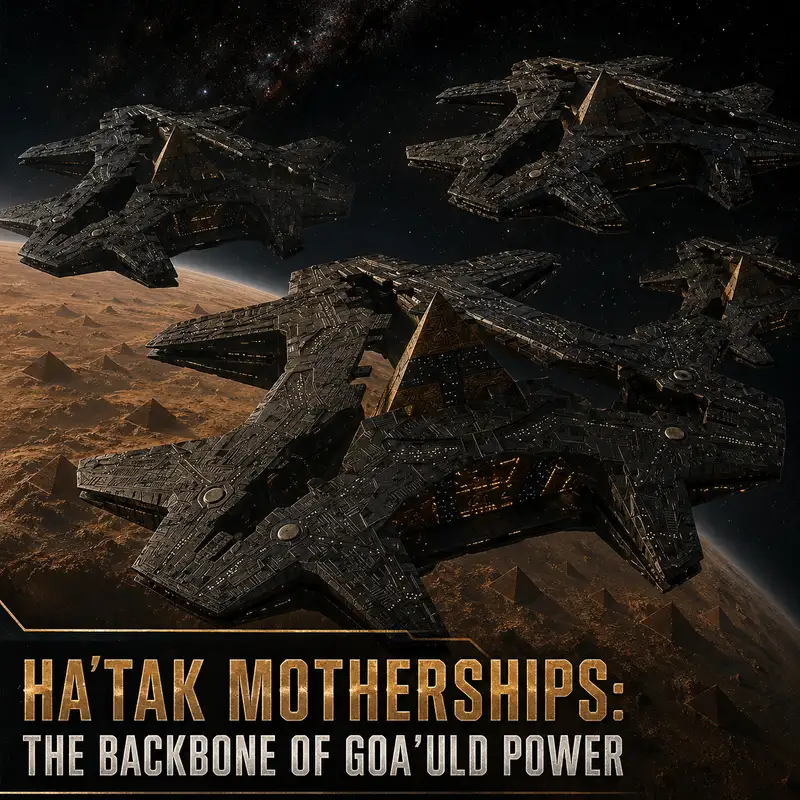
The name Ha’tak is commonly rendered as pyramid ship, and the description fits its most recognizable form. A dark central pyramid rises through a broad outer structure containing weapons, engines, hangars, and internal compartments. Ra’s vessel over Abydos established the pyramid-ship image, although its configuration differed from the standardized warships encountered later. Goa’uld construction was never completely uniform. Flagships were enlarged, modified, or equipped according to the wealth and ambitions of their owners. The class was a family of related designs rather than one immutable blueprint.
That variation is important because the Goa’uld did not operate a single imperial navy. Each System Lord controlled private ships, Jaffa crews, shipyards, and supply worlds. A Ha’tak belonged to a ruler in much the same way a Jaffa army did. Its bridge displayed that relationship openly. The pel’tak placed the Goa’uld throne behind the control stations, allowing the ruler to issue orders while remaining the visual center of the compartment. Command architecture and political theater occupied the same room, which was efficient until the commander’s vanity became part of the tactical problem.
Jaffa operated most shipboard functions. They navigated, controlled weapons, guarded critical spaces, maintained internal security, and carried out the orders of the Goa’uld or First Prime. The exact crew size is never established consistently, and different missions clearly used different complements. What matters is scale. A Ha’tak required far more than a handful of guards around a throne. It needed pilots, technicians, weapons operators, engineers, communications personnel, medical support, and troops prepared for surface operations. The ship was an institution, not a decorative shell around one System Lord.
Its power and control systems relied heavily on naquadah and crystal-based technology. Crystals served functions that Earth engineers would divide among computers, power distribution systems, control circuitry, and replaceable modules. That architecture could be repaired or reconfigured by trained personnel, but it also created critical nodes. Damage to the right crystal bank could disable propulsion, shields, or internal systems. Capturing a Ha’tak did not mean understanding every component. Earth repeatedly acquired working alien hardware before acquiring the industrial base that normally kept it working.
The construction site at Erebus exposed that industrial base. Ba’al’s forces used captive Jaffa to mine and refine naquadah while an unfinished Ha’tak hung above the labor camp on anti-gravity supports. The prisoners worked near volcanic heat, toxic conditions, and armed guards. Weak laborers were discarded. The scene removed any suggestion that Goa’uld warships appeared through divine will. They required mines, refineries, structural fabrication, power systems, skilled oversight, and a workforce that the empire considered replaceable.
Erebus also demonstrated why shipbuilding and political repression reinforced one another. Captured Jaffa who might have joined the rebellion were forced to manufacture the vessel that would transport more troops against other worlds. The shipyard consumed prisoners and produced the means to capture more. When S G One and allied forces sabotaged the anti-gravity system, the unfinished mothership fell and drew guards away from the camp. Destroying the ship was not only a dramatic diversion. It denied Ba’al a future capital asset and helped turn the labor force into a rebel formation.
A completed Ha’tak could travel through hyperspace between star systems, allowing Goa’uld power to bypass the limitations of the Stargate network. A buried or defended gate could block an infantry raid. It could not prevent a mothership from arriving above the planet. This was one of the most important asymmetries of the early war. Earth initially possessed extraordinary movement through one fixed point and almost no means of contesting the space around its own world. The Goa’uld could use the gate when convenient and ships when the gate became inconvenient.
Ha’taks could enter planetary atmospheres, hover over populated areas, and in some cases settle onto large pyramid structures built as landing platforms. The visual effect supported military occupation. A ruler could descend directly onto a sacred complex, move between ship and surface through ring transporters, and keep heavy weapons overhead while Jaffa controlled the ground. The pyramid below was not merely a temple. It could serve as a fortified interface between orbital power and local administration.
Ring transporters extended that interface. They moved personnel and cargo between prepared platforms, ships, and surface installations without requiring a shuttle to land. In combat, rings supported raids, prisoner transfers, command visits, and rapid reinforcement. They also created vulnerabilities. A transfer could be intercepted by another ring system positioned in the path, as happened during the struggle between Apophis and Heru’ur. A technology intended to make movement controlled and instantaneous became an intelligence opportunity when the enemy understood the route.
The carrier role was equally important. Ha’taks stored and launched death gliders for interception, reconnaissance, air support, and attacks against surface targets. Cargo ships could move personnel, equipment, and smaller loads between the mothership and a planet. Some operations also involved Al’kesh bombers working with larger vessels, though the exact carried complement varied and should not be treated as standard. The Ha’tak gave a System Lord a combined force rather than one gun platform. Fighters extended its sensors and weapons far beyond the hull.
Its own energy cannons could engage capital ships or strike planetary targets. Against a village, mine, or preindustrial city, precision was often unnecessary. The ability to fire from orbit made resistance appear futile and allowed a relatively small Jaffa force to threaten a much larger population. Orbital bombardment supported the Goa’uld claim of divinity because the weapon arrived from a platform most subjects could neither reach nor understand. Military capability and psychological warfare again shared the same power system.
Defensive shields made early Ha’taks extremely difficult for Earth to destroy from outside. The nuclear missiles launched against Apophis and Klorel failed because the ships detected them and raised shields before impact. Conventional aircraft had no realistic means of reaching the vessels, and Earth possessed no operational spacecraft capable of sustained combat. Later railguns and missiles improved Earth’s options, but standard Ha’tak shields remained serious defenses until more advanced weapons were integrated. The ship was not invulnerable. It was simply designed for a battlespace Earth had not yet entered.
S G One survived the first attack by entering that battlespace from inside the enemy vessel. The team had boarded Klorel’s ship through a Stargate carried in one of its compartments. Not every Ha’tak is shown with an on-board gate, so the capability should not be treated as universal. On that ship, however, the gate provided a direct route from a remote world into the interior of an invasion force. The same system that expanded Goa’uld mobility allowed four infiltrators to bypass the shields protecting the hull.
Once aboard, the team learned that a large warship can be strongest at the perimeter and fragile around its critical machinery. Explosives damaged the shield generator, while Bra’tac and other Jaffa rebels disrupted the command structure. Death gliders provided escape from the ships, but the final destruction depended on internal sabotage and collision rather than a victorious Earth fleet. The Ha’taks were lost because the attackers reached systems the shields could not protect from people already inside.
That distinction shaped Earth’s doctrine for years. Stargate Command could not reliably win a direct ship-to-ship engagement, so it used infiltration, sabotage, stolen craft, insider intelligence, and attacks against control systems. A Ha’tak’s size created internal corridors, guard posts, engineering compartments, hangars, and ring rooms that a small team could exploit. The vessel carried enough people to occupy a world, which also meant enough people to hide a defector, prisoner, or infiltrator if security failed.
System Lords compensated with compartmentalization and personal guard forces. Sensitive spaces were protected by Jaffa loyal to the ruler, while command crystals and shield generators were placed deep inside the ship. Yet political loyalty remained a poor substitute for counterintelligence. Teal’c, Bra’tac, Tok’ra operatives, and dissatisfied Jaffa repeatedly provided access that no external sensor could have created. A Ha’tak was a flying fortress, but it was still crewed by people whose families and beliefs had been shaped by the empire’s abuses.
In fleet warfare, numbers mattered. Pentagon briefings eventually described individual System Lords as operating whole groups of Ha’taks, with larger flagships directing standard vessels. A fleet could blockade a planet, divide into attack groups, or surround an enemy before weapons were fired. Apophis concealed multiple motherships during negotiations with Heru’ur and revealed them only when the deception had succeeded. Cloaking was not a universal Ha’tak feature, but those vessels showed how one technical advantage could transform an apparently balanced meeting into an execution.
The transfer of fleets after a ruler’s death made Ha’taks central to Goa’uld succession. When Sokar fell, Apophis seized much of his military establishment. When Heru’ur died, surviving forces could be absorbed rather than disbanded. A System Lord’s body might be destroyed in one engagement, while the ships, crews, and supply worlds remained available to the next claimant. Political power moved with the fleet. The empire survived repeated decapitation because its capital assets were transferable.
Cronus’s death gave Earth its first major opportunity to operate one of those assets directly. S G One and the artificial duplicate team helped kill him aboard his mothership, free Juna, and capture the vessel. The result was strategically valuable, but it did not create a Tau’ri navy. Earth had acquired one working Ha’tak, a limited pool of people able to operate it, and no established production line for its components. Possession was an operational opportunity, not an industrial revolution.
The captured ship supported the evacuation of the Tok’ra base at Vorash and carried personnel, equipment, and a Stargate for one of the most ambitious operations of the war. Samantha Carter used a connection to a black hole to remove mass from the local sun and trigger a supernova, destroying most of Apophis’s approaching fleet. The Ha’tak made the plan possible by transporting the gate close enough to the star and providing the force field and cargo capacity required for deployment.
The operation also showed the limits of treating a captured mothership as a permanent capability. The blast threw the surviving ships millions of light-years from home. Replicators infested Apophis’s vessel, entered its control systems, and improved the hyperdrive far beyond normal Goa’uld performance. The resulting transit was exceptional, caused by Replicator modification, and should not be mistaken for the standard speed of every Ha’tak. The ship reached the Milky Way rapidly because an enemy machine intelligence had rewritten the engineering assumptions.
Replicator infestation was especially dangerous because the Ha’tak’s crystal systems and internal volume gave the machines both energy and material. A crew could fight boarders with staff weapons, but Replicators used the ship itself as a resource. Once they controlled propulsion and key systems, the vessel became their platform. Apophis’s rank meant nothing to them. His flagship ultimately crashed into Delmak because the machinery no longer served the ruler seated on the throne.
Anubis pushed the design beyond the normal balance among System Lords. His command ships incorporated knowledge and weapons that standard Ha’taks could not match. Over Abydos, his enhanced vessel destroyed ships from the opposing coalition before their conventional fire could overcome its defenses. This was not proof that every later Ha’tak possessed the same capability. It was evidence that the basic platform could be modified dramatically when a ruler gained access to superior power systems and technical knowledge.
The same distinction applies to flagships. Goa’uld rulers often enlarged or customized the vessel carrying the throne, adding stronger shields, specialized weapons, laboratories, sarcophagi, or command facilities. Those upgrades reflected unequal resources. A minor ruler’s mothership, a standard fleet unit, and Anubis’s command ship could share a design lineage without performing identically. Intelligence officers had to identify the specific vessel and current configuration rather than assuming the class name settled the threat estimate.
The Battle of Antarctica demonstrated the Ha’tak’s vulnerability to a civilization-level technological leap. Anubis brought a large fleet to Earth, confident that conventional planetary defenses could not stop it. Ancient drones launched from the outpost beneath the ice penetrated shields, maneuvered through hulls, and destroyed the attacking ships in rapid succession. The result did not make Ha’taks weak. It showed that defenses calibrated against Goa’uld and early Tau’ri weapons offered little protection against an Ancient system designed on an entirely different level.
The collapse of the System Lords did not remove the ships from service. The Free Jaffa Nation inherited captured and surrendered Ha’taks, giving a newly liberated people the fleet that had once enforced their servitude. That inheritance offered mobility and political influence, but it also created disputes over control. Ships required crews, naquadah, maintenance, and centralized decisions about deployment. A council willing to celebrate liberation was less enthusiastic when asked to release three scarce motherships for a risky operation.
Against the Ori, the design reached its strategic ceiling. Free Jaffa Ha’taks joined Earth and allied forces near the supergate, then fought again around Chulak. Ori warships destroyed them with weapons their shields could not resist. One Jaffa crew attempted to deliver a bomb through ring transport during a brief shield fluctuation. Other ships maneuvered to draw fire and were eliminated. Courage and sound positioning could not overcome a technological gap that made the older capital ships expendable.
Even then, the Jaffa continued using Ha’taks because obsolescence is relative to the available inventory. A ship unable to defeat an Ori warship could still move troops, patrol former Goa’uld territory, confront regional threats, and provide orbital support. Replacing an interstellar fleet requires shipyards, trained crews, doctrine, and years of production. Liberation changed ownership immediately. It did not provide a new naval-industrial base before the next enemy arrived.
The Lucian Alliance drew the same conclusion. Its factions acquired Ha’taks from the wreckage of Goa’uld power and used them for trade enforcement, piracy, intimidation, and combat against Earth ships. The Alliance lacked the religious system of the System Lords, but the platform remained useful. A mothership could secure routes, protect agricultural interests, move armed personnel, and make a regional leader difficult to ignore. The throne changed occupants. The military economy surrounding the ship remained recognizable.
Earth’s later capital ships gradually reversed the original imbalance. Early Prometheus-class weapons struggled against Ha’tak shields, while later B C three-oh-four vessels gained better defenses, fighters, beaming systems, and eventually Asgard energy weapons. Once those beam weapons entered service, standard Ha’taks could be destroyed far more reliably. That development did not come from studying one captured ship and producing a copy. It required years of research, alliances, shipbuilding, failed prototypes, and technologies contributed by several civilizations.
Maintenance remained the quiet limit on every owner. A Ha’tak needed naquadah, crystals, trained technicians, replacement components, and facilities able to repair damage too large for the crew. The Free Jaffa and Lucian Alliance inherited many ships without inheriting a stable empire-wide support system. Some could cannibalize damaged vessels or seize old shipyards. Others likely operated until a critical failure exceeded local capability. A captured warship is most impressive on the day of capture. The maintenance report becomes more educational afterward.
The Ha’tak’s true strength was integration. It joined hyperspace mobility with orbital firepower, fighters, troops, cargo, rings, communications, and political command. It allowed a System Lord to move from court to campaign without changing headquarters. It could threaten a gate from orbit, land near a temple, deploy Jaffa, receive tribute, and leave before a weaker enemy assembled a response. No single feature made the ship decisive. The combination made it the standard instrument through which Goa’uld rule became military action.
Its true weakness was the system carried inside it. Centralized command made the ruler a critical node. Jaffa crews created opportunities for rebellion. Crystal systems offered targets for sabotage. Large interiors created security burdens. Private ownership fractured fleet cooperation. Dependence on slave-supported industry limited innovation and loyalty. The ship could dominate worlds that lacked space power, yet it repeatedly failed when opponents attacked the relationships, infrastructure, and assumptions that kept it operating.
The Ha’tak outlived the empire because it was more durable than the political mythology built around it. Ra, Apophis, Cronus, Sokar, Heru’ur, Anubis, and the System Lord council all disappeared. Their motherships passed to Jaffa commanders, criminal coalitions, resistance forces, and temporary allies. The pyramid remained in orbit after the god was gone. That is why it was the backbone of Goa’uld power. It carried not only weapons and soldiers, but the entire structure of conquest, and it remained useful long after no one believed the throne at its center was divine.