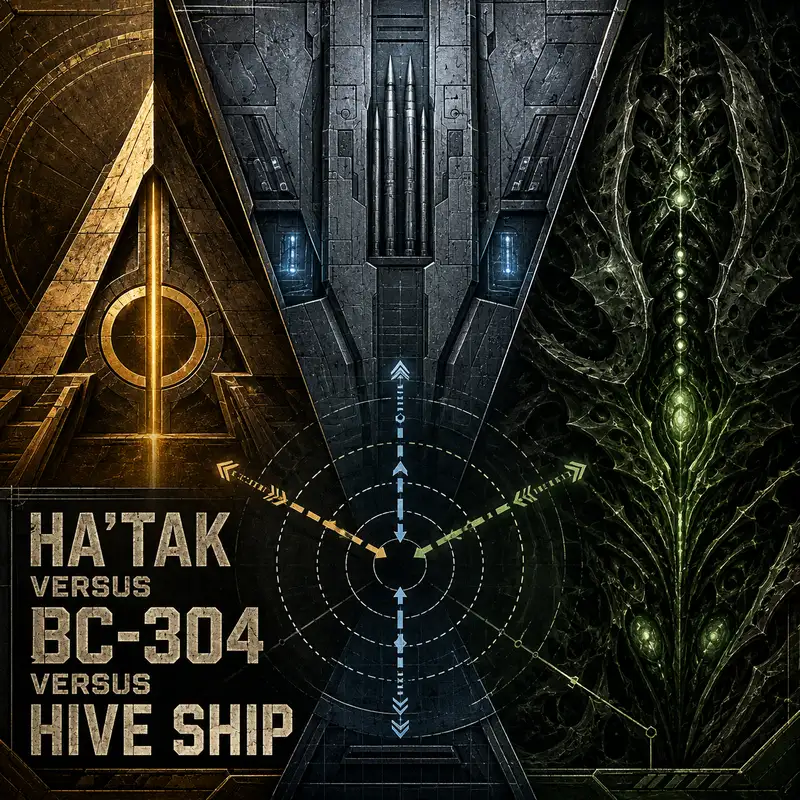
Ha’tak Versus BC-304 Versus Hive Ship
The Daedalus had reached Atlantis with an Asgard hyperdrive, defensive shields, railguns, guided nuclear missiles, F three-oh-two fighters, and a transporter capable of moving people through solid hulls. None of that produced an easy victory. Its first missiles toward a Wraith hive ship were intercepted by darts before they reached the target. The Asgard had provided advanced defenses and transportation, but not their most dangerous offensive weapons. Colonel Steven Caldwell finally ordered the transporter adapted to place a nuclear warhead inside the hive. The ship vanished in one explosion. A few hours later, the Wraith introduced a countermeasure. The advantage had lasted exactly long enough to become a requirement.
That battle captures the problem with comparing the Ha'tak, the B C three-oh-four, and the Wraith hive ship as though they were three entries on the same technical chart. They were built by different civilizations for different wars. The Ha'tak was an imperial mothership, carrier, palace, troop transport, and orbital gun platform. The B C three-oh-four was a human expeditionary battlecruiser assembled from Earth engineering and selected alien systems. The hive ship was a grown, organic carrier that moved Wraith populations, darts, weapons, and the biological economy of culling. Asking which ship was strongest requires a second question. Strongest for what mission, in what era, and with what support?
The Ha'tak was the vessel that first defined the scale of the Goa'uld threat. Its central pyramid connected the ship to the visual language of the rulers who had posed as gods on human worlds. Around that pyramid sat the larger superstructure containing engines, weapons, shields, hangars, troop spaces, transport rings, command systems, and the chambers of the ruling Goa'uld. A Ha'tak was not simply a battleship. It was a flying seat of government. A System Lord could arrive above a planet, bombard resistance, deploy Jaffa and smaller craft, and then govern from orbit with the same vessel that had carried the invasion.
That political function shaped its command arrangement. The Goa'uld ruler occupied the center of authority, while Jaffa officers and crews operated the ship beneath a hierarchy built on personal loyalty and religious obedience. The vessel could carry large numbers of warriors, death gliders, cargo ships, supplies, and prisoners. The exact crew and troop totals varied and were never established with enough consistency to support a universal figure. That uncertainty is important because not every Ha'tak was identical. Standard warships, personal flagships, upgraded vessels, and ships altered by Anubis or other rulers could differ significantly while sharing the same broad design.
The Ha'tak's hyperdrive gave the Goa'uld independent interstellar mobility across the Milky Way. It did not need a Stargate for strategic movement, and it could approach a world from orbit even when defenders controlled the gate. That made the ship the answer to one of the limits of Goa'uld imperial rule. The Stargate network connected many human settlements, but not every military objective sat conveniently beside an active gate. A Ha'tak carried the empire around the network, moved troops between systems, and allowed a System Lord to attack from a direction a village or rebel base could not close with an iris or buried gate.
Its weapons favored planetary coercion and fleet combat at relatively close range. Large energy cannons could strike ships, defensive installations, and targets on the surface. Death gliders provided fighter cover, reconnaissance, strafing, and pursuit. Al'kesh bombers and Tel'tak transports extended the force when available. The defensive shield was the crucial system. Early Earth nuclear weapons could reach a Ha'tak and still fail to produce a useful effect against the shield. For a civilization beginning the war with chemical rockets and aircraft, the difference was not one generation of technology. It was the difference between possessing weapons and possessing weapons that could reach the target's hull.
Apophis demonstrated that power with only two motherships. His invasion force approached Earth with enough Jaffa and fighters to impose occupation on a planet that had no operational space fleet. Earth survived because S G One infiltrated the ships, sabotaged them from inside, and used their proximity against them. The vessels were destroyed, but the battle did not prove that Ha'taks were weak. It proved that a powerful ship can be defeated when its command culture, internal security, and intelligence picture fail at the same time. Two motherships had nearly conquered Earth without fighting an equivalent fleet.
The design remained dangerous long after the System Lords began to collapse. Anubis fielded improved vessels and a larger flagship with technology beyond the ordinary Goa'uld standard. Ba'al used Ha'taks as military assets, mobile headquarters, and bargaining tools. Rebel Jaffa captured them and turned imperial warships into the foundation of a new fleet. The Lucian Alliance acquired others and used them as instruments of regional power. A Ha'tak could change flags more easily than it could change the political habits of the people commanding it. The class outlived the empire because so much of the Milky Way's transport, military labor, and technical knowledge had been built around it.
The B C three-oh-four emerged from Earth's attempt to stop living on captured ships and temporary miracles. Prometheus had proved that humans could build a large spacecraft around adapted Goa'uld and Asgard technology, but it also revealed the cost of prototypes, unstable systems, and components no Earth factory fully understood. The Daedalus class was the more mature answer. Earth built the hull, trained the crew, maintained the conventional systems, and produced more than one ship. Alien technology remained essential, especially in propulsion, shields, sensors, and transporters, but the vessel belonged to a human production program rather than a single recovered airframe.
Its mission was broader than fleet combat. A B C three-oh-four could carry personnel and supplies between Earth and Atlantis, escort expeditions, support off-world bases, deliver F three-oh-two squadrons, conduct orbital reconnaissance, evacuate civilians, insert teams by transporter, and serve as a joint command platform. The class operated where Stargates could not provide enough cargo capacity or where the destination gate was unavailable, hostile, or in another galaxy. That made strategic lift almost as important as firepower. Atlantis survived partly because Daedalus could bring replacement personnel, ammunition, medicine, and equipment across intergalactic distance.
The Asgard hyperdrive gave the class its greatest mobility advantage. A normal transit between Earth and the Pegasus galaxy took weeks rather than the years or generations expected from most known ships. A zero-point module could reduce the trip dramatically, but those power sources were rare and usually needed elsewhere. The faster journey during the first siege was an emergency use, not a permanent transportation standard. Even without that boost, the B C three-oh-four could move between galaxies faster than a standard Ha'tak and faster than the Wraith expected. Speed allowed Earth to reinforce, withdraw, choose an approach, and create strategic connections that its enemies could not easily match.
Early Daedalus-class armament remained heavily human. Railguns provided point defense and direct fire. Guided missiles carried conventional or naquadah-enhanced nuclear warheads. F three-oh-twos extended the ship's sensor range, intercepted enemy fighters, and attacked exposed subsystems. Asgard shields and beaming technology improved survivability and created unusual tactical options. The first Daedalus did not yet possess Asgard plasma beam weapons. The Asgard had shared enough technology to help Earth survive, while retaining systems they feared could eventually be turned against them. Alliances are often generous right up to the point where the transfer includes the ability to destroy the donor.
This early configuration was powerful but not dominant. During the defense of Atlantis, darts intercepted Daedalus missiles before they reached the hive's fighter bay. Transporting a nuclear weapon inside the target worked only after Asgard safety restrictions were overridden, and the Wraith quickly distributed jamming measures that blocked repetition. When twelve more hives approached, one battlecruiser could not defeat them through ordinary exchange of fire. Daedalus destroyed some ships through surprise and special tactics, then withdrew when its shield and systems could no longer support the fight. Atlantis survived by deception, not by winning a conventional fleet engagement.
The balance changed after the Asgard transferred their final technological legacy to Earth. Odyssey received an integrated Asgard core, advanced sensors, defensive systems, and plasma beam weapons capable of destroying vessels that had previously resisted Earth fire. Daedalus and Apollo were later retrofitted with the beam weapon. From that point, a fully upgraded B C three-oh-four became a genuine capital-ship killer. The beam could cut through advanced shields and tear apart unshielded hulls with concentrated fire. This capability belongs to the late service history of the class. Applying it backward to every earlier battle would turn technological development into a clerical error.
Even the upgraded ship remained vulnerable. Shields weakened under sustained attack. Missiles and fighter ordnance were finite. Hyperdrives could be damaged, beaming could be jammed, and the loss of a few compartments could disable systems connected through the same power and control network. Earth possessed only a small number of hulls, each carrying trained crews and alien-derived equipment that was difficult to replace quickly. A Ha'tak commander could lose one ship from a large inherited fleet and still retain regional power. Earth could lose a meaningful portion of its intergalactic transport and planetary defense capacity in one explosion.
The Wraith hive ship was built around an entirely different strategic requirement. It was a warship, carrier, mobile population center, and instrument of culling. A hive could transport Wraith through long periods of hibernation, launch large numbers of darts, attack human worlds, store captured people, and support the feeding cycle on which Wraith society depended. Its scale reflected more than a desire for large guns. The ship had to move an entire predatory military community across a galaxy where the available human population rose and fell over generations.
Hive ships were organic. Their hulls could grow, regenerate, and redirect energy toward repairing damaged sections. Standard hives generally relied on dense biological structure and regeneration rather than a conventional defensive shield. That produced a very different damage model. A shielded ship could remain untouched until its shield failed, then suffer rapid physical damage. A hive could absorb direct hits into living structure and begin repairing them, provided it still had power, time, and intact systems. The absence of a shield made precision weapons more immediately useful. The regenerative hull made incomplete damage temporary.
Their hyperdrives were strategically capable but biologically constrained. Hives crossed large distances and could pursue targets between systems, yet prolonged hyperspace travel placed stress on the organic hull. Periodic emergence allowed regeneration and recovery. This limitation mattered when a hive attempted intergalactic movement and when Atlantis tried to predict where an enemy would reappear. It also revealed the Wraith's recurring weakness. Their science could produce enormous organic ships, advanced weapons, and matter-storage technology, but efficient power generation remained inferior to Ancient and later Asgard-supported systems.
A hive's offensive strength came from heavy energy weapons and the dart swarm. The capital weapons could batter shields, damage Ancient ships, and overwhelm a lone battlecruiser through sustained fire. Darts intercepted missiles, attacked fighters, culled personnel, and deployed Wraith troops through their matter-storage beams. This gave the hive an air wing with functions no F three-oh-two squadron could duplicate. Earth fighters could destroy darts and attack the carrier. They could not remove a settlement's population in one pass or materialize boarding forces inside the enemy's defensive perimeter.
The Wraith also adapted quickly when a tactic threatened the hive itself. Daedalus beamed nuclear devices aboard several hives during the first siege. The Wraith introduced jamming. Earth fighters targeted hyperdrives and dart bays. The Wraith changed formations, launched larger intercept groups, and used their carriers' firepower to force the fighters away. In one engagement, two hives drove Daedalus shields toward failure while swarms of darts divided the F three-oh-two formation. The battlecruiser was faster and technically refined. The hives controlled the local battlespace through numbers, fighter mass, and sustained pressure.
Hive ships had serious vulnerabilities. Their unshielded hulls could be penetrated by Ancient drones, Asgard plasma beams, internal nuclear explosions, and boarding teams able to reach a critical system. Damage to the hyperdrive could trap the vessel. Destruction inside a dart bay or power area could produce secondary effects. A hive depended on a queen, command specialists, feeding supplies, and biological systems that could be disrupted by toxins or genetic intervention. The same organic integration that allowed regeneration also made the vessel vulnerable to biological and technical attacks that would have meant little to a conventional metal hull.
The zero-point-powered super-hive was an exception large enough to distort the comparison. Wraith scientists integrated Ancient power sources with an organic ship and used the surplus energy to grow a denser hull, improve sensors, increase weapons output, and accelerate strategic movement. Daedalus beam fire caused only minimal damage, while the hive's return salvo disabled major systems and stripped the battlecruiser's shields. Other Earth ships also failed to stop it before it reached Earth. That performance did not establish the normal capability of every hive. It showed what Wraith design could become when its chronic power limitation was removed.
Mobility gives the late B C three-oh-four the clearest advantage. Its Asgard hyperdrive supported rapid deployment across the Milky Way and routine, if demanding, movement between galaxies. A Ha'tak offered reliable galactic mobility and the ability to carry an occupation force without external support, but it could not match the human ship's intergalactic pace. A standard hive possessed impressive strategic reach within Pegasus, though hull regeneration and power limitations complicated long transits. The super-hive briefly changed that relationship, but only through rare power sources captured from another civilization.
In firepower, the answer changes with the date. A standard Ha'tak was vastly superior to early Earth spacecraft and remained dangerous against any planet lacking advanced defenses. A pre-beam B C three-oh-four could survive longer, maneuver better, and employ guided weapons or transporters, but ordinary missiles did not guarantee penetration of a strong Ha'tak shield. Once Asgard plasma beams became operational, the human ship gained a decisive advantage over standard Ha'taks and a strong killing capability against ordinary hives. A hive still delivered the greatest sustained fighter mass, while an exceptional super-hive could withstand weapons that destroyed normal capital ships.
Defensively, the Ha'tak and B C three-oh-four depended on shields, while the hive depended on structure and regeneration. Ha'tak shields were formidable but varied with the vessel and its power systems. Earth shields benefited from Asgard design and could absorb extraordinary punishment, yet they declined visibly under concentrated fire. Hive regeneration allowed a damaged ship to recover without a dry dock, but only if incoming damage did not outpace repair. Each system failed differently. A shield collapse could expose an otherwise intact ship. Regeneration could preserve a wounded hive while quietly draining the power needed for weapons, engines, or continued hyperspace travel.
As carriers and instruments of ground war, the Ha'tak and hive held advantages the B C three-oh-four was never intended to equal. A Ha'tak could deliver Jaffa, death gliders, bombers, and transports as part of an occupation campaign. A hive could launch large dart swarms, cull civilians, deploy Wraith soldiers, and sustain the population conducting the operation. A B C three-oh-four carried F three-oh-twos, Marines, special teams, and supplies, but it was an expeditionary combatant rather than a complete occupation system. It could dominate a narrow mission and still lack the personnel to secure one continent.
Command culture could overturn the technical balance. Goa'uld vessels were vulnerable to personal rivalry, Jaffa defection, and rulers who treated obedience as a substitute for accurate reporting. Wraith hives could coordinate rapidly under a queen, but competition among hives prevented unified strategy and sometimes made temporary alliances possible. Earth ships benefited from trained crews, specialist advice, and commanders expected to adapt, yet they also depended on a small number of irreplaceable experts and systems. No hull corrected bad intelligence. No shield protected a commander from the consequences of believing an enemy would behave according to doctrine it had already abandoned.
Numbers and industry matter more than a duel. The Goa'uld built or inherited enough Ha'taks to field large fleets across the Milky Way. The Wraith possessed enough hives to sustain culling cycles and overwhelm the Ancients through pressure across many systems. Earth fielded only a handful of B C three-oh-fours, even after the class matured. Their quality allowed them to alter battles far beyond their numbers. Their scarcity meant they could not guard every ally, escort every convoy, defend every base, and remain available for repairs at the same time. A superior ship that is three weeks away is an interesting strategic fact and an immediate operational absence.
In a late-era one-on-one engagement, a fully upgraded B C three-oh-four would hold the advantage over a standard Ha'tak. Its speed, sensors, Asgard shields, transporters, fighters, and plasma beams create too many ways to find and exploit a weakness. Against a standard hive, the same ship could win, especially if it gained surprise and brought the beam weapon onto target before dart swarms or concentrated fire reduced its shield. That is not a guaranteed outcome. Earlier B C three-oh-fours struggled against hives, and several ordinary hives could overwhelm one human ship. Against the zero-point-powered super-hive, the advantage reversed sharply.
The Ha'tak, the B C three-oh-four, and the hive ship were successful because each connected technology to a larger military system. The Ha'tak carried imperial rule and the Jaffa armies that enforced it. The hive carried the Wraith population and the culling economy that sustained it. The B C three-oh-four connected Earth industry, Asgard science, human airpower, Stargate teams, and expeditionary command. Its greatest strength was not that it became the largest ship. It was that its design could be upgraded as Earth learned. Its greatest weakness was that every upgrade increased dependence on rare knowledge, scarce hulls, and crews Earth could not afford to lose.
There is no single winner independent of mission and era. The Ha'tak was the best instrument for a System Lord who intended to arrive as ruler, bombard resistance, and leave an army behind. The hive was the strongest mobile carrier for a civilization that fought, fed, and reproduced through the same ship. The late B C three-oh-four was the most capable precision warship of the three and the most adaptable platform, but it never erased the arithmetic of fleets, logistics, and replacement. Earth built a ship that could destroy the vessels that once terrified it. Earth did not build enough of them to make terror, distance, or strategic surprise disappear.