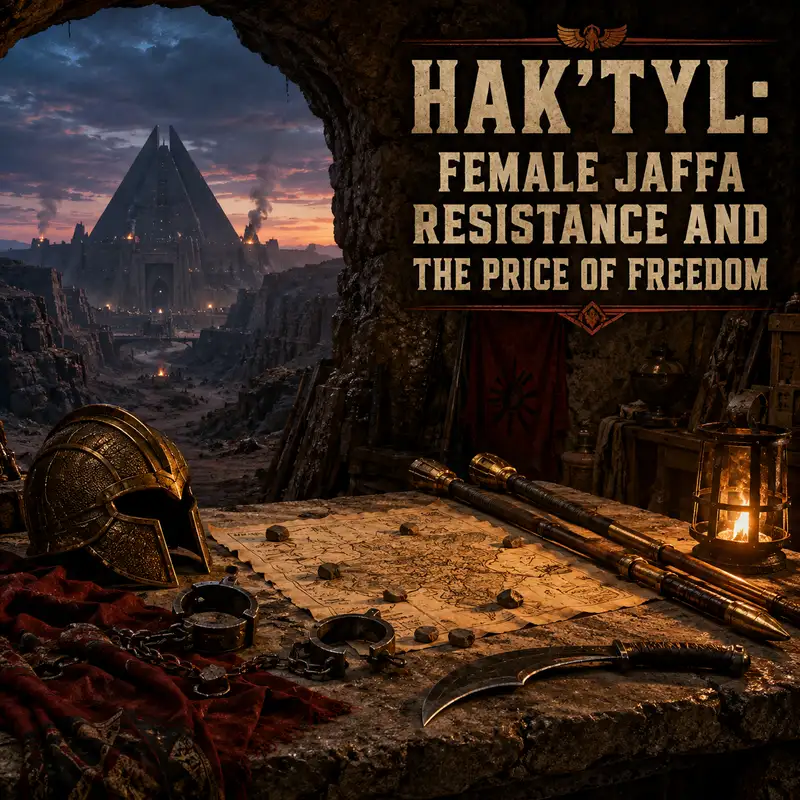
Hak’tyl: Female Jaffa Resistance and the Price of Freedom
Ishta’s resistance could save a newborn girl from Moloc’s ceremony of fire, but it could not save her from Jaffa biology. At the age of prata, roughly puberty, the child’s immune system would fail unless a larval Goa’uld was implanted. That meant the Hak’tyl had to ambush Jaffa patrols, kill warriors who might themselves have become rebels, and remove symbiotes from their bodies. Liberation had begun with rescue and immediately become a supply problem.
That contradiction defined the Hak’tyl. They were a female Jaffa resistance movement formed inside the domain of a System Lord who considered female lives militarily useless. They built a hidden sanctuary, maintained an underground rescue network, trained as warriors, and joined the larger Jaffa rebellion. Their enemy still controlled the biology that kept them alive. The central question was not simply how they escaped Moloc. It was how they could become free without reproducing the system that had enslaved them.
The surviving record is concentrated around Ishta, her senior followers, and two major crises. No complete population count, fleet inventory, or formal constitution for Hak’tyl was established. The name meant liberation and referred both to the resistance community and to the forested world that sheltered it. What can be reconstructed is an insurgent society organized around secrecy, evacuation, medical survival, and a political claim the wider Jaffa movement had not fully confronted.
Moloc’s decree had been issued about thirty years before Earth made contact. He declared that only male children would be permitted to live because only males, in his view, could strengthen his armies and lead him to victory in the wars among the Goa’uld. Every newborn female Jaffa was to be killed immediately in a ceremony of fire. Given the long Jaffa lifespan, the policy could have eliminated generations of women before it weakened Moloc’s own population enough to become inconvenient.
The policy was not an isolated act of cruelty. It was military manpower planning expressed through religious authority. Moloc defined male bodies as future soldiers and female bodies as wasted resources. The ritual converted that calculation into sacred obligation. Families were not merely ordered to surrender daughters. They were told that the deaths served a god and his war. Resistance therefore required more than hiding children. It required breaking the connection among faith, reproduction, and military service.
Ishta occupied the position from which resistance was both possible and personally dangerous. She was a high priestess in Moloc’s temple, responsible for recording births and presiding over the ceremony itself. Her status gave her privileges and access denied to most women, including movement among worlds under Moloc’s control. It also placed her inside the machinery of execution. Every rescue risked exposing not only a dissident priestess, but the records and routes connecting the entire network.
She used that access with Mala, Neith, and other trusted women to spirit infants away before they could be killed. Secrecy was severe enough that parents did not always know their daughters had survived. That protected the route under interrogation and reduced the chance that grief, hope, or rumor would expose the sanctuary. It also meant that liberation began with another painful separation. Some families mourned children who were alive because telling them the truth could have killed everyone involved.
The hidden world of Hak’tyl became nursery, training ground, headquarters, and national territory. Children rescued from Moloc grew among women who had served in his temples, households, and military system. The community preserved Jaffa language, ritual, meditation, and combat traditions while rejecting the authority those traditions had been designed to reinforce. Hak’tyl did not abandon Jaffa identity. It contested who had the right to define it.
Its armed force was suited to clandestine war rather than conventional conquest. The warriors used stealth, staff weapons, close combat, local intelligence, and surprise. They had access to the Stargate through operatives still serving within Moloc’s domain, but no observed fleet capable of challenging his ha’tak vessels. Their sanctuary remained secure only while its address remained compartmented. Their strength lay in moving people through cracks in the empire, not in holding a front against it.
The biological requirement for symbiotes placed a hard limit on that strategy. The Goa’uld had altered Jaffa physiology so that, after puberty, a larval symbiote replaced the natural immune system. An adult Jaffa without a symbiote or an effective substitute would weaken and die. Moloc controlled access to larvae through the same military and religious hierarchy the Hak’tyl opposed. Every rescued child therefore carried a future deadline.
The resistance met that deadline through raids. Hak’tyl warriors attacked Jaffa patrols, killed or disabled the soldiers, and removed their symbiotes for girls reaching prata. Ishta defended the practice as war for the preservation of children and insisted that her fighters did not target the defenseless. Teal’c recognized the tactical skill involved. He also saw the strategic trap. Each raid risked exposing Hak’tyl, consumed fighters the movement could not easily replace, and killed Jaffa who might one day reject their false god.
That was the price of remaining alive before a better option existed. Moloc’s system forced the resistance to choose between the death of a child and the death of another Jaffa. The Hak’tyl did not create that choice, but their raids still carried responsibility. Freedom movements are often judged by the enemy they oppose. They also have to be judged by the institutions and habits they build while opposing him.
Contact with S G One began through the rebel Jaffa network. Hak’tyl warriors intervened during a clash with Moloc’s forces and brought the Earth team to their sanctuary. Ishta proposed an alliance. Her people could offer intelligence from inside Moloc’s domain and experienced fighters for the wider war. In return, they needed weapons, food, supplies, and recognition from a rebellion still dominated by male Jaffa leaders.
Teal’c was both the ideal liaison and a source of friction. He had abandoned Apophis, inspired other Jaffa to reject Goa’uld divinity, and understood the biological chain binding every warrior to a symbiote. He also arrived carrying assumptions formed within the same male warrior culture Hak’tyl resisted. Ishta challenged any suggestion that her fighters required his protection. Their arguments were strategic, personal, and occasionally settled with training staffs, which at least kept the diplomatic paperwork concise.
Earth offered something more important than another shipment of weapons. Tretonin was a drug derived from Goa’uld biological research and modified to replace the immune function normally provided by a symbiote. Teal’c and Bra’tac had already survived by using it. For the Hak’tyl, it promised to end the raids for larvae and allow rescued girls to reach adulthood without carrying the young of the species that had ordered their deaths.
The promise was not a proven mass treatment. Removing a symbiote and beginning tretonin could trigger rejection, immune collapse, or other complications. Dosage had to be adjusted, and regular supplies would remain necessary. Four Hak’tyl volunteers traveled to Earth for trials. Mala took Ishta’s place because the resistance could not risk its leader. Three women survived the transition. Mala did not.
Her death was a strategic event as well as a personal loss. Mala had already watched Moloc execute the man she loved and sacrifice their daughter. She volunteered because a successful transition might end that cycle for every girl on Hak’tyl. When her body rejected tretonin, even the attempt to restore her symbiote could not save her. The proposed path to freedom had produced its first martyr before the community had decided whether to take it.
Neith interpreted the death as proof that Ishta had endangered them through weakness. She opposed tretonin, challenged Ishta’s leadership, and prepared to raid for a symbiote needed by her younger sister, Nesa. Her resistance was not irrational. Tretonin exchanged a biological dependence controlled by the Goa’uld for a pharmaceutical dependence controlled by allies. A missed shipment could still be fatal. The difference was political control and the possibility of production, not immediate biological independence.
Nesa changed the argument. She had never carried a symbiote and was approaching the age when she would need one. She refused to let another Jaffa die so that she could live and asked to receive tretonin directly. Her decision placed the right to choose with the person whose body was at stake. When Neith was later wounded during a raid, Nesa persuaded her to accept the same treatment. The youngest member of the dispute became the clearest advocate for a different future.
Most of the Hak’tyl eventually moved to tretonin and joined the wider rebel movement. This eliminated the need to steal larvae and weakened one of the Goa’uld’s most effective systems of control. It did not eliminate logistics. Tretonin had to be manufactured, stored, carried, and administered on schedule. The Hak’tyl had traded a supply chain controlled by Moloc for one supported by the Tok’ra and Earth. That was real freedom, but it was freedom with medical inventory requirements.
The alliance with the rebel Jaffa created another tension. Teal’c and Bra’tac wanted enough support to overthrow the System Lords across the galaxy. Ishta wanted Moloc removed before another generation of girls entered the fire. From the broad strategic perspective, an early uprising could be crushed and strengthen the surviving Goa’uld. From Hak’tyl’s perspective, every delay had a casualty count measured in newborn children. The larger rebellion could afford patience more easily than the people being killed while it waited.
Hak’tyl also challenged the social order the rebellion intended to inherit. Rejecting Goa’uld divinity did not automatically erase Jaffa patriarchy, marriage customs, or assumptions about who qualified as a warrior and political leader. The betrothal of Teal’c’s son Rya’c to the Hak’tyl warrior Kar’yn exposed those issues inside one family. A dispute over whether Kar’yn would kneel during the marriage ritual nearly ended the union. The disagreement was domestic, but the politics were not.
The marriage ultimately proceeded, providing a visible link between Hak’tyl and the wider rebel community. It did not resolve every cultural conflict. Kar’yn’s insistence on dignity showed that freedom could not mean merely replacing a Goa’uld master with a husband or council that preserved the same hierarchy. Hak’tyl’s political contribution was therefore larger than the number of fighters it supplied. It forced the rebellion to ask what liberation would change inside Jaffa society.
Moloc eventually penetrated the sanctuary’s security. The exact path of the compromise is not fully documented, but Ishta reported betrayal and casualties, and the entire Hak’tyl community had to evacuate. Stargate Command opened its underground base as temporary refuge while a new world was located. Cheyenne Mountain became a holding area for armed warriors, children, supplies, and a Jaffa wedding. The base had handled invasions and quarantines before. A displaced nation presented a different category of scheduling problem.
The evacuation demonstrated the strength and weakness of gate-based sanctuary. One protected address could move an entire community away from an approaching force without crossing Moloc’s space. The same movement had to pass through a single gate room, under another government’s security, with only what people could carry or send through the aperture. Hak’tyl survived because it had an ally with a secure gate. It also lost its home because secrecy had been its only strategic depth.
Even during evacuation, Ishta continued organizing resistance. Contacts inside Moloc’s ranks requested a summit to coordinate an uprising. Teal’c urged delay and broader preparation. Ishta accepted the meeting because the underground railroad could not save every girl and because support within Moloc’s own army appeared to be growing. The decision was understandable. It was also exactly the kind of concentration an enemy intelligence service would seek.
Moloc’s forces ambushed the summit. Rebel leaders and warriors were killed, and the survivors scattered. Teal’c, Ishta, and a Jaffa named Aron escaped the initial attack, but their tretonin supplies were lost or separated from them. The medical independence that had enabled their rebellion became an immediate operational vulnerability. Without the drug, Teal’c and Ishta weakened rapidly while surrounded by an enemy that knew the terrain and controlled the Stargate.
Ishta left concealment in an attempt to free captured rebels and was taken prisoner. Moloc tortured the former high priestess with a hand device, seeking information and enjoying the personal defeat of the woman who had turned his own temple network against him. When he found her tretonin, he returned it so that she would survive longer under his control. Even her medicine became an instrument in the interrogation.
The crisis was larger than the captured leader. On Goranak, an army of roughly two thousand rebel Jaffa was marching on Moloc’s temple. They controlled gliders and several Al’kesh bombers. Moloc had ha’tak vessels gathering in orbit and intended to crush the revolt. If he escaped the summit world, the uprising would face orbital fire and an enemy command structure still centered on the god it had been taught to obey.
Stargate Command planned a strike using the gate as a precision-weapons corridor. An unmanned aerial vehicle carried tretonin and a laser designator to Teal’c’s position. Moloc’s Jaffa shot it down, but Teal’c and Aron recovered the medical cartridge and targeting device from the wreckage. The operation depended on radio contact, a functioning Stargate, and one person on the far side holding a laser on the target. It was advanced joint warfare reduced to a very exposed infantry task.
Aron’s loyalty had been uncertain after the ambush, but he saved Teal’c from Moloc’s soldiers and accepted the targeting mission. Teal’c used the recovered tretonin, restored enough strength to reach Ishta, and attacked the guards around her prison. Aron positioned himself near the Stargate as Moloc prepared to depart for Goranak. The timing left almost no margin. Once Moloc passed through or his fleet began its assault, the operational opportunity would close.
Earth launched two guided missiles through the Stargate. After emerging, they followed the laser energy directed at Moloc. His guards fired at the incoming weapons, but the strike reached its target. Teal’c rescued Ishta while the explosion killed the System Lord outside. A resistance movement without a fleet had removed its ruler by combining local intelligence, a Jaffa ground operative, Tau’ri precision weapons, and the most dangerous doorway in the galaxy.
Moloc’s death was a tactical and political victory. The ceremony of fire lost the ruler who had ordered it. The uprising no longer faced the same central command, and Hak’tyl had avenged decades of murder without handing Moloc a stockpile of captured fighters. The operation also proved that Earth could project guided weapons through a Stargate when friendly personnel supplied terminal targeting. It was effective, precise by the standards of the situation, and not a capability anyone should expect to use without someone standing near the target.
The victory did not liberate Moloc’s domain by itself. Ba’al moved quickly to absorb the territory, forces, and resources left behind. The female infants were no longer threatened by Moloc’s specific decree, but the worlds had not become independent simply because one ruler died. This was the familiar difference between killing a dictator and dismantling the system that allowed another one to inherit his armies before the smoke cleared.
Hak’tyl relocated to another secure world and continued supporting the Jaffa rebellion. Its fighters had survived execution policy, clandestine rescue, medical transition, the loss of a sanctuary, and the capture of their leader. Their endurance did not come from one superior weapon. It came from a network able to move infants, information, medicine, and fighters across several political systems without losing its purpose.
After the fall of the System Lords, the Hak’tyl became part of the Free Jaffa Nation. Ka’lel, one of Ishta’s senior warriors, gained a seat on the Jaffa High Council. That transition mattered because women once marked for death at birth now possessed representation in the government formed from the ruins of the empire. It also revealed how incomplete victory remained. Freedom from Goa’uld rule did not automatically guarantee equal standing across every Jaffa region.
Ishta’s importance rests less in personal combat than in institutional transformation. She used the authority of a priestess to sabotage a religious killing system, then converted a hidden nursery into a resistance community and that community into an allied political force. She made mistakes, accepted dangerous medical trials, and sometimes allowed urgency to outrun coalition planning. Those were not departures from leadership. They were the decisions imposed on a leader whose people were dying while larger organizations discussed the proper moment to act.
Earth’s role was essential but limited. Stargate Command supplied medicine, sanctuary, weapons, intelligence support, and the missiles that killed Moloc. It did not create the resistance, choose which infants would be rescued, maintain the temple network, or bear the decades of risk before first contact. Hak’tyl was not liberated by Earth. Earth became useful because the Hak’tyl had already built an organization capable of turning outside assistance into survival.
The price of freedom was paid in several currencies. Mala died proving tretonin could fail. Jaffa patrols died supplying symbiotes before the drug was available. Families lost daughters to the ceremony or believed rescued daughters were dead. The community abandoned one home and remained prepared to abandon another. Ishta endured capture, and every warrior on tretonin carried the knowledge that a broken supply line could become a death sentence.
The Hak’tyl still changed the Jaffa rebellion’s definition of victory. Destroying false gods was not enough if their customs continued to decide whose life had value, who could fight, and who had to kneel. The women of Hak’tyl forced liberation to include bodily autonomy, survival without symbiotes, political representation, and the right to preserve Jaffa identity without accepting the hierarchy imposed by Goa’uld rule.
Their history began with infants carried away from a fire and reached its decisive military moment when missiles crossed a Stargate toward the god who had ordered those fires. Between those events stood a hidden supply network, a dangerous medicine, a lost sanctuary, repeated displacement, and women repeatedly required to prove that survival was not the same as freedom. Hak’tyl endured because it never allowed the rescue of its people to become the limit of what those people were permitted to become.