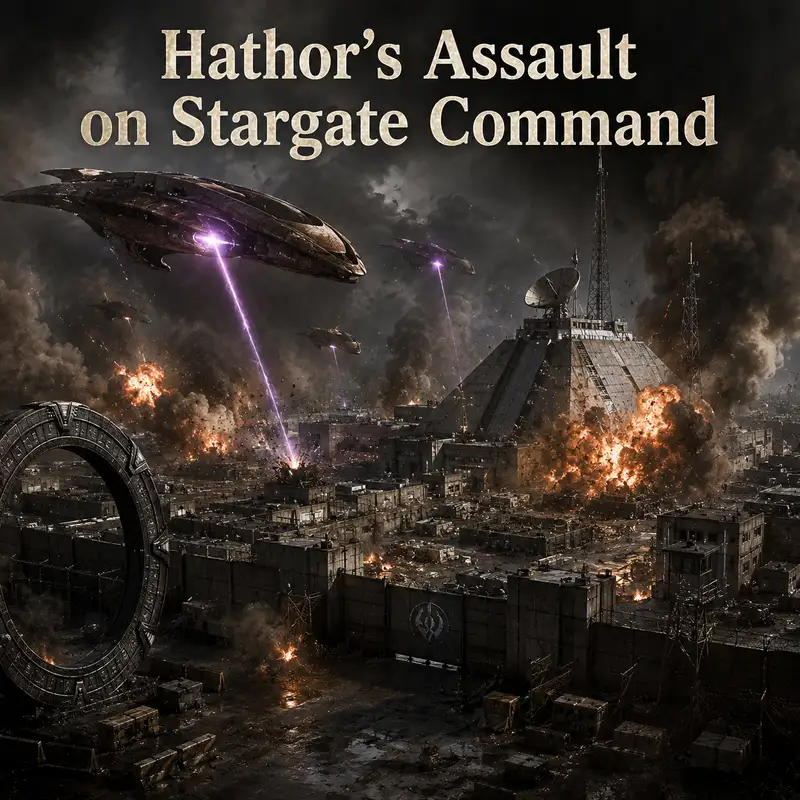
Hathor’s Assault on Stargate Command
The first alarm did not come from the Stargate. It came from the surface of Cheyenne Mountain, where security personnel detained a woman attempting to enter a classified installation. She knew the Stargate was inside. That fact earned her an interview instead of immediate removal, and the interview placed her within reach of the command staff. Hathor arrived alone, without Jaffa, ships, or visible support. Within hours, General George Hammond, Colonel Jack O’Neill, Daniel Jackson, and much of the male personnel on the base were acting in her interests. She had not defeated Stargate Command. She had converted it.
The incident began far from the mountain, in a newly opened chamber beneath a Mayan site in Mexico. Archaeologists found Egyptian hieroglyphs and a Goa’uld sarcophagus where neither should have been. Opening it released Hathor, a Goa’uld queen who had apparently been confined on Earth for nearly two thousand years. She immediately asked for Ra, killed the people who could not answer her, and left the site. The Mexican authorities attributed the deaths to tomb robbers. The surviving archaeological team sent the empty sarcophagus to Daniel because its combination of Egyptian and Mesoamerican material supported the research that had once destroyed his academic career.
That transfer created the first major security failure. A device recognized as Goa’uld technology was brought directly into Stargate Command and placed near the gate before anyone understood who had occupied it or why the original investigators were dead. The base was still learning how to handle alien artifacts recovered off world. It had even less experience with Goa’uld technology discovered on Earth through civilian archaeology. There was no established chain of custody designed for a sarcophagus connected to unexplained killings, no quarantine cordon separating it from command operations, and no assumption that the owner might be traveling behind the object.
Hathor then presented herself at the surface entrance. She claimed that she had been drawn to the Chapa’ai, the ancient name for the Stargate. The mechanism was never explained, and the surviving record does not establish whether she sensed the gate, followed the sarcophagus, or used knowledge retained from her earlier time on Earth. What matters operationally is that she located one of the most secret military facilities in the United States without outside assistance. Surface security successfully stopped her. The failure came afterward, when knowledge of the Stargate was treated mainly as a reason to question her rather than evidence that she might represent the threat the installation existed to contain.
Hammond, O’Neill, and Daniel met Hathor in a holding cell. She identified herself openly, demanded recognition as a goddess, and spoke with the altered voice associated with a Goa’uld host. Those signs should have placed the base on biological and counterintelligence alert. Instead, uncertainty worked in her favor. She could be a delusional civilian, a surviving Goa’uld, or a source with knowledge of Ra and the gate. Hammond wanted information. Daniel wanted to understand the impossible archaeological connection. O’Neill initially regarded her as strange rather than strategically dangerous. Curiosity was reasonable. Releasing her restraints was not.
Hathor’s principal weapon was neither the ribbon device on her hand nor the sarcophagus delivered to the gate room. It was a chemical influence carried in the breath. Doctor Janet Fraiser later assessed it as an unfamiliar airborne compound, possibly combining pheromonal effects with a powerful truth or compliance agent. The explanation remained provisional. The observed effect was clearer than the mechanism. Men exposed at close range became intensely receptive to Hathor, accepted her claims, defended her presence, and subordinated normal judgment to her wishes. Teal’c was unaffected because the larval symbiote within him protected his Jaffa physiology. The female personnel showed no comparable response.
This capability should not be treated as a routine power available to every Goa’uld. Stargate Command had already encountered Goa’uld rulers who depended on force, religion, and implanted symbiotes rather than immediate chemical control. Hathor’s influence was particular to her observed methods, while Earth’s legends had preserved an exaggerated memory of the same effect. Even in this incident, it had limits. She needed proximity to expose a target, the effect did not work on everyone, and her departure through the Stargate caused the controlled personnel to recover. The weapon was specialized, temporary, and devastating inside a headquarters whose authority depended on a small number of senior officers.
Daniel was the first command-level victim. Hathor used the compound while he was unfastening her restraints, then questioned him alone about Ra. Under her influence, he disclosed that Earth had killed Ra, accepted her claim of friendship, and argued that she should be welcomed as an ally against Apophis. The episode was not a failure of Daniel’s judgment in any normal sense. His capacity to consent and evaluate evidence had been chemically suppressed. Hathor later compelled sexual contact to obtain human genetic material for her offspring. The act was an assault carried out through biological control, and Daniel’s later confusion did not reduce its seriousness.
Hammond was exposed next. Daniel encouraged him to cooperate with Hathor’s ceremonial request, and Hathor used direct contact to administer the compound. From that point, the base commander’s decisions consistently expanded her freedom. He permitted her to enter the briefing area, accepted her as a guest, and offered a tour of the facility. When Captain Samantha Carter objected, Hammond treated the warning as insubordination. Command authority had not disappeared. It had been redirected. Orders still moved through the chain of command, doors still opened, guards still obeyed, and records would have shown the general issuing instructions. The headquarters looked functional because its procedures continued to operate for the enemy.
O’Neill resisted longer, but not long enough. Hathor praised him for killing Ra, used the compound, and converted his skepticism into loyalty. His training against coercion and interrogation offered no known defense against a substance he did not realize he had inhaled. Carter tried to appeal to established counterintelligence practice. Even a genuine enemy defector, she argued, would be watched rather than trusted immediately. O’Neill responded as though her caution were prejudice against a possible ally. Hathor had not merely changed his conclusion. She had supplied him with a plausible moral explanation for ignoring the security problem.
Carter recognized the pattern because she remained outside the effect and because the men’s behavior changed too quickly to be explained by diplomacy. She compared observations with Fraiser, reviewed the historical accounts associated with Hathor, and found repeated descriptions of men becoming intoxicated by her presence. Fraiser proposed a biochemical mechanism. That collaboration was an improvised intelligence fusion cell: behavioral observation, cultural research, and medical analysis combined to identify an attack that no sensor had detected. The base’s formal warning systems were looking for incoming wormholes, hostile weapons, and unauthorized movement. The decisive indicator was senior officers acting unlike themselves.
By then, Hathor’s assault had moved beyond influence operations. Daniel had been designated her chosen pharaoh and used to provide the genetic compatibility she needed to produce new symbiotes intended for human hosts. Hathor identified herself as a queen, one of the Goa’uld capable of generating larvae. She established a breeding chamber inside a base locker room, using available water and the secure underground environment as the beginning of a nest. Her objective was not simply escape or revenge against Ra. She intended to rebuild power on Earth, populate the planet with Goa’uld, and use the Stargate as the center of a new domain.
The choice of Stargate Command as the nest was strategically sound. The installation provided physical security, weapons, communications, medical facilities, cleared personnel, and direct access to the interstellar network. It was concealed from the public and isolated inside a mountain, which limited the chance that outside authorities would notice a gradual internal takeover. Its personnel were trained to obey orders quickly during emergencies. Once Hammond and O’Neill were compromised, those virtues became vulnerabilities. A secure headquarters is valuable because trusted people can move efficiently inside it. If the trust system is captured, the same efficiency helps the intruder.
Hathor’s next step was to create her own Jaffa command structure. She used a device worn around her abdomen to alter O’Neill’s body and form a symbiote pouch. She intended to implant one of her larvae and make him her first new Jaffa, effectively turning the leader of S G One into the senior warrior of her emerging household. The procedure also destroyed his normal immune function. Before implantation, he was left dependent on receiving a symbiote or advanced medical intervention. Hathor was not merely recruiting a commander. She was engineering biological dependence, the same mechanism that kept established Jaffa populations bound to Goa’uld rule.
The sequence reveals that Hathor’s assault was designed to become self-sustaining. Daniel supplied compatible human genetic material. O’Neill would supply military leadership and the first incubator. Hammond supplied institutional authority. The controlled airmen supplied immediate security. The Stargate supplied access to other worlds. Hathor supplied the queen capable of producing symbiotes. With time, she could have created additional Jaffa, implanted hosts, and expanded beyond the mountain. She arrived alone because she did not need to bring an army. Her plan was to manufacture one from the people and infrastructure already present.
Carter and Fraiser assembled the remaining resistance from female personnel who had not been affected. Teal’c joined them after explaining that his symbiote protected him and warning that the base was becoming a Goa’uld nest. The group had no formal authorization because the legal commander was compromised. They also faced an unusually difficult rules-of-engagement problem. The armed personnel defending Hathor were fellow service members acting without meaningful consent. Killing them might stop the takeover, but it would also turn the rescue force against the victims of the attack. The response therefore required discrimination, restraint, and a willingness to disobey orders that remained valid in form but hostile in purpose.
Their first attempt to confront Hathor failed because she used the compromised men as a human shield and arrest force. Hammond, O’Neill, and armed airmen surrounded the resistance in the locker room and ordered it to stand down. Carter could not fire without risking friendly casualties. The women and Teal’c were placed in a holding cell. This was the moment when Hathor achieved effective control of the installation. She possessed the commander, the principal combat leader, the archaeologist who understood her history, armed guards, and control of movement within the base. The remaining opposition was confined by its own people.
Fraiser identified the weakness that allowed the prisoners to escape. If Hathor’s compound had intensified sexual response in the controlled men, then the guards’ impaired judgment could be exploited. The prisoners lured them into the cell, incapacitated them, and recovered their weapons. It was not an elegant countermeasure, and it was certainly not in standard Air Force doctrine. It was, however, based on a medical assessment of the enemy’s effect and executed without killing the affected personnel. Carter then struck Hammond unconscious when he attempted to stop them and released Teal’c. Preserving the chain of command had become less important than preserving the commander from what his own orders were enabling.
The rescue element found O’Neill beside the larval pool before implantation. Fraiser confirmed that no symbiote had entered the pouch, but Teal’c warned that the transformation had already removed O’Neill’s immune system. Earth medicine could not reverse the procedure. The team therefore used the captured sarcophagus. That decision carried risk because the device was poorly understood, but the alternative was O’Neill’s death. The sarcophagus restored his body and removed the pouch. Hathor then attacked with her ribbon device, missed O’Neill, and overloaded the sarcophagus. It exploded, destroying a medical technology that Stargate Command had successfully used but could not reproduce or safely control.
With O’Neill restored, the resistance shifted from survival to recapture of the base. The tactical problem remained the same: Hathor was protected by friendly personnel. O’Neill retrieved tranquilizer weapons from a secondary storage location, a small example of military excess becoming useful at exactly the right moment. He and Carter returned to the breeding chamber and incapacitated the airmen without killing them. Hathor used her ribbon device against Carter and prepared to attack O’Neill. Carter recovered and fired on Hathor, driving her into the larval pool and setting the chamber ablaze. The developing symbiotes were destroyed, and the immediate biological threat ended.
Hathor survived. While personnel evacuated the unconscious airmen and Daniel remained disoriented, she reached the gate room and initiated an unauthorized outbound connection. The base alarm identified the activation, but no one reached the room in time to prevent her departure. Carter identified the destination as Chulak. When the wormhole closed, the controlled personnel returned to themselves with little understanding of what they had done. The assault ended not because Hathor was captured, but because she chose escape over continuing a fight after losing her larvae, her intended First Prime, and control of the resistance.
The gate was the final vulnerability and the reason the incident remained strategically unresolved. Stargate Command had procedures for an incoming wormhole and an iris to stop unauthorized arrivals. Hathor used an outbound connection from inside the secure perimeter. Once she gained physical access to the gate and the dialing system, the planet’s strongest border control became her extraction route. The command could secure the event horizon against an external enemy, but it had not planned for the enemy to obtain legitimate access from within. Gate security was therefore inseparable from personnel security, medical monitoring, and control of the command network.
Measured tactically, Carter, Fraiser, Teal’c, O’Neill, and the female base personnel defeated Hathor’s attempt to establish a nest. They recovered the command center, prevented O’Neill’s implantation, destroyed the larvae, and avoided mass casualties among the controlled personnel. Measured as a counterintelligence operation, the result was less complete. Hathor escaped with direct knowledge of Cheyenne Mountain, Earth’s personnel, the gate program, and the death of Ra. She also knew that Earth lacked a reliable defense against her biological influence. The base survived, but the adversary left with intelligence no after-action report could retrieve.
The human cost extended beyond physical wounds. Fraiser and Teal’c were shot during the fight near the sarcophagus. Hammond had to confront the fact that his own authority had imprisoned the people trying to save the planet. O’Neill’s body was forcibly altered for use as a Jaffa incubator. Daniel had been chemically controlled, sexually assaulted, and used in the production of Goa’uld offspring. Most of the affected personnel remembered little or nothing after Hathor left. Lack of memory can complicate responsibility, but it does not erase trauma. The official recovery of the base was cleaner than the personal recovery of the people inside it.
Hammond’s response acknowledged the real source of the victory. He recommended Carter and Fraiser for commendation because they had retained judgment and done what was necessary when the command structure failed. That recognition mattered institutionally. Carter had questioned direct orders, armed personnel without authorization, struck a general officer, and used force inside a classified facility. Under normal conditions, each act would demand investigation. Under compromised command, those same acts preserved the mission. The incident demonstrated that disciplined initiative includes knowing when obedience is serving the enemy.
The assault also exposed a blind spot in early Stargate doctrine. The command had been organized around threats arriving through the gate. Hathor came from Earth’s own archaeological past, entered from the surface, and used an artifact transported by civilians. The mountain, iris, armed guards, and classification system all assumed that danger would approach from a recognizable direction. Hathor crossed every boundary by appearing to be a source, a guest, and a possible ally. The base did not need a stronger blast door to stop her. It needed quarantine, independent medical authority, counterintelligence review, and command succession procedures capable of surviving the sudden compromise of senior leaders.
Her methods also clarified how Goa’uld imperial power could grow without a conventional invasion. A queen could produce symbiotes. Symbiotes could seize hosts. Jaffa dependence could be created biologically. Religious claims could then justify the hierarchy built by coercion. Hathor attempted to compress that imperial process into one underground installation. She began with seduction and promises of alliance, moved to reproductive control, and planned to end with a new armed caste. The progression was not incidental. It was a miniature version of Goa’uld state formation, conducted inside the headquarters responsible for fighting it.
Hathor’s later operations confirmed that the failure at Cheyenne Mountain did not end her ambitions. She rebuilt a force in secret, captured S G One, and constructed a detailed imitation of Stargate Command to manipulate the team’s memories and extract intelligence. That later deception showed how much she had learned from her time inside the real base. She understood its appearance, procedures, and psychological authority well enough to reproduce them as an interrogation environment. Her first assault had failed to capture Stargate Command permanently, but it gave her a model she could weaponize.
The central question is therefore not how one Goa’uld fought her way into Cheyenne Mountain. She did not. Hathor succeeded because Stargate Command treated access, authority, and loyalty as separate security problems when she could attack all three at once. She entered through the surface, captured leaders through biology, turned orders into weapons, used controlled personnel as shields, and prepared the gate as the center of a new domain. The resistance prevailed only because enough people remained outside her influence to recognize that the headquarters was functioning normally for the wrong commander.
Hathor’s assault left Earth with a precise warning. A fortified base can stop an army and still fall to one person who can alter the judgment of those holding the keys. Stargate Command survived because Carter and Fraiser trusted observed behavior over rank, Teal’c recognized the biological threat, and O’Neill returned to the fight after being rescued by technology no one fully understood. The mountain was recovered, but Hathor escaped through the same gate she intended to rule from. Earth kept its command center. It lost the comforting belief that the enemy had to arrive from another world.