Hive Ships, Cruisers, and the Wraith Way of War
The Daedalus destroyed its first Wraith hive ships with a tactic the enemy had never encountered. Asgard transporters placed nuclear weapons directly inside the organic vessels, bypassing the need to penetrate their hulls. The result was immediate and devastating. Then the surviving Wraith changed their defenses. Transporter locks failed, the simple method disappeared, and Earth’s newest battlecruiser had to fight on less favorable terms. The exchange revealed the central quality of Wraith naval warfare. Their individual ships did not have to be the most advanced in Pegasus. They had to survive long enough to adapt.
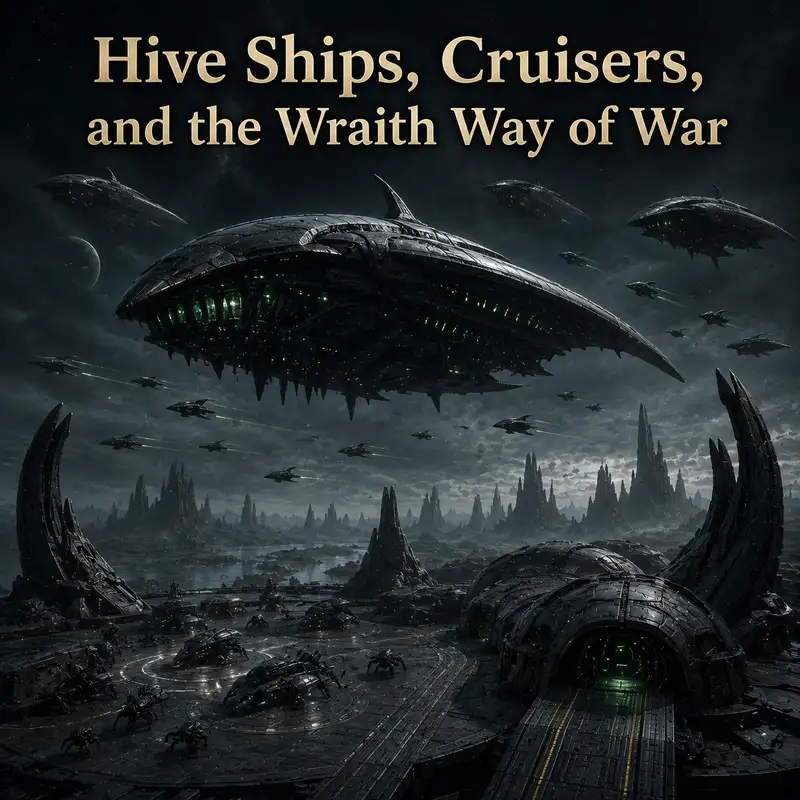
A hive ship was more than a capital warship. It was the moving center of a Wraith political faction, carrying its leadership, warriors, technicians, Darts, prisoners, food reserves, laboratories, and hibernating population. A human navy separates headquarters, supply depots, troop transports, hospitals, and combat vessels whenever resources allow. The Wraith combined many of those functions inside one living platform. Destroying a hive therefore removed much more than firepower. It could eliminate a queen, disrupt reproduction, erase stored intelligence, kill thousands of personnel, and deprive a faction of its home.
That concentration also explains why Wraith fleets were organized around hives rather than permanent territorial bases. A queen did not need a fixed capital on a defended planet. Her capital traveled with her. Feeding grounds mattered, hidden facilities mattered, and planets could be strategically valuable, but the core of political and military authority remained mobile. A hive could cull one region, withdraw into deep space, enter hibernation, or join another queen’s campaign without abandoning the institution that made it sovereign.
Wraith ships were grown through biotechnology rather than assembled entirely from inert metal. Their hulls, internal passages, control surfaces, and many major systems were organic in design. The surviving record never provides a complete shipbuilding process, and it would be misleading to describe a hive as merely a very large animal. It was a deliberately engineered spacecraft whose living components performed structural, computational, and restorative functions. The distinction mattered whenever Earth personnel boarded one. They were not walking through a machine decorated to look biological. They were moving inside a weapon whose architecture could heal and change.
Control reflected the same design. Wraith consoles responded through biological and telepathic interfaces that ordinary humans could not reliably use. Teyla Emmagan could operate a captured hive only because her ancestry included traces of Wraith genetic material and because she could enter portions of their mental network. Earth scientists could restore damaged systems, connect external equipment, and interpret some functions, but access did not equal mastery. Atlantis could salvage a hive. It could not immediately turn one into a routinely crewed Earth warship with a maintenance manual and a training syllabus.
The organic hull gave standard hive ships limited regenerative ability. Damage that would remain a permanent breach in a conventional vessel could sometimes be sealed as living material recovered. This encouraged a different approach to survivability. Most standard hives did not demonstrate conventional energy shields comparable to those aboard Ancient or Earth battlecruisers. They depended instead on enormous mass, compartmentalization, redundant biological systems, and the ability to heal damage that was not immediately fatal. That made them durable, but not invulnerable.
The difference became obvious against precision weapons. Ancient drones could penetrate deep into a hive and destroy critical sections. Later, Asgard plasma beams mounted on Earth battlecruisers cut through standard Wraith hulls with lethal efficiency. Nuclear weapons detonated internally could destroy a hive even when external attacks had failed. The Wraith answer was not to pretend those weapons did not matter. They dispersed, jammed, intercepted, concealed, concentrated numbers, and sought ways to prevent the enemy from gaining a clean firing opportunity.
A hive’s weapons were distributed across its vast body. Energy batteries could bombard cities, wear down shields, engage capital ships, and support Darts or boarding forces. Their exact number and output are not established consistently enough for a reliable technical specification. Operationally, the important fact is that a hive could maintain heavy fire from several areas of its hull while carrying an air wing and a large ground force. It was a carrier and siege platform at the same time.
Wraith cruisers filled the level beneath the hive. They were smaller warships used as escorts, patrol vessels, local strike platforms, and independent mission ships. A cruiser did not carry the same political weight or combat mass as a hive, but it allowed a faction to investigate a signal, guard an approach, transport personnel, or threaten a human world without committing its principal vessel. Cruisers extended the queen’s reach and preserved the hive for missions worthy of its risk.
The surviving record does not establish one universal cruiser table of organization. Different vessels may have carried different complements, and Wraith factions did not operate through a centralized procurement office. What remains consistent is their supporting role. Cruisers accompanied hives during major operations, broke away when the capital ships were destroyed, and conducted missions on their own when a full hive would have been unnecessary or too visible. They were the Wraith equivalent of a mobile middle layer between the enormous hive and the single-pilot Dart.
Darts completed the fleet’s combined-arms design. Their best-known function was culling human populations, but in fleet combat they also served as interceptors, scouts, assault transports, and expendable defensive screens. During one engagement, swarms of Darts deliberately intercepted nuclear missiles headed toward hive ships. The tactic was costly in pilots and craft, but it protected assets of much greater value. Wraith commanders understood exchange ratios perfectly well. They simply valued the pieces according to hive survival rather than human expectations.
The Dart bays were also a vulnerability. Concentrated railgun fire against launch areas could trigger secondary explosions and disable a hive from within. A carrier that sends out hundreds of armed craft necessarily creates openings, traffic lanes, fuel or energy connections, and densely packed equipment. The Wraith gained offensive reach through their air wing and accepted a dangerous internal concentration in return. Earth commanders learned to target the point where the hive’s greatest tactical flexibility became a structural weakness.
Hyperdrive performance created another tradeoff. Wraith vessels could cross interstellar distances and concentrate fleets across Pegasus, but their organic systems suffered from prolonged exposure to hyperspace radiation. On long journeys, they had to leave hyperspace and allow the ship to recover. Those pauses slowed strategic movement and created predictable interception opportunities. When two hives attempted to reach Earth using stolen Lantean hyperdrive information, Atlantis calculated where they would have to stop and sent damaged Earth and Ancient warships to meet them.
The limitation did not make the Wraith slow in every operational sense. Within Pegasus, their fleets still moved far faster than any human society without starships could react. A village might receive no warning before Darts emerged through a Stargate or descended from orbit. A hive could strike several systems, withdraw, and reappear elsewhere before local allies assembled a response. The periodic recovery requirement mattered mainly to opponents with long-range sensors, capable ships, and enough intelligence to predict the route.
Wraith commanders worked constantly to reduce that disadvantage. They captured Lantean vessels, studied Ancient propulsion, stole information from Atlantis, and upgraded their own drives. They did not need to reproduce the entire scientific culture of the Lanteans. They needed enough improvement to shorten transit, outrun pursuit, or open a route to Earth. Their technology was less advanced in fundamental science, but their research priorities were often brutally practical.
The first modern siege of Atlantis showed how hive ships were intended to fight. Three hives advanced on the city as a group. An Ancient defense satellite destroyed one before failing. The remaining two continued toward Lantea, launched waves of Darts, inserted warriors, and forced the expedition to spend drones, nuclear weapons, railgun ammunition, and personnel merely to remain alive. When those hives were destroyed, Atlantis discovered that a much larger second wave was already approaching. The Wraith did not treat the first formation as the whole campaign.
That depth was the product of a civilization built for attrition. Atlantis estimated that at least sixty hive ships existed in Pegasus and acknowledged that the true number could be higher. The figure was an intelligence estimate, not a complete naval register, but it established the scale of the problem. Earth could celebrate destroying two or three hives and still face a species whose remaining factions retained dozens of mobile capitals. Tactical success removed ships. It did not collapse Wraith naval power.
The ancient Lanteans had faced the same arithmetic. Their warships were faster, better shielded, and armed with superior drones. In individual engagements they could destroy Wraith vessels at favorable rates. The Wraith compensated through numbers, dispersed command, and the ability to continue after losing formations. Captured zero-point modules powered a cloning facility that multiplied warriors on an immense scale. The facility did not manufacture every hive ship, but it expanded the warrior population available to replace casualties, conduct assaults, and keep pressure on the Lantean defensive network.
Wraith fleets also fought without one permanent central command. Each hive belonged to a queen or faction with its own territory and interests. Major campaigns required coalitions rather than orders from a galactic admiralty. This reduced strategic unity, especially after premature awakening created competition for food. It also made the fleet extraordinarily difficult to decapitate. Destroying one command ship removed one queen’s power. It did not compel unrelated hives to surrender.
When a common threat became severe enough, separate hives could still mass effectively. They had done so against the Lanteans and later joined Atlantis and the Travelers against the Asurans. Their cooperation did not require political harmony. It required agreement that the enemy threatened every participant’s survival. Once the immediate danger passed, the coalition could dissolve, and the same ships might turn their weapons on one another before the debris had finished cooling.
The Wraith civil war demonstrated the fleet’s political nature. Hive ships formed distinct groups, attacked rivals, seized crews, and competed for feeding grounds and strategic facilities. A damaged hive found drifting in space had been attacked by another Wraith faction, not by Atlantis or the Replicators. For human intelligence analysts, Wraith-on-Wraith weapons residue became evidence of a changing balance of power. For the Wraith, civil war was a contest over mobile states, not merely a mutiny among ships flying one flag.
Feeding shaped naval logistics at every level. Hive ships carried humans in organic cocoons for later use, allowing crews to remain away from a planet after a culling. Hibernation chambers reduced consumption when food was scarce or when a hive needed to wait for centuries. Darts converted settlements into transportable reserves. A Wraith fleet did not require a conventional chain of refrigerated supply ships, but it did require access to living populations. Human worlds were therefore fuel points, medical reserves, and strategic objectives at once.
This made Wraith blockades and sieges different from human operations. A hive outside Atlantis could wait while its crew fed from stored captives or nearby worlds, then enter periods of reduced activity. The defenders behind a shield consumed finite power, ammunition, food, and replacement parts. The Wraith did not need to storm the city immediately if time favored them. During the ancient siege, the Lanteans retained an almost unbreakable shield and still lost the war because the fleet outside controlled the wider theater.
The same logistical structure reduced the need for planetary occupation. Wraith ships could cull a world, destroy dangerous industry, and leave. They did not need to build ports, road networks, or permanent garrisons on every feeding ground. The hive remained the base, and the cruisers and Darts provided the reach. This was efficient against scattered human societies. It was less suited to holding dense territory against a technologically capable opponent that could contest orbit and strike the fleet’s mobile headquarters.
Wraith sensors and communications supported that mobility, but they were not omniscient. Atlantis could conceal the city with a cloak, mislead approaching fleets, and exploit gaps in Wraith awareness. At the end of the first siege, Earth forces detonated a nuclear weapon above Atlantis and activated the cloak at the same moment. The Wraith accepted the apparent destruction and departed. Their fleet had the firepower to continue the siege. It lacked the information needed to recognize that the target still existed.
Deception worked in both directions. Wraith commanders used false alliances, stolen access codes, computer viruses, tracking devices, and captured intelligence to position their ships. A fleet could approach under the cover of negotiation while its specialists searched for Earth’s location. A cruiser could investigate a signal without exposing the principal hive. A Dart could scout or insert an infiltrator before the larger assault arrived. Wraith naval doctrine was not simply massed bombardment. It integrated espionage and technical collection with force.
Their response to Asgard transporters remains the clearest example of rapid adaptation. The Daedalus initially destroyed hives by beaming nuclear weapons into them. The surviving Wraith introduced interference that prevented a reliable transporter lock. Earth still possessed the warheads and the beaming system, but the combination no longer produced the same result. A single successful enemy technique had been studied, countered, and removed from the next engagement. The device worked exactly as designed. The doctrine expired after contact with an opponent capable of learning.
Missile defense followed a similarly practical logic. Wraith ships did not need a perfect energy barrier if Darts could intercept incoming weapons, electronic interference could defeat targeting, and massive hull sections could absorb near misses. This was not as elegant as an Ancient shield. It was also distributed. Losing one interceptor or one emitter did not necessarily expose the entire vessel. The approach imposed casualties, but Wraith warfare had always been willing to exchange numbers for survival of the hive.
The absence of conventional shields still left standard ships vulnerable to later Earth upgrades. Once Daedalus-class vessels received Asgard plasma beams, the balance shifted sharply in direct combat. A beam-armed Earth battlecruiser could destroy ordinary hives with far fewer strikes than earlier railguns and missiles required. Wraith commanders could answer with greater numbers, surprise, or avoidance, but they could not make the hull ignore the energy. Technology had changed the exchange rate, just as captured cloning technology had changed it during the ancient war.
Living construction also created biological failure modes. Disease, defective gene therapy, or uncontrolled growth could affect the vessel as well as its crew. One Wraith attempt to use an incomplete treatment designed to remove the need for feeding produced a crisis throughout both the hive population and the ship’s systems. The same integration that allowed the hull to heal meant that a biological problem could become a propulsion, life-support, and structural problem. A steel warship does not catch its captain’s disease. A hive came considerably closer.
Boarding a hive remained dangerous even when the ship was crippled. Its corridors could contain hibernating warriors, concealed compartments, culling chambers, and control systems that responded to Wraith minds. Damage might seal off entire sections while leaving other areas pressurized and active. The ship’s size made complete clearance nearly impossible for a small team. Capturing one was therefore an intelligence opportunity and a security problem at the same time. A derelict hive could be empty, sleeping, infected, trapped, or waiting for its rightful crew to return.
Critical systems could still be targeted. Hyperdrive generators, Dart bays, weapon sections, and command spaces were vulnerable to precision attack. Sheppard exploited the ventral hyperdrive area during the attempt to stop two hives from reaching Earth. Daedalus concentrated railgun fire on launch bays and used the resulting internal explosions to compound the damage. The Wraith hull could heal ordinary wounds. It could not regenerate a destroyed propulsion system quickly enough to escape an enemy already firing.
The Wraith way of war therefore favored operational resilience over platform perfection. A hive could absorb damage, withdraw, recover, and return. Cruisers could continue patrols while the principal ship healed. Darts could be sacrificed to preserve the capital vessel. Rival hives could replace a destroyed formation in the wider theater even when they had no intention of avenging it. The system expected losses and kept functioning, which is one reason the Lanteans found their superior weapons strategically insufficient.
The most dramatic exception was the zero-point module-powered super-hive. A Wraith faction spent more than a year integrating stolen Ancient power into an organic vessel. The additional energy increased the ship’s growth, strengthened its hull, improved its weapons, expanded sensor performance, and transformed its hyperdrive. The result crossed the intergalactic distance to Earth, detected a cloaked Puddle Jumper, crippled the Daedalus, and defeated other Earth battlecruisers sent to intercept it.
The super-hive revealed that power generation, not design alone, had limited standard Wraith ships. Given Ancient energy, the same biological architecture became far more dangerous. Its hull resisted weapons that had destroyed ordinary hives. Its fire pushed even a fully powered Atlantis toward Earth’s atmosphere. The ship was not defeated by winning a normal exchange of fire. Sheppard’s team detonated a nuclear weapon inside it after Atlantis arrived close enough to create an opening.
That vessel was also an exception, not proof that every hive could become one. Integrating the zero-point module required rare captured technology, long modification, and a faction able to protect the project. The Wraith could not manufacture modules at will. The super-hive demonstrated the ceiling of their biotechnology while confirming the weakness of their industrial position. They could exploit an extraordinary power source. They could not create a renewable supply.
Hive ships and cruisers made the Wraith dominant because they turned a fragmented species into a fleet of mobile predatory states. The hive carried command, population, logistics, air power, and strategic fire. Cruisers extended its reach. Darts connected orbit to the gate and the village below. Organic construction traded shields and industrial standardization for healing, biological control, and adaptability. The system was less elegant than Lantean naval power and more sustainable under attrition.
The Wraith did not require every battle to end with a superior ship standing alone over the field. They required enough hives to survive, enough humans to feed them, and enough time to learn from whatever had just killed the others. Their ships could be penetrated, infected, deceived, stranded, and destroyed. Their way of war remained dangerous because the loss of one fleet became information for the next. In Pegasus, the most important Wraith weapon was not the energy battery along a hive’s hull. It was the civilization inside the hull, still adapting as the wreckage cooled.