Hosts, Symbiotes, and Genetic Memory
On Tollana, one human body stood before a tribunal with two claimants inside it. Skaara spoke first, frightened but unmistakably himself. Then the device on his chest changed, his eyes flashed, and Klorel answered through the same mouth. The Goa’uld argued that the original host no longer truly existed. Skaara’s testimony made that position difficult to sustain. He remembered his family, his abduction, the invasion of his body, and every act committed while he was unable to control his own hands. The tribunal was not deciding who had captured a ship or violated a treaty. It was deciding who owned a living body when a sentient parasite had taken command of it.
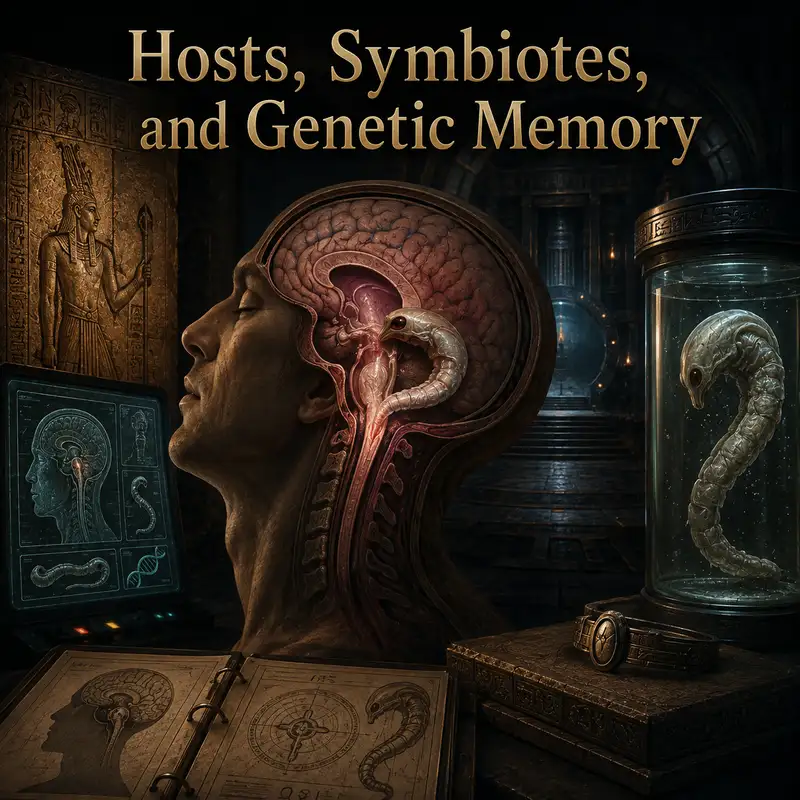
That case exposes the central fact of Goa’uld biology. A host and a symbiote are not merely two organisms occupying the same space. They are two minds connected through one nervous system, sharing memories, senses, pain, and physical risk while possessing radically unequal control. Genetic memory makes the arrangement even more consequential. A Goa’uld does not enter a host as an inexperienced creature that must be educated from the beginning. It can arrive carrying the accumulated knowledge, loyalties, prejudices, and ambitions of its lineage. The host supplies a body. The symbiote supplies an inherited civilization. Together, they can become a ruler who appears to have lived for centuries because, in an important sense, the memory of that ruler’s world has.
The species began far from the palaces and warships associated with the System Lords. On the planet designated P three X eight eight eight, primitive Goa’uld evolved in water as predators. Fossil evidence indicated that they existed for millions of years before developing the parasitic relationship that later defined them. Those early forms did not even contain the naquadah later found in Goa’uld blood. They were dangerous aquatic organisms, but they were not yet imperial administrators, engineers, priests, or military commanders. Their transformation began when they learned to enter another species and use a body far better suited to movement on land.
The Unas were the first known hosts. They were strong, durable humanoids native to the same world, and some developed physical safeguards to protect the neck from attack by symbiotes. The surviving evidence suggests that possessed Unas eventually learned to use the Stargate and carried the Goa’uld beyond their homeworld. That was the decisive evolutionary leap. The symbiote no longer needed to develop hands, speech, endurance, or the ability to manipulate tools. It could acquire those capabilities in moments. Each successful blending gave a vulnerable aquatic creature the strength and mobility of an Unas, while later human hosts offered greater linguistic, social, and technological possibilities.
A symbiote can enter through the back of the neck or through the mouth. It penetrates soft tissue, connects itself to the central nervous system, and assumes control of the host’s body. The process can happen quickly enough to defeat normal security precautions. Once established, the symbiote controls movement, speech, and outward behavior. It can read the host’s memories and use personal knowledge to imitate the person whose body it has taken. The resonant voice and glowing eyes associated with the Goa’uld are displays, not unavoidable symptoms. A symbiote can suppress them when deception is more useful than ceremony.
This makes Goa’uld infestation a counterintelligence problem as much as a medical emergency. During the rescue operation on P three X eight eight eight, primitive symbiotes entered members of an expedition without the rest of the team recognizing the compromise. Entry through the mouth left no neck wound. The symbiotes did not carry naquadah, so Samantha Carter could not sense them despite her earlier contact with Jolinar. Familiar voices, uniforms, and personal histories could no longer be trusted. Teal’c was forced to restrain his own team until the infiltrators revealed themselves. The incident demonstrated a harsh rule for gate operations. Exposure to a Goa’uld environment can compromise personnel without changing their appearance, and the person who returns may know every procedure the original person knew.
The host usually remains conscious. Goa’uld rulers often denied this, claiming that nothing of the host survived, because that claim converted enslavement into biological inevitability. Skaara disproved it when Tollan technology temporarily suppressed Klorel and allowed him to speak. Sha’re surfaced when Amaunet became dormant during pregnancy. Other liberated hosts remembered what had been done through their bodies. The host is therefore not absent. The host is imprisoned behind the senses, able to witness violence, betrayal, and humiliation without the ability to stop any of it. Possession is not simply the loss of physical freedom. It is prolonged confinement inside one’s own actions.
Removing a symbiote does not reduce the problem to ordinary surgery. The Goa’uld depends on a host for long-term survival, while the host may be killed by the trauma of extraction, by damage already caused, or by the symbiote itself. Tok’ra specialists learned procedures that could separate the two, but even they treated removal as dangerous. Jolinar told Stargate Command that leaving Samantha Carter was possible, though difficult and potentially fatal. When Jolinar later died protecting Carter from an assassin, Carter survived because the symbiote used its remaining strength to preserve her. Freedom sometimes required cooperation from the very organism that had taken control.
The biological benefits are real, which helps explain why voluntary blending is possible. A mature symbiote can heal injuries, resist many diseases and toxins, strengthen the body, and extend the host’s life. Naquadah introduced into the bloodstream can permit access to Goa’uld devices and allow some blended individuals to sense its presence. These advantages do not excuse involuntary possession. They explain its military value. A Goa’uld gains a resilient platform capable of surviving wounds that would disable an ordinary human. The host’s body becomes command post, life-support system, authentication token, and protective armor, all while retaining a perfectly human appearance.
Host selection was therefore strategic, not incidental. Human bodies were abundant, adaptable, and capable of presenting the image a ruler wanted subjects to see. A System Lord could choose a host for strength, beauty, knowledge, family connection, or political symbolism. When one body became unsuitable, the symbiote could seek another, preserving the ruler’s identity while treating the host as replaceable equipment. Sarcophagus technology extended this arrangement even further, but the underlying continuity belonged to the symbiote, not the face. A population might believe it had served the same immortal god for generations even when several human lives had been consumed to maintain that appearance. Immortality, in this system, was partly medicine and partly an extremely successful concealment of succession.
Memory moves in both directions. The symbiote gains access to the host’s experiences, language, relationships, and practical knowledge. The host may also encounter memories belonging to the symbiote, particularly when normal control is disrupted. While Amaunet slept, Sha’re could perceive information that belonged to the Goa’uld inside her. After Jolinar’s death, Carter retained fragments of the Tok’ra operative’s life, including emotional attachments and strategically useful recollections. The boundary between the two minds is therefore permeable. One may dominate, but neither passes through the experience unchanged.
The Tok’ra prove that domination is a political choice rather than a biological requirement. They are the same species as the Goa’uld, yet they reject involuntary hosts and seek people who knowingly agree to share their bodies. In a stable Tok’ra blending, host and symbiote remain distinct personalities. Each can speak, each can exercise control, and each contributes knowledge to the partnership. Martouf and Lantash were not one person with an unusual name. Jacob Carter and Selmak were not a human wearing an alien as equipment. They were paired lives whose survival and decisions became mutually dependent.
That arrangement is not free of tension. Jolinar entered Carter without consent because the previous host was dying and an assassin was close behind. The emergency explains the decision, but it does not transform it into consent. More broadly, every Tok’ra host must trust a partner who possesses the physical ability to seize control. Tok’ra ethics, custom, and mutual dependence restrain that power. Biology alone does not. The relationship works because both minds accept limits and because the surrounding society recognizes the host as a person rather than raw material. The distinction between Goa’uld and Tok’ra is therefore constitutional. One system treats control as ownership. The other treats capability as a responsibility that must be shared.
Carter’s experience with Jolinar also showed that separation is not erasure. She retained enough memory to locate the Tok’ra and recognize people Jolinar had known. Later, those memories provided access to information about imprisonment and escape that Jolinar had never willingly described. Carter also retained naquadah in her body, allowing her to use certain Goa’uld technologies and eventually sense other beings carrying the element. A brief blending left lasting neurological, emotional, and physiological consequences. From an intelligence perspective, that made Carter an extraordinary source. From a human perspective, it meant that an alien life and an alien death remained present in her long after the symbiote was gone.
A Jaffa carries a symbiote under very different conditions. The larval Goa’uld rests in an abdominal pouch and does not normally control the Jaffa’s mind. There is no ordinary exchange of language, personality, or strategic knowledge. Instead, the symbiote replaces the Jaffa’s natural immune function, improves healing, and contributes to strength and longevity. The Jaffa is therefore neither a conventional host nor merely a guard assigned to protect an animal. The Jaffa is a living incubator whose health has been deliberately tied to the survival of the larva.
The prim’ta ceremony formalized that dependence. A young Jaffa received a larval symbiote and became biologically reliant upon it. After roughly seven to eight years, the symbiote matured and had to be removed to take a host, while the Jaffa required another larva. This created a reproductive pipeline protected by religion and enforced by military hierarchy. Jaffa armies defended Goa’uld territory, raised the next generation of Goa’uld, and depended on their rulers for replacement symbiotes. Every formation was therefore also a nursery and a supply chain. Rebellion threatened not only command authority but the biological system that kept the soldiers alive.
At the beginning of that system stands a queen. Goa’uld queens can fertilize their own eggs, making reproduction essentially asexual, and they can produce large numbers of offspring. More important, the queen decides what inherited knowledge those offspring receive. This is not a vague set of instincts. A young symbiote can be born with the intellect and knowledge of the queen who produced it, carrying the collective memory of a lineage. Under normal conditions, that inherited personality emerges when the symbiote takes a host, allowing it to assume control immediately rather than spending years learning language, politics, technology, and the customs of rule.
Genetic memory is the Goa’uld equivalent of an archive that reproduces itself. A queen can transmit languages, historical experience, scientific knowledge, information about enemies, and the habits of command. What takes a human institution schools, records, apprenticeship, and repeated exercises can be compressed into biological inheritance. A new symbiote may enter its first host already understanding the hierarchy it serves and the methods used to dominate a population. It does not inherit omniscience. It cannot know events the queen never learned, and inherited information can become outdated. Yet the system gives the Goa’uld extraordinary continuity across generations.
Inherited memory and personal experience were not the same thing. The queen provided a curated starting archive, but each symbiote then accumulated its own history through the hosts it occupied. A new host contributed languages, professional skills, relationships, fears, and knowledge of local society. The symbiote’s identity therefore became layered from three sources: the lineage remembered at birth, the life it had lived independently, and the memories taken from successive hosts. That complexity did not divide moral responsibility evenly. The host supplied information involuntarily, while the symbiote decided how to use it. Access to another person’s memory could make deception more convincing. It could not make the captive responsible for the decisions of the captor.
That continuity also preserves failure. A lineage can transmit ancient grudges, assumptions of superiority, and political habits formed under conditions that no longer exist. The child begins with the parent’s lessons before accumulating independent experience. In a civilization organized around conquest, queens repeatedly pass on memories shaped by conquest. This helps explain why Goa’uld rulers can be individually intelligent while remaining trapped inside recurring patterns of betrayal, vanity, and coercion. Genetic memory does not make tyranny unavoidable. It makes inherited culture unusually difficult to escape when the culture itself is carried into consciousness before the first independent decision.
Egeria demonstrated the other possibility. She opposed Ra and produced the symbiotes who became the Tok’ra. Through genetic memory, she passed more than technical knowledge. She transmitted a rejection of Goa’uld domination and a belief that hosts should not be enslaved. Her descendants remained biologically Goa’uld, but their inherited political identity pointed them toward resistance. The Tok’ra are therefore not evidence of a separate species becoming more humane. They are evidence that a queen could use the same mechanism that preserved imperial rule to preserve rebellion against it.
Her captivity on Pangar revealed how much control a queen possessed over inheritance. Pangaran scientists forced Egeria to produce symbiotes for the manufacture of tretonin. She withheld the collective knowledge of her lineage, leaving the offspring as mental blank slates rather than fully formed Goa’uld personalities. When one entered a Pangaran, it did not immediately become a calculating ruler. The blending left the host in a coma-like condition because the symbiote lacked the developed identity normally prepared to take command. Egeria also introduced a flaw into her offspring in an effort to sabotage the program. She could restrict memory and alter biology, although the consequences did not unfold as she intended.
The most dangerous exception to normal inheritance was the Harcesis. When two human hosts carrying Goa’uld conceived a child, the Goa’uld genetic memory could pass into the human offspring. The child was not a symbiote and did not need to take a host. It was a human being born with the secrets of the Goa’uld. Such births were forbidden and the children hunted, because a Harcesis represented an intelligence archive outside Goa’uld control. Apophis and Amaunet nevertheless produced a son, Shifu, whom Apophis intended to use as a future host. The attempt to secure personal continuity created a person capable of exposing the civilization that produced him.
Shifu’s response was to bury the inherited memories deep within his mind. Under the guidance of Oma Desala, he refused to treat the archive as a weapon waiting to be opened. When Daniel Jackson sought access to that knowledge, Shifu used a constructed vision to show how easily the promise of perfect intelligence could become the justification for absolute power. The vision was not an alternate historical record. It was a warning. Goa’uld genetic memory contained technical answers, but it also carried the experiences, fears, and habits of those who had used those answers to rule. Information and moral formation could not be cleanly separated.
For military intelligence, the implications are severe. A symbiote that captures an officer may gain access to gate addresses, procedures, personal relationships, and the weaknesses of an organization. A host recovered from a Goa’uld may possess fragments of enemy memory, but those recollections can be traumatic, incomplete, or difficult to access. A captured queen is potentially a source whose offspring could carry selected knowledge, though coercing reproduction creates obvious moral and security dangers. A Harcesis could reveal generations of secrets without carrying a detectable symbiote. In this environment, personnel recovery, quarantine, medical screening, and psychological assessment are all parts of counterintelligence.
The problem also forces a distinction between identity and physical possession. The Goa’uld claim that control creates ownership. The Tollan tribunal rejected that argument because Skaara remained a conscious person with the original claim to his body. Klorel was also sentient and biologically dependent on a host, which made simple execution morally complicated. The solution was separation, with priority given to Skaara and an effort made to preserve Klorel elsewhere. That judgment did not solve every future case, but it established an important principle. Dependency can create an obligation to seek a humane remedy. It does not create a right to enslave someone else.
Liberation remains incomplete when the symbiote is removed. A former host may carry memories of crimes committed through the body, knowledge never requested, and physical changes caused by blending. Carter survived Jolinar and gained abilities that later helped Earth, but those benefits arrived through an experience she had not chosen. Other hosts emerged after years of suppressed consciousness into bodies, relationships, and political worlds that had changed around them. Medical extraction could end control. It could not restore lost time or erase the memory of watching another will use one’s face.
The Goa’uld system turned biology into imperial infrastructure. Queens functioned as reproductive centers and living archives. Jaffa provided protected maturation, military service, and a population made dependent on continued access to larvae. Human hosts supplied mobility, appearance, memory, and social access. Genetic inheritance preserved command culture without relying entirely on schools or written records. Even human reproduction became a security concern because a Harcesis could move forbidden knowledge beyond the symbiote line. The empire’s ships and weapons mattered, but the system reproduced itself inside bodies long before a fleet entered orbit.
Hosts, symbiotes, and genetic memory explain both the endurance of Goa’uld power and the limits of Goa’uld claims about themselves. Skaara proved that a host could survive beneath domination. The Tok’ra proved that the same biology could support partnership. Egeria proved that inherited memory could carry resistance as readily as tyranny. The Goa’uld empire lasted because it treated bodies as territory and memory as property. Its deepest vulnerability was that neither claim was absolute. A body could be reclaimed, a lineage could reject its inheritance, and even a species born remembering an empire could choose not to serve it.