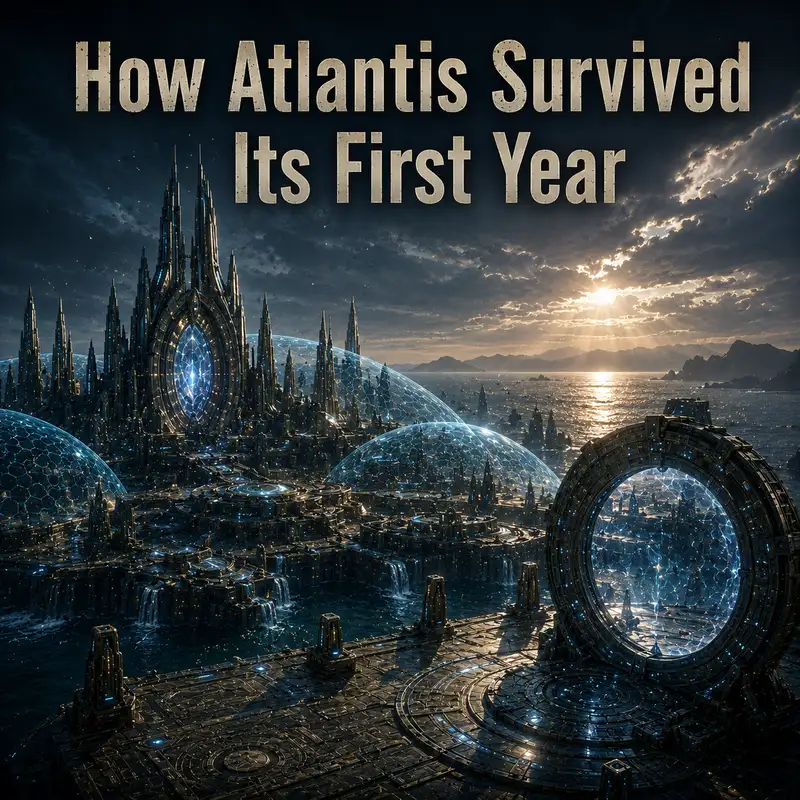
How Atlantis Survived Its First Year
The Wraith fleet had stopped firing, but Atlantis was more vulnerable than at any earlier point in the siege. Its shield was down. A modified Puddle Jumper cloak now concealed the entire city, leaving the towers physically unprotected beneath ten hive ships. The enemy had just watched a nuclear explosion where Atlantis should have been. If one commander doubted the deception and ordered a test shot into the ocean, Earth’s first expedition to Pegasus would end without enough warning to raise the shield again.
That moment provides the clearest answer to how Atlantis survived its first year. The expedition did not survive because it possessed a superior city, a flawless commander, or a decisive weapon. It survived by repeatedly converting incomplete technology, local alliances, professional expertise, and calculated risk into a little more time. Each crisis removed one option. The people in Atlantis responded by building another from whatever remained.
The expedition had begun as a one-way journey. Earth used its only available zero-point module to establish an eight-chevron wormhole to Pegasus, knowing the power source might be exhausted by the attempt. Elizabeth Weir led an international force of scientists, soldiers, physicians, engineers, and support personnel through the gate with no guaranteed method of return. The official objective was exploration and recovery of Ancient knowledge. The practical assumption was that Atlantis would provide the resources needed to sustain the mission.
Atlantis provided a failing shield instead. The city lay beneath an ocean, protected by three zero-point modules that had spent ten thousand years holding back the water. Only the last reserve remained, and the arrival of the expedition awakened systems throughout the city, increasing the demand. Water began flooding the outer sections. Earth-built naquadah generators could operate lights, laboratories, and selected controls, but they could not maintain the shield beneath the full weight of the sea.
The city survived because an alternate Elizabeth Weir had reached the Lanteans ten thousand years earlier and persuaded Janus to alter Atlantis’s future. She spent millennia in stasis, waking at intervals to move the power load among the modules. Janus added a failsafe that raised the city when the remaining energy fell below the level required to hold back the ocean. The expedition did not know any of this when Atlantis rose to the surface. Its first survival was the result of a contingency created by someone who had already watched another version of the mission die.
The surface solved the flooding problem and created a defensive one. Atlantis no longer needed a citywide shield merely to remain habitable, but it was now visible from orbit and almost completely exposed. The expedition possessed no local fleet, no charged zero-point module, and no reliable contact with Earth. The base had survived its first hours by spending the last inheritance of the people who built it.
The leadership structure changed just as quickly. Colonel Marshall Sumner, the expedition’s senior military officer, was captured during the Wraith attack on Athos. Major John Sheppard led a rescue, ended Sumner’s suffering during feeding, killed the Wraith Keeper, and helped awaken dormant forces across Pegasus. He returned as the ranking military officer after winning a rescue that had enlarged the war. Atlantis survived because Weir accepted the command reality in front of her rather than waiting for a replacement that could not arrive.
Weir and Sheppard formed the first essential partnership of the expedition. She retained overall civilian command, diplomatic authority, and responsibility for the multinational mission. Sheppard directed field teams, base defense, and military operations. Neither arrangement matched a conventional outpost. A civilian diplomat could authorize combat missions and a newly arrived Air Force major could become the senior officer because the appointed colonel had died on the first day. Pegasus was not especially respectful of organizational charts.
Their command worked because expertise remained distributed. Rodney McKay and Radek Zelenka controlled scientific systems neither leader could operate alone. Carson Beckett made medical and quarantine decisions that could close sections of the base. Peter Grodin translated Ancient control functions into practical operations. Teyla Emmagan provided regional intelligence, political access, and an understanding of the Wraith that no Earth database contained. Atlantis survived as a network of specialists rather than a headquarters issuing solutions from one desk.
Sheppard’s first field team reflected the same design. Ford brought conventional military discipline. McKay brought scientific exploitation at the point of contact. Teyla brought local legitimacy and intelligence. Sheppard connected those specialties and made the final risk decisions. Four people could not occupy a planet or defeat the Wraith, but they could identify a threat, negotiate access, recover information, and reach the gate before a larger force arrived. The team survived because leadership moved toward whoever understood the immediate problem.
The Athosians made that network possible. They had lost their home during the expedition’s first contact and entered Atlantis as refugees. They also became the expedition’s first source of food knowledge, gate addresses, cultural interpretation, and warning about the culling cycle. Teyla joined Sheppard’s team, while Halling and other Athosians helped the newcomers understand that Pegasus was an inhabited political environment, not an archaeological site surrounding one valuable city.
The alliance was imperfect. Repeated Wraith encounters led Atlantis security personnel to suspect that the Athosians were revealing team movements. The real cause was a Wraith tracking device hidden among Teyla’s possessions and unknowingly activated by Sheppard’s Ancient gene. The investigation damaged trust, and many Athosians chose to live on the Lantean mainland rather than remain inside the base. Atlantis kept its first alliance because Weir admitted the error and allowed distance instead of demanding dependence.
That lesson mattered because isolation turned every local relationship into logistics. Food stocks declined before expedition crops could mature. Medicine, ammunition, batteries, and replacement components were finite. The Stargate offered extraordinary mobility, but it did not manufacture supplies. A team could cross the galaxy in seconds and still return to a storeroom whose inventory continued moving in only one direction.
Isolation also affected morale and judgment. An energy-based lifeform once produced a shared illusion in which expedition members believed they had returned to Earth and could soon travel back to Pegasus. The deception succeeded because it offered exactly what the one-way mission had denied them: family, familiar authority, and the assurance that failure could be reversed. Recognizing the false reality required personnel to question the answer they most wanted to accept. Psychological resilience became another form of base security.
The search for food exposed the hidden Genii state beneath an agricultural surface. The Genii possessed soldiers, laboratories, an industrial base, and a nuclear weapons program. Atlantis needed their crops and intelligence. The Genii needed Puddle Jumpers, scientific assistance, and delivery systems for an attack on sleeping Wraith hives. The two sides had complementary capabilities and almost no trust. Their first joint operation ended in betrayal, leaving Atlantis with valuable Wraith data and a determined human adversary.
That hostility nearly destroyed the city during a planetary storm. Atlantis lacked the power to raise its shield, so most personnel evacuated while McKay and Zelenka tried to channel lightning through the city’s conduits. The Genii learned that the base was nearly empty, entered through the Stargate using a compromised Athosian identification code, seized the control room, and took Weir and McKay hostage.
Sheppard survived because he remained outside the captured command center and understood the city better than the attackers. He hid the explosives they wanted, disabled generators, used transporters and life-signs detectors, and forced the Genii to divide an already inadequate force. Ford, Teyla, and Beckett returned through the storm’s eye. McKay and Weir manipulated the attackers’ dependence on their technical knowledge. The expedition retook the city and raised the shield before the wave struck.
The operation revealed a pattern that would define the first year. Atlantis rarely solved a crisis with one system. The storm defense required Lantean infrastructure, Earth generators, McKay’s calculations, Zelenka’s engineering, Weir’s command decisions, Sheppard’s resistance, Beckett’s ability to fly a Jumper, and Athosian assistance. Remove one element and the plan failed. Add them together under pressure and the city survived, although usually without leaving much safety margin for the report.
Attempts to find sanctuary showed the limits of diplomacy under pressure. Some human societies offered trade but not defense. Others protected themselves through technology, custom, or arrangements Atlantis could not ethically appropriate. The Hoffans pursued a drug that might make feeding lethal to the Wraith even though its early form killed many recipients. Atlantis could advise, negotiate, and sometimes evacuate. It could not promise that every ally would be protected, and it could not treat every desperate local strategy as an extension of Earth policy.
Atlantis itself remained one of the expedition’s most dangerous environments. A child released an energy entity that fed on the city’s power. A Puddle Jumper became trapped halfway through a Stargate, placing the crew under the gate’s maximum connection limit while Sheppard lay injured. An Ancient nanite virus escaped inside the city, producing hallucinations and fatal brain hemorrhages. The base was not a finished installation handed over with current maintenance records. It was an abandoned technological ecosystem filled with systems that could become threats as soon as someone restored power.
These crises forced the expedition to create procedures faster than it created knowledge. Gate authentication, quarantine, restricted access, medical isolation, power management, and scientific review became defensive systems in their own right. The most advanced device in the room was often less important than knowing who could shut the door, cut the generator, or prevent a frightened team from returning through the gate with an unknown infection.
Medical capability preserved the expedition’s fighting strength as surely as weapons did. Beckett’s Ancient gene therapy expanded the pool of personnel able to operate Lantean systems, although compatibility did not create instant proficiency. During the nanite outbreak, quarantine, neurological observation, and controlled power shutdowns mattered more than firepower. In a population with few replacements, one infected technician or injured pilot could remove a capability the city needed to survive. The infirmary was therefore part of the defensive network, not support located behind it.
The same was true of mobility. Puddle Jumpers allowed teams to use space gates, approach Wraith vessels under cloak, and evacuate people who could never reach Atlantis on foot. They also depended on Ancient interfaces, a limited pool of compatible operators, and components Earth could not manufacture. One damaged engine pod could trap a craft in an event horizon. One lost Jumper permanently reduced the fleet. Atlantis survived by using the craft aggressively while never possessing enough to treat them as expendable.
Power remained the dominant strategic limitation. The expedition searched for zero-point modules because one charged device could restore the shield, open a wormhole to Earth, or activate other city systems. It found clues, abandoned facilities, and one module on Dagan. The modern Brotherhood took that device before Atlantis could use it. The expedition could locate Ancient power more easily than it could establish a lawful, secure, and repeatable supply.
The discovery of the alternate Weir clarified why the city had survived long enough to be found, but it did not solve the current shortage. It instead gave the expedition five possible addresses associated with Lantean outposts and a reminder that power had always required sacrifice. Atlantis’s great capabilities existed behind an energy requirement Earth could not meet. The city was a fortress whose strongest door could be locked only by consuming a battery nobody knew how to build.
Intelligence became the substitute for unavailable firepower. Teyla’s inherited Wraith genetic traits allowed her to sense approaching hives and enter parts of their telepathic network. The ability carried genuine risk, and some Atlantis personnel feared the enemy could use the same connection against her. The expedition nevertheless gained warning it could not have collected through sensors alone. Teyla learned that the Wraith had awakened early, were short of food, and knew that Earth existed.
That knowledge transformed the siege from a local defense into a planetary-security operation. The Wraith did not merely want to destroy an irritating expedition. They wanted Atlantis intact because its database and intergalactic gate might provide access to billions of humans in the Milky Way. Saving the city and denying it to the enemy became simultaneous objectives. If the defense failed, Atlantis would have to be destroyed before capture.
McKay found a way to send Earth a compressed data burst through a wormhole too brief for physical travel. The transmission carried intelligence on the Wraith, technical reports, and personal messages from people who did not expect to survive. It did not bring immediate rescue. It did something nearly as important. It allowed Earth to understand the threat, prepare a response, and recover the institutional knowledge of the expedition even if the city fell.
The Wraith advance exposed every weakness still present. A hidden infiltrator had entered Atlantis aboard a Dart weeks earlier and remained in unused sections while the city’s biometric sensors covered only the gate room. The expedition located and killed him, but it could not determine exactly what he had transmitted or sabotaged. The enemy had already crossed the air-defense perimeter and lived inside the base before the main fleet arrived.
The last Ancient defensive satellite destroyed one hive ship and then failed after a single shot. Peter Grodin remained aboard because the repair that restored the weapon had disabled the air lock. He died when the surviving hives destroyed the station. The incident summarized Atlantis’s inherited defenses. Ancient technology could still kill a capital ship after ten thousand years. Earth could activate it, but not restore the surrounding network that made it sustainable.
Weir ordered evacuation and prepared the city’s self-destruct. Zelenka developed a virus intended to erase the distributed Ancient database before explosives broke the city apart. The plan accepted that physical destruction alone might leave enough information for the Wraith to recover Earth’s location. Atlantis had crossed a galaxy to preserve Ancient knowledge and reached the point where survival required erasing it.
Earth reopened the gate before the evacuation was complete. Colonel Dillon Everett arrived with Marines, railguns, nuclear weapons, and authority to take military command. The Daedalus was crossing between galaxies with a recovered zero-point module and was expected in four days. Atlantis now had reinforcements and a fixed requirement: remain alive until the ship arrived.
The first defensive layers failed rapidly. The Wraith used asteroids to trigger the nuclear minefield and let the resulting radiation blind Atlantis sensors. Darts attacked the city, culled gun crews, and inserted warriors through their transport systems. Sheppard used the remaining Ancient drones against the aircraft, preserving the towers while emptying the city’s irreplaceable arsenal. Railguns and ground teams held selected sectors, but the defense contracted from space to the sky and then into the corridors.
McKay and Zelenka developed a plan to guide nuclear-armed Puddle Jumpers remotely through the control chair. The modified generator powering the system failed when it was needed. Sheppard took a Jumper himself and flew toward a hive ship with no extraction plan. The Daedalus arrived during his final approach, transported him aboard, and allowed the armed craft to continue into the target.
The ship then delivered the zero-point module to Atlantis, raised the city shield, and transported another nuclear weapon into the final hive. The immediate assault ended. Ford was recovered from the ocean after Wraith enzyme exposure had kept him alive and begun changing him. Everett survived feeding but was left physically devastated. Victory restored the base without restoring everyone who had defended it.
A second Wraith formation followed. The Daedalus ambushed the fleet and destroyed two hives by transporting nuclear weapons inside them. The survivors activated countermeasures before a third strike could occur. Ten hives continued toward Atlantis, proving that Earth’s most effective new tactic had an operational life measured in minutes once the enemy understood it.
The final plan abandoned the attempt to destroy the fleet. Teyla convinced the Wraith through their mental network that Atlantis intended to self-destruct. The Daedalus placed a nuclear weapon above the city shield. During the explosion, McKay transferred the city from shield to cloak. The Wraith saw the warning, the blast, the radiation, and then an empty ocean. They concluded that the objective had been destroyed and left the system.
Atlantis survived its first year because the expedition learned to treat survival as a series of connected problems rather than one heroic battle. It preserved power, controlled the gate, built local alliances, improvised logistics, accepted scientific authority, adapted the chain of command, gathered intelligence, and denied the enemy the decision it wanted. No one system remained dependable for long. The organization did.
The cost prevents the first year from being described as an uncomplicated success. Sumner and Grodin were dead. Ford had been altered and fled the city during the final deception. Everett had been left physically devastated by feeding. The Athosians had been displaced and mistrusted. The Genii had become enemies. Human worlds across Pegasus faced an early Wraith awakening partly caused by the expedition’s arrival. Atlantis survived while the surrounding strategic environment became more dangerous.
The expedition also changed permanently. It had arrived as an isolated research mission hoping to recover Ancient knowledge and find a way home. It ended the year as a defended forward base linked to Earth by a battlecruiser, responsible for allies in Pegasus, and engaged in a war whose enemy now knew humanity existed beyond the galaxy. Survival had created commitment.
The revealing image is not Atlantis rising from the ocean or the Daedalus arriving in time. It is the city hidden beneath a cloak with its shield turned off, while the Wraith search the water above it. Atlantis survived because its people understood that they could not always overpower the threat. They could still manage what the threat believed, preserve the institution behind the technology, and keep enough capability alive to face the consequences after the fleet departed.