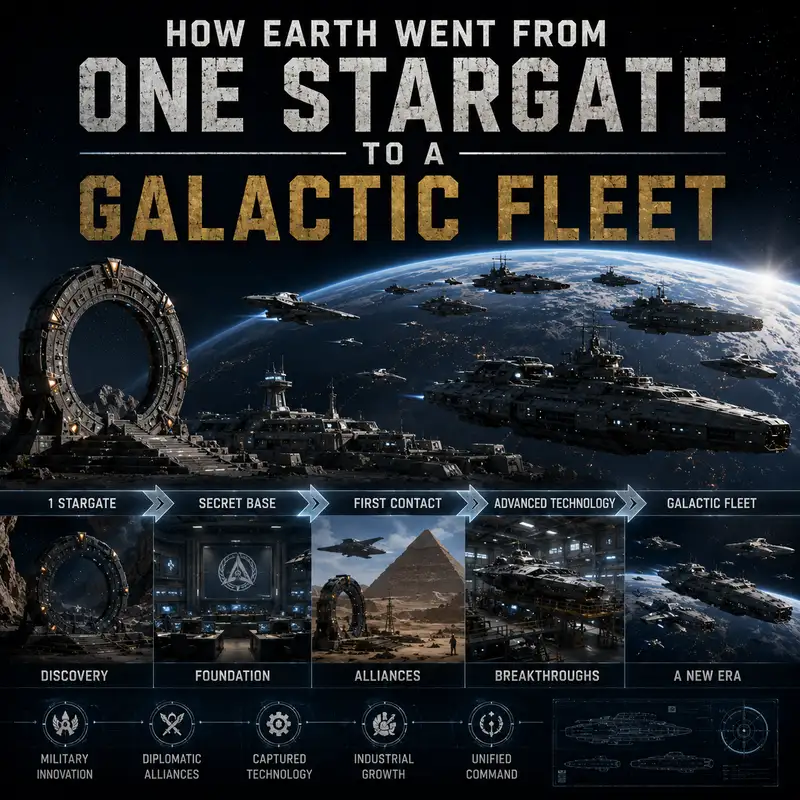
How Earth Went From One Stargate to a Galactic Fleet
The George Hammond was holding position above Icarus Base when the Lucian Alliance came out of hyperspace. Three Ha’tak motherships opened fire while gliders and troop transports descended toward the installation. Colonel Samantha Carter’s battlecruiser could contest the attackers in orbit, but it could not beam personnel through the base’s protective shielding, stabilize the naquadria-rich planet beneath them, or keep every landing craft away from the ground. Earth possessed an intergalactic warship. The base was still lost.
That battle is a useful place to measure Earth’s transformation. Barely more than a decade earlier, its entire interstellar force had consisted of one Stargate beneath Cheyenne Mountain and small teams carrying rifles through it. By the time Icarus fell, Earth operated aerospace fighters, off-world installations, several battlecruisers, international command arrangements, Asgard-derived weapons, and expeditions in more than one galaxy. The growth was extraordinary. It was also incomplete enough that one successful enemy attack could still erase a strategic base.
Earth did not reach that point through a single invention or a clean sequence of upgrades. The fleet emerged from a system built around reconnaissance, technological acquisition, industrial adaptation, political bargaining, allied assistance, and repeated failure. Every ship represented dozens of earlier missions whose connection to shipbuilding had not been obvious when the gate first opened. The central question is therefore not how Earth found enough alien technology to build a fleet. It is how Earth turned discoveries into institutions able to produce, crew, supply, and command warships repeatedly.
The starting position was almost uniquely vulnerable. After Apophis reopened the Stargate, the President authorized nine SG teams to explore the network, identify threats, and make peaceful contact when possible. Stargate Command possessed instantaneous access to distant worlds, but no orbital defense, no interstellar communications network independent of the gate, and no reliable way to rescue a team whose destination gate was blocked. Earth had strategic mobility through one doorway and almost no strategic depth behind it.
Apophis’s first attack fleet demonstrated the difference. Two Ha’tak motherships approached Earth behind shields that existing weapons could not reliably penetrate. S G One stopped them by infiltrating the ships, sabotaging their systems, and escaping before the vessels destroyed one another. Earth survived through a special operation conducted inside the enemy formation, not through control of space. The victory proved that small teams could exploit weaknesses in a stronger force. It also proved that the planet had no dependable answer if the next enemy refused to provide an accessible corridor and several unattended explosives.
That warning shaped the early Stargate Command doctrine. SG teams gathered intelligence, developed allies, recovered artifacts, studied enemy practices, and looked for technologies that might narrow the gap. Their value came from combining soldiers, scientists, archaeologists, linguists, and alien knowledge in units small enough to move through the gate. The program did not begin as a fleet-development command. It became one because nearly every off-world discovery was eventually judged against the same question: could this help prevent another fleet from reaching Earth?
The Stargate accelerated collection without removing logistics. A control crystal, weapons sample, or portable generator could reach Earth in seconds after a team secured the route home. Heavy equipment still had to fit through the ring. Every shipment still required handling, security, quarantine, and a functioning gate at both ends. The portal made distant resources reachable. It did not mine the ore, refine the alloy, understand the circuitry, or explain why an apparently unnecessary component had been installed by the original builder.
Area Fifty-One became the institution responsible for that conversion. Recovered death gliders, Goa’uld control systems, naquadah generators, transport technology, alloys, biological samples, and unique artifacts entered a classified network of laboratories and contractors. Scientists could activate some devices long before they understood them. Engineers could reproduce one effect without reproducing the civilization that had made it reliable. The laboratory’s real achievement was learning to distinguish between possessing an artifact and fielding a military capability.
The X three-oh-one supplied the clearest early lesson. Engineers combined two captured death gliders with human controls and missiles to create an aerospace interceptor. The prototype flew successfully until a hidden recall system overrode the pilots and sent the craft toward Apophis’s territory. Earth had modified the visible aircraft without removing the enemy authority embedded inside it. The problem was not merely a missed component. It was the assumption that captured hardware became human equipment once familiar instruments were attached.
The X three-oh-two changed that relationship. Its systems drew heavily from Goa’uld principles, but the airframe, controls, safety logic, and integration were human-built. The fighter’s naquadria-powered hyperspace generator proved unreliable, preventing routine interstellar travel. Engineers retained the atmospheric and spaceflight capabilities that worked and stopped requiring the aircraft to perform every mission imagined for the prototype. The production F three-oh-two became useful because Earth accepted an imperfect fighter it could manufacture, maintain, and improve.
That transition was more important than any isolated performance figure. A captured glider offered immediate capability with no secure production line. The F three-oh-two created squadrons, instructors, maintainers, spare parts, weapons procedures, and a growing body of aerospace doctrine. It could be deployed from Earth, assembled at an off-world base, or carried aboard a larger ship. Earth’s first true space-combat force began when another crew could fly the next aircraft without depending on the people who had survived the first experiment.
Fighters could contest local air and space, but they could not carry themselves between distant systems, remain on station for long periods, or provide the command facilities required for fleet operations. The X three-oh-three Prometheus answered that problem. Built in secrecy beneath Nevada, it combined a human hull and crew environment with alien-derived propulsion, artificial gravity, shields, sensors, ring transporters, and control crystals. Its early hyperdrive depended on unstable naquadria because Earth had no mature power source capable of meeting the requirement.
Prometheus was both breakthrough and warning. It gave Earth independent interstellar movement, fighter carriage, orbital presence, and an extraction route that did not depend on a destination Stargate. It also suffered propulsion failures, required repeated allied upgrades, and was hijacked before completing normal trials. A project large enough to build a battlecruiser required contractors, technicians, security personnel, and suppliers. Secrecy hid the ship from the public. It did not make every person inside the compartment trustworthy.
The ship’s defining battle came over Antarctica. General George Hammond took Prometheus and F three-oh-twos against Anubis’s invasion fleet while S G One searched beneath the ice for an Ancient outpost. The human force could not defeat the Goa’uld armada. It could keep the approach contested, absorb enemy attention, and buy the minutes needed for Jack O’Neill to activate the Ancient drones. Earth’s first battlecruiser mattered because it created conditions for another weapon to decide the battle.
The Antarctic victory did not give Earth a dependable planetary shield. The outpost required a compatible operator, a rare zero-point module, and a finite stock of drones that Earth could not manufacture. Its spectacular success created deterrence and political leverage, but it remained inherited infrastructure rather than an industrial capability. Earth’s leaders now possessed a fleet prototype and an Ancient arsenal. Neither could be treated as available in unlimited quantity or on every battlefield.
The battle also exposed an organizational gap. Stargate Command controlled gate missions. Prometheus belonged to a separate ship program. Area Fifty-One managed research. The Antarctic site required international and scientific oversight. Foreign governments had learned enough to demand participation. Homeworld Security was created to place these capabilities beneath a broader strategic headquarters, with Hammond overseeing Stargate Command, the ship program, and the Ancient outpost from the Pentagon.
That institutional change was as important as the hardware. A fleet needs priorities, readiness standards, intelligence coordination, repair schedules, command relationships, and rules for deciding which crisis receives the available ship. Homeworld Security, later Homeworld Command, connected the gate, off-world bases, research programs, aerospace forces, and planetary defense. The headquarters could not manufacture another battlecruiser during an emergency. It could at least prevent several classified organizations from discovering the same emergency independently.
International politics shaped the fleet from the beginning. Russia’s possession of a second Stargate gave Moscow leverage over the program and eventually secured access, personnel roles, technology sharing, and a battlecruiser of its own. Britain, France, China, and other partners entered the classified system through agreements and the International Oversight Advisory. Earth’s ships remained closely tied to the United States Air Force, but the claim that one nation alone should control interstellar transportation and alien-derived weapons became progressively harder to sustain.
The National Intelligence Department and the Trust represented the darker version of the same transformation. Rogue officials and private sponsors stole technology, operated unauthorized off-world programs, compromised contractors, and used alien systems for political coercion. The fleet required secrecy to protect its shipyards and research. That secrecy also allowed people with clearances to divert components before any public institution knew the components existed. Earth’s technological rise created a counterintelligence battlefield inside the industrial system supporting it.
Prometheus remained a prototype because Earth could not standardize every compromise inside its hull. The B C three-oh-four class represented maturity. Daedalus integrated Asgard-derived shields, sensors, transporters, and an intergalactic hyperdrive into the design from the beginning. Human missiles, railguns, fighters, command systems, and maintenance practices remained central. The result was not technologically independent, but it was repeatable enough that Earth could build sister ships and train crews around a common platform.
Daedalus proved the strategic value of the class by reaching Atlantis during the Wraith siege. It delivered a zero-point module, reinforcements, nuclear weapons, and an enduring connection between Earth and the isolated expedition. The ship’s weapons helped save the city, but its recurring voyages were equally important. Daedalus carried personnel, heavy equipment, medical support, political authority, and a route home. Earth had built a warship that functioned as a supply line across galaxies.
Odyssey gave Homeworld Command a second mature platform for Milky Way operations. Korolev placed a B C three-oh-four under Russian command. Apollo expanded Earth’s striking power in Pegasus. Sun Tzu established a Chinese-operated battlecruiser. George Hammond entered service under Samantha Carter and supported the Icarus Project. The vessels shared a class, but they did not always share identical upgrades, national priorities, or availability. The fleet was international in participation and coalition-based in command rather than a unified planetary navy.
Losses arrived as quickly as new hulls. Prometheus was destroyed by an Ori-designed satellite over Tegalus. Korolev was destroyed on its first major mission when four Ori warships crossed the supergate at P three Y two twenty-nine. Earth’s missiles and railguns could not penetrate the enemy shields, while Ori beams cut through B C three-oh-four defenses. The disaster demonstrated that Earth had learned to build fleet units before it had learned to defeat every fleet those units might encounter.
The Asgard’s final transfer closed part of that gap. Before ending their civilization, they placed their recorded knowledge, a computer core, advanced power systems, and new plasma beam weapons aboard Odyssey. The beams could destroy an Ori warship through direct fire. Selected systems were later fitted to Daedalus and Apollo, allowing Earth ships to destroy Asuran warships that had once demanded far more cautious tactics. The fleet had gained a credible anti-capital weapon rather than another method dependent on boarding, sabotage, or an internal nuclear device.
The gift did not make Earth equal to the Asgard. Odyssey’s core contained knowledge that human scientists could study but not automatically reproduce at industrial scale. Its integration created a signature the Ori could track. The same archive was later misused to manufacture a Replicator aboard the ship. Advanced technology increased combat power and the consequences of political or security failure. Earth had inherited scientific potential faster than it had inherited the wisdom normally expected to accompany it.
The campaign against the Asurans showed what the upgraded fleet could accomplish. Daedalus and Apollo ambushed and destroyed Ancient-designed warships, then joined Wraith and Traveler vessels in a coalition battle above Asuras. Their beam weapons targeted enemy ships and hyperdrives while a separate technical plan collapsed the Replicator population into a mass that destroyed the planet. The Earth ships were powerful enough to shape the fleet battle. They still required allies and a scientific solution to end the strategic threat.
The Wraith super-hive demonstrated the opposite limit. Enhanced by a zero-point module, one hive damaged Daedalus, crippled Sun Tzu, and damaged Apollo without being stopped. Earth’s best weapons remained insufficient against a target operating far above the normal Wraith class. Atlantis, an internal nuclear strike, and several improvised operations were required to destroy it near Earth. A fleet can be mature and still meet an enemy outside its design assumptions.
Industrial capacity determined how quickly Earth could recover from such losses. Naquadah supplied power and supported alien-derived systems. Trinium reduced structural weight while increasing strength after proper refining. Naquadria offered exceptional energy for prototypes and strategic weapons, but its instability made it a dangerous foundation for routine propulsion. Off-world mines, negotiated access, geological surveys, refining, classified contractors, and secure shipyards were as important to the fleet as bridge crews.
The industrial base was hybrid because Earth itself remained hybrid in technological development. Conventional factories produced hull sections, electronics, missiles, railgun ammunition, life-support equipment, and countless ordinary components. Alien materials and designs were concentrated where terrestrial science could not meet the requirement. Asgard technology improved propulsion, shields, sensors, transporters, and weapons. Goa’uld-derived principles informed control systems and early spacecraft. Ancient discoveries supplied capabilities Earth often could use but rarely manufacture.
Crews were another form of industrial capacity. A battlecruiser required pilots, engineers, medical personnel, sensor operators, weapons teams, damage-control specialists, intelligence staff, and commanders able to act beyond immediate communication with Earth. F three-oh-two squadrons required their own maintenance and training systems. One successful prototype could rely on Samantha Carter and a small group of experts. A fleet had to function when those experts were assigned elsewhere, injured, or dealing with another device that had chosen the same afternoon to become unstable.
Logistics remained the quiet limit behind every deployment. A ship sent to Atlantis was unavailable over Earth. A vessel under repair did not count merely because its name remained on the fleet list. Fighters needed ammunition and parts. Shields, beams, hyperdrives, and transporters competed for power. Rare zero-point modules could strengthen one mission only by remaining unavailable to another. Earth acquired intergalactic reach faster than it acquired enough hulls to cover every obligation created by that reach.
The fleet never replaced the Stargate. The two systems solved different military problems. Gates moved small teams and selected supplies almost instantly between known, usable addresses. Ships reached places without functioning gates, carried larger loads, remained in orbit, and provided firepower, sensors, medical facilities, and alternate extraction. SG teams supplied cultural knowledge, intelligence, sabotage, and diplomacy. Battlecruisers supplied endurance and force. Earth’s strongest doctrine combined them instead of choosing one.
That combination explains why small teams remained central even after the Asgard upgrade. A beam weapon could destroy an enemy ship but could not determine which faction controlled it, whether civilians were aboard, or what retaliation would follow. Sensors could find a power source without explaining the political arrangement surrounding it. The fleet gave Earth new options. SG teams still discovered which option was likely to solve the problem rather than make the next one larger.
By the later period, Earth possessed a fleet with intergalactic reach, but not a fleet large enough to dominate either galaxy. Prometheus and Korolev had been lost. Daedalus, Odyssey, Apollo, Sun Tzu, and George Hammond had all entered service, though their condition, configuration, and availability varied. Odyssey carried unique Asgard capabilities. Atlantis itself had reached Earth, but it was not a routine fleet unit. The order of battle was formidable by human standards and thin by the scale of its commitments.
The attack on Icarus Base returned every limitation to one battlefield. George Hammond could fight Ha’taks in orbit and launch F three-oh-twos against gliders. It could not beam through the installation’s shielding, prevent every landing, or stabilize the planet after the enemy attack pushed its naquadria core toward destruction. The survivors escaped through the Stargate to Destiny. The battlecruiser remained operational while the strategic installation disappeared beneath it. Space superiority had not automatically produced control of the objective.
Earth went from one Stargate to a galactic fleet because it learned to convert missions into institutions. Reconnaissance became intelligence. Captured devices became research programs. Failed prototypes became production aircraft. One hybrid battlecruiser became a standardized class. Secret American programs became multinational commands. Alien alliances became propulsion, shields, transporters, and weapons that human crews could integrate into their own doctrine. None of those transitions was automatic, and nearly every one was purchased by a failure that exposed what Earth still did not understand.
The fleet’s greatest strength was not any particular beam weapon or shield. It was the ability to learn, build another hull, train another crew, and connect the new capability to the gate network that had started the process. Its greatest weakness was the speed of its expansion. Political commitments, distant expeditions, and new enemies multiplied faster than ships, power sources, and experienced personnel. Earth became capable of intervening almost anywhere without becoming capable of controlling everything its intervention set in motion.
One Stargate had first made Earth vulnerable by opening a route to a war it did not understand. The fleet made Earth harder to conquer by giving it depth beyond that doorway. Yet every battlecruiser still depended on addresses found by SG teams, materials obtained on other worlds, knowledge shared by allies, and institutions disciplined enough not to treat access as ownership. Earth became a galactic power not when it built the strongest ship, but when it could lose a ship, preserve the lessons, and send another crew back into the dark with a better plan.