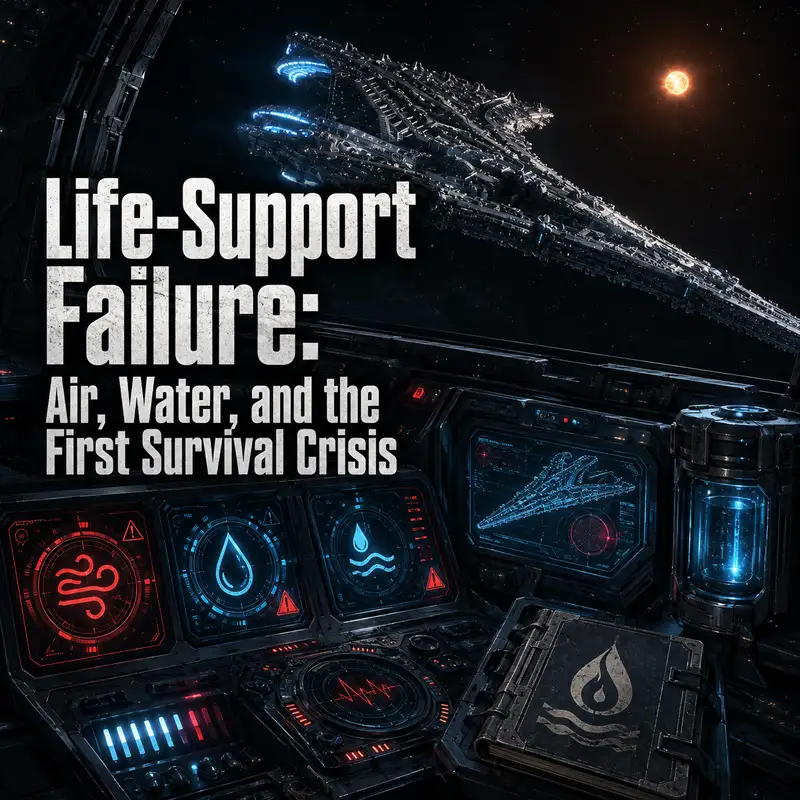
Life-Support Failure: Air, Water, and the First Survival Crisis
The water reservoir was under guard when its level fell again. No one had entered, and Destiny’s sensors showed no obvious leak. Yet the ship had already lost roughly half the water available when the Icarus survivors arrived. Rumor aboard the vessel placed the missing volume at forty thousand liters. The military responded with tighter rationing, searches, and surveillance. The civilians responded with a reasonable question: if the water had not leaked away and no one could reach the tank, who controlled the truth about what remained?
That mystery came only days after the expedition had nearly suffocated. The first survival crisis aboard Destiny was not one mechanical failure but a chain connecting damaged hull sections, exhausted carbon-dioxide scrubbers, inadequate supplies, uncertain planetary reconnaissance, water loss, contamination, and political distrust. Air and water became the first resources over which the accidental crew had to organize labor, accept casualties, and define authority. The central problem was simple enough to state. How could more than eighty evacuees survive aboard a million-year-old ship when the systems keeping them alive were failing faster than they could understand them?
The survivors had not boarded as a prepared expedition. They arrived during the destruction of Icarus Base carrying wounded personnel, weapons, scientific cases, communication stones, and whatever supplies could be moved through the gate in seconds. The intended expedition commander remained behind. The base physician died before the evacuation. Several essential items on the manifest never reached the ship. No maintenance team had inspected Destiny, calculated consumption for the actual population, or prepared quarters and medical support. They had escaped the explosion. They had not reached a safe installation.
A spacecraft life-support system is less a single machine than a negotiated relationship among atmosphere, water, power, waste processing, temperature control, and crew behavior. Oxygen alone does not make a cabin safe. People exhale carbon dioxide, release moisture, consume water, produce waste, and generate contaminants. In a closed environment, those outputs must be captured, processed, stored, or reused. If carbon dioxide is not removed, headaches and elevated heart rates appear before impaired judgment, unconsciousness, and death. If water recovery fails, every drink becomes a permanent reduction in the reserve. Destiny’s technology was extraordinary. Its maintenance status was not.
The first visible problem was loss of atmosphere. Search teams found damaged compartments and a shuttle whose forward windows had failed. An intermittent force field was slowing the escape of air, but it could not compensate for the damage. The inner hatch connecting the shuttle to Destiny would close only from inside. Once sealed, whoever operated it would remain on the wrong side of the pressure boundary. The technical problem therefore became a personnel decision. The crew could preserve the ship’s atmosphere only by leaving one person inside a compartment that could no longer support life.
Senator Alan Armstrong made that decision before Colonel Everett Young could act. Armstrong had suffered severe injuries during the evacuation and understood that his remaining life was measured in less time than the ship’s air supply. He entered the shuttle, sealed the hatch, and isolated the breach while his daughter watched from the corridor. His death did not repair Destiny. It converted an immediate loss of atmosphere into a slower carbon-dioxide emergency. That distinction bought the crew perhaps a day. It was also the first demonstration that life support was not an engineering subject separate from command. The system could be stabilized because one injured civilian accepted a cost the machinery could not avoid.
Sealing the leak exposed the next failure. Destiny’s processing nodes contained exhausted alkaline residue where functional carbon-dioxide scrubber material should have been. Crew members were already reporting headaches, and Lieutenant Tamara Johansen observed elevated heart rates across the population. The science team identified calcium-rich material or lithium hydroxide as possible substitutes. Medical-grade soda lime had appeared on the Icarus supply manifest, but it never reached the ship. That missing container was now strategically important. A mundane absorbent that might have occupied one corner of a storeroom had become more valuable than most of the advanced equipment carried through the gate.
The crisis divided authority before Young had fully recovered from his injuries. Nicholas Rush possessed the best understanding of Destiny’s systems, but he had already lied about being placed in command by Earth. Lieutenant Matthew Scott had temporary military authority without the experience or information normally given to a commander. Camile Wray represented civilian oversight, while Johansen had become the ranking medical officer by default. Each could identify part of the problem. No one controlled all of it. The ship needed scientific diagnosis, military coordination, medical triage, and civilian cooperation before the expedition had agreed upon a government.
Destiny then acted on information the crew did not possess. The ship left faster-than-light travel, detected a seeded Stargate within range, and dialed a desert world that might contain material suitable for the scrubbers. A countdown showed that the stop would last just over twelve hours. The humans could not extend it, redirect the vessel, or determine why several other addresses were locked out. Destiny had provided an opportunity, not a rescue plan. The crew still had to cross the gate, confirm a return route, locate the material, carry it back, and complete the repair before the ship resumed its voyage.
Scott led the mission because Young remained injured. Rush and Doctor Andrea Palmer understood what the team was seeking. Greer provided security and the physical endurance needed to move people and equipment. Eli Wallace, Doctor Jeremy Franklin, and Curtis added technical help and labor. Their equipment was basic by interstellar standards: field testing supplies, limited water, weapons, radios, packs, a kino, and the handheld remote required to dial the older gate network. There was no vehicle, air support, medical evacuation platform, or detailed map. The planet offered a desert large enough to hide the needed deposit and a deadline too short for a proper geological survey.
Initial samples contained related minerals but not enough of the material required. The team believed a dried lake bed or former saltwater basin might hold a concentrated deposit of granular limestone. Finding one meant crossing open terrain in severe heat while testing the ground at intervals. Every test consumed time and water. Every mile outward had to be walked again during extraction. The team could improve search coverage by splitting, but doing so weakened security and divided the limited communications equipment. The Stargate had eliminated the distance between Destiny and the planet. It had done nothing about the distance between the gate and the resource.
The mission also became a referendum on whether Destiny was worth saving. Palmer, Curtis, and Franklin concluded that the desert search might fail and attempted to use the remote to dial one of the addresses the ship had rejected. A habitable planet might offer air, water, and permanent refuge without requiring them to repair a vessel they could not control. Rush argued that a few hours could not establish whether another world was safe or sustainable, and that abandoning Destiny would destroy their only plausible route home. Two people crossed to another planet. Franklin was stopped by gunfire before he could follow. The first supply mission had already produced a break in command.
Scott continued alone after heat and exhaustion forced Rush to turn back. During the search, he encountered the sand-like swarm he had noticed earlier. When he poured water onto the ground, the particles moved toward it. Whether the organisms deliberately guided him afterward is not established with certainty, because Scott was dehydrated and experiencing visions. The evidence does show that he eventually found the dry lake bed and the concentrated lime the team needed. The same life form would later cause the water crisis aboard Destiny, an irony no reconnaissance report could have predicted.
Finding the deposit did not complete the mission. Scott had to dig and carry enough material while already close to collapse, and Greer had to leave the gate area to recover him. They reached the ramp with seconds remaining before Destiny’s scheduled departure. Eli used his arm to interrupt the event horizon, gambling that the Stargate’s safety systems would prevent the connection from closing while matter was in transit. The gate remained active long enough for Scott, Greer, and the lime to pass through. The operation succeeded through endurance and an emergency use of a system nobody had fully tested.
The distinction between tactical and strategic success was immediate. The team recovered the substitute material and restored effective air circulation. People throughout Destiny felt the change as the repaired scrubbers began moving cleaner air. Yet no one knew how long the replacement would last, whether other processing nodes would fail, or how the material interacted with Ancient equipment designed for a different compound. The crew had not created a renewable life-support industry. It had found a field-expedient cartridge and installed it before the atmosphere became lethal. The device worked, which was excellent news. The maintenance schedule remained something of a mystery.
Air restored enough time for the expedition to discover that its water was disappearing. Young confirmed that the reserves had fallen to about half their arrival level. Destiny was a closed system, so simple evaporation could not explain the loss. The water-recycling equipment was not fully reliable, but sensors showed no conventional leak. This created a more difficult intelligence problem than the failed scrubbers. A broken filter could be inspected. Missing water without a physical trail suggested sensor error, concealed consumption, an unknown ship process, or another presence aboard.
Young guarded the reservoir, tightened rationing, and used kinos to monitor conversations. Greer searched quarters for stolen food and water. Sergeant Spencer was found with hidden protein bars and placed under restraint. Those measures protected limited stores, but they also made the military appear to be using scarcity to consolidate control. Civilian personnel speculated that officers were concealing the real supply. Their suspicion was not proof of conspiracy. It showed that rationing requires legitimacy as well as arithmetic. People will accept hardship longer when they understand the inventory, the distribution rules, and the evidence behind them.
Johansen supplied the missing intelligence. She encountered a cloud of tiny organisms able to form shapes and respond to her presence. The phenomenon matched what Scott had seen on the desert world. A small number had probably crossed with the returning team or equipment, then reproduced aboard Destiny. Their attraction to water explained why the reservoir kept falling even while guards prevented human access. The event was a quarantine failure, though not a careless one. A kino could survey atmosphere and terrain, but a dispersed organism resembling grains of sand could pass through the gate without registering as a conventional threat.
The organisms did not behave like an invading military force. They appeared to need water and may have been attempting to communicate. That ambiguity did not make them harmless. When Corporal Gorman encountered the swarm, he fired his sidearm. The organisms engulfed him and inflicted injuries from which he later died. His response was understandable in a dark corridor aboard a damaged ship, but it converted an uncertain contact into a fatal engagement. The expedition had to contain a life form it barely understood without destroying it or losing more people and water.
Destiny provided another narrow opportunity by stopping within range of a frozen planet. It was the only candidate available, not a favorable destination. Surface temperature was approximately minus forty-seven degrees Celsius. The atmosphere was extremely thin, dominated by carbon dioxide, and contained almost no breathable oxygen. Ice near the Stargate carried dangerous concentrations of ammonia and other chemicals. The crew needed pure water, but the first material within easy reach was poisonous. Once again, the ship had identified a world associated with the required resource without solving the extraction problem.
Only two Ancient spacesuits were ready for use. A third might have been repairable after another day, but Destiny would return to faster-than-light travel before then. The available suits were themselves more than a million years old and showed signs of degradation. Young selected Scott to accompany him and placed Johansen in command aboard the ship. Their suit reserves allowed just over eight hours under expected exertion, less than the vessel’s departure window. The mission therefore had two deadlines. Destiny might leave after roughly eleven hours, but the men could suffocate inside their suits long before the gate became unavailable.
The ice near the gate failed testing, so Young and Scott moved across a frozen lake toward more promising terrain. Eli improvised a levitating cargo sled by combining a platform with several kinos, giving the pair a way to move far more ice than they could carry. The sled still had to be pushed over broken ground, loaded by hand, and returned to the gate. A plasma cutter helped, as did rifle fire when caution became less useful than speed. The expedition had acquired Ancient anti-gravity technology and was using it as a handcart, which was exactly the correct military application under the circumstances.
They found pure ice at a frozen waterfall and began sending loads back through the gate. Each transfer required coordination between the surface team and the crew aboard Destiny. Ice had to be cut into manageable pieces, secured to the sled, pushed to the gate, moved through the event horizon, unloaded, and the platform returned. The throughput was limited by two people, one sled, suit air, and the power required to maintain repeated gate connections. An almost instantaneous wormhole did not make the work instantaneous. It merely placed both ends of a difficult supply line in adjacent rooms.
During the final collection effort, Scott fell into a crevasse and became wedged above a deeper drop. Young could have preserved the remaining ice and returned alone. Rush warned that continued rescue work risked losing both men and the resource mission. Young refused to leave Scott. He used the available rope, spent time and air extracting him, then placed the unconscious lieutenant on the sled. Much of the final ice load had to be removed to make room. The decision reduced the amount of water delivered to Destiny, but it preserved the expedition’s principal field officer. Logistics exists to sustain people. When the cargo and the person cannot both be carried, command reveals which one it considers replaceable.
Aboard the ship, Johansen developed a containment plan for the swarm. Eli sealed selected corridors while Greer and other personnel prepared a barrel and a route to the gate room. Johansen stood in the organisms’ path, accepted the risk of direct contact, and allowed them to enter the container. The crew then dialed the ice planet and sent the barrel through while Young and Scott were still near the Stargate. The swarm emerged, formed a face-like shape near Scott, and moved away into an environment rich in frozen water. The contact ended not through extermination but by relocating the organisms to a world better suited to their needs.
The operation did not refill Destiny’s tanks. The last sled returned carrying Scott rather than a full load of ice. Rationing therefore continued. What changed was the direction of the crisis. The unexplained water loss had an identified cause, the organisms were removed, and the recycling system could be repaired without a hidden consumer draining the reserve. The crew had again avoided death without achieving abundance. Survival aboard Destiny would repeatedly depend on turning an immediate collapse into a smaller problem that could be managed later.
The air and water crises established the expedition’s first operating doctrine. Essential stores had to be inventoried, guarded, and rationed. Planetary missions required environmental testing, a confirmed return address, a countdown, communications checks, extraction limits, and enough labor to move the resource. Scientific teams needed security, while security personnel needed scientific guidance before deciding that an unfamiliar life form was hostile. Contamination could move in both directions through the gate. Every successful collection mission therefore carried a quarantine requirement, even when the threat looked like dust.
The crises also established the political stakes of life support. Whoever controlled information about air and water appeared to control the community. Young’s searches and surveillance were responses to real scarcity, but they encouraged the belief that military authority might use scarcity to silence dissent. The desert defection showed how quickly people would seek another future when they lost trust in the ship’s leadership. A ration is not merely a measured quantity. It is a promise that the burden is being shared and that the person issuing it is not keeping a private reserve.
Destiny’s automation proved useful without becoming benevolent. The ship detected worlds that might contain needed resources, dropped from faster-than-light travel, and made selected addresses available. It did not explain its reasoning, wait for exhausted teams, guarantee that material near the gate was safe, or provide trained personnel to retrieve it. The humans had to convert machine-selected opportunities into workable operations. Destiny could point toward limestone and ice. It could not decide how much risk Scott should accept, whether Young should abandon him, or whether an alien organism deserved relocation instead of destruction.
The first survival crisis was won in increments. Armstrong sealed a breach and bought time. The science team identified the failing scrubbers. Scott and Greer recovered the lime. Eli kept the gate open. Young and Scott mined the ice. Johansen identified and contained the organisms. Military personnel enforced rationing, while civilians forced the command to confront the legitimacy of those measures. No single action made the ship safe. Together, they kept one closed atmosphere and one shrinking reservoir from becoming graves.
Air and water made Destiny’s strategic reality unmistakable. The expedition was beyond reinforcement, dependent on an ancient vessel it could not fully control, and supplied through brief gate windows to worlds surveyed long before human arrival. Its first battlefield was not a planet or an enemy ship. It was the environmental system surrounding every person aboard. The crew survived because it learned that life support was command, logistics, intelligence, science, medicine, and politics compressed into the same set of pipes. Destiny did not become habitable because the crisis ended. It became habitable because the people aboard learned how to keep buying one more day.