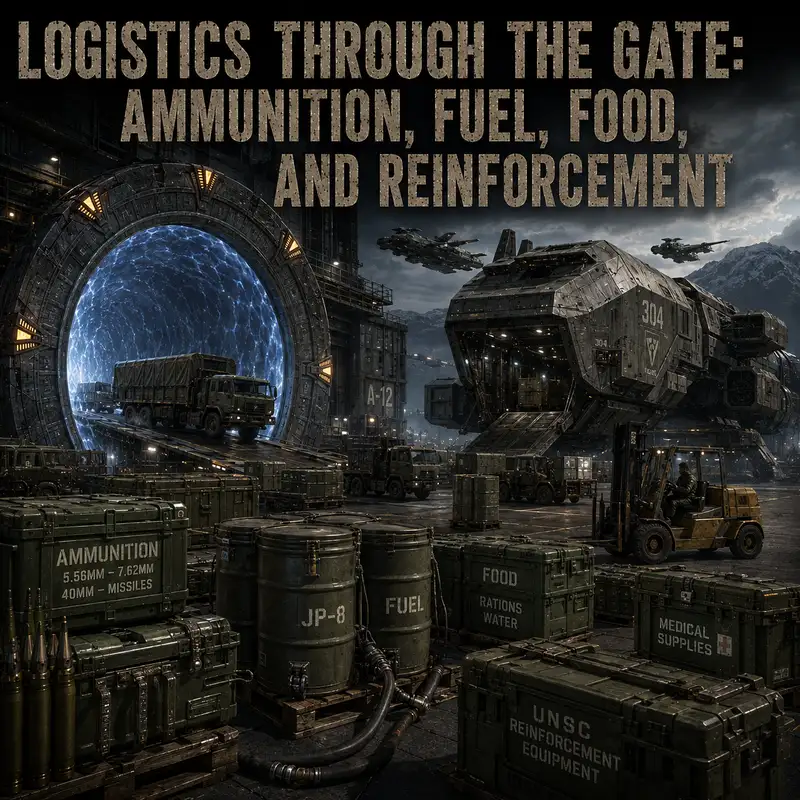
Logistics Through the Gate: Ammunition, Fuel, Food, and Reinforcement
Colonel Dillon Everett stepped through the Atlantis Stargate with Marines, ammunition, railguns, and nuclear weapons. The journey from Earth took seconds. The resupply problem remained measured in days. The zero-point module powering the intergalactic wormhole could not be sent through while it was sustaining the connection, so it had to travel aboard Daedalus. The reinforcements reached the city immediately. The power source they needed to survive the siege was still crossing the space between galaxies.
That contradiction defined logistics through the Stargate. The gate eliminated distance between two fixed points, but it did not eliminate capacity, handling, security, fuel, maintenance, medical support, or the need to control the destination. A crate could cross the galaxy almost instantly and still be useless if no one on the far side could move it away from the gate. A battalion could be placed on another world rapidly in theory and defeated in detail if the enemy controlled the receiving area.
Stargate Command began with teams small enough to fit the transportation system. Four-person units could carry rifles, ammunition, radios, explosives, medical supplies, scientific instruments, and enough food and water for a limited mission. Their size was not only a dramatic preference or a special-operations tradition. It matched the logistical reality of operating through one doorway into terrain that had usually been seen only through a mobile analytic laboratory probe.
Every deployment began before the wormhole opened. The team needed an address, a mission plan, environmental data, authentication equipment, medical preparation, and a load arranged around what people could carry after arrival. The probe went first because sending a convoy into an atmosphere that could not support human life was an inefficient use of both personnel and paperwork. Once the destination was judged usable, the control room opened a short window in which every person and every item had to move in the correct order.
The Stargate itself imposed rules that shaped the supply system. Matter traveled from the dialing gate to the receiving gate, not both ways at once. Radio signals could pass in either direction, but returning personnel required the far side to close the first connection and dial Earth separately. Only one destination could be connected at a time. Normal wormholes also faced a thirty-eight-minute limit unless extraordinary energy or outside conditions held them open longer.
Those rules turned the gate room into a strategic terminal and a chokepoint. Outbound troops, cargo, probes, and vehicles competed for the same ramp. Incoming teams, casualties, diplomatic visitors, and recovered devices arrived through that same space after a separate connection was established. A delayed crate could hold up the entire movement. A damaged vehicle could block the ramp. One suspicious authentication code could stop everyone behind it while the iris remained closed.
Load planning also mattered. The first crates through needed to contain what the receiving party required first, not what had been easiest to place near the Earth ramp. Security equipment, medical kits, communications, and handling tools had to arrive before bulk stores. A poorly sequenced convoy could place food and spare clothing beside the event horizon while the equipment needed to move them remained in Colorado. Interstellar logistics still rewarded the person who packed the truck correctly.
Earth’s iris made the home gate defensible and complicated every return. A team transmitted its identification code before the barrier opened. The procedure protected the planet from hostile forces and captured radios, but it also meant an inbound convoy could not simply arrive unannounced. Medical teams, security personnel, and cargo handlers needed to know what was coming. A wounded officer, an alien artifact, and a sealed biological sample might all fit through the gate. They did not belong in the same receiving procedure.
On the far side, most planets offered no comparable protection. An SG team emerged through a narrow, visible event horizon into a predictable area, often on open ground. The first people through had to secure the area while the rest followed. Heavy weapons, ammunition cases, and medical equipment were most useful after they arrived, which was also when the soldiers protecting them were busiest. If an enemy covered the gate with prepared fire, instant strategic movement became a very short assault across a very predictable front.
This made gate security part of logistics. A destination had to be more than reachable. It had to remain usable long enough to receive supplies and later send personnel home. The dial-home device had to function. The gate could not be buried, moved, shielded, or occupied by the enemy. The route from the gate to the actual objective also had to support movement. A supply cache sitting beside the Stargate did little for a team operating miles away without vehicles or local carriers.
Ammunition was the simplest requirement and one of the easiest to underestimate. Earth weapons were effective partly because their cartridges, magazines, grenades, and explosives came from an industrial system Stargate Command understood. A P ninety did not require a Goa’uld armorer or an alien power cell. It still became dead weight after the last magazine was fired. Every off-world engagement was therefore limited by what the team carried, what had been pre-positioned, or what could be sent after the gate route was secured.
The gate allowed rapid replenishment under favorable conditions. A team in contact could radio for additional ammunition, establish a new wormhole, and receive crates within minutes. That sequence required a working dial-home device, a safe receiving area, and enough time to unload before the enemy reached the gate. The request also had to compete with every other movement scheduled through Earth’s only operational portal. Instant transit did not create an infinite number of loading bays.
Captured alien weapons helped but did not replace the supply chain. Staff weapons and zat guns used compact energy systems and could be valuable when conventional ammunition ran low. Earth could operate many captured examples, but reliable mass production was another matter. Standard rifles remained standard because their ammunition, spare parts, training, and maintenance already existed. A weapon recovered from a dead Jaffa was an opportunity. A pallet of compatible magazines was a plan.
Explosives magnified the handling problem. S G teams routinely carried C four for sabotage and emergency denial, while larger missions required missiles, nuclear devices, or specialized warheads. These could pass through the Stargate, but moving them through a command center beneath Colorado demanded security, safety, and precise coordination. An off-world base could store strategic munitions away from Earth, yet that base then became a target whose address had to remain secret.
Fuel was less visible because many field missions were conducted on foot. The problem grew as Earth introduced unmanned aircraft, ground vehicles, F three-oh-twos, generators, and battlecruisers. Conventional engines still required fuel, lubricants, replacement parts, and trained maintainers. Alien-derived systems required power cells, control crystals, naquadah, and technical knowledge. The Stargate could move those supplies. It could not create them after arrival.
Portable naquadah generators changed off-world sustainment because they replaced long fuel convoys with compact power. A generator could support communications, laboratories, medical systems, defensive equipment, and alien interfaces far from any terrestrial electrical grid. It still had an operating life, maintenance requirement, and maximum output. A base drawing more power than the generator could provide had not solved logistics. It had merely discovered the electrical version of running out of ammunition.
The local dial-home device usually supplied the power needed to operate a Stargate. Earth’s gate lacked its original device and depended on external power and a human-built dialing system. That difference made Cheyenne Mountain both capable and vulnerable. Earth could control the gate through its own computers, but a major power failure or damaged dialing system could isolate every team waiting to return. The transportation network remained dependent on the electrical and mechanical systems surrounding each end.
Heavy equipment exposed the gate’s physical limit. Personnel, probes, crates, and small vehicles could move directly through the ring. Larger systems had to be broken into sections, moved as separate loads, and rebuilt by technicians on the far side. That process required tools, lifting equipment, test gear, and a secure work area. The final component arriving in seconds did not shorten the hours or days needed to turn the collection of parts back into an operational machine.
Earth used this method to deploy F three-oh-two fighters to Vis Uban during the operation against Anubis’s mothership. The aircraft were disassembled, transported through the gate, and reassembled beside a prepared runway. The movement gave Earth aerospace power on a world that no battlecruiser had carried them to. It also required engineers, ground crews, weapons, fuel, and protection while the fighters existed as several expensive piles of components.
The example showed the gate at its logistical best. It allowed a force to bypass interstellar distance and establish a temporary air base close to the target. It also showed why the portal was not magic. The runway still had to exist. The weather still mattered. The fighters still needed maintenance and a mission plan. If the destination gate had been under fire, the aircraft would have arrived in pieces and remained that way.
Food and water created a quieter demand. A four-person team could carry enough for a short reconnaissance mission. An Alpha Site, research base, mining camp, or expedition could not depend indefinitely on rations passing through one portal. Every meal shipped from Earth occupied movement capacity that might otherwise carry ammunition, medicine, or repair parts. Long-term bases therefore needed stored reserves, local water, local food production, trade, or scheduled resupply.
The first Atlantis expedition demonstrated the cost of isolation. Its members entered the Pegasus galaxy without a routine return route to Earth and had to survive on the supplies they brought, what the city still contained, and what they could obtain locally. The Pegasus Stargate network supported movement among nearby worlds, but it did not deliver terrestrial replacement parts or medical specialists. Atlantis could explore widely while remaining separated from the industrial system that had equipped the expedition.
Daedalus changed that situation by carrying bulk supplies, personnel, fighters, and heavy equipment between galaxies. The ship was slower than a wormhole but could move loads the expedition could not sustain through rare intergalactic gate connections. It also provided an alternate extraction route when a local Stargate was blocked. The gate and the ship solved different logistical problems. One collapsed travel time. The other provided capacity, flexibility, and support at the destination.
The emergency reinforcement led by Everett exposed the difference with unusual clarity. Earth could use a scarce zero-point module to open an intergalactic wormhole and send troops and weapons immediately. It could not send the module powering that wormhole through the same connection. Daedalus carried the module physically, using its energy to shorten the voyage before delivering it to Atlantis. The fastest route moved the defenders. The slower route moved the capability that kept them alive.
Medical evacuation followed the same logic as ammunition resupply. A casualty could reach Earth almost instantly after the team secured the gate, dialed home, transmitted the correct code, and moved the patient through. Every step before the crossing remained difficult. A wounded person still had to be stabilized, carried across terrain, protected during movement, and brought to a functioning gate. If the dial-home device was destroyed or the gate was occupied, the distance to Earth might as well have been measured conventionally.
Cheyenne Mountain also had to receive the casualty safely. Medical staff needed warning, the iris had to open, and quarantine rules could not be ignored merely because the patient was bleeding. Stargate Command had encountered parasites, engineered diseases, radiation, nanotechnology, and organisms that altered their hosts. A rapid medical evacuation could save one person and expose an entire base if the receiving procedure failed.
Reinforcement was equally conditional. The gate could deliver troops faster than any aircraft or ship in human history, but the destination had to remain in friendly hands. A commander defending an off-world base could request another team, Marines, ammunition, and medical support. Those forces still emerged through one opening into whatever fire plan the enemy had prepared. Reinforcement through a controlled gate was rapid. Reinforcement through a contested gate was an opposed crossing with no room to maneuver.
This was why Alpha Sites and Beta Sites required stockpiles rather than confidence in emergency resupply. Food, ammunition, medicine, power systems, and communications had to be waiting before Earth lost access to its primary base. A fallback site that depended on Cheyenne Mountain for every essential item would fail at the same moment the fallback plan became necessary. Strategic depth had to be supplied in advance.
Evacuation revealed the harshest capacity limit. During the first major Goa’uld attack, selected personnel began moving to an Alpha Site. The gate could preserve a command cadre, scientists, military personnel, and others needed to continue resistance. It could not evacuate the population of Earth. The Alpha list was therefore a logistical decision with political and moral consequences. One portal provided a route off the planet and forced leaders to decide who could reach it in time.
Off-world bases created a network of smaller supply problems. A research installation needed laboratory equipment, replacement filters, food, medical stocks, and security. A mining camp needed drills, power, transport, and a way to move ore back to Earth. A fighter site needed a runway, fuel, munitions, and maintainers. Combining several functions at one location reduced duplication and created a target whose loss could erase several capabilities at once.
The Gamma Site demonstrated this concentration of risk. Scientists studied hazardous organisms away from Earth, which protected the homeworld from a containment failure. When the R seventy-five insects escaped, the gate room was overrun and the base had to be destroyed. The off-world location had performed its strategic purpose by keeping the danger away from Earth. It had also consumed the laboratories, supplies, and infrastructure placed there.
Enemy control of a Stargate could collapse an entire local supply system. Burying the ring, placing a shield across it, removing the dial-home device, or simply holding the surrounding terrain could isolate forces without defeating them directly. A fleet in orbit could attack a base whose gate defenses remained intact. Gate control provided access to a world. It did not provide air superiority, orbital defense, or control of the roads beyond the event horizon.
The enemy could also use the network as a logistical weapon. A hostile force that learned an address could send troops, bombs, radiation, disease, or a locked wormhole. Earth’s iris reduced that danger at home, while most allied worlds lacked the same protection. Every address shared for trade or reinforcement increased the number of people who could compromise the route. Logistics and intelligence became the same problem once the enemy acquired the destination.
The intergalactic gate bridge attempted to improve the route between Earth and Atlantis by creating a chain of Stargates with a transfer station between galaxies. Personnel could cross far faster than aboard Daedalus without expending a zero-point module for every connection. The system also created fixed relay points, software dependencies, and a station that had to remain secure. When the Wraith penetrated the bridge, the faster route became an invasion corridor.
Destiny provided the most severe example of gate logistics stripped of Earth’s industrial support. The Ancient ship could connect only to worlds within range during limited stops. Teams had to identify a useful planet, gather water, food, medicine, or other materials, and return before the countdown ended. The gate still moved people instantly. The ship’s movement and the narrow dialing window turned every supply mission into a race against departure.
The Destiny expedition also showed what happened when local acquisition replaced scheduled resupply. There was no depot on the far side, no Daedalus following with heavy cargo, and no Alpha Site stocked for emergency use. Every useful resource had to be found, judged safe, collected, and carried by people who might not receive another chance. A failed mission did not delay comfort. It reduced the number of days the expedition could continue.
Earth’s battlecruisers eventually relieved some pressure on the gate network. They could carry fighters, bulk cargo, replacement crews, and supplies to worlds without a usable Stargate. They could remain in orbit, provide transport beams, and recover teams from alternate locations. Ships also required fuel or power, ammunition, maintenance, shipyards, and crews. They shifted the logistics problem from one portal to an industrial fleet system. They did not remove it.
The political system behind supply mattered as much as the machinery. The United States controlled most early gate operations and much of the industrial base, while international partners supplied funding, personnel, and political support. Decisions about which expedition received a zero-point module, which ship carried the next cargo, or which government received a battlecruiser were also decisions about strategy and influence. Scarcity ensured that logistics became diplomacy by other means.
The Stargate gave Earth an advantage no conventional military had ever possessed. It allowed a small force, a medical team, or a critical component to cross interstellar distance before an enemy fleet could complete a hyperspace jump. It also compressed the supply chain into a single opening that could be watched, blocked, overloaded, or lost. Distance disappeared inside the wormhole. Everywhere around it, logistics remained stubbornly physical.
Everett’s reinforcements reached Atlantis in seconds because Earth controlled both ends long enough to send them. The zero-point module arrived later because power, cargo, and strategic movement could not all use the same solution at once. That was the enduring logic of logistics through the gate. The portal made extraordinary operations possible. The war was sustained by everything that had to be packed, guarded, carried, repaired, and waiting on the far side when the event horizon vanished.