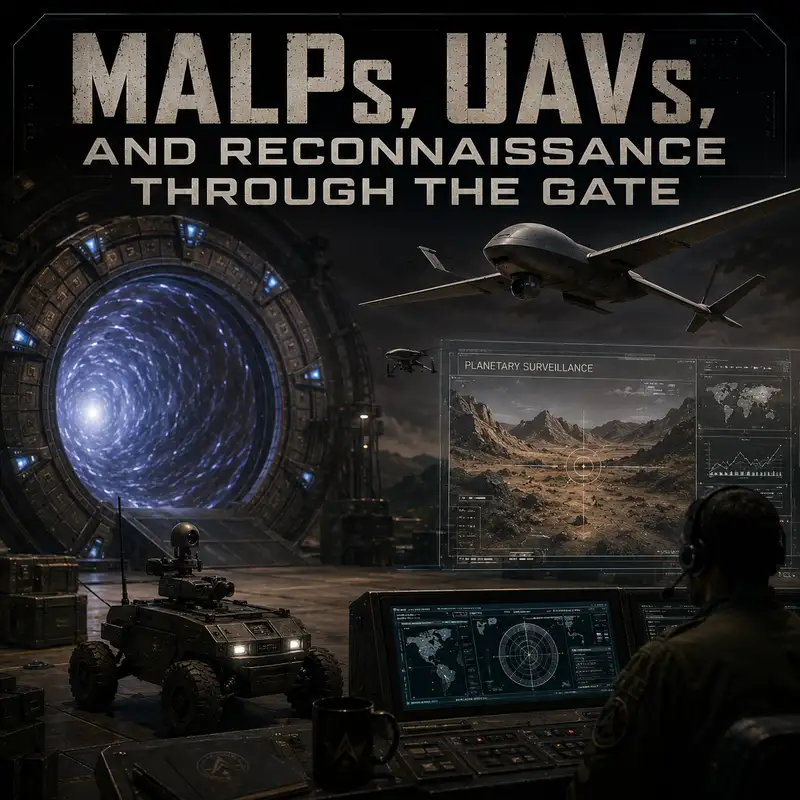
MALPs, UAVs, and Reconnaissance Through the Gate
The unmanned aerial vehicle had been launched to prevent a reconnaissance team from walking ten miles into unknown terrain. Its automatic terrain radar was functioning, its heat sensors had detected scattered warm areas, and its control link was designed specifically for long-range work through the Stargate. Then the signal weakened. The aircraft stopped responding, struck a living organism, and crashed. The machine had been sent because it was expendable. Its loss created first contact, an ecological emergency, and a recovery mission for S G One.
That incident captured the contradiction at the center of off-world reconnaissance. Unmanned systems reduced the number of people exposed to an unknown planet, but they did not make the mission neutral, invisible, or safe. A probe could be shot, captured, misled, infected, or used as a route back into Stargate Command. It could return accurate measurements and still produce the wrong conclusion. The central question was not whether a machine should go first. It was how much confidence commanders should place in what the machine could see.
The Stargate provided almost instantaneous transportation and almost no natural visibility. An address did not reveal whether the receiving ring stood in a forest, a fortified chamber, a frozen valley, an active battlefield, or beneath several meters of water. The event horizon was not a window. Once the wormhole formed, the control room could receive radio signals, but no one could look through the gate and inspect the destination with ordinary sight. Early expeditions therefore faced a familiar military requirement in an unfamiliar form. Someone, or something, had to cross the line of departure before headquarters could understand the landing zone.
The first Abydos expedition used a tracked vehicle to send back images and environmental data. It showed another Stargate and conditions compatible with human survival. It did not reveal Ra’s ship, the nearby population, or the political order controlling the planet. The machine answered its assigned questions. Planners nearly failed by treating those answers as a description of the whole world.
Stargate Command eventually standardized the mobile analytic laboratory probe, usually shortened to MALP. The MALP was an Earth-built ground vehicle carrying cameras, microphones, radio equipment, environmental instruments, and a remotely controlled drive system. Different missions used its sensors to examine atmosphere, temperature, radiation, ultraviolet levels, visible structures, possible life signs, and the immediate condition of the destination. It could also help locate the dial-home device and show whether the gate area offered enough room for a team to emerge without immediately falling, drowning, or meeting a squad of Jaffa at conversational distance.
Its greatest advantage was replaceability. Stargate Command could build, repair, modify, and lose MALPs without waiting for an alien ally. The equipment still required batteries, motors, cameras, radios, technicians, and spare parts, but Earth understood that industrial burden.
The standard sequence was straightforward. Stargate Command dialed the address, opened the outgoing wormhole, and drove the MALP up the ramp. Because radio and other energy signals could pass in both directions, operators could control the vehicle and receive telemetry while the connection remained active. They panned the camera, advanced beyond the event horizon, and examined the area around the receiving gate. The base commander then decided whether to send people, gather more data, or close the connection and mark the address for later review.
The procedure changed gate travel from a blind experiment into managed risk. It did not create certainty. Enemies could wait beyond the camera, settlements could lie miles away, and ships in orbit would remain unseen. Breathable air revealed nothing about local law, disease, or political intent. The MALP reduced the unknowns. It did not remove them.
The first category of information was physical access. Was the gate upright? Was the opening clear? Did the receiving area contain stairs, rubble, deep water, a cliff, or a wall immediately in front of the event horizon? After the Alpha Site was attacked, Stargate Command sent a MALP and saw little more than rocks. The vehicle had arrived through a gate knocked onto its face and fallen into the cavity excavated by the opening vortex. The feed confirmed that a rescue team could pass through. It could not confirm whether the dial-home device had survived or whether enemy forces were waiting beyond the rubble.
The feed could identify damage without solving it. A team might carry an alternate power source and attempt manual dialing, but that required time beside an exposed gate. Soldiers and engineers still had to secure the area and restore the route home.
The second category was environmental viability. MALP reports routinely described breathable air, temperature, radiation, toxins, pressure, and other conditions necessary for human entry. Those readings prevented obvious disasters and helped medical personnel prepare specialized equipment. They were also limited by unfamiliar biology and physics. On one apparently ideal world, the probe showed a beautiful garden and harmless conditions. The people entering it were captured by a technology that trapped their minds inside constructed experiences. The atmosphere had been safe. The mission environment had not.
At the enormous pyramid containing the crystal skull, the MALP reported breathable air and no complex life signs. It discovered unusual particle readings and entered a vast interior chamber. Then it reached a narrow bridge it was too large to cross. The camera could zoom toward the object on the far side, but the vehicle could not approach it. Later radiation readings continued to reach Stargate Command, yet the probe did not explain what had happened to Daniel Jackson or reveal the beings associated with the structure. Sensors had detected the measurable effects. They had not interpreted the event.
The same limitation applied when the Atlantis expedition prepared to leave Earth. The eight-chevron connection might be available only once because of its extraordinary power requirement. The command sent a MALP first and received evidence of oxygen, no measurable toxins, functioning life support, and a large intact room. That report supported the decision to move an entire multinational expedition through the gate. It could not confirm the city’s power reserves, its position beneath an ocean, or whether the travelers would ever return. A few minutes of telemetry carried the weight of a strategic deployment because no better reconnaissance option existed.
Mobility was the MALP’s most obvious weakness. The vehicle could roll across ramps, corridors, hard ground, and moderate terrain. It was less useful against narrow bridges, dense forest, steep slopes, deep mud, water, collapsed buildings, and obstacles designed to stop movement. A gate placed inside a structure might allow only a few meters of travel. A gate surrounded by stairs could turn a capable laboratory into an unusually well-instrumented piece of furniture.
The camera created another constraint. Operators saw only what the lens faced, from the height and angle the vehicle allowed. A hostile soldier could wait behind the gate, above a doorway, or beyond nearby vegetation. A quiet monitor was limited evidence, not proof of safety.
Once a team deployed, the MALP often remained near the gate as a communications and observation platform. Personnel could speak through its radio while the wormhole was active, show headquarters the scene around them, or reposition the camera toward a prisoner or damaged installation. On a world divided between the Bedrosians and Optricans, local forces captured the MALP and used it during a tense exchange with General Hammond. When the captors fired on the machine, Stargate Command lost its only visual link. The probe had become a negotiation channel and then a target.
On another world, inhabitants removed the MALP because they did not want S G One communicating with Earth. The loss immediately affected command and control. The team still possessed personal radios, but the mobile platform had marked the planned contact point and provided a stronger link near the gate. Removing it isolated the patrol and concealed what was happening from headquarters. A machine intended for reconnaissance had become part of the local political contest over who could speak to the outside.
MALPs could also contribute to tactical warning after deployment. At an Ancient site being guarded by S G Three and S G Five, personnel monitored equipment on the probe and detected multiple aircraft approaching at speed. That warning allowed the gate force to begin dialing Earth and alert S G One before Goa’uld bombers arrived. The MALP was no longer merely checking the atmosphere. It was supporting a defensive perimeter and the withdrawal of several teams under air attack.
The advantage came with an electronic signature. Control signals, radios, and telemetry announced that a capable force was using the gate. An enemy could monitor those emissions, locate the landing zone, or study procedures. A captured probe also proved that someone beyond the planet intended to return.
The Goa’uld understood the value of unmanned reconnaissance as well. On P three X six six six, an S G team encountered a Goa’uld probe among Ancient ruins. The team destroyed it, but the device had already transmitted a signal. The result was not merely the loss of enemy equipment. It was a warning that another power had found the site. Jaffa reinforcements followed, the battle expanded, and a routine survey became a casualty evacuation under ground and air attack. Counter-reconnaissance had failed by seconds.
Direct destruction was the simplest enemy response. On a planet where O’Neill was believed trapped with another team member, Stargate Command sent two MALPs. The second was struck by zat fire shortly after arrival. General Hammond then ordered an unmanned aerial vehicle launched. The sequence showed a mature reconnaissance system. When the slow ground platform could not survive or see far enough, the command shifted to an aircraft capable of searching a wider area.
The unmanned aerial vehicle solved the MALP’s range and terrain problems by leaving the ground. The small aircraft could pass through the Stargate at speed, use automatic terrain radar, carry cameras and other sensors, and fly search patterns well beyond the landing zone. It could cross rivers, forests, ridges, and broken ground that would stop a wheeled probe. For search and rescue, it could cover in minutes what a patrol might need hours to walk.
Airborne reconnaissance introduced its own gate requirements. The receiving side needed open airspace and enough distance for the aircraft to stabilize. A gate inside a sealed chamber, underwater site, or narrow ruin could make launch impossible. Every sortie also began on a predictable flight path, allowing defenders near the ring to prepare their fire.
The first major long-range test illustrated both promise and risk. The aircraft’s automatic terrain radar worked, and thermal sensors found warm areas that might have represented life. Then an unfamiliar low-frequency phenomenon interfered with control. The UAV crashed into a living organism roughly ten miles from the gate. S G One deployed to recover the flight recorder and discovered a population whose survival depended on a symbiotic relationship with the organism. Damage from the crash altered the sound sustaining that relationship and made the inhabitants ill.
The reconnaissance platform had not merely observed the environment. It had changed it. The mission also showed why recorded data mattered. Audio from the flight helped the team identify the changed frequency and develop a way to restore the biological system. The same machine that caused the crisis preserved evidence needed to solve it. Unmanned operations reduced immediate personnel risk, but they did not eliminate diplomatic or ecological responsibility for the effects of Earth equipment.
UAVs became especially useful when a MALP found a site but could not survey the surrounding region. After the crystal-skull incident, elevated radiation discouraged another ground team. Hammond authorized a UAV to conduct a long-range search around the pyramid instead. The decision reflected proper risk layering. The MALP had characterized the interior and continued reporting radiation. The aircraft would examine the larger area. Neither platform could explain the artifact itself, but together they reduced the need to send more people into a phenomenon no one understood.
During the effort to recover O’Neill, the UAV flew over the wooded terrain and reestablished direct radio contact. It confirmed that he was alive, that an injured man could not move, and that Jaffa forces surrounded the area. Then the signal was lost. The aircraft had converted uncertainty into actionable intelligence, but it could not remain overhead indefinitely or defeat the force on the ground. Search and rescue still required personnel, weapons, medical support, and control of the Stargate.
At the destroyed Alpha Site, a UAV flew search patterns over the hills while ground teams followed tracks and checked shelters. Samantha Carter was injured, concealed, and being hunted by one of Anubis’s armored warriors. The aircraft expanded the area commanders could examine and carried weapons that might assist the search force. The enemy shot it down. Carter then recovered an intact missile from the wreckage and improvised an attack. The reconnaissance asset failed in its intended role and became a source of battlefield salvage, which is a respectable second career for military hardware.
Later UAV missions combined observation with logistics and targeting. When Teal’c required tretonin on a world controlled by Moloc, Stargate Command prepared an aircraft to drop the medicine, circle back, and illuminate targets near the gate for missiles launched through the wormhole. The plan linked reconnaissance, resupply, and precision attack in one platform. Jaffa fire damaged the aircraft before it could complete the targeting run. Teal’c recovered the tretonin, but the missiles could not be guided without the airborne designator.
The UAV was not an independent solution. It depended on a launch crew, an open wormhole, communications, fuel, guidance, and a recovery or loss plan. If it went down, the medical package might land in enemy territory and the strike plan might collapse. Unmanned meant the crew stayed on Earth, not that support disappeared.
Neither MALPs nor UAVs were invisible. A ground probe entering through an active Stargate could be heard and seen. An aircraft crossing at speed was even more obvious. On a peaceful world, that appearance might be interpreted as exploration. On a defended world, it could resemble surveillance or the opening move of an attack. Stargate Command frequently decided that the force-protection benefit justified the intrusion. Local governments were not always consulted before a camera rolled into their territory.
This created an intelligence dilemma. The safest way to learn whether a world was inhabited was to send a probe. Sending the probe might be the act that alerted the inhabitants, damaged trust, or triggered a defensive response. When the Bedrosians captured a MALP, they demanded technical plans and Earth’s location because the machine appeared to support an enemy claim about their own history. When the electronic life-form later called the Entity encountered a MALP’s radio emissions, it interpreted them as an attack that had caused extensive damage.
The Entity incident was the most serious warning about contamination through reconnaissance. Stargate Command sent a probe to determine whether a world was safe. The radio energy harmed a civilization existing within an electronic environment. The Entity traveled back through the outgoing wormhole as energy, entered Earth’s computer systems, and eventually took control of Carter’s body. The MALP had protected a human scout from crossing first. It had also provided a technical pathway for a threat no biological quarantine procedure could detect.
That event changed the meaning of probe safety. An unmanned vehicle could carry contamination outward through radiation, sound, exhaust, lubricants, or electronic emissions. It could carry contamination home through code, energy, recorded data, or hardware retrieved from the destination. The absence of a human passenger did not break the chain of contact. It only changed the form of the chain.
Commanders also had to distinguish reconnaissance failure from evidence of danger. A lost signal might mean enemy fire, terrain masking, depleted power, damaged equipment, unusual radiation, or a civilization deliberately cutting communications. A motion detector might miss an immobile threat. A life-sign system might not recognize unfamiliar biology. A dark screen might indicate an unlit room rather than a destroyed probe. The correct response was not always to cancel, and not always to send a team. The machine provided data. Judgment converted data into policy.
Routine availability required maintenance. Probes returned with damaged cameras, contaminated wheels, depleted batteries, cracked housings, and alien material attached to components never designed to leave Earth. Technicians repaired and reconfigured them because reconnaissance doctrine fails quickly when the entire fleet is waiting for parts.
The machines also competed for gate time. A MALP required an outgoing connection long enough to cross, maneuver, and transmit useful information. A UAV needed launch preparation and a clear receiving path. During emergencies, those minutes could delay a rescue force or occupy the only route while an incoming team tried to return. The Stargate provided galactic reach through one narrow portal. Even reconnaissance had to be scheduled through the same doorway used for troops, refugees, supplies, diplomats, and casualties.
MALPs and UAVs did not replace S G teams because reconnaissance required interpretation. A camera could show an armed formation but not determine whether it was a ceremonial guard, a police unit, or an army preparing an ambush. Sensors could identify a mineral deposit but not establish who owned it. A UAV could locate a village without understanding its government. Daniel Jackson, Teal’c, Carter, and military commanders were still required to connect imagery with language, technology, enemy doctrine, and local intent.
Their real achievement was procedural. Before Stargate Command, Ernest Littlefield crossed an active wormhole in a diving suit because no one had another way to learn what was beyond it. The later program sent expendable machines first, analyzed the return, prepared medical and military support, and accepted human risk only after narrowing the unknowns. That was not glamorous, but it was the difference between experimentation and an expeditionary system.
The final image is a control room watching a grainy feed from another planet. The atmosphere is breathable. The gate is upright. No one is visible. A path leads beyond the edge of the camera, and the commander must decide whether the quiet scene represents safety, concealment, or a problem the sensors do not know how to name. The probe goes first so that a human being does not have to. It can never decide whether the human being should follow.