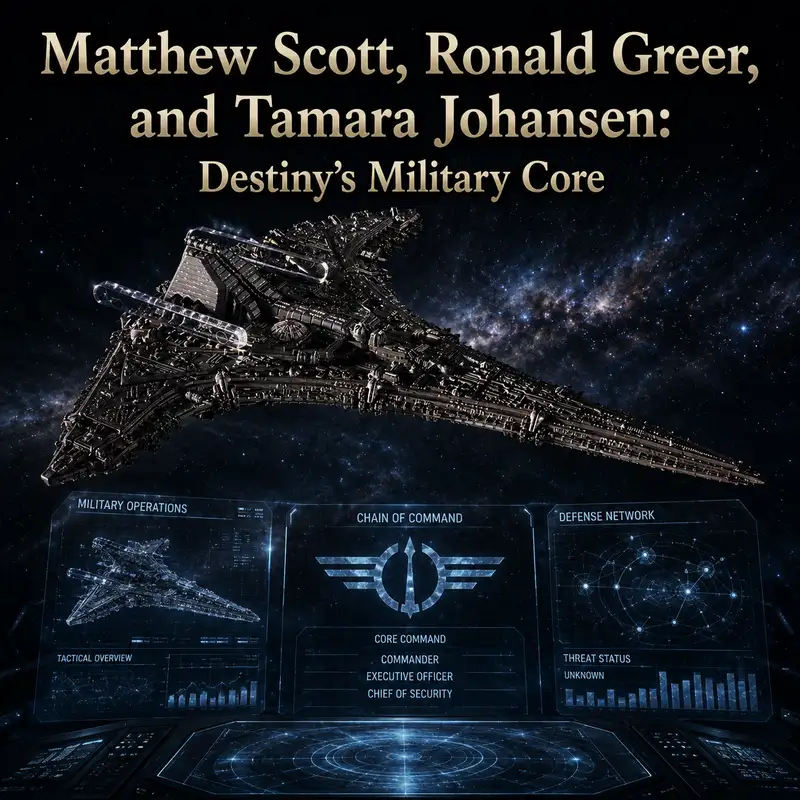
Matthew Scott, Ronald Greer, and Tamara Johansen: Destiny’s Military Core
Scott and Greer came back through Destiny’s airlock after crossing the hull in spacesuits, exposed to radiation from a nearby pulsar and cut off from most of their own people. The Lucian Alliance controlled the gate room. Colonel Everett Young and the majority of the expedition had been forced onto a planet. In the infirmary, Lieutenant Tamara Johansen lay unconscious after being shot while serving as a medic under enemy control. Destiny’s formal command structure had been broken into isolated pieces. Yet Scott began organizing a counterattack, Greer moved through the corridors as its tactical edge, and Johansen’s condition became one of the human costs they were fighting to reverse. The two officers and their senior enlisted leader had reached their clearest roles by surviving the collapse of every plan that had brought them there.
Matthew Scott, Ronald Greer, and Tamara Johansen were not the entire military contingent aboard Destiny. Young remained the commanding officer, and personnel such as Vanessa James, Hunter Riley, and other Air Force and Marine members carried essential responsibilities. The three nevertheless formed the expedition’s military core because they supplied its most persistent operational functions. Scott provided junior command and led off-world missions. Greer supplied senior enlisted discipline, security, and ground-combat experience. Johansen preserved the force through medicine while bridging the divide between military orders and civilian survival. None had been selected as part of a balanced ship’s crew. Catastrophe placed them together, then required them to become the command team, tactical element, and medical service that Destiny did not already possess.
Matthew Scott entered the crisis as a first lieutenant in the United States Air Force. He was young for the authority he would inherit and had experienced more personal loss than his outward calm suggested. His parents died when he was a child, and a priest raised him until alcoholism claimed that guardian as well. Scott once considered the priesthood, then entered a different form of service. His faith remained part of his identity, but it did not make him certain or untouched by fear. He was a junior officer with training, compassion, and enough humility to know when he lacked an answer. Destiny would repeatedly demand decisions before experience had time to catch up with rank.
At Icarus Base, Scott was not the expedition commander. Colonel David Telford held that assignment, while Young commanded the installation. When the base began collapsing, Young chose Scott to cross first and take control of the receiving side. Scott entered an unknown gate room with no reconnaissance report and immediately began clearing people from the ramp, treating the Stargate as both an escape route and a lethal traffic problem. Young arrived critically injured and placed him in charge. Scott’s first command did not begin with a briefing, a roster, or even confirmation that the atmosphere would remain breathable. It began with wounded personnel, flying equipment, darkness, and more evacuees arriving faster than he could organize them.
His response established the style he would carry through the expedition. Scott gave direct orders without pretending to understand Destiny. He organized three-person search teams, rationed radios and flashlights, and required regular reports. He relied on specialists rather than competing with them. That approach suited a ship where the commissioned chain of command knew less about the platform than the scientists examining its consoles. Scott’s strength was not technical mastery. It was his ability to keep frightened people moving while converting incomplete advice into action. His weakness was that empathy could become hesitation, especially when Chloe Armstrong or another person close to him was involved. He commanded through relationships, which built loyalty but also made every casualty personal.
Greer entered Destiny from the opposite direction. He was a master sergeant in the United States Marine Corps, an experienced noncommissioned officer whose discipline in combat coexisted with serious problems outside it. His father had returned from war psychologically damaged and became abusive toward both Ronald and his mother. Greer learned early that safety depended on endurance, vigilance, and the ability to absorb pain without showing it. The result was a soldier with exceptional composure under fire and a temper that could turn disagreement into violence. Those traits were not separate parts of his personality. They came from the same defensive structure, useful in a corridor fight and dangerous in a briefing room.
When the Lucian Alliance attacked Icarus, Greer was confined and awaiting court-martial after assaulting Telford. Young released him because a base under attack needed a Marine more than it needed a prisoner. Greer helped recover trapped personnel, fought through the evacuation, and crossed immediately before Young. His presence aboard Destiny was therefore almost accidental even by the standards of the larger accident. He had not been chosen by Rush as an ideal expedition member. He had been considered a disciplinary liability. Within hours, he was counting the surviving weapons, assigning them across search teams, and giving Scott the realistic security picture on which the lieutenant’s orders depended. The man least welcome on the original roster became one of the people the new crew could least afford to lose.
The relationship between Scott and Greer became a classic officer and senior-enlisted partnership, although it was less formal than any professional military school would have preferred. Scott held command authority. Greer translated that authority into movement, security, and force. He recognized threats quickly, enforced boundaries, and told Scott what frightened or indecisive subordinates often would not. Scott, in turn, gave Greer restraint and a legitimate chain through which to act. More than once, Scott physically or verbally checked Greer before anger became a strategic problem. More than once, Greer steadied Scott when the lieutenant doubted Young or himself. Their friendship worked because neither man supplied what the other already possessed.
Johansen’s path was different again. She was a first lieutenant in the Air Force and a field medic at Icarus Base, working beneath the base’s senior physician. She wanted to become a doctor but had not been able to afford medical school earlier in life. By the time Icarus fell, she had obtained a scholarship and was preparing to leave the Stargate Program. She had one foot outside the institution when the attack made departure impossible. The evacuation killed Doctor Simms and carried Johansen to Destiny as the only surviving person with substantial medical training. A medic who had expected to become a student was suddenly treated as the chief medical officer of an isolated intergalactic expedition.
The difference between those positions was enormous. Johansen could stabilize trauma, manage field injuries, and perform emergency care. Destiny required diagnosis, surgery, obstetrics, psychiatry, infectious-disease control, long-term treatment, and medical administration. She lacked a hospital staff, a modern laboratory, reliable pharmaceuticals, and the ability to evacuate a patient to a higher level of care. Ancient devices existed in the infirmary, but access and comprehension came slowly. Every patient arrived at the highest medical facility available because there was nowhere else to send one. The ship had crossed billions of light-years. Medical evacuation remained approximately the distance from one side of the infirmary to the other.
The trio’s division of labor appeared within the first hours. Scott established order around the gate room and assumed temporary command. Greer inventoried weapons and became the expedition’s security backbone. Johansen treated Young, broken bones, head injuries, and the casualties brought from Icarus. Their functions overlapped without becoming interchangeable. Scott could direct a search but could not decide whether a patient was fit for duty. Johansen could issue medical restrictions but could not personally secure every damaged compartment. Greer could clear a corridor but could not determine which Ancient system the science team should activate. The military core worked because it linked command, force protection, and preservation of life rather than pretending one form of authority could replace the others.
The first planetary supply operation tested that arrangement immediately. Failing air scrubbers forced Scott to lead a team through the gate to a desert world in search of material that could remove carbon dioxide from Destiny’s atmosphere. He had a fixed countdown, limited water, no orbital support, and scientists who understood the mineral requirement better than he did. Greer carried an exhausted Rush back toward the gate, then returned into the desert to find Scott rather than accepting that the lieutenant was lost. Scott eventually located the needed limestone, and Greer helped bring both the officer and the material home. The mission succeeded because the officer pursued the objective, the specialists identified the resource, and the senior noncommissioned officer refused to leave a man behind.
Greer’s loyalty was equally complicated. He trusted Young with a consistency Scott sometimes found difficult to understand. That confidence was not simple obedience. Greer had seen Young release him at Icarus, rely on him under fire, and judge him by performance after everyone else had reasons to see only a disciplinary record. In return, Greer became Young’s most reliable tactical enforcer. During the civilian seizure of sections of Destiny, he helped the military retake control. His efficiency protected the ship, but the operation also revealed the danger of using armed force inside a community that had no separate civilian space. Greer could restore a corridor faster than the leadership could restore legitimacy.
Scott often stood between those two levels of command. He supported Young, but he also heard civilian concerns, maintained close relationships outside the military, and understood that Destiny could not operate as a permanent detention facility. He was the officer most likely to carry an order from the colonel into a mixed team and make it sound like a practical requirement rather than a declaration of occupation. That made him valuable and vulnerable. Personal involvement with Chloe affected his judgment during her alien transformation, while his relationship with Lieutenant James before the evacuation complicated the small military community. Scott was not emotionally detached enough to be an ideal staff officer. He was emotionally present enough to hold people together.
Johansen occupied an even more difficult boundary. Her medical duties required her to treat military personnel, civilians, prisoners, and enemies according to need. Her commission placed her inside Young’s command structure, while her patients depended on her willingness to oppose command decisions that endangered them. An earlier affair with Young, and the pregnancy that followed, created a profound conflict inside that relationship. Johansen still had to brief him as a medical officer, treat him as a patient, and serve a crew aware that the commanding officer had personal reasons to care about her safety. The circumstances would have challenged a fully staffed military hospital. Destiny provided one medic, limited privacy, and no reassignment office.
The Lucian Alliance boarding action forced all three roles to operate under enemy pressure. Scott and Greer used spacesuits to bypass controlled sections of the ship and reentered through an airlock while pulsar radiation threatened the hull. They gathered intelligence through kinos, rescued members of the science team, and fought through confined corridors where a missed shot could damage systems nobody knew how to replace. Johansen was compelled to treat Alliance casualties, including Commander Kiva, because the invaders needed her skill even while distrusting her uniform. She was shot during the crisis and lost the child she was carrying. Tactical success eventually restored the ship. It could not restore what the battle had taken from its medical officer.
That operation showed why the trio mattered more than any formal table of organization. Scott made decisions with most senior leaders absent. Greer converted those decisions into a mobile counterattack. Johansen’s value was recognized even by the force occupying the ship, because controlling Destiny meant little if wounded personnel could not be kept alive. The Alliance had brought armed troops and a plan for seizure. It had not brought a sustainable medical service or enough technical expertise to operate without the original crew. The defenders won partly because the expedition’s military core was integrated with civilians and scientists rather than existing as a separate guard force.
The treatment of Dale Volker revealed how far Johansen’s improvised medical service had developed. Johansen diagnosed end-stage renal disease and concluded that he required a transplant. Destiny had no transplant team, conventional operating theater, or organ bank. Greer proved compatible and volunteered a kidney with very little concern for his own comfort. Johansen carried out the procedure using the Ancient medical database, the ship’s surgical equipment, and personnel she trained to assist. The operation saved Volker, but it also exposed the risk concentrated in two people. The security force temporarily lost its strongest field operator, and the medical service placed its only practitioner at the center of a procedure she could not hand to another surgeon.
Greer’s donation complicates the image of him as merely the expedition’s weapon. He could be aggressive, suspicious, and frightening when he believed a threat was present. He was also intensely protective of the people he accepted as his own. That protectiveness extended beyond the military and beyond personal friendship. He volunteered part of his body for a scientist whose work helped keep the ship functioning. Afterward, he experienced fear in a way that unsettled him. During a later hunting mission, he hesitated to fire and admitted that the darkness experienced during surgery had made death real to him. His courage did not disappear. It became informed by fear rather than protected from it.
The same hunting operation brought the entire military core into one coherent test. An alien predator abducted Johansen and Corporal Reynolds. Young took Greer and a mixed rescue party to track them, but ordered Scott to remain aboard and command Destiny. Scott wanted to join the search. Accepting the order meant recognizing that his duty was larger than the people in danger. On the planet, Johansen treated Reynolds’s injured leg, repaired a damaged radio, built a defensive position, and refused to abandon him. Greer overcame his own uncertainty, followed the trail, and made contact. The rescue succeeded because Scott held the ship, Greer closed with the threat, and Johansen kept the casualty alive long enough to be recovered.
Their roles also provided three different forms of morale. Scott offered reassurance and a sense that authority could remain humane. Greer offered confidence that someone would stand between the crew and whatever came through the corridor. Johansen offered the promise that injury did not automatically mean abandonment. None of those assurances was absolute. Scott could not guarantee rescue, Greer could not defeat every enemy, and Johansen lost patients she would have saved on Earth. Their value came from continuing to perform despite those limits. On Destiny, morale was not optimism. It was evidence that the next crisis would find someone already moving toward it.
The trio’s relationship with Young prevented the expedition from depending entirely on one damaged commander. Scott could take over when Young was injured, absent, or psychologically exhausted. Greer gave Young a trusted senior enlisted leader who could read the mood of the military personnel and execute difficult orders. Johansen could challenge him from a medical position that neither Scott nor Greer possessed. Their loyalty was real, but it was not identical. Scott questioned, Greer committed, and Johansen insisted on the human consequence. Together, those responses supplied a rough form of command review aboard a ship without a proper staff, judge advocate, inspector general, or medical board.
They also helped absorb former Lucian Alliance personnel into the expedition. Scott and Greer initially guarded prisoners who had tried to seize Destiny, while Johansen treated their wounded and later worked alongside individuals such as Varro. Cooperation did not erase the boarding action or the death it caused. It recognized that the ship lacked the food, space, and manpower for permanent separation. Greer’s suspicion remained useful, Scott’s operational pragmatism made joint missions possible, and Johansen’s medical neutrality created contact that was not based solely on coercion. The transition from enemy force to controlled auxiliary was one of Destiny’s most difficult security problems, and it required all three forms of authority.
As the automated drone campaign tightened around Destiny, the military core adapted again. Scott led shuttle and gate operations where the enemy could predict access points. Greer conducted boarding, recovery, and security missions while operating with fewer people than a conventional unit would assign to one damaged compartment. Johansen treated combat injuries, radiation damage, and the long consequences of earlier missions, including Lisa Park’s blindness. The drone threat could not be solved by courage alone, but courage remained necessary to execute the science team’s solutions. The bridge calculated routes and shield frequencies. Scott, Greer, and Johansen dealt with what happened when those calculations met bodies.
Their record was not spotless. Scott’s personal attachments sometimes affected his judgment, and his youth showed when command required emotional distance. Greer’s temper repeatedly approached the line between force and abuse. Johansen’s relationship with Young compromised the appearance of impartiality, while exhaustion and inadequate training increased the risk of medical error. None of them had the personnel, equipment, or institutional support their duties normally required. That context explains their failures without erasing responsibility. Destiny did not make professional standards irrelevant. It made meeting them harder and made every lapse more dangerous because no replacement organization waited nearby.
By the time the drone blockade forced the crew into stasis, the three had become something more durable than the roles they carried through the gate. Scott was no longer simply a junior officer pushed forward by a wounded colonel. Greer was no longer the Marine released from confinement because the base needed another rifle. Johansen was no longer a medic waiting to depart for medical school. They had become the expedition’s operational continuity. A command decision could pass through Scott, become action through Greer, and remain connected to human survival through Johansen. Their authority came from rank, but their legitimacy came from repeated performance when rank alone could not keep anyone alive.
Destiny’s military core was effective because it was incomplete in three complementary ways. Scott had authority without long command experience. Greer had experience and force without independent command authority. Johansen had responsibility for life without the medical system normally required to protect it. Catastrophe made each weakness dangerous, then made the other two people part of the answer. They did not turn Destiny into a conventional military vessel. They made it possible for a mixed, unwilling expedition to function as one crew. At the edge of the universe, military power was not measured only by weapons or rank. It was measured by whether someone could lead the mission, defend the people, and keep the wounded alive long enough to face the next decision.