Michael Kenmore: Prisoner, Experiment, and Warlord
An incoming wormhole opened in Atlantis, and the identification code belonged to a team expected home from a routine mission. The gate shield dropped. A Puddle Jumper crossed the event horizon and entered the gate room. The officer whose code had been transmitted was not aboard. Michael was. He had returned with a small force of hybrid soldiers, a stolen Ancient craft, and enough knowledge of Atlantis security to trap the control room behind an improvised force field. The prisoner once told that he was a human lieutenant had become a commander capable of penetrating the city that invented him. His final assault revealed the full arc of his transformation. Atlantis had tried to turn an enemy human. Instead, it helped create a warlord who understood both sides of the Pegasus war and belonged to neither.
Michael Kenmore was not his original name. The surviving record never establishes the name he used as a Wraith, his place within a hive, or the life he lived before capture. Atlantis personnel selected him as the first involuntary test subject for Carson Beckett’s Wraith retrovirus, a treatment intended to suppress the Iratus-derived portions of Wraith biology and leave a physically human patient behind. The experiment had an immediate military purpose. A transformed Wraith could no longer feed in the usual way, would lose important physical advantages, and might become easier to control. For an expedition facing hive ships it could not defeat in a sustained war, biological conversion appeared to offer a way to neutralize enemies without destroying every one of them. The concept was scientifically ambitious. The plan for managing the person created by it was considerably less developed.
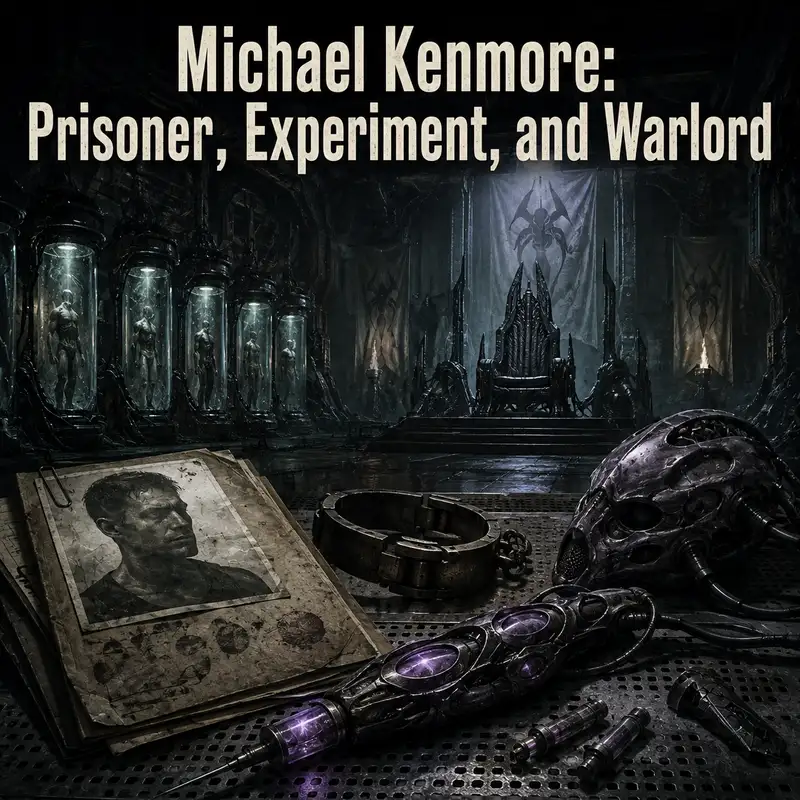
When the subject woke, the expedition did not tell him he had been a Wraith. He was informed that he was Lieutenant Michael Kenmore, a member of the Atlantis military contingent who had been captured during a mission and rescued after behaving heroically. His missing memories were blamed on trauma. A photograph provided fictional parents in Texas. Personal possessions gave the invented quarters a plausible history. Teyla Emmagan told him they had been friends. Daily injections required to prevent his Wraith traits from returning were described as insulin for diabetes. The deception involved command personnel, medical staff, security officers, and people Michael was encouraged to trust. It was not one lie told during an emergency. It was an identity constructed as part of the experiment.
The false biography solved an immediate containment problem by postponing the moment when Michael understood what had happened. It created a larger intelligence problem because his instincts and knowledge survived. He understood elements of Wraith technology that a human officer should not have recognized. He experienced dreams and reactions inconsistent with the history he had been given. Ronon Dex treated him as an enemy even while others insisted he belonged among them. Security followed him closely, which is rarely the best way to persuade a man that everyone around him considers him ordinary. Michael eventually found medical records and visual evidence of his transformation. The expedition had changed his appearance and disrupted his memory, but it had not erased his ability to compare evidence.
Once confronted, Atlantis acknowledged the truth. Michael understood that the person called Lieutenant Kenmore had never existed. He also understood that the treatment was not permanent. Without repeated medication, his Wraith physiology would return. Command considered increasing the dosage and compelling continued treatment. The possibility of suppressing his recovered memories again remained part of the discussion. From the expedition’s perspective, release was impossible because he knew Atlantis had survived the siege. Keeping him as a Wraith was dangerous, and execution would turn a medical project into a very short detention policy. From Michael’s perspective, the people who had altered his body were now explaining why they alone possessed the authority to decide what he would become next.
He escaped once inside Atlantis, killing Sergeant Cole during the attempt, but was recaptured. The killing demonstrated that Michael was not a passive patient and that the expedition’s security concerns were real. It did not resolve the origin of the crisis. He was moved to an off-world site, where Teyla attempted to reach the part of him she believed remained capable of trust. Michael used their connection to manipulate her, seized her as a hostage, and escaped again. His first independent actions mixed fear, violence, and calculation. He did not yet command an army or possess a political program. The available evidence suggests that he wanted to prevent another forced transformation and return to the only society he remembered as his own.
The Wraith did not restore him. His altered biology marked him as contaminated. He later described being discovered as partly human, declared unclean, and nearly killed. That rejection completed the isolation Atlantis had begun. Humans regarded him as a Wraith whose instincts made him unsafe. Wraith regarded him as a creature carrying an unacceptable human element. Michael could move between the two cultures, understand both, and claim membership in neither. This condition did not predetermine what he would become, but it removed the ordinary restraints of loyalty. A commander without a state can still have enemies, and Michael now had two civilizations available for the role.
His next return to Atlantis came as an intermediary for a Wraith faction during the civil war among the hives. The faction proposed using Beckett’s retrovirus against rivals, converting enemy crews into humans who could then be consumed. Michael’s presence made the offer possible because he understood the treatment, the expedition, and the political fear surrounding both. The alliance was never a peace agreement. It was a bargain among belligerents who expected to betray one another when the balance improved. The Wraith faction inserted malicious code into Atlantis systems, stole information, and gained data useful for reaching Earth. Michael then helped Atlantis personnel oppose those hives, not because he had forgiven the expedition, but because his supposed allies had also treated him as expendable.
During the resulting crisis, the retrovirus was dispersed aboard a damaged hive ship. Just under two hundred Wraith were transformed, placed in stasis, and transported toward an isolated settlement. Michael, who had helped the expedition defeat the hives, was also brought back under guard. Atlantis then subjected him to the retrovirus a second time. Ronon stunned him, and Beckett administered the treatment without consent. Whatever uncertainty had surrounded the first experiment no longer applied. Michael understood the process, rejected it, and was forced through it again. Atlantis had converted a hostile prisoner into a human body, restored his Wraith form through interrupted treatment, and then converted him once more. The procedure was becoming less like medicine and more like an adjustable detention setting.
The transformed Wraith were settled on a planet without a Stargate and told that disease had destroyed their community and damaged their memories. Atlantis supplied daily medication while hoping the group could eventually farm and support itself. The arrangement lacked a permanent cure, a lawful status for the settlers, and a credible answer to what would happen if they discovered the truth. Michael recovered enough memory to organize resistance. He killed a fellow settler who threatened to expose the plan, captured Beckett, and allowed several subjects to revert. A Wraith hive altered course toward the planet, drawn by the recovering population and the possibility of reclaiming them.
Atlantis had buried a Mark Nine nuclear device beneath the settlement as a failsafe. Michael found and disabled it. The weapon confirmed his darkest interpretation of the project. The expedition spoke of creating human lives while preparing to erase the entire population if control failed. When rescue operations collapsed and the approaching hive threatened to recover the subjects, an Atlantis-controlled hive fired on the camp from orbit. Many of the people below still appeared human and believed Atlantis had saved them from a plague. Sensors later detected no survivors. Michael had escaped. The colony did not merely fail. It reinforced his belief that neither Wraith nor humans would accept altered beings as equals.
That experience became the foundation of Michael’s ideology. He no longer sought readmission to a hive or recognition from Atlantis. He concluded that he would survive only by creating a population designed to belong to him. On a hidden world, he began reversing the logic of Beckett’s experiment. Instead of suppressing Wraith traits to produce ordinary humans, he used Iratus bugs, human subjects, embryo manipulation, and Wraith knowledge to create creatures with greater strength and aggression. The early results were unstable and physically monstrous. They were also proof that Michael could reproduce the method that had been used on him and redirect it toward his own military requirements.
The transition from fugitive to warlord depended on more than biology. Michael acquired laboratories, a cruiser, weapons, transport, prisoners, coerced specialists, and secure sites beyond ordinary gate surveillance. He gathered intelligence on both Wraith movements and Atlantis operations. His forces did not resemble a conventional state military. They had no civilian government, recognized territory, or public legitimacy. Authority rested on Michael’s personal control of the research, the ships, and the transformed soldiers. That made him a warlord in the precise sense. He commanded armed followers and strategic resources outside any larger political order, using violence to build the population he intended to rule.
His later hybrids were more sophisticated than the first creatures. Michael refined the retrovirus to create human-looking soldiers with enhanced strength and Wraith-derived abilities but without the ordinary need to feed. His altered appearance and retained abilities suggested that he had also applied parts of the research to himself. He regarded this mixed condition not as contamination but as superiority. The Wraith had rejected him for being too human. Atlantis had rejected him for remaining Wraith. Michael turned both accusations into a claim that a new species should replace the old powers of Pegasus.
The Athosians became central to that program. Michael abducted the population, including Kanaan, Teyla’s partner and the father of her unborn child. He transformed Kanaan and others into hybrids, then used Kanaan’s connection with Teyla to manipulate her perceptions across interstellar distance. Teyla’s inherited Wraith genetic traits already made her unusual. Her child represented a combination Michael believed could strengthen his research and his telepathic control. The kidnapping was therefore personal, scientific, and strategic at once. Teyla was one of the few people who had attempted to understand him, which did not inspire restraint. It made her and her family more valuable targets.
Michael also cloned Carson Beckett from genetic material taken while the physician was his prisoner. The clone possessed Beckett’s appearance, much of his memory, and the expertise Michael required. He was forced to improve the Hoffan drug, a treatment that made humans poisonous to feeding Wraith but killed a substantial portion of those who received it. Michael’s version reduced the immediate death rate to roughly thirty percent, still a catastrophic cost. He distributed the agent among human populations without informed consent, apparently through ordinary supplies. Atlantis’s initial assessment projected about two hundred thousand deaths across eight known worlds, assuming the outbreak did not spread farther.
The weapon served a coherent strategy. Infected humans killed Wraith who attempted to feed on them. Hives lost warriors and access to reliable feeding grounds. Fear spread faster than medical certainty, encouraging Wraith factions to blame one another and intensifying the civil war. Michael could then attack weakened hives, seize equipment, and recruit or manufacture additional forces. Human deaths were not accidental from his perspective. They were the accepted cost of denying resources to the Wraith. He had transformed the entire human population of Pegasus into strategic terrain, with villages functioning as biological minefields whether their inhabitants agreed or not.
His methods reflected the original Atlantis experiment with disturbing consistency. Beckett’s team had treated biology as a military vulnerability, memory as an obstacle, and identity as something that could be overwritten for a larger purpose. Michael adopted the same premises and removed the remaining restraints. He altered prisoners, fabricated loyalties, used medical dependence as control, and judged consent irrelevant when survival was at stake. The resemblance does not make the two programs morally identical. Atlantis sought to defend human populations from predation. Michael pursued personal dominion through mass coercion. It does explain why he understood the expedition’s logic well enough to weaponize it.
An alternate future showed how dangerous that strategy could become. In the branch created when John Sheppard was absent from critical events, Michael exploited the poisoned food supply and the fighting among the hives. Within less than a year, he brought the Wraith close to collapse. He then returned to devastated human worlds, converted the strongest survivors into hybrids, and exterminated those he considered useless. That future was erased and does not belong to the final prime chronology. It remains important as an intelligence assessment. Michael’s plan was not merely the fantasy of an injured prisoner. Left without effective interference, it could reorganize the balance of power across Pegasus.
Sheppard returned with knowledge of that possible future, allowing Atlantis to act before Michael’s program matured. An operation against his main facility left the compound in ruins, but Sheppard, Ronon, and several others survived beneath the wreckage. Michael escaped with Teyla and withdrew aboard his cruiser. She gave birth while captive. Kanaan broke from Michael’s control long enough to help the prisoners resist, and an Atlantis team boarded the ship using a cloaked Puddle Jumper. Teyla and her child were recovered. The Daedalus destroyed the cruiser, but Michael stole the Jumper before the ship was lost. Once again, the expedition eliminated his infrastructure without eliminating the commander.
The loss changed Michael’s position. His laboratories, cruiser, and large-scale program had suffered a major defeat. He still possessed intelligence, technical knowledge, hybrid followers, and an Ancient craft capable of passing through the Atlantis gate shield when paired with a valid identification code. He used those assets for a final raid. By transmitting the code assigned to Major Nelson’s team, Michael brought the stolen Jumper directly into Atlantis. A modified Wraith stun-pulse system combined with the Jumper’s cloak created a force field around the gate and control room. The assault was small, precise, and based on security procedures learned through years of contact with the expedition.
The mission revealed both his skill and his decline. A strategic commander might have preserved the remaining force, rebuilt laboratories, or continued biological attacks from concealment. Michael instead risked everything to seize Teyla’s son and punish Atlantis. Personal grievance had narrowed a galactic program into a hostage operation. His technical preparations were still formidable. He controlled the gate room, isolated defenders, and held the city’s most important transportation node. Yet his plan depended on one captured craft and a small group of hybrids inside an enemy base. The warlord had become tactically sophisticated and strategically consumed by the people who had made him.
Rodney McKay defeated the force field by using the Stargate’s unstable opening vortex to destroy the Jumper positioned above it. With the barrier gone and his soldiers defeated, Michael retreated through the city. Sheppard fought him high on an Atlantis tower. Michael survived blows that would have incapacitated an ordinary human and ended hanging above the city. Teyla confronted the man who had abducted her people, transformed Kanaan, imprisoned her during childbirth, and tried to take her son. She caused him to fall. No surviving evidence in the core record establishes another escape.
Michael’s campaign became a diplomatic liability for Atlantis even before his death. When representatives of Pegasus worlds placed the expedition on trial, his plague and hybrid program were presented as consequences of Earth intervention. The accusation had an undeniable factual core. Atlantis had selected him as its first Wraith test subject, created the false Kenmore identity, transformed him twice, and failed to contain the results. The coalition’s argument sometimes treated every later atrocity as though the expedition had ordered it. That went too far. Institutional responsibility for creating a foreseeable danger is not the same as personal responsibility for every crime the danger later chooses to commit.
Michael remained accountable for those choices. Rejection did not require him to kidnap civilians. Medical abuse did not compel him to clone Beckett, poison inhabited worlds, transform prisoners, or plan the extermination of those he judged weak. His victimization explains the structure of his grievance and the tools he selected. It does not acquit him. The most accurate judgment is that Atlantis created the conditions from which Michael emerged, then repeatedly deepened them through secrecy, coercion, and failed containment. Michael converted those conditions into a deliberate project of conquest.
The name Michael Kenmore began as a control measure, a fictional biography intended to make an experiment easier to manage. It became the only identity its subject could fully claim. The Wraith denied him his old place. Atlantis could not make the invented lieutenant real. Michael answered by building soldiers who would never question where they belonged because he would design both their bodies and their loyalties. That was the central contradiction of his life. He fought against being defined by others by denying the same freedom to everyone under his power.
Atlantis tried to turn an enemy human and succeeded only in changing his body. The prisoner it named Michael turned that violation into a doctrine, then chose every atrocity required to enforce it. He was neither merely Atlantis’s victim nor merely a Wraith monster. He was a warlord created where biological warfare, institutional fear, and personal vengeance met. Atlantis gave a nameless prisoner a human name. Michael made that name one the entire Pegasus galaxy learned to fear.