Michael’s Hybrids: Building a New Species for War
Carson Beckett had a pistol aimed at Michael’s chest and every reason to fire. His hand shook. His expression showed that he wanted to pull the trigger, but his body would not obey. Michael calmly explained that Beckett, like the other beings he had created, remained open to his mental influence. The moment revealed the real purpose of the hybrid program. Michael was not merely breeding stronger fighters. He was designing a population whose physical abilities, biological needs, and loyalty could all be controlled by one commander.
Michael’s objective was larger than revenge against Atlantis or survival outside Wraith society. He intended to build an army that would replace the Wraith as the dominant power in Pegasus. The new soldiers would possess abilities beyond those of normal humans, retain enough intelligence to operate advanced technology, and avoid the Wraith’s greatest logistical weakness: the need to feed on human life. Michael called them a new race. In practice, they began as manufactured troops produced through captured bodies, coerced science, and laboratories hidden across the gate network.
The program grew directly from Michael’s own transformation. Atlantis had used Carson Beckett’s retrovirus to suppress the Iratus-derived portions of a captured Wraith and leave a physically human subject behind. The treatment disrupted memory, required repeated medication, and never gave its unwilling patient control over the process. Michael later reverted only partway and was rejected by both humans and Wraith. He responded by reversing the logic of the experiment. If Atlantis could force a Wraith toward humanity, he would force human and Iratus biology toward a form that served him.
Michael lacked nearly everything normally required to create a new military power. He had no recognized government, secure homeworld, industrial population, or dependable alliance of hives. What he possessed was Wraith biological knowledge, access to stolen equipment, a talent for coercion, and experience as the subject of a transformation program. His solution was to make biology perform the work of recruitment and political organization. Instead of persuading followers to accept his authority, he would construct followers whose bodies made resistance difficult and whose survival did not depend on Wraith feeding grounds.
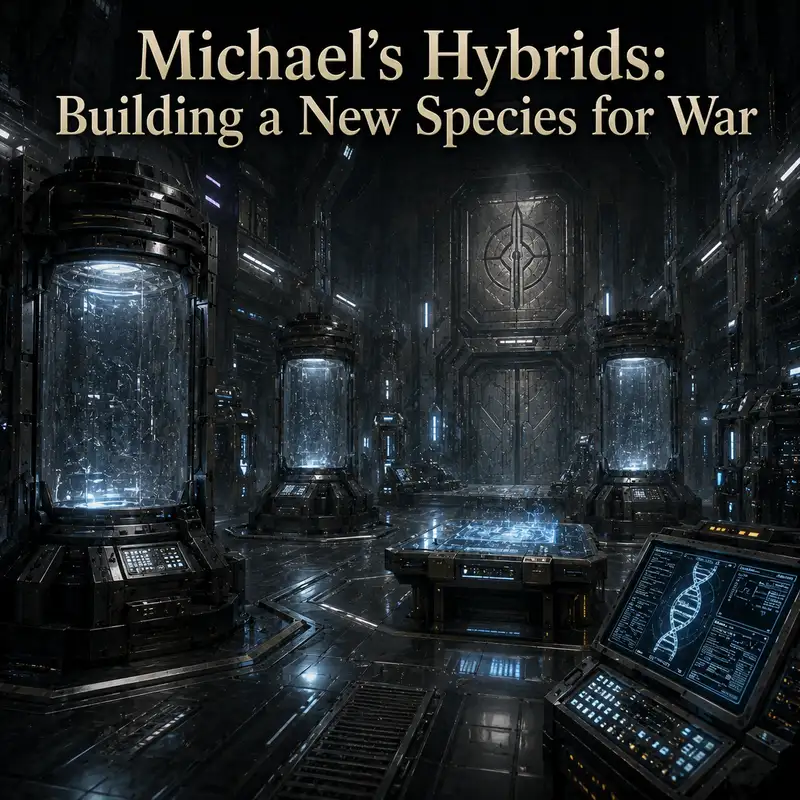
His first major laboratory was hidden beneath the abandoned settlement of the Taranians. The population had disappeared, Atlantis reconnaissance teams had been killed, and sections of the underground complex were protected from ordinary life-sign detection. Inside were incubation rooms, human corpses, Iratus bugs, eggs, experimental compounds, and creatures large enough to tear through armed Marines. The facility was not an improvised torture chamber. It was a covert research and production site with security zones, containment areas, genetic workstations, and enough subjects to support repeated trials.
Michael explained the process with the detachment of a technician describing an inconvenient production step. He allowed an Iratus bug to gorge itself on a human victim and absorb as much human genetic material as possible. The feeding killed the subject. Timing then became critical. The bug had to lay an egg before the absorbed material filtered from its body. Michael treated the egg and grew the resulting organism inside a pod. He was attempting to accelerate, direct, and militarize the evolutionary process believed to have produced the Wraith over many generations.
The first-generation hybrids were bipedal creatures with far more Iratus characteristics than human ones. They were strong, fast, aggressive, and difficult to stop with small arms unless fire struck vulnerable areas. In tunnels and confined corridors, those qualities made them effective shock troops. They could climb through ventilation shafts, ambush patrols, and continue attacking after wounds that would disable a human soldier. They were also crude instruments. Their limited judgment, extreme aggression, and dependence on controlled incubation made them poorly suited to operating ships, managing prisoners, or building a political order.
Michael had already expanded beyond one incubation room. He said the Taranian complex contained multiple production areas and that other planets supported related experiments. Recovered information suggested that his available creatures numbered well into the hundreds. He also appeared to be using gate addresses associated with Atlantis’s Pegasus contacts to locate human subjects. This was a distributed clandestine program. Separate laboratories reduced the chance that one raid would destroy everything, but each site required power, equipment, security, transport, and a continuing supply of unwilling people.
The Taranian project demonstrated the gap between creating a battlefield predator and creating an army. A creature that could kill a Marine was useful during an ambush. It could not necessarily pilot a cruiser, interpret sensor data, maintain a laboratory, conduct reconnaissance, or negotiate with another faction. Michael needed soldiers who combined Wraith strength with human adaptability and enough cognitive independence to perform complex missions. He also needed them to remain loyal after leaving his immediate presence. The first generation proved that his method could produce violence. It did not yet produce a military institution.
Carson Beckett’s knowledge offered the path to a more refined design. During the crisis on the isolated world where Atlantis had settled transformed Wraith, Michael obtained genetic material from the original Beckett. He later used it to create a biological duplicate carrying the physician’s memories and expertise. The clone believed he was the real Carson Beckett because, from his perspective, his remembered life simply continued. Michael had manufactured a scientist rather than recruited one, turning medical knowledge into another captured resource.
Even that resource required coercion. The Beckett clone initially refused to help combine Wraith and human genetics. Michael brought a young prisoner into his cell, killed her in front of him, and promised another death for every day of resistance. Beckett cooperated. He was also dependent on regular injections that prevented his cloned body from deteriorating, and Michael had made him receptive to mental control. The research organization therefore rested on hostage murder, medical dependence, and command influence. It produced results, but it could not produce voluntary loyalty or independent scientific judgment.
With Beckett’s expertise, Michael refined the retrovirus into a second-generation conversion process. Rather than growing towering insectoid creatures from treated eggs, he altered living humans into human-Wraith hybrids. These soldiers retained largely human form and enough personality to speak, plan, and use complex systems. They possessed physical ability beyond an ordinary human and no longer carried the defining Wraith requirement to feed. Michael had moved from breeding attack animals toward converting existing people into a deployable military population.
Removing the need to feed changed the strategic mathematics. A normal Wraith force required access to human populations, control of culling routes, and a political system capable of protecting feeding territory. Scarcity had already driven the hives into civil war. Michael’s hybrids could fight without consuming the same resource as their enemy. Every human world denied to the Wraith weakened the hives without starving Michael’s soldiers. A force supplied by ordinary food and Wraith technology could campaign across Pegasus while rival hives fought over a shrinking biological reserve.
Michael modified himself according to the same principle. By the time he explained the mature program to Teyla, his feeding hand appeared human and he claimed no longer to require human life. His body served as proof that the balance could be maintained without erasing advanced Wraith traits. He was not restoring himself to the person Atlantis had fabricated, and he was not returning to his former hive identity. He was defining the desired species through his own condition, with himself as prototype, commander, and political center.
The second-generation hybrids solved the command problem through a mental link. Michael could influence his creations even when they consciously opposed him. Beckett could want to kill him and still be unable to fire. Kanaan could remember Teyla and remain compelled to serve the cause Michael had placed above that relationship. This was stronger than ordinary discipline and weaker than complete remote control. The hybrids could reason and act on their own, but Michael had built a privileged channel into their decisions. Loyalty was not taught. It was biologically enforced.
That design supported a far wider range of military roles. Hybrids guarded laboratories, secured prisoners, operated Wraith bridge systems, patrolled compounds, flew or supported flight operations, and fought as organized ground troops. They could use stunners, understand orders, and coordinate aboard Michael’s cruiser. During a later recovery operation, hybrid teams searched wreckage and nearly reached trapped Atlantis personnel before the rescue force did. The mature soldier looked human enough, thought clearly enough, and carried enough Wraith capability to function inside both human settlements and organic warships.
The force still had a serious decapitation vulnerability. Michael’s influence made him the principal command node, source of legitimacy, and designer of the soldiers’ identity. The screen record never establishes an independent hybrid government, reproductive system, or succession process. If Michael died, the army could continue fighting for a time, but it had no demonstrated political structure for deciding what came next. A manufactured species intended to dominate a galaxy still depended on one fugitive moving between secret laboratories.
Control was also imperfect. Kanaan eventually resisted Michael long enough to help Teyla and the Atlantis team escape. Beckett’s inability to fire did not erase his desire to oppose his creator. The hybrids retained memories, attachments, and elements of their earlier identities. Those human remnants were useful because they made complex action possible. They were dangerous because they could produce disobedience. Michael wanted soldiers intelligent enough to improvise and obedient enough never to question him. Military organizations have pursued that combination for a very long time. Biology did not make the contradiction disappear.
The abduction of the Athosians provided Michael with a large new pool of subjects. The entire settlement on New Athos vanished, leaving personal belongings and evidence of a rapid removal. The surviving record does not show that every Athosian carried unusual Wraith genetics. Most were valuable because they were accessible humans who could be imprisoned, tested, converted, or used to pressure Teyla. Among them was Kanaan, who did possess the same inherited ability to sense the Wraith that Teyla carried. That made him more valuable than an ordinary captive.
Michael converted Kanaan and used the relationship between him and Teyla as an intelligence channel. Teyla believed Kanaan was reaching across space to ask for rescue. Michael later revealed that he had shaped those visions himself and used Kanaan’s image as the lure. The operation drew a pregnant Teyla away from Atlantis protection and into an ambush. It combined genetic knowledge, telepathic manipulation, human attachment, and patient counterintelligence. Michael did not need to penetrate Atlantis by force. He persuaded one of its most capable members to walk toward the collection point.
Teyla’s unborn child became the final research objective. Both Teyla and Kanaan carried inherited traces of Wraith genetic modification, known among the Athosians as the gift. Michael believed their child contained a combination that could supply data missing from his hybrid design. The screen record does not define the exact sequence he expected to isolate or the precise improvement it would create. His own statements make the strategic purpose clear. The child was intended to perfect a force already built around enhanced ability, mental linkage, and independence from feeding.
The hybrid army was only one half of Michael’s campaign. The other half was the modified Hoffan drug. His improved version still killed roughly thirty percent of the humans exposed to it, while survivors became poisonous to any Wraith that attempted to feed. Michael distributed the agent across multiple worlds without consent, apparently through food or water. The random pattern made every feeding ground suspect. Hives lost warriors, abandoned populations, and accused rival factions. Michael called the biological attack an opening salvo because it prepared the political and logistical environment for his new army.
The strategy had a coherent sequence. First, poison the Wraith food supply. Second, intensify civil war as hungry hives competed for populations believed to be safe. Third, strike weakened factions with soldiers who did not share their dependence. Fourth, convert selected human survivors into more hybrids. Michael was not simply trying to manufacture troops faster than the Wraith. He was altering the ecosystem of the war so that Wraith biology became a liability and surviving human biology became his recruitment base.
This was a campaign of replacement rather than liberation. Human worlds were not being protected so their people could govern themselves. They were being sorted. Some would die from the drug. Some would survive as bait poisonous to the Wraith. The strongest could be transformed into soldiers. Everyone else remained expendable. Michael intended to remove the Wraith from the top of the Pegasus order and install a species answering to him. The victims changed. The political principle did not. One power would still decide which human bodies existed to sustain another.
Supporting the program required an improvised military-industrial network. Michael used Wraith laboratories, captured ships, Darts, hidden compounds, biological databases, coerced specialists, human prisoners, and agents moving through trading worlds. He distributed facilities so a single raid would not end the work. That flexibility created vulnerabilities. Each compound could be compromised by a prisoner, trader, worshipper, or recovered data device. Supplies had to move through routes Atlantis and rival Wraith could monitor. A clandestine laboratory can avoid a front line. It cannot avoid logistics.
Atlantis gradually reconstructed the network through several intelligence streams. Missing Hoffan archives showed that someone had taken specific research rather than merely destroyed a city. Traders carried possessions stolen from the Athosians. Wraith contacts supplied rumors from worshippers. Captured personnel revealed additional facilities. The Daedalus provided mobility and beaming support for raids beyond the normal reach of a four-person team. Michael’s secrecy delayed the response, but every abducted population, infected world, and abandoned laboratory generated another trace for his enemies to follow.
One raid recovered the Beckett clone and freed a group of Athosians, but Michael escaped with Teyla aboard his cruiser. The rescued physician provided firsthand knowledge of the research program, including the coercion behind it and the dependence built into his own body. Atlantis also captured data and prisoners from the facility. The operation did not end hybrid production, but it deprived Michael of a major base, exposed his command methods, and converted one of his manufactured assets into the most valuable source against him.
When Michael returned to the compromised compound, his hybrids operated as a mature field force. They searched the ruins, pursued survivors, manned his cruiser, and fought Atlantis rescue teams. The Daedalus engaged the ship in orbit while ground personnel tried to recover Sheppard, Ronon, and others buried below. Michael accepted Dart and ground-force losses when withdrawal required it, demonstrating that his new species remained expendable to its creator. Kanaan finally broke through the mental control, helped Teyla and her child escape, and enabled the team to leave in a Dart before the Daedalus destroyed the cruiser.
The destruction of that ship disrupted one of the largest hybrid forces Atlantis had encountered, but it did not erase every result of the program. Michael escaped using a stolen Puddle Jumper. Other laboratories and early variants remained in Pegasus. One abandoned facility later contained human-Iratus experiments whose biology had moved so far from humanity that Carson Beckett could offer no medical restoration. When those subjects were released, they attacked the nearby population and the investigating team. Failed prototypes had become autonomous biological hazards after the command that created them had moved on.
The later treatment of Kanaan and the surviving mature hybrids exposed their ambiguous status. Beckett’s retrovirus could reverse the conversion and restore them to human form. Atlantis used it, then kept the former hybrids under controlled conditions on the mainland while authorities assessed the danger. They had served Michael, operated his ship, and fought Earth personnel. They had also been kidnapped, altered, and mentally compelled. The same person could be enemy combatant, experimental victim, medical patient, and intelligence risk. Reversing the body did not settle which category should govern the future.
An erased alternate future demonstrated what Michael’s system might have achieved if Atlantis failed to recover Teyla. In that branch, he expanded the Hoffan campaign until Wraith factions tore into one another over contaminated food. He attacked during their weakened state and brought the species close to defeat within less than a year. He then returned to infected human worlds, selected the strongest survivors, converted them into hybrids, and exterminated the rest. Teyla died, and her child became part of his research. This was not the prime timeline, but it revealed the intended campaign at full scale.
The alternate future also exposed the difference between a successful weapons program and a viable civilization. Michael could grow an army by consuming existing populations, seizing ships, and using terror to suppress resistance. The record never shows his hybrids reproducing independently, choosing leaders, sustaining families, or creating institutions not centered on war. His new species expanded through conversion and selection because those were the processes he controlled. It could conquer territory. Whether it could become anything other than an army with a population attached remains unanswered.
Michael’s hybrids were technically impressive because they addressed the exact vulnerabilities he understood best. They removed the hunger that constrained the Wraith, retained the abilities needed to use Wraith technology, and carried enough human adaptability for complex operations. They were strategically fragile because their production depended on stolen expertise, captive subjects, hidden infrastructure, and one commander’s mental influence. Michael had escaped societies that denied him control over his own identity. He answered by building people whose identities were military equipment. The new species was designed for war, and that design left it with no future Michael had not already chosen.