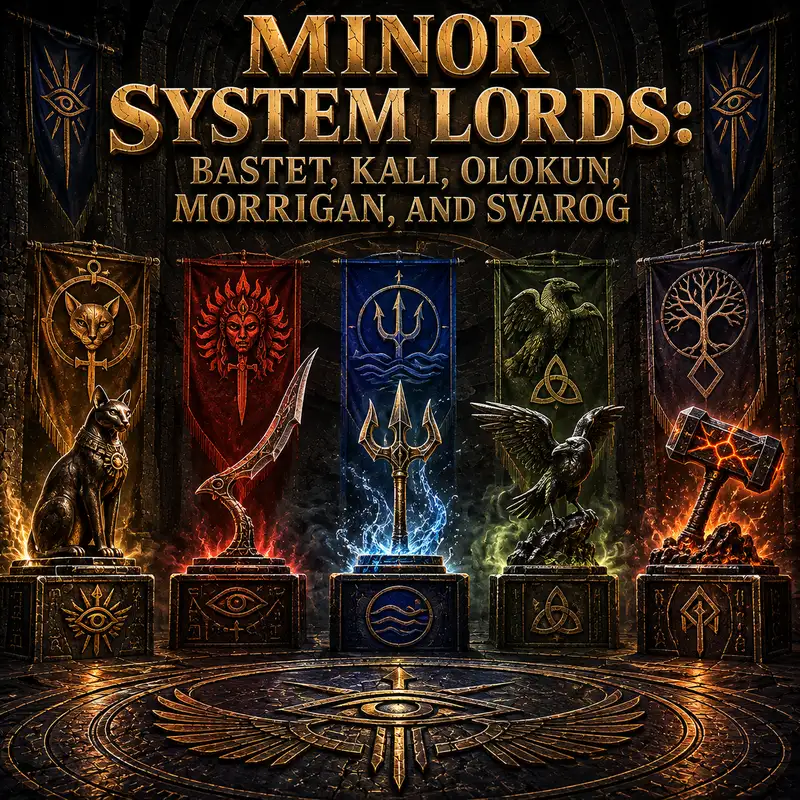
Minor System Lords: Bastet, Kali, Olokun, Morrigan, and Svarog
Daniel Jackson entered the summit chamber carrying enough symbiote poison to kill every Goa’uld ruler in the room. Seven System Lords had gathered in neutral territory. Earth knew several of them well enough to fear. The others were names, costumes, fragmentary intelligence reports, and almost no direct contact. Bastet stood beside Kali. Morrigan watched through the servants moving around the chamber. Olokun arrived nursing recent losses. The seventh delegate was later identified as Svarog. Daniel’s mission required him to kill all of them, even though Stargate Command could not have drawn a reliable map of most of their domains.
That gap is the central fact behind the so-called minor System Lords. Bastet, Kali, Olokun, Morrigan, and Svarog were minor only from Earth’s point of view and from the amount of surviving screen record devoted to them. At the time of the summit, they were counted among the seven most powerful rulers left in the Goa’uld political order. They commanded fleets, Jaffa, outposts, servants, and subject worlds. What Earth lacked was sustained access. A ruler could dominate several star systems for centuries and still appear in a Stargate Command file as a face seen once across a guarded room.
Their limited visibility reveals how much of the Goa’uld empire existed beyond the wars personally fought by S G One. The modern conflict began with Ra and Apophis, then expanded through encounters with Sokar, Cronus, Heru’ur, Yu, Ba’al, and Anubis. Those names became familiar because their campaigns repeatedly intersected with Earth. The absence of repeated contact with another ruler did not indicate weakness. It usually meant that the ruler’s territory, enemies, and immediate ambitions lay somewhere else.
The summit occurred after the deaths of Cronus and Apophis created a severe power vacuum. The surviving System Lords fought over abandoned fleets and territories, suffering heavy losses and consuming enormous resources. Eventually, self-interest imposed a truce. They selected a space station in the Hassara system because it was considered neutral territory. Weapons were forbidden. Access was restricted to cargo ships. Each ruler could bring one human attendant. It was a diplomatic conference designed by people who assumed every other guest would attempt murder if the furniture provided enough cover.
The Tok’ra saw a rare decapitation opportunity. Their plan was to insert Daniel as Lord Yu’s lo’taur, the highest-ranking human servant in a System Lord’s household. He would release a poison lethal to symbiotes after all seven targets arrived. The operation depended on impersonation, a manipulated memory, close access to Yu, and confidence that the Goa’uld leadership would sit together long enough for one device to work. It also depended on the assumption that killing the visible rulers would fracture the empire faster than another power could absorb it.
The five lesser-known delegates matter because they formed most of that target set. They were not observers invited to fill empty chairs. Their fleets and domains were substantial enough that the Tok’ra believed their simultaneous deaths might push the Goa’uld into a galaxy-wide succession war. Their votes could recognize a new System Lord. Their losses could alter the balance among every surviving ruler. Their servants could collect intelligence, and their Jaffa could change allegiance when a master fell. They were the connective tissue of the old order.
Bastet’s reputation reached Daniel through political intelligence rather than battlefield contact. She and Kali had once made a treaty with the Goa’uld Sobek. During the feast celebrating the agreement, they turned against him. The story circulating among the System Lords held that Sobek’s severed head remained displayed in Bastet’s palace. Whether every detail of that rumor was accurate mattered less than its diplomatic purpose. Bastet and Kali wanted other rulers to believe that an alliance with them could be profitable, and that relaxing security during the celebration was inadvisable.
The partnership also shows that Goa’uld cooperation was possible. It was simply instrumental. Bastet and Kali could combine forces against a third ruler, coordinate deception, and divide the benefit. Nothing in the surviving record suggests that the treaty created a permanent union or shared command. Their success came from preserving separate power while concentrating it briefly against Sobek. This was the normal logic of System Lord diplomacy. Cooperation was a maneuver, not a surrender of sovereignty.
By the time of the Hassara summit, Bastet and Kali had both suffered attacks from the unidentified power later revealed as Anubis. Ba’al reported that their setbacks resembled losses experienced throughout the ruling class. Bastet’s own account was more specific. When an outpost under her control was attacked, her First Prime disabled and boarded an enemy vessel. The boarding party found Jaffa who had previously served Cronus and Sokar, along with one bearing the mark of Olokun. Bastet later stated that one of the engagements had cost her two motherships, a loss large enough to shape any discussion of accommodation.
That discovery was valuable tactical intelligence and dangerous political evidence. Anubis had been gathering Jaffa from defeated or surrendered forces and using them under a concealed command structure. The mixed markings prevented the other System Lords from identifying a single enemy. They also encouraged suspicion that one delegate was secretly attacking the rest. Bastet’s First Prime had successfully boarded a hostile ship, but the evidence recovered from it served Anubis’s deception almost as well as it served the summit.
Olokun immediately became the suspect. He explained that one of his motherships had been surrounded and that the Jaffa aboard surrendered rather than die. Those warriors may then have entered Anubis’s service. His answer reveals a serious weakness in the Goa’uld military system. Jaffa loyalty was presented as sacred and permanent, yet defeated units could be absorbed by another ruler. The forehead mark identified former ownership. It did not guarantee present allegiance.
Olokun had other reasons to enter the summit cautiously. Yu warned Daniel that Olokun was angry over a recent loss to Yu’s forces and might murder Yu’s servant out of spite. That detail places Olokun inside the ordinary territorial warfare preceding the truce. He had lost to one delegate, lost a mothership and its crew to the hidden adversary, and then found his own symbol among troops attacking Bastet. He was both victim and accused, which was exactly the position Anubis wanted every rival to occupy.
Olokun was not entirely passive when Anubis’s offer became public. After the council voted to restore the banished ruler, Olokun asked what Anubis would provide in repayment for the damage caused while building his forces. The question was practical. Anubis had attacked them, taken Jaffa, destroyed ships, and then requested recognition. Olokun wanted compensation or at least a visible act of service. He still voted in favor because the power Anubis had demonstrated made refusal more dangerous than admission.
Morrigan’s known method was quieter. Yu warned his disguised servant not to speak freely with Morrigan’s attendant. The man would use casual conversation to draw out strategic information. A previous servant in Yu’s household had reportedly revealed the location of a secret base and paid for the mistake when the base was attacked. Morrigan’s intelligence system therefore operated through human slaves positioned beside other rulers, listening for details that senior Goa’uld might dismiss as harmless household talk.
That method was well suited to the political structure. The System Lords compartmentalized information from one another, but their courts required attendants, pilots, guards, technicians, and messengers. A human servant could move through spaces where an unfamiliar Jaffa commander would attract attention. He could ask about travel, supplies, or a master’s mood without sounding like a formal interrogator. Morrigan treated the ceremonial household as an intelligence collection environment. The servants carrying drinks were also collecting order-of-battle information.
Her later decision was consistent with that preference for survival over spectacle. When Ba’al’s campaign against the remaining System Lords reached a critical stage, Tok’ra intelligence reported that Morrigan had capitulated. Bastet and Olokun were dead, while Yu and Amaterasu prepared a last stand. Morrigan chose surrender rather than destruction. The record does not establish whether she remained alive afterward, retained any territory, or entered Ba’al’s service under negotiated terms. Capitulation does establish that her forces ceased functioning as an independent System Lord domain.
Kali remains the least documented of the five. She was identified as Kali the Destroyer, shared the successful betrayal of Sobek with Bastet, suffered setbacks during Anubis’s concealed rise, voted to restore him, and participated in the summit’s rituals. After that, the reliable screen record does not establish her fate. There is no confirmed death, surrender, or surviving domain. The honest historical answer is not to manufacture a campaign because a title demands completeness. It is to recognize that Stargate Command’s archive remained incomplete.
That incompleteness has strategic meaning. Intelligence services rarely possess equally detailed files on every member of a hostile coalition. Some leaders become collection priorities because they threaten the homeland directly. Others are known through intercepted reports, defectors, diplomatic sightings, and the markings on captured troops. Kali may have controlled a significant force while remaining outside Earth’s main operational theater. The absence of a detailed dossier would have made her more difficult to assess, not less important.
Svarog provides the strongest surviving example of one of these rulers in active conquest. The seventh summit delegate was not named in the dialogue heard at the station, though production commentary later identified him as Svarog. Soon afterward, his forces moved against Latona, a peaceful world protected for centuries by a device called the Sentinel. Earlier rogue personnel from Earth’s National Intelligence Department had tried to dismantle and steal that technology. In the process, they killed the human caretaker required to activate it and left the planet defenseless.
Svarog exploited the opening. His Jaffa entered the planet before the main assault, imposed a curfew, patrolled the territory, and informed Latonan leaders that the world had been added to his domain. The message offered survival through submission. When the population resisted, the promised sequence followed. A Ha’tak arrived in orbit, bombarded the city, and broadcast Svarog’s claim. A battalion-sized Jaffa force supported by death gliders advanced on the Sentinel while other troops threatened the Stargate and the remaining Earth teams.
This was a conventional planetary seizure conducted against a society believed to have lost its only strategic defense. Svarog used reconnaissance, advance troops, coercive administration, orbital fire, and follow-on ground forces. He did not need to occupy every home before declaring victory. He needed to destroy or capture the Sentinel, control the gate, break the political leadership, and make continued resistance appear fatal. The plan was sound if the defense truly could not be restored.
Earth’s earlier interference had created the emergency. S G Nine had already taken casualties. S G Three could not hold the Stargate without reinforcement. S G One was trapped near the Sentinel with ammunition running low, while the city remained under bombardment. Evacuation through the gate offered the only conventional means of saving civilians, but the Latonans trusted the device that had protected them for three hundred years. Svarog’s attack turned a covert technology theft into a planetary defense crisis.
The Sentinel activated only when a human life joined with the machine. Colonel Sean Grieves, the rogue officer responsible for the caretaker’s death, took that role. A burst of light removed Svarog, his Jaffa, and the invading force. The available record treats them as destroyed. No fleet engagement, prolonged insurgency, or negotiated withdrawal followed. One System Lord entered a system expecting a nearly defenseless target and disappeared with the force committed to conquest.
Svarog’s defeat demonstrates the danger of incomplete technical intelligence. He correctly identified that the Sentinel was not operating. He did not understand why. Neither did Earth. The machinery had not been ruined in the ordinary sense. A required human component had been removed. Once another person supplied that component, the defense recovered immediately. Svarog’s sensors could observe inactivity. They could not reveal the social and biological condition required to make the device function.
The episode also shows how a ruler with a major seat at the summit could die in what appeared to be a regional operation. System Lord status did not provide a safe distance from command. Goa’uld rulers often accompanied fleets because personal presence reinforced authority and allowed direct control. That practice made decisions faster and succession more violent. Svarog concentrated political leadership, orbital power, and ground forces around one target. The Sentinel removed all three from the campaign at once.
The Hassara summit connects the five rulers more directly than their separate biographies do. They had gathered to stop internal warfare from destroying the resources they needed to rule. Anubis had already attacked Bastet, Kali, Olokun, Ba’al, Yu, and likely other domains without identifying himself. He used captured Jaffa from several former masters to make the attacks resemble betrayal from within. Then Osiris entered the chamber and offered the source of the violence as the solution to it.
Bastet, Kali, Morrigan, Olokun, Svarog, and Ba’al voted to restore Anubis to the rank of System Lord. Yu alone refused. The vote was not an expression of trust. It was recognition that Anubis had accumulated enough power to impose costs on all of them. His promised contribution was the destruction of the Tok’ra and the Tau’ri, threats every delegate understood. While they deliberated, his forces were already attacking the Tok’ra base on Revanna.
The five lesser-known rulers therefore helped make Anubis legitimate. Their votes gave him access to the political order he intended to dominate and reduced the chance that the others would unite against him immediately. Bastet and Olokun asked questions about his conduct, but both accepted the bargain. Kali, Morrigan, and Svarog joined the majority without a recorded objection. Their decision was rational within the short-term incentives of a fragmented empire and disastrous in the longer war.
The summit’s closing ritual showed what still bound these rivals together. A container of living symbiotes was transported into the chamber, and the assembled rulers consumed them as part of the celebration. Their human attendants remained outside the ruling circle, even though at least some servants regarded future implantation as promotion. The scene joined politics, biology, and class. Bastet, Kali, Morrigan, Olokun, and Svarog used different symbols and controlled separate armies, but they recognized the same hierarchy. Goa’uld ruled. Jaffa fought and incubated their young. Human servants supplied labor, intelligence, and possible hosts. Rivalry occurred inside a shared imperial culture, not between fundamentally different states.
Daniel stopped the Tok’ra assassination because Anubis changed the strategic calculation. Killing all seven delegates would have removed the only organized powers capable of resisting his immediate expansion. The minor System Lords had become a buffer, not because Earth approved of their rule, but because several competing tyrants were temporarily preferable to one dominant ruler with unfamiliar technology. It was a grim balance-of-power judgment made while Daniel still carried the means to kill everyone in the room.
Their later fates show how quickly that buffer eroded. Svarog died at Latona. Anubis’s rise and fall reshaped the remaining fleets. Ba’al acquired Kull warriors and turned them against his rivals. Bastet and Olokun were reported dead. Morrigan surrendered. Kali disappeared from the surviving record. Ships, Jaffa, mines, and worlds outlived their owners and passed into larger domains. The decline of the minor rulers did not remove military capacity from the galaxy as quickly as it concentrated that capacity in fewer hands.
This is why their subject populations matter even when the records do not preserve their names. A change at the summit could replace the symbol over a Stargate without changing the labor quota, the Jaffa garrison, or the risk of becoming a host. When Bastet or Olokun died, their worlds did not automatically become free. When Morrigan capitulated, the people beneath her did not participate in the negotiation. The political map changed through transactions among rulers while civilians experienced the result as another army arriving to collect tribute.
Latona provides the clearest human view. Svarog’s Jaffa announced ownership before the population had accepted defeat. Orbital bombardment followed when persuasion failed. The intended future was familiar: service, enslavement, host selection, and a military occupation centered on the Stargate and the destroyed defense system. The planet survived because the Sentinel worked once its human component was restored. Most worlds in minor Goa’uld domains possessed no comparable device and left much thinner records.
The phrase minor System Lord can therefore mislead. These rulers were minor characters in Earth’s surviving narrative, not minor political actors when they sat at Hassara. Bastet and Kali demonstrated coalition and betrayal. Morrigan used household intelligence and chose capitulation. Olokun showed how Jaffa and ships could be captured and reassigned. Svarog conducted a full planetary assault and died because his intelligence failed at the decisive technical detail.
Together, they explain why the Goa’uld empire was so difficult to map and so difficult to destroy. Power was distributed among rulers whose domains could operate for years without direct contact with Earth. Their rivalries created exploitable seams, but their fleets and garrisons survived the death of individual masters. A campaign could remove one ruler and strengthen another. A diplomatic vote by figures barely known to Stargate Command could restore Anubis. A surrender by Morrigan could transfer an entire regional force without a battle visible to Earth.
The five names around the summit table were not empty decoration. They represented the hidden scale of Goa’uld rule, the limits of Tau’ri intelligence, and the middle tier of power that kept the old order functioning after famous rulers died. Their stories are incomplete because Earth never saw most of what they controlled. What the surviving fragments do show is enough. Bastet, Kali, Olokun, Morrigan, and Svarog helped admit Anubis, fed Ba’al’s rise through defeat or surrender, and proved that an empire can be governed by rulers who remain almost invisible to the people eventually responsible for bringing it down.