Naquadah, Trinium, and the Industrial Base of Interstellar War
Colonel Edwards did not need another scientific discovery. He needed ore. Initial core samples from P three X four-oh-three contained too little naquadah to support Earth’s shipbuilding plans, and the Pentagon wanted more F three-oh-twos and more battlecruisers. A deeper sample then showed a concentration dozens of times richer. The geological problem appeared solved. Almost immediately, one of Edwards’s men disappeared, and the mining camp learned that the deposit lay inside land the indigenous Unas regarded as sacred.
That collision between a fleet requirement and an inhabited landscape explains more about Earth’s rise as a space power than any launch ceremony. Interstellar war required extraordinary ships, but extraordinary ships still began with extraction, refining, fabrication, transport, and political access to raw material. Naquadah supplied energy and critical systems. Trinium supplied strength without conventional weight. Naquadria offered immense power in a dangerously unstable form. Together, they made Earth’s new military possible while exposing how incomplete its industrial independence remained.
The first material was present before Stargate Command understood what it had. The Stargate itself was made from naquadah, and the people of Abydos had spent generations mining the same substance under Ra’s rule. Earth therefore encountered the mineral first as part of an imperial economy. The Goa’uld controlled transportation, weapons, and political authority partly because they controlled access to naquadah and the technology built around it. The mine and the gate were components of the same system.
Naquadah was not simply a fuel poured into an alien engine. It acted as a dense energy source and as a material central to Goa’uld power systems, weapons, spacecraft, and control technologies. Earth scientists could observe those applications long before they could reproduce them. That difference mattered. Recovering a staff weapon demonstrated what naquadah could power. Building a safe reactor, manufacturing replacement components, and training technicians to maintain one created an industrial capability.
The Orbanian exchange provided one of the decisive steps. The young scientist Merrin brought a compact naquadah reactor to Earth and taught Samantha Carter enough of its design for the technology to be understood and adapted. The device was valuable not because it was the largest power source Earth had seen, but because it could be reproduced in portable form. A civilization does not build a field army around one irreplaceable artifact. It builds around equipment that another technician can operate after the inventor goes home.
Naquadah generators soon became the electrical backbone of off-world operations. They powered laboratories, temporary bases, shields, alien interfaces, and systems far beyond the reach of terrestrial grids. Later versions produced substantially more energy, although increased output usually shortened operating life or introduced another engineering compromise. They could support an Ancient control chair for a limited period. They could not replace a zero-point module or erase the difference between human and Ancient power generation.
Portability changed logistics. A generator could pass through the Stargate with a team, be installed at an isolated site, and provide reliable power without fuel convoys stretching across another planet. That allowed Earth to maintain research facilities, communications, medical equipment, and defensive systems where no local infrastructure existed. The Stargate reduced distance. The generator reduced dependence on whatever electrical system happened to be available after arrival, which was often nothing and occasionally something that attempted to kill the repair team.
The same material also intensified Earth’s weapons. Naquadah-enhanced nuclear warheads used the mineral to increase destructive output beyond a conventional device of similar size. Earth could deliver such weapons through the gate, aboard fighters, or from battlecruisers. This gave commanders a means to threaten hardened alien targets before Earth possessed comparable energy weapons. It also created a recurring temptation to solve a technical problem by making the explosion larger, a method with excellent paperwork until the target world contains naquadah deposits of its own.
Shipbuilding created a much larger demand. Prometheus and the later B C three-oh-four class depended on alien-derived systems that could not be built from ordinary aerospace materials alone. The screen record does not provide a complete bill of materials, and it would be a mistake to imagine every corridor and bolt made from naquadah. Human industry still supplied conventional structures, electronics, weapons, life support, and thousands of ordinary components. Naquadah was concentrated where its energy or compatibility with alien technology made it indispensable.
P three X four-oh-three revealed the scale of that demand. A small sample might power an experiment. A battlecruiser program required sustained extraction measured across years, multiple hulls, and replacement systems. Edwards’s team was not prospecting for a museum specimen. It was searching for enough ore to support production. Low-grade deposits could exist in enormous quantities and still be economically useless once excavation, refining, gate transport, and security were included.
The mining team treated the site first as geology and only later as history. Artifacts indicating an Unas presence were moved aside while the survey continued. Lieutenant Ritter was killed after entering territory the Unas considered protected. Colonel Edwards responded as a military commander facing an unseen hostile force. Daniel Jackson recognized a different problem. The humans had established an industrial camp inside a burial landscape tied to the enslavement and deaths of the Unas ancestors.
Washington’s requirement did not disappear because the claim was legitimate. Earth still needed the naquadah, and the deposit was rich enough to support multiple ships. Senior officials considered relocating the Unas by force if negotiations failed. The plan would have secured the mine in the narrowest sense and reproduced the logic of the Goa’uld economy Earth claimed to oppose. A technologically stronger outsider would remove an indigenous population so that its strategic resources could be extracted elsewhere.
Daniel and Chaka produced another solution. The Unas agreed to work the mine themselves and provide naquadah for the war against the Goa’uld, the power that had enslaved and killed their ancestors. Earth received access without taking control of the sacred ground. The Unas retained authority over the site and connected the labor to their own historical purpose. The agreement was not merely a diplomatic success attached to a mining story. It became part of the industrial base.
That arrangement carried its own unresolved questions. The surviving record does not describe production quotas, compensation, safety standards, refining locations, or how long the agreement remained active. It establishes that political consent and cultural knowledge solved a supply problem military pressure was about to make worse. The people most familiar with the terrain became partners rather than obstacles. Earth’s fleet acquired raw material, and the Unas acquired a direct role in the destruction of their former enslavers.
Trinium presented a different industrial challenge. When first found on the Salish world, raw trinium was too brittle for manufacturing because of its impurities. Once properly refined and forged, it was described as dramatically lighter and stronger than steel. That combination made it ideal for any structure in which mass competed with protection, propulsion, payload, and endurance. Every unit of weight removed from a hull could become additional equipment, weapons, fuel, shielding, or simply less demand on the engines.
The discovery also produced an early warning about extraction policy. Stargate Command sent S G Eleven to obtain more trinium and began approaching the planet as a resource site. The Salish lived under the protection of advanced beings who had adopted the identities of their traditional spirits. Those beings could provide refined trinium to the Salish and had no interest in turning their world into an Earth-operated mine. The humans saw a strategic mineral. The local population saw protected land and a relationship Earth had not understood.
The effort ended without the mining rights Stargate Command wanted. The spirits intended to bury the Stargate rather than permit further interference. Earth later possessed enough trinium for major projects, including material connected directly to Prometheus, but the live-action record does not map the replacement source or the complete refining chain. That gap should remain a gap. The important point is that Earth found another supply, another arrangement, or both. It did not establish the right to take the first deposit merely by needing it badly.
A leaked trinium sample almost exposed Prometheus before the ship had entered normal service. The security breach demonstrated how a rare material could reveal an entire hidden program. A journalist did not need blueprints for the battlecruiser. She needed one alloy that could not be explained by terrestrial science and a trail of classified spending. Industrial secrecy is harder than operational secrecy because mines, laboratories, contractors, shipments, and fabricators create evidence long before the finished weapon leaves the hangar.
Trinium’s operational value was structural rather than spectacular. It appeared in alloys associated with Earth spacecraft and later in hardened doors and other components. Its precise percentage in each ship is never established. The material mattered because human-built vessels had to carry alien-derived systems while remaining light enough to maneuver and strong enough to survive damage after shields failed. A shield could absorb the first attack. The hull still had to hold atmosphere when the shield percentage reached zero.
Refining was as important as mining. Raw trinium could not simply be cut from a riverbed and bolted onto a ship. Impurities had to be removed, the material had to be formed into usable alloys, and each batch had to meet standards strict enough for vacuum, acceleration, and battle damage. The screen continuity rarely visits those factories, but the ships prove they existed. Prometheus could be an experiment. A class of B C three-oh-fours required repeatable metallurgy, quality control, and replacement parts.
Standardization mattered because alien-derived systems placed unfamiliar stresses on every surrounding component. A hull section had to tolerate acceleration under inertial dampening, conduct or isolate power from crystal-based systems, accept repairs by human damage-control teams, and remain compatible with upgrades that had not existed when the ship was laid down. A material could be exceptionally strong and still be unsuitable if Earth could not weld it, inspect it, or reproduce the same alloy after combat. Fleet construction began when metallurgy became a procedure rather than an improvisation.
Naquadria offered the most dramatic shortcut and the worst industrial bargain. It was a heavier, less stable isotope of naquadah, created artificially after the Goa’uld Thanos experimented on the world later called Langara. A chain reaction converted portions of the planet’s ordinary naquadah deposits into naquadria. The result stored far more usable energy in a compact mass. It also became increasingly difficult to control as engineers drew greater output from it.
The people of Kelowna discovered the material while preparing for war against neighboring nations. Their research produced a naquadria bomb, political secrecy, espionage, and an accident that killed Daniel Jackson’s body while he prevented a larger disaster. The mineral entered Earth’s strategic program through an alliance already entangled with a planetary arms race. Naquadria was never a neutral laboratory sample. From the beginning, it connected power generation, weapons development, national survival, and distrust among governments.
Jonas Quinn brought Earth access to the material, and the X three-oh-two program used it to shrink a hyperspace generator to fighter scale. The power density solved the size problem. Instability defeated reliable navigation. Energy fluctuations prevented the prototype from locking onto Abydos, although a brief hyperspace window later carried an overloaded Stargate millions of miles away from Earth. The system worked for approximately the amount of time required to save the planet and not long enough to become routine transportation.
Prometheus repeated the lesson at capital-ship scale. Its early hyperdrive relied on a naquadria reactor that gave Earth independent interstellar movement before a more stable solution was available. During the ship’s shakedown, the reactor became unstable and had to be jettisoned near Tagrea. Prometheus survived, landed, and waited for assistance through a Stargate that had to be recovered from local history. Earth had built a starship able to cross light-years and was stranded by the power source that made the crossing possible.
Naquadria therefore became a specialized material rather than the foundation of the mature fleet. It remained useful when enormous energy had to fit inside a limited package. The Mark Nine warhead used naquadria enhancement to attack targets such as a Stargate and its surrounding installation. At Kallana, even that weapon failed because the Ori force field absorbed the detonation. Greater energy remained subject to the physics and strategy of the target. A larger bomb is still a poor solution when the enemy has designed the battlefield to consume explosions.
Langara demonstrated another hazard. The original conversion process had continued beneath the surface, and a later bomb test helped drive the reaction toward deeper naquadah deposits. If the chain reached the wrong region, the planet could be destroyed. Carter, Jonas, and their partners stopped the immediate progression by isolating the unstable vein. The same resource that promised military advantage threatened the civilization mining it. Industrial development had become a planetary containment operation.
A similar logic surrounded Icarus Base. Earth established the project on a world whose naquadria-rich core could supply the immense power required to dial the nine-chevron address. The base existed because no ordinary terrestrial source could meet the requirement. When the Lucian Alliance attacked, the planet destabilized and exploded, destroying the installation and stranding the evacuees aboard Destiny. Naquadria had opened a route beyond known range. It had also made the launch site impossible to save once the battle reached the core.
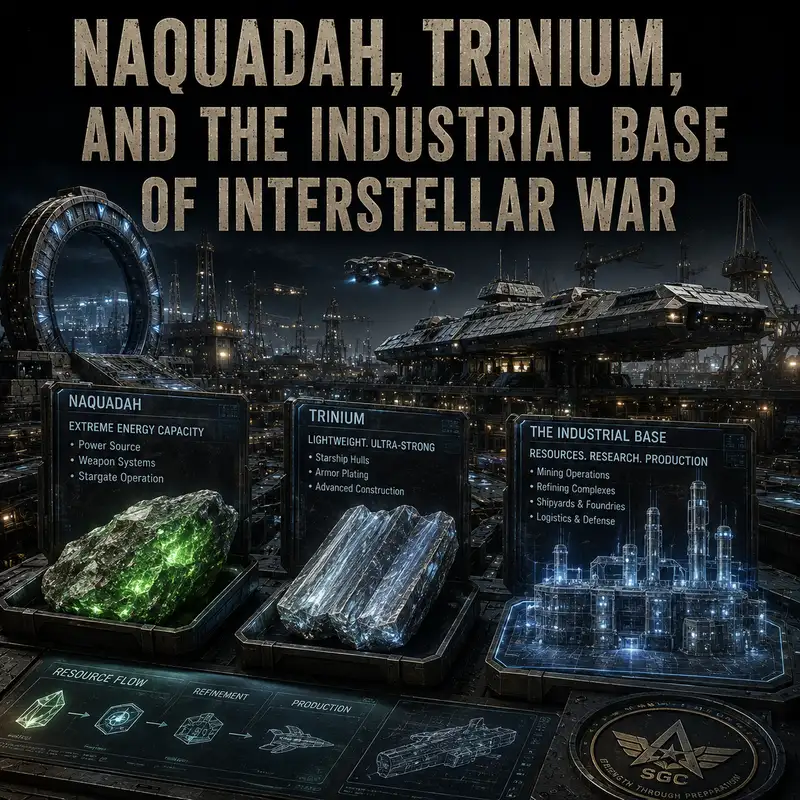
These materials shaped different parts of the industrial system. Naquadah offered the most sustainable combination of energy, weapons enhancement, and compatibility with recovered technology. Trinium reduced structural mass and increased durability after proper refining. Naquadria supplied exceptional power where normal designs could not meet the requirement, but its instability made it unsuitable as the routine foundation of a fleet. One built capacity. One made capacity practical. One encouraged engineers to attempt missions before a safer power source existed.
The industrial base supporting them stretched far beyond Area Fifty-One. Geological teams found deposits. Archaeologists and diplomats determined whether those deposits could be used without beginning another war. Mining crews and local partners extracted the ore. Scientists characterized it. Metallurgists refined it. Contractors fabricated components under compartmented security. Military test organizations integrated those components into aircraft and ships. Maintainers turned prototypes into equipment that could survive a second mission. The finished battlecruiser was only the visible end of the chain.
The Stargate made that chain possible and constrained it. Heavy machinery, generators, personnel, samples, and refined material could move between worlds in seconds once a wormhole was established. Everything still had to reach the gate, fit through the opening, survive transit, and clear the receiving facility. One blocked address could isolate a mine. One hostile force in orbit could attack a garrison that controlled the local gate. One contaminated shipment could bring an off-world hazard directly into Earth’s logistics system.
Security became an industrial requirement. Rogue National Intelligence Department cells and the Trust had already shown that classified technology could move through contractors, laboratories, and private networks. A stolen sample of trinium could expose Prometheus. Stolen naquadah could become a bomb. Naquadria research could attract Goa’uld infiltration or private weapons programs. Protecting the fleet meant protecting geological data, transportation schedules, refining methods, control crystals, and the people who knew which project names concealed the real work.
Internationalization added another layer. Russia and China eventually operated B C three-oh-four battlecruisers, while other governments participated through the International Oversight Advisory. Common ships required common technical data, training, spare parts, and access to rare materials. The record does not show a fully independent national supply chain behind each vessel. It shows a coalition fleet dependent on a shared, highly classified industrial system whose political ownership remained less clear than its military purpose.
The final Asgard knowledge transfer did not eliminate these constraints. A database could explain advanced shields, beam weapons, transporters, and power systems. It could not instantly create every factory, material, precision tool, or trained workforce required to reproduce them at scale. Earth retrofitted selected systems onto existing ships, an extraordinary achievement. It still needed naquadah, trinium, conventional industry, secure shipyards, and years of accumulated engineering experience to turn an Asgard design into a dependable human capability.
Earth’s interstellar military was therefore neither a collection of stolen alien devices nor a sudden leap into post-scarcity technology. It was a hybrid war economy built behind secrecy. Conventional terrestrial industry produced most of what could be produced conventionally. Alien materials were concentrated into the systems and structures that made space warfare possible. Allies supplied knowledge Earth lacked. Off-world populations supplied access Earth could not lawfully assume. Every new hull represented technology, diplomacy, and logistics held together long enough to pass inspection.
The moral test remained attached to the supply chain. Goa’uld power had been built on mining worlds, enslaved labor, technological monopoly, and the ability to remove local populations from strategic decisions. Earth needed the same minerals without becoming another version of the empire it was fighting. The Salish world showed how quickly urgency could become intrusion. P three X four-oh-three showed that negotiation could produce access while preserving local authority, although only after armed forces had nearly turned the mine into a battlefield.
Colonel Edwards went to P three X four-oh-three looking for rocks large enough to become ships. He found that the decisive part of the industrial base was not underground. It was the agreement determining who would mine, why they would mine, and what the finished weapons would defend. Naquadah powered Earth’s expansion. Trinium made its ships practical. Naquadria let those ships and weapons exceed safe limits when survival demanded it. None of the three created a fleet by itself. The fleet existed because miners, scientists, engineers, diplomats, local allies, and crews converted rare material into repeatable force without losing sight of who paid for the ore.